Comments
Key takeaways
Various fishing-related interventions and aquafeed-related interventions (e.g. supporting fishmeal substitutes) can have important effects on animal agriculture, and there are potentially important tradeoffs to consider. I graph the relationships between various foods and feeds, and provide background on them. Focusing on the impacts on farmed animals, the most important takeaways are probably the following:
- Increasing the catch of wild aquatic animals for feed, increasing the utilization of aquatic animal byproducts for feed, increasing/improving non-animal fishmeal substitutes or pushing for lower fishmeal requirements (promoting herbivorous species, R&D to reduce fishmeal inclusion rates) per farmed aquatic animal
- is likely to increase aquaculture (Costello et al., 2020, Section 4, Figure S2 and Tables S13–S16; Kobayashi et al., 2015, Table 3 / World Bank, 2013, Table E.2; Bairagi et al., 2015, Table 1 / Bairagi, 2015), including shrimp aquaculture in particular, as they are major fishmeal-consuming species.
- is likely to decrease insect farming, by reducing the need for or the relative appeal of insects as a fishmeal substitute.
- has unclear effects on the use of live brine shrimp nauplii and other live feed for crustacean larvae, and fish larvae, fry and fingerlings. I have not investigated this, but it’s worth flagging the possibilities of complementation and substitution.
- Conversely, decreasing the catch of wild aquatic animals for feed is likely to decrease aquaculture and increase insect farming, but has unclear effects on brine shrimp nauplii and other live feed.
- Decreasing the catch of wild aquatic animals for food (direct human consumption) has unclear impacts on farmed (and bred) animals.
- By substitution, it would probably increase aquaculture (and other animal agriculture) overall by weight, but this may not say much about numbers or welfare impacts, given shifts between farmed species.
- It could increase (by substitution) or decrease (by reducing the availability of fishmeal from fish/crustacean byproducts) shrimp farming and the farming of other animal-consuming species. This could also then respectively increase or decrease insect, feed fish and/or brine shrimp nauplii production for feed.
- It would also reduce fishmeal from byproducts, which could increase insect farming.
- The effects on fish stocking depend on how the reduction is achieved. If achieved through an increase in overfishing, fish stocking could increase. If achieved through a reduction in fishing pressure where fishing pressures are already low, fish stocking could decrease. This would have an effect on brine shrimp nauplii production in the same direction as that on fish stocking, assuming brine shrimp nauplii are fed to fish raised for stocking.
Note that demand shifts for wild-caught animals can have the opposite sign effects on their catch due to overfishing (St. Jules, 2024a). The above considers the actual quantities supplied directly, not the effects of demand shifts.
All of this also ignores the effects of shifts in food production on wild animals, both aquatic and terrestrial, which could be good or bad and more important in the near term (Tomasik, 2008–2019a, Tomasik, 2008–2019b, Tomasik, 2015-2017, St. Jules, 2024b).
Acknowledgements
Thanks to Brian Tomasik, Ren Ryba and Tori for their feedback on an earlier draft, and Saulius Šimčikas for his supervision on an earlier unpublished project. All errors are my own.
Relationships between products
Fishing, aquaculture and other animal agriculture and breeding interact in multiple ways, as depicted in the figure below:
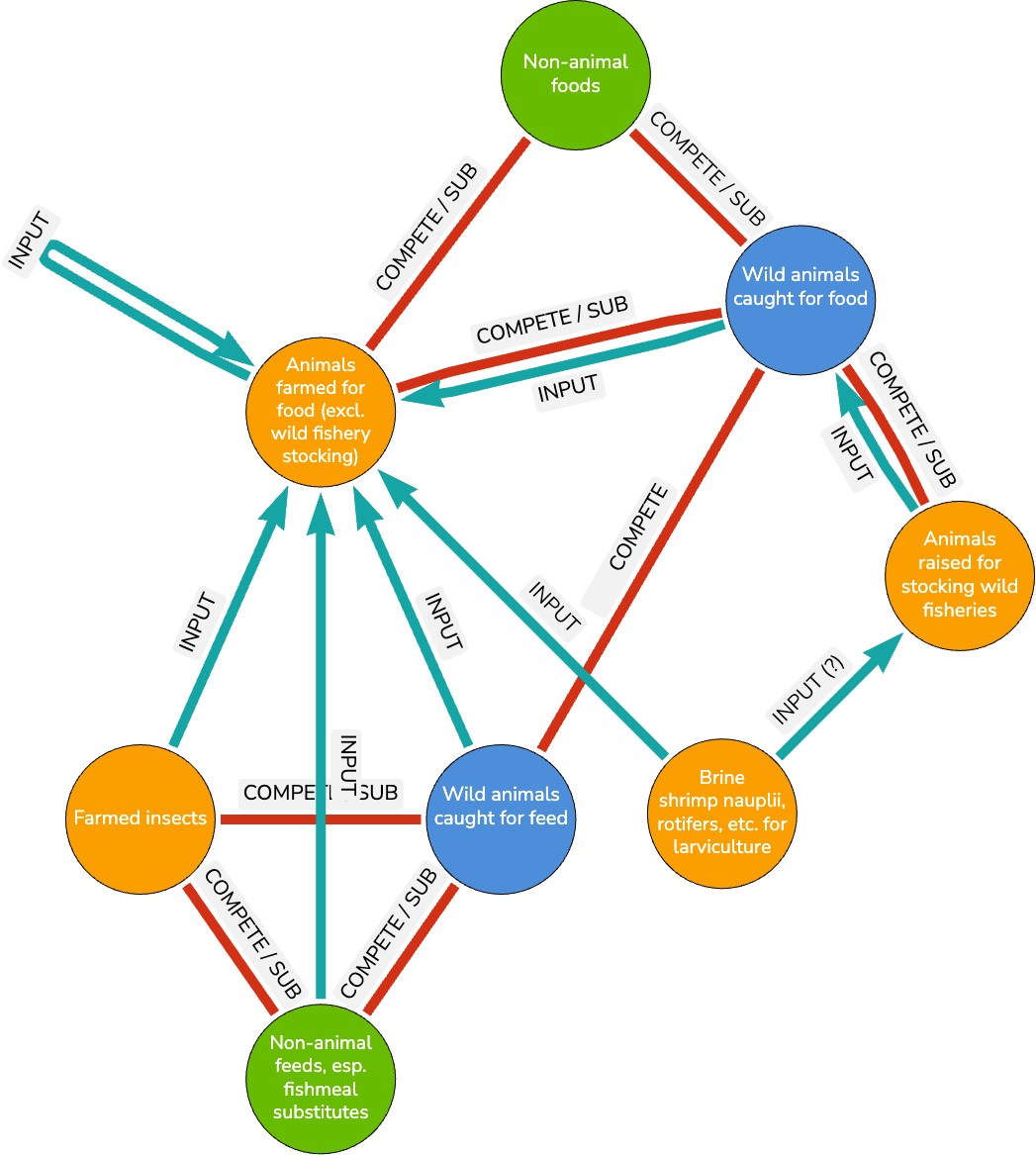
- Fishing competes with animal agriculture and animal aquaculture in particular for food (direct human consumption): if more wild aquatic animals are caught for direct human consumption, less animal agriculture or aquaculture is necessary for the same amount of human food. Conversely, less wild capture would require more animal agriculture (aquaculture) to compensate, if (aquatic) animal consumption by humans were held constant. Reductions in aquatic animal consumption could reduce both wild capture and animal aquaculture or primarily reduce animal aquaculture by weight, and reductions in animal product consumption generally could primarily reduce animal agriculture, because of substitution effects and the inelasticity of wild-capture supply (St. Jules, 2024c and FAO, 2022, Figure 3).
- Fishing supports animal aquaculture (and animal agriculture more generally) through the supply of aquafeed ingredients: fishmeal and fish oil from whole wild-caught fish and crustaceans and from processing byproducts of wild-caught fish. More aquafeed ingredients, whether fishmeal or substitutes, including plant-based ones and farmed insects, could mean more animal aquaculture, and vice versa. Fishmeal substitutes also compete with one another. I discuss this further in Fishmeal, fish oil and substitutes.
- Governments may respond to higher fishing pressure (and overfishing) by raising (farming) (more) aquatic animals to release into the wild, i.e. stocking (Šimčikas, 2019, Cheng et al., 2006).[1] Reducing fishing pressure, e.g. via negative demand shifts for seafood or wild-caught seafood in particular, would plausibly reduce fish stocking, at least in expectation and more so if it can be targeted at wild capture fisheries more likely to be stocked. Animals raised for stocking wild fisheries compete with other wild-caught animals and animals farmed for food, and contribute to — by themselves becoming or producing descendents who will become — wild-caught animals.
- Larviculture, the breeding and aquaculture of fish, crustaceans and bivalves during their youngest stages, especially as larvae, often depends on the production of live feeds, themselves often artificially produced, like brine shrimp (Artemia) nauplii (young larvae) and rotifers. I discuss this further in Larviculture feeds.
Animals as feed
Animals are used as feed for other animals, especially farmed aquatic animals and — I assume — animals raised to stock wild fisheries. As inputs, their use should generally scale with aquaculture and stocking, although substitution or reductions in need — e.g. shifts towards more herbivorous species — can increase aquaculture while decreasing animal aquafeeds they substitute.
Fishmeal, fish oil and substitutes
Fishmeal is produced from whole fish or fish parts (processing byproducts) by drying and grounding, often after defatting. Fishmeal is used as a high-protein feed ingredient in animal agriculture, fur farming and pet food. Around 63-75% of global fishmeal was used in aquaculture in 2009 and 2010 (Froehlich et al., 2018, Figure 1; Bavinck et al./FAO, 2023, p.68; European Commission, 2021, p.8.; Shepherd & Jackson, 2013), and around 78% in 2019 (European Commission, 2021, p.8). Fish oil is the oily fat extracted from fish or parts of fish in the production of fishmeal, often rich in omega-3 (DHA and EPA), and is also used in animal agriculture, fur farming, pet food and in human food and supplements for its omega-3 contents.
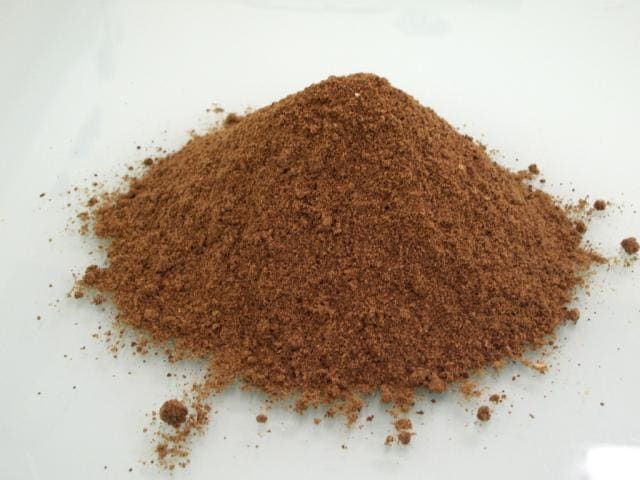
Fishmeal and fish oil (and krill meal and krill oil) production and use accounts for a large share of wild capture of fish (and krill). A large share of wild-caught fish (and krill), are caught to feed farmed animals, especially as fishmeal and fish oil in aquaculture, around ½ of individual wild-caught fish or 490–1,100 billion individual fish in 2010 (Mood & Brooke, 2024), another 113 Antarctic krill per year (Borthwick et al., 2021 (pdf)), and around 9% to 20% of wild-caught aquatic animals by weight annually (Pauly et al./ Sea Around Us).[2] This may make interventions to reduce catch for fishmeal appear promising, at least naively. However, it’s unclear whether this would be good or bad for wild aquatic animals (St. Jules, 2024a, St. Jules, 2024b). Furthermore, there are important potential impacts for farmed animals, good or bad, which is the focus of this article.
Around 25% of fishmeal and over 50% of fish oil are produced from byproducts/residues/wastes of fish processing (OECD/FAO, 2023, Figure 8.4), from both wild-caught fish and farmed fish, not through the reduction of whole wild-caught fish. Some are also produced from byproducts of processing invertebrates, like shrimp and squid. Chicken byproducts, as avian meal, also sometimes substitute fishmeal (Mowi, 2023, p.66).
Salmonids (mostly Atlantic salmon and rainbow trout) and shrimp/prawns accounted for >40% of global fishmeal use in aquaculture[3], are major farmed aquatic animal groups by volume produced and consumed,[4] with shrimp by number farmed (Waldhorn & Autric, 2023), and they and I’d guess other predatory aquatic species currently practically require fishmeal (and/or fish oil) in their diets when farmed. Existing potential fishmeal and fish oil substitutes generally have major limitations.[5] The fishmeal and substitutes supplies and prices are therefore major limiting factors to the growth of the aquaculture of these species, and plausibly aquaculture in general.
I’d expect raising or removing the fishmeal limiting factor will tend to increase aquaculture, and this can happen through multiple paths:
- more fishmeal produced allows more aquaculture,
- improving fishmeal substitutes allows more aquaculture when they actually further substitute fishmeal (and could even increase wild catch), and
- shifting towards lower fishmeal use per farmed animal — whether by reducing the amounts in those that consume fishmeal now or by shifting towards (more) herbivorous aquatic species — allows more aquaculture.
Increasing aquaculture would be bad to those farmed animals if they have bad lives or farming them otherwise wrongs them overall.
Multiple models of supply and demand project increases in aquaculture this way relative to baseline scenarios, including:
- technological innovation scenarios resulting in 50% and 95% reductions in fishmeal and fish oil feed requirements per animal in Costello et al., 2020 (Section 4, as well as Figure S2 and Tables S13–S16, with extreme future demand or with low demand for bivalves/independent demand across their broad seafood categories),
- the increased fishmeal from fish processing waste scenario in Kobayashi et al., 2015, Table 3 / World Bank, 2013, Table E.2, and
- substituting genetically modified soybean oil for fish oil in Bairagi et al., 2015, Table 1 / Bairagi, 2015.
Even if aquaculture or animal agriculture output volumes were held constant, more fishmeal and substitutes or other work to reduce fishmeal inclusion rates — the percentage of fishmeal making up the diet — in shrimp diets could shift aquaculture and other animal agriculture towards shrimp/prawn aquaculture. Shrimp (and other crustaceans) have been estimated to use 24–27% of fishmeal used in aquaculture (European Commission, 2021, p.8, Boyd, 2015, p.9, Naylor et al., 2021, Table 1), and fishmeal makes up around 12% of their diets, much higher than the 1–3% for the more commonly farmed tilapia, fed carp and catfishes (Hua et al., 2019, Figure 2, FAO, 2022, p.43):
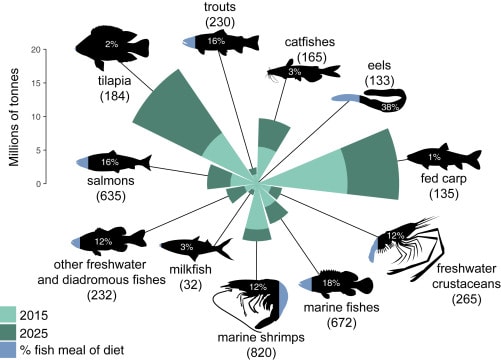
Holding total animal aquaculture production (tonnes) constant, increasing the fishmeal and substitutes supply or decreasing fishmeal inclusion rates in shrimp aquaculture could increase the number of animals farmed, because shrimps/prawns are much smaller than the farmed animals for which they would substitute and already outnumber farmed vertebrates by numbers, at 440 billion (decapod) shrimp farmed per year, and 230 billion farmed (decapod) shrimp alive at any moment (Waldhorn & Autric, 2023).[6] This should be adjusted for moral weights, as in Grilo, 2023 and St. Jules, 2024d (sheet).
On the other hand, hundreds of thousands of tonnes and trillions of individual insect larvae[7] could come to be farmed to substitute fishmeal annually, and one of the main targets for the growing insect industry (de Jong & Nikolik, 2021 (pdf), Rowe, 2020, Faes, 2022 (pdf)). Then, plant-based fishmeal substitutes and/or shifts to more herbivorous species — including bivalves — could mitigate this.
Larviculture feeds
In larviculture, i.e. the rearing of larval aquatic animals or fish fry, live animals are often used as feed, especially brine shrimp (Artemia) nauplii (newly hatched larvae) and rotifers, although others are also used. For reviews of live feeds used in larviculture, see Conceição et al., 2010, Sales, 2011, Das et al., 2014, Santosh et al., 2023, Xavier et al., 2023, Kandathil Radhakrishnan et al., 2020, Barad et al., 2017, Chakraborty & Priyanka Halder Mallick, 2023, Nielsen et al., 2017. Around 500 trillion brine shrimp nauplii seem to be artificially produced (via breeding) and fed live to aquatic animals annually (Boddy/Shrimp Welfare Project, unpublished estimate; reproduced calculations here).
The production of brine shrimp as feed should generally scale with aquaculture and fish stocking, except where substitution occurs. That being said, when accounting for their lifespans, probability of sentience and welfare ranges or moral weights, it’s plausible that brine shrimp nauplii are not very important compared to other farmed animals (St. Jules, 2024d). Rotifers likely matter even less on average per individual, being much smaller and probably less cognitively sophisticated, with only around 200 neurons, fewer even than the nematode C. elegans (Tomasik, 2016–2018).
Note that increasing the production or reducing the prices of fishmeal or its substitutes would increase aquaculture, and with it larviculture, and so probably the production of feeds in larviculture, like brine shrimp nauplii.
Wild catch vs aquaculture
Increasing fishing yields – e.g. by reducing overfishing or by fishing previously unfished species or in unfished regions — increases fishmeal and fish oil ingredients available for aquaculture and so may support aquaculture production itself. However, increased fishing yields for species caught for direct human consumption also compete with aquaculture (including regular aquaculture and raising fish to stock wild fisheries) for limited demand for direct human consumption and so partially displace aquaculture. The effect on aquaculture could depend on the wild-caught species and end use.
Improvements in fishery management for animals caught primarily for feed, like Peruvian anchoveta, if such improvements increase yields, would probably increase aquaculture.
It’s unclear if increasing the yields of animals wild-caught primarily for direct human consumption (food) would increase or decrease aquaculture, but it seems more likely to decrease it. They compete more directly with aquaculture products, so they may directly substitute them. If demand for seafood would have been limited the same either way, then this would just shift farmed aquatic animals to wild-caught ones. However, the leftover residues (byproducts or wastes) from processing fish for direct human consumption are also often processed into fishmeal and fish oil, and account for over 24% of fishmeal and 50% of fish oil now (OECD/FAO, 2023, Figure 8.4). Overall, growth in wild capture was estimated to reduce aquaculture, despite increased fishmeal and fish oil supply (World Bank, 2013, Table E.2).
However, this reduction in aquaculture and increase in fishmeal and fish oil supply could also be accompanied by a shift in the share of aquaculture output by species, e.g. shifting towards species with greater fishmeal needs, including shrimp, possibly increasing the number of animals farmed. The possibility of such a shift was not assessed in World Bank, 2013.
- ^
Cheng et al. (2006) write:
Excess fishing has seriously damaged the traditional fisheries resources along China’s coast, and some resources are even on the brink of extinction. For the restoration of those resources, China not only continues to reduce fishing effort, but artificial restocking and sea enhancement have been also developed to restore selected severely depleted stocks. For instance, artificial restocking and sea enhancement for paste shrimp (Acetes chinensis) and jellyfish (Rhopilema esculentum) has been established for over twenty years. In addition, systematic artificial restocking and sea enhancement of depleted stocks, such as large yellow croaker (Larimichthys croceus), red sea bream (Pagrosomus major), swimming crab (Portunus trituberculatus), akiami paste shrimp (Acetes japonicus), and Chinese sturgeon (Acipenser sinensis), has shown relatively strong effects. For instance, the large yellow croaker was almost commercially extinct in its natal habitat in the northern East China Sea in the late 1990s, but small amount of large yellow croaker was caught in 2002 after a few years of artificial restocking and sea enhancement. Currently, funds for restocking and sea enhancement are included in the national and local financial budget, and it is expected that its scale will be increased for the depleted species.
- ^
The share of all individual wild aquatic animals caught for feed annually may be relatively small, if you include wild-caught shrimp (Waldhorn & Autric, 2023 and Ryba et al., 2023), which seem to be mostly caught by numbers for shrimp paste, an ingredient in some Southeast Asian and East Asian cuisines.
- ^
Of fishmeal used in aquaculture in 2019, 15% was used for salmonids and 25% for crustaceans (mostly shrimp) according to the European Commission (2021, p.8). According to Boyd (2015, p.9), salmonids (mostly Atlantic salmon and rainbow trout) used 27% of fishmeal in aquaculture; crustaceans (mostly shrimp), 26%; and marine fish, 26%. According to Table 1 in Naylor et al., 2021, salmon and trout accounted for 42% of net wild fish use in aquaculture, and shrimp, 24%.
- ^
They are major farmed species by volume produced and consumed globally (FAO, 2021, p.4, FAO, 2022, Table 10), and by volume consumed in Europe (European Commission, 2020) and the US (Hamid, 2023)
- ^
At least one of the following typically applies to potential fishmeal substitutes:
1. (much) more expensive than fishmeal per gram of (digestible) protein: insect meals, single-cell proteins, most individual amino acids, some protein concentrates, isolates and hydrolysates,
2. too limited in availability: insect meals, single-cell proteins, maybe nut meals and/or terrestrial animal byproducts,
3. too low in protein: most plant-based ingredients without protein concentration, isolation or hydrolysation, other than soybean meal, gluten meals, nut meals and perhaps other legume (pea, lupin) meals, canola/rapeseed meal
4. otherwise impairs animal production, reducing animal growth, animal health/survival or the quality of the final product if fishmeal is entirely replaced: insect meal (Weththasinghe et al., 2021), soy products (Sales, 2009 and Collins et al., 2019); see also Luthada-Raswiswi et al., 2021 and Qian et al., 2024.
- ^
According to Waldhorn and Autric (2023), around 440 billion shrimp are farmed per year, and 230 billion farmed shrimp are alive at any moment, several times more than all farmed fish and chickens combined, and — I’d expect — more than all farmed vertebrates combined. However, whether shifting between fish aquaculture and shrimp aquaculture is good or bad for these farmed animals depends on their relative moral weights.
- ^
Black soldier fly larvae are slaughtered at a fresh/wet/live weight of around 0.1 to 0.2 grams (Nyakeri et al., 2019, Figure 1, Shishkov et al., 2019, Broeckx et al., 2021, Moula et al., 2018, Fitriana et al., 2022, table 3) and dried weight of around a third of this, after around 10 to 14 days of rearing.


Executive summary: Interventions related to fishing, aquaculture, and aquafeeds can have important effects on animal agriculture, with potential tradeoffs to consider between aquatic and terrestrial animal welfare.
Key points:
This comment was auto-generated by the EA Forum Team. Feel free to point out issues with this summary by replying to the comment, and contact us if you have feedback.