Please note that the content displayed is an initial outline and is due to change, as we just started to explore workplace/professional groups. Don’t hold back on giving feedback – your comments could help community members to decide on what to work on or improve existing ideas, so it could be essential.
These posts result from a consulting project for the Centre for Effective Altruism (CEA), which was realized as an initiative to explore the potential of Effective Altruism workplace/professional groups. However, even though financially supported by CEA the content of these posts does not necessarily map CEA’s strategy or imply any future strategic decisions or CEA investments. The views expressed don't always represent those of the authors and/or contributors and their employers.
Summary
The EA community should consider prioritizing community building for workplace and professional groups as they are potential solutions for the current skill gap and the possible value drift people experience when entering a job at a non-EA organization (Read more)
On a personal level, you should prioritize community building if you want to multiply your impact, meet like-minded people, engage more deeply with EA ideas and organizations and/or want to build career capital (Read more)
The EA community shouldn’t prioritize this if other priorities (e.g., expanding groups regionally) are more urgent and if there’s a risk of doing accidental harm (Read more)
We identified 30 existing workplace/professional groups and it’s plausible that we missed some (Read more)
We recognized 15 potentially impactful areas for new groups (high uncertainty though) (Read more)
We’ve listed some thoughts on how to start a workplace/professional group,e.g.,
Find below some potentially helpful resources and contacts (Read more)
Why the EA community should prioritize this
Workplace/professional groups can create impact by preventing value drift, influencing careers, donations and institutions. Look at our case studies for illustrative examples to support this claim and this post for more considerations about the impact of workplace/professional groups.
Preventing value drift: Workplace/professional groups can help with the retention of EAs. Many people were involved with EA during university, started earning-to-give and then had to prioritize non-EA-related commitments. It seems plausible that we can keep them engaged or foster their engagement again
Influencing careers: Helping people to transition to more impactful roles within their organization or within EA organizations might solve one of the current bottlenecks of the EA community: Finding enough skilled people (esp. as there’s currently a funding overhang)
Influencing donations and institutions: There’s probably a lot of low-hanging fruit (e.g., optimize the donation portfolio of community members or of a company, help a government navigate the COVID-19 pandemic, …)
Why you should prioritize this
You can multiply your impact by helping others to do more good through community building. Much of this impact could be counterfactual: If you don’t bring people together and help them figure out their path, maybe no one else will
You build a lot of career capital in a low-risk environment with relatively low investments (e.g., start volunteering for a group)
Within your organization:
You will become the “impact person”, which will probably lead to people approaching you with new opportunities you weren’t aware of
You will demonstrate leadership and management skills
You will build a network with like-minded people, which makes it easier to transition within your organization
Within the EA community:
The aspects above apply roughly to the EA community
Additionally, you will deepen your EA knowledge on the run as you will have EA discussions on various topics (e.g., when giving career advice)
Furthermore, you will strengthen skills, which are currently in high demand from EA organizations (e.g., entrepreneurial, people, community building and independent thinking skills)
Workplace/professional groups might not be our most urgent priority (e.g., it could be more impactful to focus on establishing EA groups in large and neglected regions like India) We are currently exploring this with CEA
Workplace/professional groups could lead people to enter less impactful career paths and have them stay longer than they usually would because there’s a community in place. Countermeasures include staying up to date with 80,000 hours’ latest career advice, giving a balanced overview of pros and cons as well as encouraging to talk to people with different opinions
From an individual perspective:
Even though it’s a rewarding experience, it can be time-consuming. Volunteer work comes on top of your existing workload, and you end up spending more time interacting with your employer or professional field (which may not always feel restful)
You have ideas for another more impactful project. In some cases having a more targeted intervention could be more impactful (e.g., founding something like Founders Pledge or directly setting up an EA headhunting organization)
You have other (personal) priorities
Your group might already be waiting for you
Here's a list of existing workplace/professional groups. We encourage all group organizers to put their group on the EA resource hub as we are currently working with CEA on making filtering for workplace/professional groups available. For now, sorting by location is the best option. Please reach out to Anneke if we have missed your group in this list or if we should correct anything. Also, we’d be happy if you allowed us to link you as a group organizer.
Politics/civil service groups (e.g., in the US federal government, India)
University groups for professors/lecturers (e.g., EA Oxford lecturers)
...
There are some potentially impactful professional groups, which don’t have an active group organizer yet (Facebook group exists already in some cases, see also considerations for the Theory of Change)
Starting now is excellent timing, as you can create a lot of value now by shaping how we think about workplace/professional groups at the beginning. We believe that currently is the right time to do a lot of exploration, out-of-the-box thinking and hypothesis testing and want to encourage you to do so.
If you have only 1 hour per week, we believe that there is much value in simply having one visible workplace/professional group to connect like-minded people.
Please note that these are illustrative steps you can take. Feel free to change the order and skip some steps based on your circumstances.
Check if there’s already an existing group in the section above or check for Facebook groups. The EA resource hub is going to be updated soon and will provide a complete list of all groups. If there is, don’t stop here. Reach out to the contact person and discuss how you can help
If there isn’t a group, found one – if you want to discuss your ideas with someone, reach out to one of the contacts provided below
Look for a co-founder(optional), if that would boost your motivation, improve your reasoning and likelihood for staying engaged (as recommended by charity entrepreneurship)
Think about the design of your group. Does it make sense to have one internal group of highly engaged EAs and one external group, which might not even be labeled as an EA group? Should the group be public or private (e.g., people can apply via a public google form for a private group)?
Set yourself up for success.
What are my key uncertainties? Who can help me solve them quickly?
What do I personally need to stay motivated?
What are my personal goals? How can I align them with my efforts?
You can start small. There are low-effort ways to contribute that don’t take up a lot of time, e.g., organizing a call with some EAs you found in your field. We believe that it’s possible to be a platform connecting other EAs with an investment of 1 hour/week
Launch a website and/or an organization microsite. No need to reinvent the wheel or to put a lot of content on it – you can simply copy an existing site, e.g., from the EACN and set it up quickly via Wix.com – this is also the perfect task for a volunteer
Track relevant information on your members for internal use, e.g., name, email, engagement, EA knowledge, career plans, follow-ups, company, location, LinkedIn profile – don’t forget to think about data protection. (We recommend the free version of Airtable)
Connect with new members with a welcome message and by offering a 1-1. (We recommend Calendly for scheduling 1-1s)
How to run workplace/professional groups
You had success launching your group, you got a decent number of people, had probably some failures, but you got the first things organized. Congrats!
The next steps might be:
Review and update your initial Theory of Change and priorities based on your learnings and the latest EA thinking
Carry out a member survey can help you to understand the needs of your members and areas for development better (check out this example)
Create a newsletter to also keep the majority of the audience engaged with EA thinking, who don’t join your events. For your newsletter, use MailChimp and copy-paste (e.g., the EACN newsletter structure). You can recycle relevant content from other newsletters (e.g., EA London) – volunteers can easily do this
Consider getting funding if your group is up-and-coming:
Get funding for a group organizer (e.g., the EACN got funding to hire a Managing Director with a consulting-competitive salary from the EA Infrastructure Fund; or you can apply for CEA’s Group Organizer Funding)
Get funding for your running expenses (e.g., food and meals for events, software, advertising costs, specific group projects) via the CEA Group Support Funding
Build the next generationof leadership so the community does not collapse if you’re not able to run it anymore
Create a decentral network with many 1-1 connections to make the community more robust, e.g., by organizing 1-1 between team members or outsourcing tasks to volunteers with the primary objective of getting them engaged
Focus on the (potentially) most impactful members of your group and think about how you can support them even better
Take care of community health – talk about successes, but also be aware of potential conflicts and try to provide resources to solve them
All workplace/professional group organizers reported time constraints as their key challenge. Countermeasures could include:
Before tackling a new task, ask yourself “Am I the only person who can do this, or is there anybody I could rely on? How can I find someone?”
Think about how to structure your sub-groups/volunteers so it takes some responsibility from your shoulders (e.g., you could have someone in charge for regions, sub-organizations or roles like being in charge of students)
Hand over the entire responsibility like “You own the newsletter!” or “You can start and run this workplace group”
Create visibility on open tasks, ongoing activities and past successes and volunteering activities (e.g., with a Trello board incl. responsibilities of members)
Use the Value of Your Time Calculator from Clearer Thinking to decide what external services (e.g., spend more on taxi rides or getting groceries delivered to your home) you want to buy to free up your time
Share your learnings with the wider EA community in the EA forum and provide updates to the EA hub resources website
Three things I wish I had known before starting a group
Don’t reinvent the wheel - someone likely did the same thing before, and you can just copy-paste-adapt it
Having a community is incredibly valuable in itself – focus even more on community building for people who already got a decent understanding of EA and less on direct work to optimize for long-term impact (in most cases)
Put the right people in the center – it’s crucial to have strategic thoughts, where you want to be going. However, it’s also essential to meet the people where they are. Offer the ones whom you believe are a right fit space to develop and pursue their interest
How to prevent accidental harm
Communicate about EA and new or sensitive EA cause areas in ahigh fidelity way to avoid misrepresenting EA concepts. This is especially important if you consider discussing problems that may have significant information hazards, such as biosecurity. This EA Global talk is about how to avoid accidental negative impact with your project
Draw out the deeper-level values that lead us to object-level ideas esp. when starting a discussion about EA with simple ideas (e.g., the cost-effectiveness of charities)
Invite an external speaker, if you aren’t sure if you have enough content knowledge (see speaker suggestions below)
Discuss your doubts, risks and uncertainties with some of the contacts below
Think carefully about the EA knowledge of volunteers when assigning tasks/responsibilities to them. Almost everyone can organize an event with a speaker. However, intro 1-1s require someone with more EA knowledge to have good answers to more in-depth questions
Devon and Federico from High Impact Professionals, esp. for individual connections for working professionals (e.g., matchmaking with High Impact Charities)
Reach out to the other group organizers listed above
Please feel encouragedto join an existing workplace/professional group, If you are a working professional. If there’s none in your field: Just think about founding one!
Aaron Gertler, Alex Barnes, Alex Igna, David Nash, Devon Fritz, Federico Speziali, Jan-Willem van Putten, Joan Gass, Max Dalton, Meg Tong, Rob Gledhill, Simon Asbach, Tobias Jolly and Zachary Robinson: We would like to express our great appreciation for your thoughts and feedback.
Definitions
Workplace/professional groups
An EA workplace group is a community of people who work for the same institution. An EA professional group is a community of people who work in the same field and therefore have the same or a similar profession – they don’t necessarily have to work for the same employer.
Highly Engaged EAs (HEAs)
Highly engaged EA (HEA) is the metric that CEA uses to understand community building, and being a HEA is a very high bar. It’s someone who takes a significant action, based on high-quality reasoning, and impartially altruistic principles. For example, they made a career decision based on EA principles.
They can be, but don’t have to be active group members.
Active group members
People who are actively engaging, e.g., organize and attend events and generally engage with EA ideas. Please note that these don’t have to be the most impactful group members
Theory of Change (ToC)
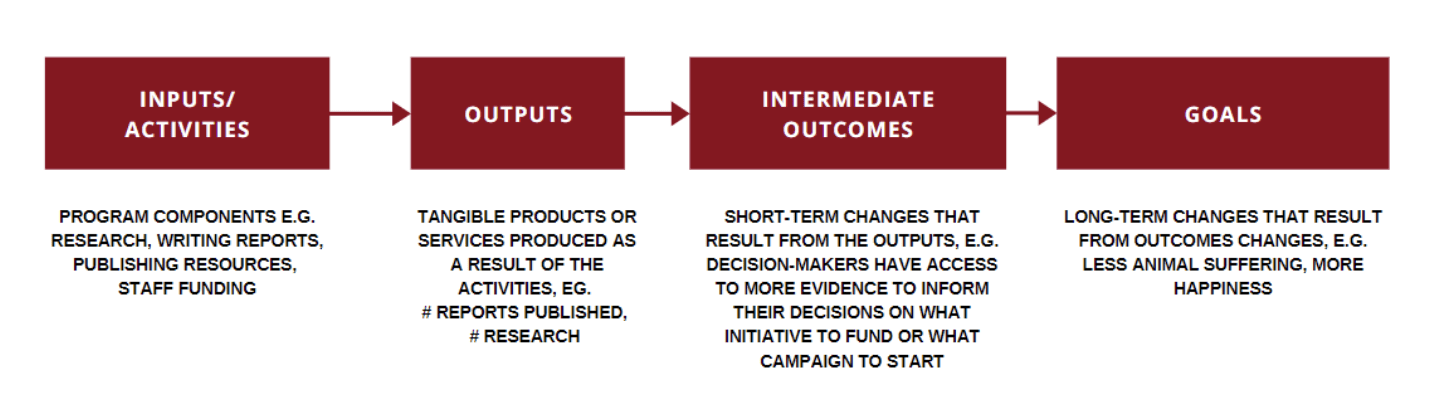
Our understanding of a Theory of Change is aligned with Charity Entrepreneurship’s definition: It’s a comprehensive description and illustration of how activities can lead to the desired goal.
Note: This post was crossposted from the Coefficient Giving Farm Animal Welfare Research Newsletter by the Forum team, with the author's permission. The author may not see or respond to comments on this post.
Subtitle: On vegan advocacy, effective altruism, and FIFA
I turn 40 today. Here are some hot takes.
On factory farming
1. Our biggest challenge is salience. If factory farming led the evening news, it wouldn’t last lo...
Impressions from the 21st Annual U.S. Cluster Headache Patient Conference, organized by Clusterbusters.
On the morning of the last day of the conference, E. was hanging out with other “clusterheads” outside the conference hotel when he started having a cluster headache attack. Before he could go back to his hotel room, J. offered E. his DMT v...
TL;DR:
The movement has an evidence problem. To solve it, for each intervention we need to know:
* What types of evidence that intervention needs
* What types of evidence different sources can give us
In this post, we outline a framework for evidencing an intervention through five stages:
...