Comments
I first watched the YouTube videos of Jack Hancock in high school, and they might be where I first heard the case for the moral significance of wild animal suffering. I met Jack at EAG London last year. He recently released a film called The Dying Trade: it is one of the best films I’ve watched, and I recommend you watch it.
Jack is a vegan activist. His father is a slaughterhouse worker. A big part of the film is spent reckoning with that fact, thinking about how we should treat those we are close to, when they work in an industry dedicated to systematic killing.
In college, Jack learned what happens to animals on factory farms. He went vegan and annoyed the people around him by telling them to do the same (so relatable!). He became an activist and started making YouTube videos. For the first time, he seriously grappled with the facts about what his father does—that his father works in the industry that Jack considers to be the cruelest on Earth, where his day job is to kill.
The film introduces us to a roving band of characters.
First, of course, are the animals. At one point, Jack breaks into a factory farm in the middle of the night, to film. You can see the bloated, emaciated bodies of the chickens who can barely walk—see their bloodied exterior from festering open wounds. Some lie slowly dying, others try desperately to move but cannot. It is not graphic. It is horrifying.
We meet Temple Grandin, who designed slaughter techniques to minimize animal suffering. Grandin did more to reduce animal suffering than almost anyone else alive. But Grandin’s attitude is puzzling—while she acknowledges that many welfare issues on the farms remain, she describes farms as pretty good. When Jack asks her about the conditions of broiler chickens, she declines to answer. She describes the life of a crated pregnant pig as being like having to spend the entire duration of your pregnancy in an airline seat, without ever being able to go into the aisles. Yet she sees this as a cause for tweaks at the margins, to make things less cruel, rather than a reason to swear off meat entirely. Grandin is not vegan.
We meet a former slaughterhouse worker named Tom who has serious PTSD from working in the slaughterhouse. Tom describes the horrific conditions for slaughterhouse workers: working day and night to kill. He says he dreams of slaughterhouses six days a week, and began having violent impulses shortly after he started working in a slaughterhouse. He’d dissociate while at work and drink heavily to get through it. Everything must happen so fast in the slaughterhouse: he’d have to kill an animal every thirty seconds for ten hours non-stop. When procedures failed, he once saw a cow be skinned alive. Another time, a mechanical failure led to a worker being sawed in half.
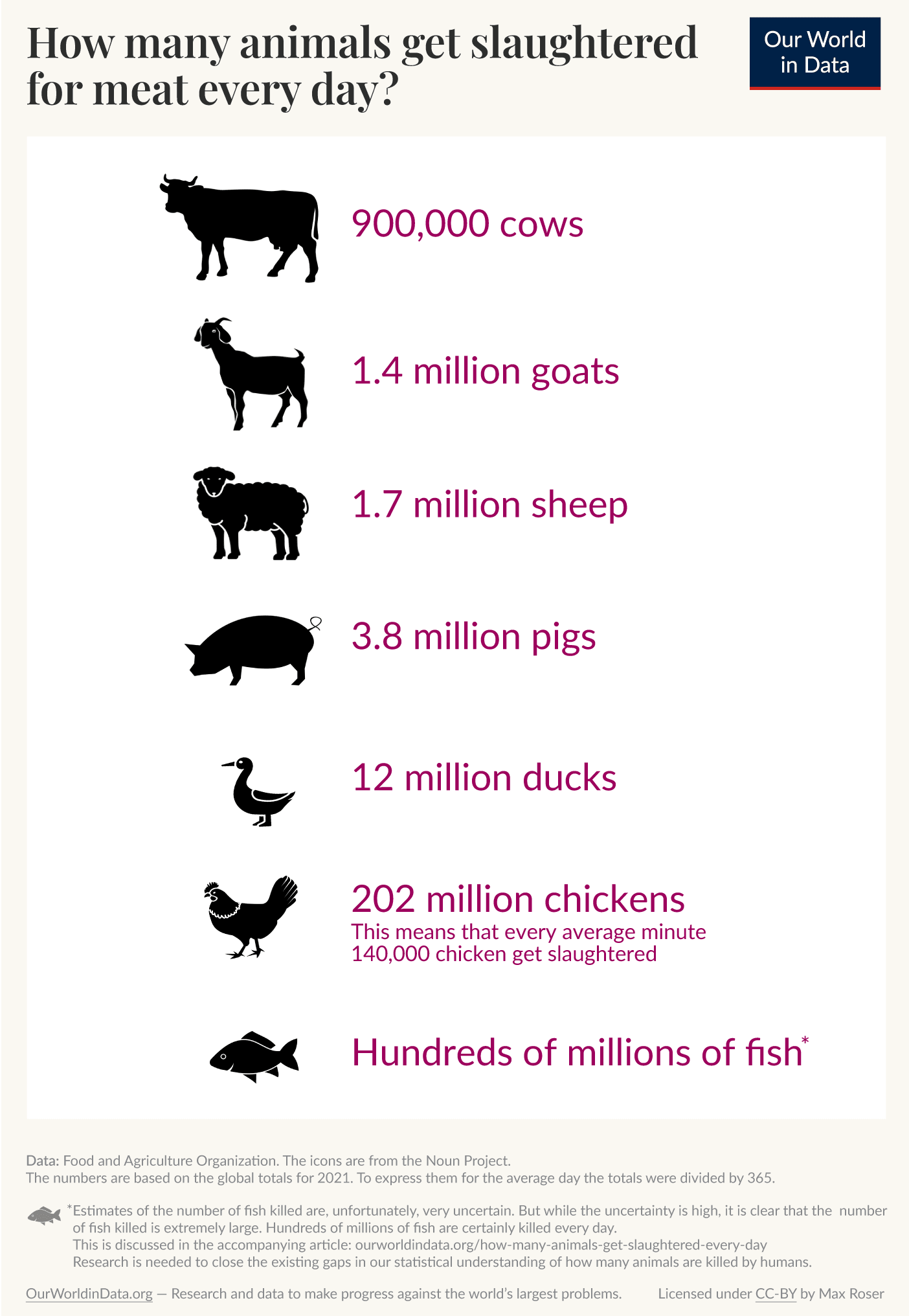
We meet Alex Hershaft, a holocaust survivor who has come to see what we do to animals as similar to what the Nazis did. Is this an unreasonable comparison? You don’t have to think animals matter as much as people to think that killing hundreds of millions of animals every day, who were tortured for months, is one of our gravest crimes. More suffering occurs in a few years in the factory farms than all suffering in human history.
Hershaft first became concerned about animal welfare when, as a consultant, he visited a slaughterhouse. He saw piles of bones and hearts—a pig’s heart looks a lot like a human’s heart. The more he looked into what we do to animals, “the more it looked like what the Nazis did to us.” This was a horrifying realization: the Americans and the Brits were supposed to be the good guys—they defeated the Nazis. And yet the Americans and the Brits have their own industry dedicated to systematic extermination. Hershaft came across a quote from Isaac Bashevis Singer that resonated:
In relation to [animals], all people are Nazis; for the animals, it is an eternal Treblinka.
Interestingly, Hershaft doesn’t blame the meat industry itself. To his mind, they are just responding to consumer demand. It is the consumers, he thinks, who are really to blame. This strikes me as a confused moral analysis; it’s like saying that hitmen aren’t to blame because they’re responding to market demand, or that producers of child pornography aren’t culpable because they’re responding to consumers. Both producers and consumers are to blame. It’s everybody’s fault.
We meet Gail Eisnitz, who the Washington Post described as one of the most courageous undercover investigators of cruelty to animals. She once witnessed a cat get run over intentionally, and had to not react in order to continue her investigation. She describes how watching cruelty day in and day out numbs us to it. The first cow you see skinned alive is a tragedy, the millionth is a statistic. One of the most moving parts of the film was something she said at the end:
“I wish the animals I’d written about and countless billions of others could know on some universal level that someone, somewhere, was mourning their pitiful lives and violent deaths—crying for those in factory farms and slaughterhouses. “Does anyone know we’re here?” Yes, we know, we’ve heard and we’ve listened, we know you are there.
Eisnitz places most of the blame on the industry itself. It is interesting to see how her perspective clashes with Hershaft’s—who they each think is primarily to blame.
The film ends with an unsettling question: to what extent should we blame slaughterhouse workers, whose job is to kill innocent beings who don’t want to die? Here is what I think we can say confidently: to the extent that they are worse than the rest of us, it is in degree and not in kind. The typical consumer of animal products also facilitates the torture of animals—they just do it more indirectly. The one who purchases the flesh of a chicken is as responsible as the worker who cuts her throat. As Hershaft memorably put it, “The monsters are not under our bed. They are within us.”
42
The documentary, and "animal welfare" in general, is not about abstaining from meat or anything on the demand side. Rather, it is a supply side effort intended to (and only to) reduce suffering before an inevitable and necessary death. Indeed the supply (and profitability) of animal products would necessarily go up, because the improved conditions would result in more animals surviving to slaughter.
Grandin should be viewed as the ultimate Animal Welfare hero, and all Animal Welfare advocates should aspire to model her: reduce animal suffering, not being vegan be damned! Why judge her by an absent standard?
This reminds me of an interaction between Jack and his father in the documentary:
Jack's statement here is not very "vegan" either...
Thoughts?
-The Dub-meister