Summary
Indonesia is on-track to achieve a demographic bonus: in 2030-2040, Indonesia will experience a demographic bonus where the number of productive age population (15-64 years) will be greater than the unproductive age population.
Considering the state of the Nation as a middling LMIC, Indonesia stands to benefit massively should more of this demographic bonus joins a career that does good.
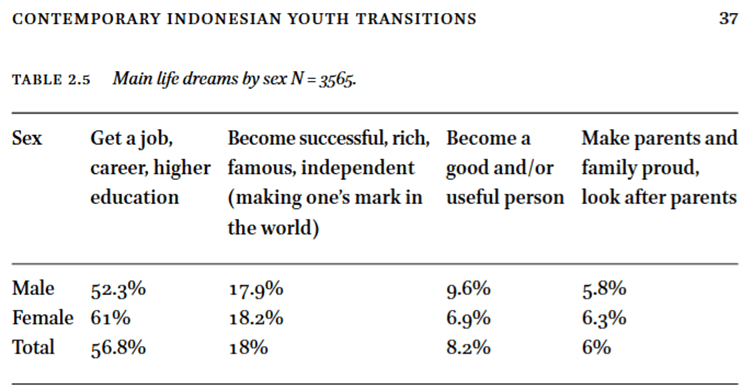
However, most youths still place lesser-than-altruistic paths of life as their main aspiration, indicating a possible opportunity to intervene and redirect some parts of this population boom towards high-impact careers.
The State of the Problem
While more of the population has attained higher education, living standards, and general improvement of well-being, many Indonesians still live in poverty.
As of March 2025, 8.47% of Indonesians, or about 23.85 million people, lived below the poverty line according to Indonesia's Central Statistics Agency (BPS). The national poverty line in March 2025 was IDR 609,160 per person per month (about 35 USD).
In 2023, Indonesia reported 418,546 malaria cases, a decrease from 443,530 in 2022, but it remains the country with the second-highest number of malaria cases in Asia. The highest burden of cases is in the Papua region, which accounts for approximately 92% of all malaria cases in the country.
Indonesia has the second-highest burden of TB globally, with estimates of around 1.1 million cases and 125,000 deaths annually. In 2023, the government recorded over 816,000 cases, and by March 2025, nearly 890,000 cases had been detected.
As of early 2025, an estimated 570,000 people are living with HIV in Indonesia, with about 63% (approximately 356,000) identified and 67% of those on medication. Indonesia's progress toward the triple 95 targets is significantly off-track. The country has identified approximately 63% of the estimated people living with HIV (PLHIV), with only around 55% being virally suppressed.
Other indicators also indicate that Indonesia is facing an inequality crisis. The Gini ratio for household consumption expenditure was 0.388 in March 2023, a slight increase from previous years, indicating rising inequality. This issue has also driven the recent events of political instability in the nation.
Opportunity for Change
Even as economic and environmental conditions continue to challenge growth, educational attainment remains steadfast, as of 2024, Indonesia's Gross Enrollment Rate in Higher Education reached 32.00%, up from 31.45% in 2023. Every year, almost 1.3 million students graduate from bachelor’s-level education in Indonesia, supplying a competitive labour market.
In the midst of the highly-competitive labour market, opportunity is not yet distributed equally, and graduates of various quality are spread out in many industries. Oftentimes, the best and brightest are being led into less-altruistic fields such as Management Consulting and Professional Services (albeit less so in recent years).
In the nonprofit field, which I worked in for around 1.5 years or so, oftentimes we are left with less-than-ideal quality candidate pools, making running complex or ambitious projects hard and less effective.
One gap we identified, is that more prestigiously-perceived industries often run career exploration and development programs, such as company site visits, career days in top universities, campus hiring and development programs such as McKinsey & Company’s Young Leaders for Indonesia program, and Phillip Morris’ INKOMPASS programs. On the other hand, nonprofit almost never invested in such programs, except for a few such as Tanoto Foundation’s Fellowship program, the UNDP’s Diversity Traineeship (both of which I was a beneficiary of) and some smaller networking or mentorship programs.
Theory of Change
Similar with what Benh713’s TOC on his proposal for Africa, the basic mechanism here is career redirection: helping high-potential individuals choose more impactful paths than they otherwise would have. Making high-impact careers more visible in a world of high-prestige careers with hidden net-negatives.
Proposed MVP
Currently, I own a network of 300+ development professionals ranging from economic research to health services implementation in Indonesia. This network, currently idle as I seek for a model to leverage it, seems fit for this purpose. I currently seek to produce:
If support allows, I also plan to:
Run cohort-based mentoring circles for students, enabled with one or two mentors from a specific path to introduce students to a path of work in-depth
Create a One-on-one advising matching portal
Offline meetups and networking sessions
Expected Impact
Again, as with Benh713’s assessment, “It’s hard to quantify the counterfactual value of redirecting one career, but it seems plausible that helping even a few dozen people per year shift toward higher-impact paths could lead to substantial downstream value”.
Even if only 10-15 individuals out of (maybe) 1,000 accessing our resources decided to switch paths, their change in direction could easily generate a substantial counterfactual impact.
Open Questions
Reach: Indonesia is a big, big nation spread out many different geographies and information bubbles. How can we reach the most and engage the most?
Granularity: Quality of education varies widely in Indonesia. How do we make content and advice that is understandable and accessible for this wide level of variation?
Next Steps / How You Can Help
I’m looking to test interest and explore this idea further over the next few months. Immediate needs:
I would love to hear thoughts and comments in the replies.
Please do get in contact with me on linkedin.com/in/cprabhaswara if you would like to talk about this more in-depth!