Comments
Crosspost of a blog post.
A recent investigation uncovered that the leading insect farming company, Ynsect, was a horrifying disaster. While company leadership soaked up millions in subsidies with sunny rhetoric about their commercial success, the dark reality inside the farm was like nothing anyone imagined.
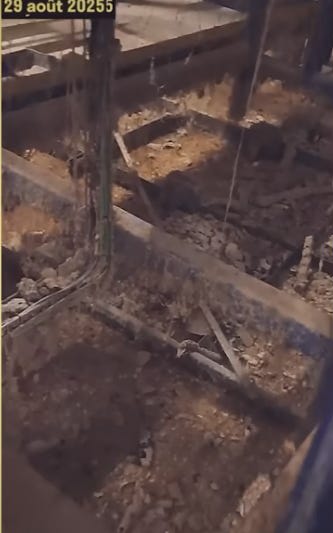
Investigators found filth clogging the machines, endangering workers. Larval bins would routinely break open, leading to repeated showers of larvae. Insects crawled all over the place, wholly uncontained. Airborne larval food floated haphazardly through the air, making workers sick. Birds wandered freely throughout the facility, their feces coating the machines. The whole area was a deluge of filth, feces, disease, and pollution.
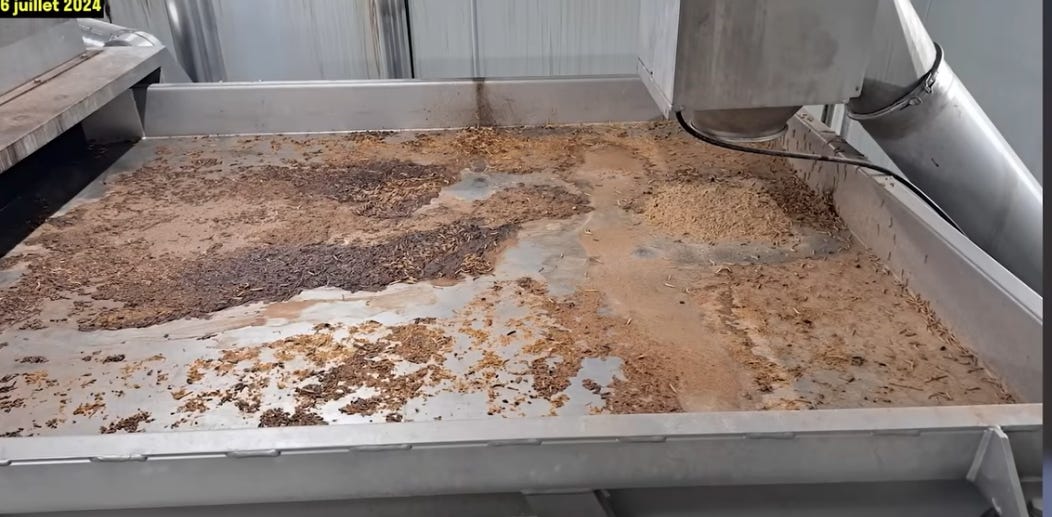
The photos above show what the place looked like. In person, it was even more of a horror show. Investigators described1:
And here, in the photos and videos, you don't have the smells. In reality, it makes you dizzy. It's impossible to breathe. Even with a mask, it makes you feel sick.
The accounts from workers were even more harrowing.
There was no dust extraction, nothing at all. I started having a runny nose, itchy eyes, a scratchy throat, my nose running, my eyes burning, and difficulty breathing. Rashes on my hands, on my feet, on my knees... Everything around the joints. I had great difficulty breathing…especially in the evening when I was at home, lying down, almost sleeping outside.
Outside? Outside, in my stairwell. I couldn’t sleep lying down in my bed anymore. I held onto a railing, I thought I was going to pass out…
…
They told me they would contact occupational health, but they didn't.
That worker later relayed, “My lungs were so swollen that they were pressing against my rib cage. And that's what was preventing me from breathing.”
Ynsect is now bankrupt, having taken millions of euros in public funding and generated essentially no revenue. As Corentin Biteau, co-founder of ONEI which researches insect farming in France, notes “Ynsect’s 2023 figures were stark: €656K in revenue for €80M in losses. Maintaining insects at 25–30°C year-round, operating complex facilities, and competing with commodity feed prices proved too difficult.”
Ynsect was the industry leader. It was seen as the model of how to do insect farming right. And yet even with hundreds of millions of euros, it wasn’t remotely able to be economically viable. If the industry leader can’t avoid bankruptcy, and no one can figure out how to have a remotely viable business model, what hope is there for the insect farming industry?
What are we doing? Why do taxpayers have to fund these economically unsustainable, environmentally destructive disasters that poison workers and pollute the local environments? Why is the government taking your money and my money to fund disaster insect farms that can’t pay for themselves?
On every front, the insect farming industry is a disaster.
It’s a disaster economically. In recent years, a quarter of the 20 largest insect farms have gone bankrupt, and many of the ones that remain teeter on the edge of bankruptcy. The largest Dutch newspaper notes that investors have gotten increasingly wary about funding insect farms after their repeated economic implosions.
What is the path forward? It won’t be feeding farmed insects to people, who don’t want to eat insects and certainly won’t eat black soldier flies—the main species being farmed. The industry’s aim is to provide low-quality feed to factory farmed animals. But insect feed is much more expensive than alternative feeds, and that’s highly unlikely to change in the future. Maintaining appropriate temperatures so that the insects can grow is expensive, and the industry hasn’t found a way to cut costs.
It’s a disaster environmentally. Insects being fed to animals generate over 13 times more carbon emissions than soy-based alternatives. Nobody has been able to explain what the path forward is for the industry—even as they demand more funding from unwilling taxpayers.
When people tout insect farming as environmentally sustainable, they normally compare it to meat. And sure, if you eat a bug burger instead of a beef burger, that will be better for the environment. But no one wants to eat burgers made from bugs, so instead the insects are fed to the animals we eat. Insect farming is an industry complementary to conventional factory farming, not a competitor. If you’re concerned about the environmental footprint of factory farms, that is an argument against insect farming, not for it.
It’s a disaster on animal welfare grounds. Most animals killed each year are now farmed insects, and they’re kept in horrifying conditions without any welfare protections, even as evidence is increasingly coming in for their sentience. They’re often killed by being microwaved, suffocated, frozen, or boiled. We should be wary of boiling potentially sentient beings by the trillions, even if they’re small and don’t have many neurons. We shouldn’t do it unless there’s a good reason.
On the farms, insects are kept in overcrowded conditions where they express none of their natural behaviors. Disease is a ubiquitous feature of their lives. A report by Rethink Priorities notes “reports of larger disease outbreaks in the industry abound, including viral and fungal infections (reviewed in the paper); these diseases may be associated with significant mortality, as well as suffering related to symptoms that develop before death.”
I think we go wrong in our neglect of insects and they matter more than we naively think. It seems reasonably likely, in my view, that they can feel fairly intense pain, and the moral arguments against taking their pain seriously are not convincing. But even if you reject this view, you should always be wary about torturing trillions of beings for basically no reason. We should strive to be compassionate and not hurt animals in large number if there’s no need to do so.
You don’t have to be a bug rights activist to think that if we’re farming in hideous conditions so many bugs that most farmed animals we slaughter are now bugs, and so far no benefits have materialized at all, and there’s no story of how future benefits might materialize, and their welfare is wholly ignored even to the point where they’re microwaved to death, something very bad is going on. Scott Alexander put it well:
In the same way, even if there's only a 50-50 chance insects have moral value, or a 1% chance, still seems like you should avoid factory-farming and killing ten trillion of them, which is about how many we currently farm
…
Really any normal person should be able to take care of all their insect-harming needs without going over whatever moral budget they set for themselves - the same kind of venial sin as buying a banana even though this is probably bad for the rainforest somehow. It’s not a problem unless you’re factory-farming ten trillion insects, at which point it really starts to add up.
With conditions this dire, with feces covering and insects crawling over dilapidated machines, where workers struggle to breathe, the catastrophe isn’t contained. It spreads to the surrounding countryside, bringing novel diseases to nearby wildlife. Alarmingly, diseases on insect farms could spread. A paper by Gałęcki & Sokół found parasites in 81.33% of examined insect farms. In 30.33% of cases, parasites could infect humans. Should we risk innocent people being infected by parasites so that insect farms can make costly feed for farmed fish?
It would be one thing if insect farming provided an alternative to conventional meat. At least in that case there would be some argument for tolerating them. But in light of the fact that they are wholly without upside, tormenting trillions of insects unnecessarily, making people sick, and poisoning and polluting the surrounding landscape, they must go. It is a catastrophe and an embarrassment that so many have been duped by their bogus promises of replacing the meat industry and that taxpayers must fund their craven operations.
56


I don't think subsidies should exist at all to start with.