Comments

If one holds a non-person-affecting view and believes that a marginal human life today is positive in expectation, they should save the letters. Many longtermists are sympathetic to these moral views.
Some possible objections to this, not necessarily held by me:
- Some hold mixed person-affecting and non-person-affecting views which allow them to avoid this conclusion.
- Even if one accepts the conclusion, it doesn't necessarily follow that the corollary--creating one person is as good as saving a life--means population growth should be prioritized over other interventions.
- The conclusion implies that abortion is morally wrong. Some EAs would endorse this, but others would find this corollary deeply objectionable.
- The meat-eater problem casts doubt on the value of creating or saving human lives.
- Some might accept the thought experiment's conclusion in a vacuum, but believe that the preservation of a norm of not killing someone to save some letters seems societally valuable.
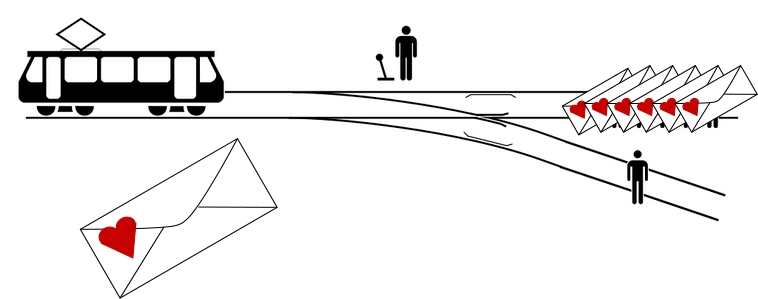

The main problem I see with this thought experiment is assuming away replaceability. It is implausible that the 10 people involved in these love letters would have zero children in the absence of these love letters, but that is what we are asked to believe. I suspect that virtually all scenarios where an action causes someone to be born suffer from replaceability. Even abortion does: most people want children, they just don't want them at the time they have an unintended pregnancy. So I'm not sure how much we learn from this thought experiment.
Is this kind of replaceability compatible with current practices in Longtermism?
What is the consequence of the claim that if I fail to take an action to preserve Future People, Other Future People likely replace them?
Let's say I give money to MIRI instead of saving current people, based on some calculations of future people I might save. Are we discounting those Future People by the Other Future People? Why don't we value Other Future People just as much as Future People? Of course we do.
Perhaps that is the point of this thought experiment. Perhaps "of course you don't pull the switch" is the only right answer precisely because of replaceability.