In the latest edition of my Tactics In Practice (TIPs) series, I analyzed the research behind protest in the animal protest movement! The full resource is well worth reading for any activist who uses street demonstrations — check out the full thing here: Tactics In Practice: The Science Of Protests And Demonstrations.
Key Highlights:
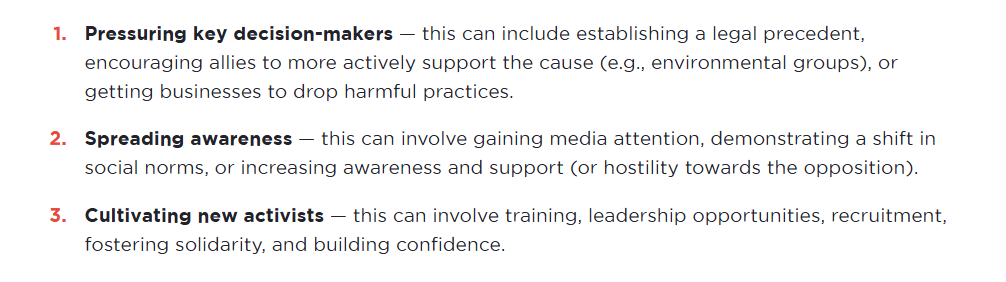
Protest groups tend to have three main goals, shown below. I wasn't able to find empirical evidence on Goal 3 (positive or negative), but anecdotal conversations lead me to believe that protests can serve as good cultivation tools for other activists. But I was able to find more information on the other two goals.
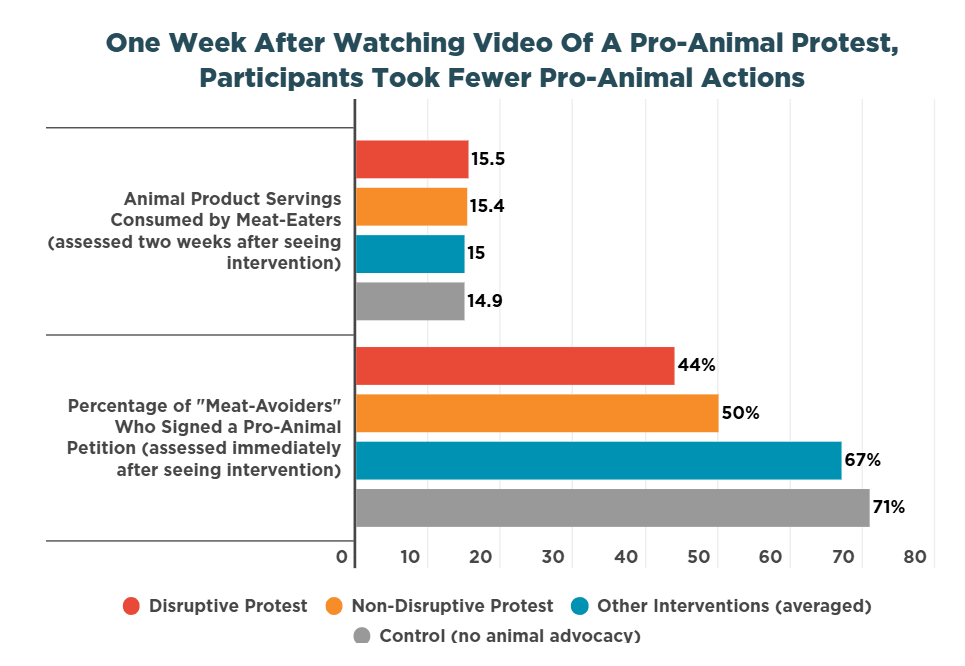
Protests can’t change people’s diets; we need to pursue other targets. (That doesn't mean protest is a bad tactic! Just that it's ineffective if we apply it to the wrong target)
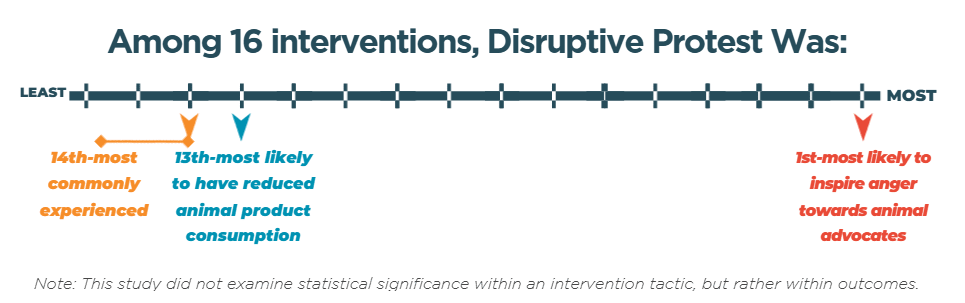
All protest has some form of backlash — this backlash is among the highest of animal advocacy interventions, if not the highest. While research shows this backlash fades over time, activists need to think critically about how to work with it. Either take steps to reduce the backlash (through media plans, carefully chosen tactics, etc.), or as part of a larger strategy. Which brings us to:
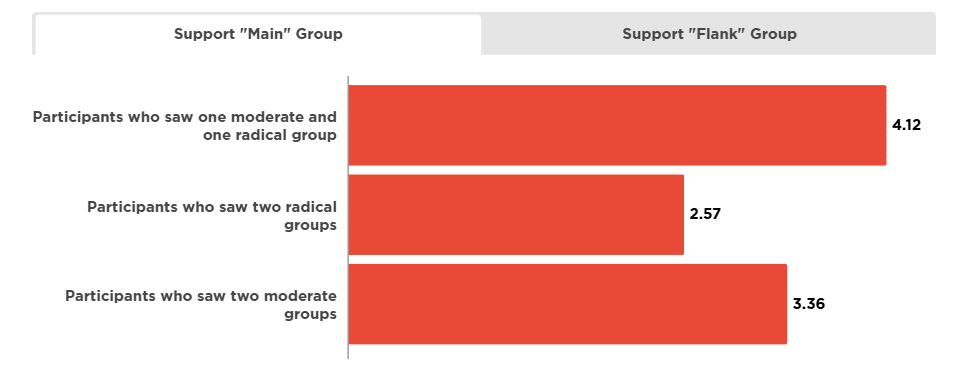
We need to think more critically about the “radical flank effect” (sometimes called “good cop, bad cop”) — if one protest group is perceived as more radical, a more moderate group will be more accepted. However, this requires careful strategy and coordination. I personally believe that groups involved in protest should consider which role they play in the broader ecosystem: are they radical? Moderate? And how will different groups engage with the key decision-makers?
Protest impact depends on the media in both the short-term and long-term, so protest groups need a media outreach plan.
Protestors need to think very carefully about the salience of their protest — where, when, and why is this protest taking place? Can activists carefully choose a cause more likely to garner media attention (something more specific than “animal rights”)?
Groups need to pick the goals of the protest carefully. As mentioned above, "go vegan" is unlikely to have much impact. This requires understanding opinion polling on a topic as well as the likelihood of specific stakeholders to create positive change.
Note: This post was crossposted from the Coefficient Giving Farm Animal Welfare Research Newsletter by the Forum team, with the author's permission. The author may not see or respond to comments on this post.
Subtitle: On vegan advocacy, effective altruism, and FIFA
I turn 40 today. Here are some hot takes.
On factory farming
1. Our biggest challenge is salience. If factory farming led the evening news, it wouldn’t last lo...
Impressions from the 21st Annual U.S. Cluster Headache Patient Conference, organized by Clusterbusters.
On the morning of the last day of the conference, E. was hanging out with other “clusterheads” outside the conference hotel when he started having a cluster headache attack. Before he could go back to his hotel room, J. offered E. his DMT v...
TL;DR:
The movement has an evidence problem. To solve it, for each intervention we need to know:
* What types of evidence that intervention needs
* What types of evidence different sources can give us
In this post, we outline a framework for evidencing an intervention through five stages:
...