Comments
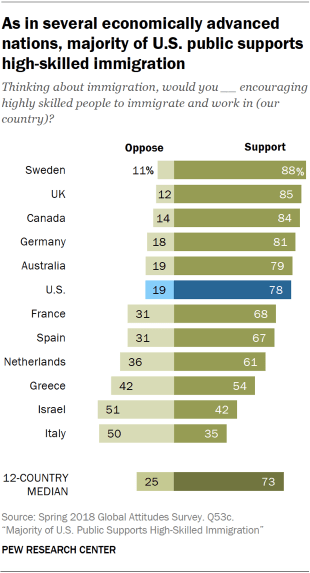
According to a 2019 Pew Research Center survey of people in 12 countries, majorities of the public in Sweden (88%), the United Kingdom (85%), Canada (84%), Germany (81%), Australia (79%), and the United States (78%) support high-skilled immigration. Even among people who want fewer immigrants, support for high-skilled immigration in these countries is high.[1]
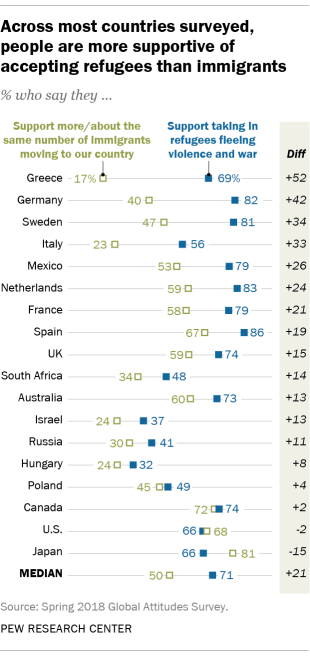
Additionally, people in many developed countries support admitting refugees even if they're not as keen on immigration in general.[2]
“Majority of U.S. Public Supports High-Skilled Immigration.” Pew Research Center, Washington, D.C. (2019). ↩︎
“People around the world express more support for taking in refugees than immigrants.” Pew Research Center, Washington, D.C. (2019). ↩︎



I don't have an answer to which countries would be more receptive to the idea, definitely don't try here in Israel!
I am however interested in the claimed effectiveness of open borders. Do these estimates take into account potential backlash or political instability that a large number of immigrants could cause? I understand that theoretically, closed borders are economically inefficient and solidify inequality, but I fear that open borders could cause significant political problems and backlash. Even if we were to consider this backlash to be unjustified or immoral, we need to keep it in consideration when thinking of the effects of this policy. Am I unjustified in thinking that significant negative political effects are possible?
I think these concerns are valid. The website Open Borders: The Case addresses many of the main arguments against open borders, including the possibility of nativist backlash to increased immigration.
"Nativist backlash" refers to the hypothesis that a country opening its borders to all immigration would cause a significant portion of current residents to subsequently turn against immigration. The problem with this claim is that the probability of backlash depends on how a country adopts open borders in the first place. Nathan Smith writes: