Executive summary: Renaissance Philanthropy presents ten open-source “Playbooks” as practical frameworks to help philanthropists translate ambitious, counterfactual goals into coordinated, high-leverage action across science, markets, and policy.
Key points:
The Commitments playbook argues that artificial deadlines, public calls to action, and “anchor commitments” can coordinate diverse actors around a bold, outcome-driven goal when legislation or markets are too slow or fragmented.
The Common Task Method proposes accelerating scientific progress by defining a formal task, releasing gold-standard datasets, setting quantitative metrics, and maintaining leaderboards, potentially with “extensible living datasets” that generate new data on demand.
Coordinated Research Programs (e.g., ARPA-style programs, Focused Research Organizations, Virtual Institutes) are presented as suitable for cross-disciplinary, non-venture-scale problems where unified, actively managed teams can outperform fragmented lab funding.
Market Shaping emphasizes “pull mechanisms” such as advance market commitments, prizes, or milestone payments to correct market failures and incentivize innovation in areas with high social value but weak commercial incentives.
Mid-Scale Science highlights tens-of-millions-dollar investments in datasets, platform technologies, foundation models, automation, software, and shared facilities as a neglected but potentially transformative layer between single-PI grants and “big science.”
Additional playbooks—including Thesis-Driven Philanthropic Funds, Policy Entrepreneurship, Prize Competitions, Target Product Profiles, and Scientific Field Creation—outline structured approaches to lower barriers to ambitious giving, influence policy agenda-setting, attract diverse innovators, guide R&D toward unmet needs, and intentionally build new scientific fields.
This comment was auto-generated by the EA Forum Team. Feel free to point out issues with this summary by replying to the comment, andcontact us if you have feedback.
Renaissance Philanthropy have ten open-source Playbooks designed to turn ambition into action, offering a pattern language for high-impact, counterfactual philanthropic giving.
I've shortened each Playbook here to varying degrees to make this an easy, skimmable reference material. Some Playbooks were shortened significnantly, so I'd encourage interested people interested in any specific playbook to read more at their respective links.
“We are not just going to be waiting for legislation… I’ve got a phone that allows me to convene Americans from every walk of life—non-profits, businesses, the private sector, universities—to try to bring more and more Americans together around what I think is a unifying theme.”
— President Obama, January 14, 2014
The Challenge:
Solving our biggest societal challenges—whether in science, education, health, or climate—requires action from a diverse mix of actors: companies, nonprofits, researchers, governments, investors, and more. Each holds a piece of the puzzle, but no single entity can solve the problem alone.
Too often, efforts to drive progress stall because:
Leaders are working in silos without coordination.
There’s no shared sense of timing, urgency, or measurable progress.
Existing tools like legislation or market incentives are too slow, too rigid, or politically constrained.
Yet many individuals and institutions are ready to act. What’s missing is a structured way to channel that readiness into collective momentum and urgency toward important goals.
The Play:
The commitments model provides a framework for coordinated action—leveraging artificial deadlines, public calls to action, and shared accountability—to rally diverse stakeholders around a common objective. Here’s a step-by-step guide to putting it into practice:
Define a bold, outcome-driven goal: Start by articulating a goal that’s big enough to inspire, but clear enough to drive action. What problem are you trying to solve? What does success look like in 3–5 years?
Map your dream commitments: Use a thought experiment: imagine you have a “magic laptop” that turns press releases into reality. Write your dream announcement:
A bold headline stating the goal
A few paragraphs of context and rationale
1–2 paragraphs per commitment, following the formula: Organization A commits to take action B to achieve outcome C
Think expansively—these actors can include governments, philanthropists, companies, researchers, skilled volunteers, and more.
Secure anchor commitments: Share your vision with a few trusted partners and invite them to be early adopters. Having 1–3 prominent “anchor” commitments helps build credibility and momentum for others to join.
Issue a call to action: Launch a public or semi-public call for commitments, ideally led or endorsed by a well-known figure or institution. Be sure to include what Tim O'Reilly calls an architecture of participation—a clear explanation of how different types of stakeholders can get involved.
Host a commitments workshop or design session: Organize a focused convening to brainstorm and shape specific commitments. Having influential stakeholders in the room can attract interest and accelerate decision-making.
Create urgency with a deadline: Set a clear timeline by scheduling an event where commitments will be announced. If possible, align with an existing high-profile event to increase visibility and drive urgency. Deadlines unlock decision-making.
“Alone we can do so little, together we can do so much.”
— Helen Keller
The Challenge:
Despite advances in frontier models, we have yet to see this progress fully applied in important areas of science like chemistry, materials science, and climate science
Researchers used DeepMind’s AlphaFold to predict the structures of more than 200 million proteins from roughly 1 million species, covering almost every known protein on the planet! Although not all of these predictions resulting from AlphaFold’s open-access Protein Structure Database will be accurate, this is a massive step forward for the field of protein structure prediction.
However, we’re not seeing the same level of impact across other areas of science. That’s because we’re under-investing in the infrastructure needed to apply AI at scale—things like open datasets, shared benchmarks, and collaborations between experimental and computational researchers.
The question that science agencies and different research communities should be actively exploring is – what were the pre-conditions for AlphaFold, and are there steps we can take to create those circumstances in other fields?
The Play:
The Common Task Method (CTM) unites research communities to achieve progress on a challenging, well-defined task using standardized datasets and clear success metrics
One framework which explains the success of AlphaFold and how we might replicate that success in other fields is what linguist Mark Liberman calls the “Common Task Method.”
In a CTM, competitors share the common task of training a model on a challenging, standardized dataset with the goal of achieving a better score. They typically have four elements:
Tasks are formally defined with a clear mathematical interpretation
Easily accessible gold-standard datasets are publicly available in a ready-to-go standardized format
One or more quantitative metrics are defined for each task to judge success
State-of-the-art methods are ranked in a continuously updated leaderboard
Computational physicist and synthetic biologist Erika DeBenedictis has proposed adding a fifth component, which is that “new data can be generated on demand.” Erika, who runs competitions such as the 2022 BioAutomation Challenge, argues that creating extensible living datasets has a few advantages. This approach can detect and help prevent overfitting; active learning can be used to improve performance per new datapoint; and datasets can grow organically to a useful size.
In many cases, ambitious R&D problems are not well-suited to individual academic labs, startups, or other existing institutions.
Problems can fall outside the scope of an academic lab for a variety of reasons. Academic labs tend to prioritize specific types of novelty, have modest resources, and focus on specific research domains. In practice, this means that a problem can be too engineering-heavy or require too much coordination between multiple disciplines to be a good fit for an individual academic lab.
While startups can be a natural entity to tackle many cutting-edge problems that fall outside the scope of academic labs, this is only in certain cases. Venture capitalists tend to fund startups to work on technologies that not only address problems with large market caps (~$1 billion+), but which can capture a large portion of that market in a reasonable amount of time (~10 years). In practice, this means startups are generally geared toward solving problems with large commercial markets — and most of the scientific risk often needs to be resolved before fundraising.
Many problems that are wildly important to society are ill-suited to individual academic labs, are not venture-scale, or are laden with scientific risk. Coordinated Research Programs (CRPs) are a natural approach to tackling these problems.
The Play:
Coordinated Research Programs (CRPs) are suited to tackling large, cross-disciplinary problems that are not in line with the typical work of a single field’s academic labs. Often, CRP-shaped problems are larger in scope than what an individual academic lab can pursue. ARPA-style programs are one classic example of a CRP. Focused Research Organizations (FROs) — time-bound R&D organizations that assemble startup-style teams to pursue an ambitious technical goal, such as developing improved implants to measure and modify brain activity — are another example. Virtual Institutes, which coordinate distributed R&D teams towards a shared technical vision with multiple leaders (one for each team), are a third example.
Fueled by an ambitious technical goal and active management, CRPs enable funders to allocate funds in ways that are super-additive — compared to funding a smattering of labs separately working on problems related to your goal. In early ARPA history, the CRP approach helped deliver world-changing technologies like the internet and early autonomous vehicles. Today, it is seen as a natural approach to tackling problems like mapping an entire mammalian brain or developing blood substitutes.
The timing must be right to undertake a CRP. If you have a clear goal in mind, the time is right for a CRP when the collective knowledge in relevant technical areas has progressed to the point where a coordinated team of engineers, researchers, and others can make far more progress working as a team than as a set of disjoint labs with their own budgets. This coordinated team working in lockstep to pursue the problem can be housed under the same roof (as with FROs) or in separate organizations contracted to work together towards a shared goal (as with ARPA programs).
It is important that a funder thoroughly assesses whether the time is right before diving into a CRP. If it is an opportune time, a CRP can be an ideal use of funds. But the success of CRP efforts is often built upon the knowledge generated by prior research. If a funder is dedicated to some technical problem and not enough is known about the problem to undertake a CRP, then a more traditional research effort, such as those undertaken at universities, might be more appropriate. If the CRP approach does fit a problem, a medium-sized set of funds can go a long way. CRP efforts in the low eight-figure range have changed the world on more than one occasion.
“Give me a lever long enough and a fulcrum on which to place it, and I shall move the world.”
— Archimedes
The Challenge:
Market forces sometimes fail to incentivize innovation for some of our most pressing challenges
Some technologies with high social value have insufficient commercial value, discouraging private investment in research and development. These market failures hinder solutions to global threats such as climate change, pandemics, and neglected diseases.
The Play:
Market-shaping instruments, such as advance market commitments, incentivize and de-risk R&D
In recent years, governments and the private sector have used market shaping to correct for market failures, spurring the development of life-saving COVID vaccines, climate solutions, and antibiotics and restoring America’s leadership in space.
This involves:
Identifying a consequential problem that market forces will not immediately solve. For example, many climate solutions have a “green premium.” A public or private customer who is willing to pay the green premium can help drive down the cost through economies of scale and learning by doing, reducing or eliminating the green premium. Another example is innovations that benefit low-income communities, such as vaccines and therapies for Neglected Tropical Diseases.
Crafting a performance-based description of the salient features of an effective solution. Defining eligibility criteria at the outset guarantees that winning proposals actually address consumer needs.
Pledging a financial reward, such as a prize, subsidy, purchase order, or series of milestone payments, to one or more teams that solve the problem. The promise of future payment activates future markets for yet-to-be-developed solutions, motivating firms to pursue innovation in domains they might otherwise neglect.
The upfront commitment of a financial reward is also known as a “pull mechanism.” The University of Chicago’s Market Shaping Accelerator (MSA) explains:
Whereas “push” funding pays for inputs (e.g. research grants), “pull” funding pays for outputs and outcomes (i.e. prizes and milestone contracts). These mechanisms “pull” innovation by creating a demand for a specific product or service, which drives private sector investment and efforts towards developing and delivering that product or technological solution.
“Progress in science depends on new techniques, new discoveries, and new ideas, probably in that order.”
— Sydney Brenner
The Challenge:
Traditional research models are not designed for the mid-scale investments needed to accelerate the pace of science and innovation
The development of new techniques, tools, and datasets sometimes requires mid-scale investment: focused support of tens of millions of dollars that falls between grants to individual principal investigators (PIs) and “big science,” like the Large Hadron Collider or James Webb Space Telescope. These investments have the potential to move an entire field forward, solve a range of important scientific and societal challenges, and reduce the time and cost associated with an end-to-end innovation process, such as developing new materials or engineering microorganisms to create a circular economy.
Currently, government-funded mid-scale grants often support “centers” or “hubs” with 20 or more PIs from multiple universities. Every PI receives funding for roughly one postdoctoral researcher or graduate student. These centers enable loose collaboration, which can be powerful for open-ended discovery in an area, but not the pursuit of projects that require unity of effort and tightly organized collaboration, such as the development of a new scientific instrument or a large, high-quality dataset. University pay scales and structures also make it difficult for such centers to recruit and retain professional engineers, such as chip designers or machine learning engineers.
Mid-scale projects may be growing in importance because of the potential of AI to accelerate the pace of scientific discovery. Unlocking the potential of AI for Science will require investments such as foundation models for science, large, diverse, high-quality datasets used to train AI models, platform technologies that lower the cost of generating the data, self-driving labs that allow for rapid iteration between computational and experimental approaches, and modern, production-quality software that integrates AI, simulation, and design.
The Play:
Given the potential flexibility of their funding, philanthropists and foundations can work with the research community to not only identify high-impact midscale projects, but to co-design the right mechanisms to fund, organize and incentivize the R&D
There are many types of mid-scale science projects. In some cases, these might make sense to create and sustain as “public goods,” such as open datasets, or broadly-available user facilities. In other instances, the research may lead to a startup or a new commercial product or service. Although these are described below as distinct types of projects, many initiatives may involve combinations of these approaches.
Datasets and benchmarks. Open-access datasets and benchmarks are allowing researchers to train powerful AI models. For example, the Protein Data Bank has enabled Nobel Prize-winning advances in both protein structure prediction (AlphaFold), and protein design (RFDiffusion). EvE Bio’s “pharmome” is mapping the unintended targets of small-molecule pharmaceutical drugs. This open dataset could help researchers predict the negative side-effects of drugs before they reach patients, and identify opportunities to repurpose existing drugs to treat a broader range of diseases. Align to Innovate is working with the research community to define and create datasets improving “structure to function” prediction using AI. You can read more about the importance of datasets and benchmarks in our playbook on the Common Task Method.
New platform technologies for both imaging/characterization/measurement and synthesis/fabrication/perturbation. In many instances, our ability to understand some complex phenomena (e.g., the architecture of the human brain with respect to memory, perception, problem-solving) is limited by existing research tools. Investing in the development of new and improved tools, or lowering the cost of existing tools, can have a transformational impact on a field. Examples include a reduction in the cost of sequencing the human genome from $100 million to $100, or the impact that electron microscopes and the ability to see individual atoms has had on materials science.
New foundation models for science. Although Large Language Models have been trained on text, researchers are beginning to train foundation models on scientific data. For example, Tatta Bio is developing genomic language models that are trained on trillions of base pairs from metagenomic datasets, and that can predict novel types of protein-protein interaction. It may be difficult for academic researchers to train these foundation models in the absence of philanthropic support if they require large datasets, expensive GPU clusters, and professional ML and software engineers.
Automation for science. Although not all experiments can be automated, scientific automation has a number of potential benefits. It can allow researchers (particularly graduate students and postdocs) to spend more time on the design of experiments and the interpretation of results, as opposed to repetitive manual tasks. Automation can also increase the reproducibility of research results, and make it easier for researchers to incrementally increase the size of a dataset if it is particularly valuable for training an AI model. “Cloud labs” (remote access to automated scientific equipment and reagents) can expand the number of experiments that any single researcher can take advantage of. “Self-driving labs” (integrated combinations of AI, automated equipment, software for the orchestration of scientific workflow),can accelerate the pace of scientific discovery. AI can create a system of closed loop experimentation by identifying the most valuable experiment to do next. In many fields, human judgment and intuition are still playing an important role, so developers of self-driving labs are working on designing the right forms of human-machine interaction.
Modern scientific software. Although university researchers develop academic prototypes of scientific software, they often lack the incentive, talent and funding to develop and maintain “production-quality” code. In many instances, researchers also lack the resources to rewrite legacy code so that it is written in a modern language, optimized for modern computer architectures such as GPUs, and is designed to be integrated with AI. For example, some researchers are producing scientific software so that key parameters in a model can be “learned” and therefore improved over time.
Foundries or shared facilities. Some resources needed for scientific research are expensive, or also require access to specialized expertise. For example, in the 1980s, DARPA accelerated progress in the field of microelectronics with a program called MOSIS, which gave academics and small businesses access to the ability to prototype new chip designs.
Sector-specific public goods. One example is the Fusion Prototypic Neutron Source (FPNS), which will allow research to discover radiation tolerant materials for fusion reactors. Investment in an FPNS would benefit many fusion companies, in the same way that federal investment in wind tunnels in the 1930s strengthened U.S. leadership in aeronautics.
“No matter who you are, most of the smartest people work for someone else.“
— Bill Joy
The Challenge:
Ambitious philanthropy has a high barrier to entry.
The landscape of global wealth continues to expand rapidly. According to the World Ultra Wealth Report 2024, the global ultra-high-net-worth (UHNW) population increased by 7.6% in 2023 to 426,330 individuals. Within that, the number of UHNWIs in the United States grew by 13.1%. In fact, there are now more than 100,000 individuals and families globally with at least $50 million in wealth, and 2,000 families in the U.S. alone that have more than half-a-billion in wealth. These individuals collectively hold over $49 trillion in wealth—more than the combined GDP of the US and Chinese economies.
While high-net-worth individuals express commitment to philanthropy, their actual giving levels remain well below their potential and stated desires. According to Bridgespan, ultra-wealthy American families donated just 1.2% of their assets to charity in 2023. Most of these people face real barriers. Research from Barclays Private Bank indicates that at least 20% of them indicate not having enough knowledge or experience with charitable organizations. This is significant, because these same people are also reluctant to build out large teams or develop new infrastructure to inform their giving. Unfortunately, this means that they miss out on ambitious opportunities, both for their organizations and society, because they do not have the capacity to conduct due diligence and maintain oversight of emerging areas. The result is that many high-potential projects go unfunded, particularly in areas requiring deep technical expertise or complex coordination across multiple stakeholders.
Philanthropists need a better path to participate in ambitious giving.
The Play:
Philanthropic funds enable donors to create more impact in areas they care about without hiring large in-house teams
Philanthropic funds represent a powerful alternative to traditional models of either giving to a small number of Principal Investigators (PIs) and nonprofits or giving large gifts to well-established institutions. The philanthropic fund model consists of three core pillars:
Compelling Thesis: a clear articulation of one or multiple ambitious goals the Fund aims to accomplish in a specific time frame (three years, five years, etc), the capital required, how the capital will be spent to reach the goal, and how impact will be measured and sustained;
Field Leader: the individual who can credibly drive this thesis to execution based on their expertise and passion, ability to spot and develop compelling ideas, and connectivity to both donors and performers in the space;
Anchor Donor: the donor that capitalizes the fund either fully or partially (minimum is 20-30% of the overall goal capital raise).
“Each problem that I solved became a rule, which served afterwards to solve other problems.”
— René Descartes
The Challenge:
Misconceptions about how policy change happens mean most people underinvest in policy agenda-setting
Most technical experts underinvest in policy agenda-setting, treating the government as a black box that requires significant funding and expertise to influence. Common myths include:
Policy change requires legislation. In reality, executive actions can be equally impactful. For example, a new USCIS rule led to a 30% increase in O-1 visa use.
You need to be a donor to influence policymakers. In reality, policymakers rely on academia and civil society to provide ideas and outside support for their goals. For example, through agenda-setting papers and technical assistance, a small group of motivated individuals established ARPA-H with a $3 billion budget.
Policy campaigns are resource-intensive. In reality, if you are able to identify a window of opportunity, a modest investment of time and resources can make a substantial difference. This is especially the case if a policy proposal will not trigger ideological opposition or opposition from entrenched interest groups.
The Play:
The presence of effective policy entrepreneurs working on a problem can have a meaningful impact on policy outcomes
Policy entrepreneurs are able to identify the right policy lever to make progress on a problem, develop the documents needed to instantiate their idea, find and recruit allies, and leverage key dates on the calendar to make progress.
Having an agenda. Policy entrepreneurs are able to provide detailed answers to questions like:
What am I trying to get done? What is the status quo? What is a more desirable future in the issue area that I care about?
How will my project get done? What public and private actions or resources are needed to achieve my goals?
How will I know if my idea is successful?
What metrics of success can be tracked over time?
Why do I believe this is the right thing to do, and that doing A will (or is likely to) cause B to occur?
Whom do I need to convince of the value of my idea? Who should be involved in its implementation?
How do I communicate the essence of my idea to a non-expert?
Creating the documents that are necessary for a policy to be considered and implemented. It’s likely that, at some point in the process, policymakers will need to draft one or more documents in order to make and implement a decision.
Finding allies. Policy entrepreneurs are able to find people with shared interests who can help them get the job done. They think about people with specific skill sets whom they could recruit to support their effort.
Making the schedule their friend. Policy entrepreneurs have a keen awareness of the calendar and are often working backwards from a key date or milestone. For example, every year, typically in January or February, the President gives a State of the Union Speech where they highlight the administration’s priorities.
Having a large and growing toolbox. Policy entrepreneurs must be able articulate a coherent relationship between means and ends. They also need to identify the policy levers that will help achieve a given goal, such as changes in the tax code, regulatory policy, legislation, R&D investments, etc.
How to support policy entrepreneurs. Philanthropists can support technical experts in their area of interest who have or are motivated to learn the skillsets and mindsets of policy entrepreneurs. There are a number of ways to do so.
Support tours of duty. Philanthropists can support the placement of talent into congress via fellowships administered by external entities, such as professional societies (e.g. AAAS), universities, and nonprofits (e.g. Horizon Institute for Public Service).
Train subject matter experts on skillsets and mindsets of policy entrepreneurship. Philanthropists can support programs to help subject matter experts become more effective policy entrepreneurs.
Capture tacit knowledge of civil servants and political appointees. Philanthropists can support programs to capture the learnings of civil servants and political appointees. Many policy entrepreneurs are so absorbed in the daily work of getting things done that they don’t take the time to document what they did and how they did it.
Policy readiness levels. Effective policy entrepreneurship rests on spotting policy windows. NASA and the Defense Department use a technology readiness level to assess the maturity of a technology – from basic research to a technology that is ready for deployment. Policy entrepreneurs can similarly develop the “policy readiness” of an idea by taking strategic action to increase a proposal’s chance of success. Policymakers are often time constrained, and therefore more likely to consider proposals that have anticipated the questions raised by the policy process. These include:
What is a clear description of the problem or opportunity?
What is the case for policymakers to devote time, energy, and political capital to it?
Is there a credible rationale for government involvement or policy change?
Is there a root cause analysis of the problem?
What can we learn from past efforts to address the problem?
What can we learn from a comparative perspective?
What metrics should be used to evaluate progress? What strategy should policy-makers have for dealing with Goodhart’s Law?
What are the potential policy options, and who needs to approve and implement them?
What are the documents that are needed to both facilitate a decision on the idea, and implement the idea?
Has the idea been reviewed and critiqued by experts, practitioners, and stakeholders? Is there a coalition that is prepared to support the idea? How can the coalition be expanded?
How might tools such as discovery sprints, human-centered design, agile governance, and pilots be used to get feedback from citizens and other key stakeholders, and generate early evidence of effectiveness?
What steps can be taken to increase the probability that the idea, if approved, will be successfully implemented?
“An invasion of armies can be resisted, but not an idea whose time has come.“
— Victor Hugo
The Challenge:
The problem to solve is clear but the solution isn’t.
For some problems (e.g., designing a COVID vaccine), there is a natural set of problem solvers (e.g., pharmaceutical companies). For others, it is less obvious, either because the field is nascent, the means to solve the problem are widely available (e.g., a laptop), or because the problem is interdisciplinary, making it harder to pinpoint a single industry or sector as the natural home for solutions.
The Play:
Competitions engage a diverse community of solvers to develop innovative solutions
Prize competitions invite a broad community of individuals and teams to attempt to make progress on a problem. Prize competitions are:
Inclusive. They cast a wide net and offer a low barrier to entry to attract diverse, sometimes unexpected talent. This avoids involving only the “usual suspects” and has the additional benefit of building a larger community of practice dedicated to solving the same problem.
Flexible. Prize competitions set forth a problem to be solved and the characteristics of a solution, but they are not prescriptive about how the problem should be solved.
Force-multiplying. Done well, the benefits of competitions can extend beyond prize money. Winners receive third-party validation of their work, enhancing their credibility. Often, competitions offer innovators feedback, even if they don’t win. They can use this feedback to further develop their innovation after the competition ends.
When to use a competition:
Is there a clearly defined, achievable goal? A prize must have a clearly defined goal that’s within grasp of potential competitors. It should be ambitious but reachable within a given timeframe. For example, the Ansari XPRIZE offered $10 million for the first privately funded team to launch a reusable, manned spacecraft to an altitude of 100 kilometers twice within two weeks.
Is there a need to attract more innovators to solve a particular problem Competitions are useful to expand the scope and kinds of talent working on solving a problem. The overhead of a competition may not be worth it if only a few innovators are capable of solving the problem; and in that case, a grant or contract is a more appropriate mechanism.
Are innovators willing to accept the risk of not winning the prize? Competitions are most effective when they attract a broad and diverse pool of innovators, increasing the likelihood of viable solutions. Widespread participation will only occur if enough innovators determine that their participation is worthwhile, even if they don’t ultimately win. That’s why prize competitions are typically designed with low barriers to entry, like a short application.
How to design a competition:
Define the problem. The need and problem must be clearly articulated. One useful tool for doing this is a target product profile (TPP). A TPP is a strategic document that summarizes the features of an innovation needed to address an unmet need. It outlines the desired characteristics of a target product by defining the intended use, target population(s), and other desired attributes, including safety and efficacy-related characteristics. You can read more in our TPP playbook here.
Determine the target maturity level of solutions. Before launching a competition, the desired readiness of winning solutions must be determined. Completions can range from attempting to crowdsource new ideas to incentivizing the development of commercial solutions. The target level of maturity will help to determine factors like the prize amount that can be offered (i.e., more developed solutions merit a larger prize) and the type and breadth of supports the competition will offer.
Recruit innovators. A big, complex problem should attract a large competitor pool. Building and maintaining a large funnel of talent is a year-round effort. It involves advertising the competition through social media, targeting relevant industry groups and message boards, and relying on “connectors” who have large networks and are skilled in matching talent with opportunities. Since most competitors won’t submit their proposals until shortly before the competition closes, it’s best to gauge interest early through an eligibility quiz, email sign-up, or live events like webinars and office hours. This gives a sense of how many and what kinds of innovators to expect and allows time to adjust the recruitment strategy, if needed. Once there is a list of interested innovators, competition organizers should communicate regularly with them, providing reminders of deadlines and opportunities to ask questions. With a wide funnel and supportive touchpoints, participants will be guided from hearing about the competition to submitting a strong proposal.
Specify evaluation criteria. Clear rubrics should be established to evaluate innovations fairly.
Select judges. A competition needs a set of evaluators and judges with expertise in the problem area.
Set the prize amount. This should depend on the size and complexity of the problem to solve. Lower amounts are typically offered for ideas while higher amounts make sense for more refined prototypes and products.
Consider your policy on intellectual property. While some competitions allow innovators to retain their intellectual property, others do not. Like a competition’s prize amount or submission requirements, its stance on intellectual property will influence innovators’ decision to compete.
Design a feedback process. There should be a clear plan and process for the level of feedback and support each participant will receive, as well as how it will be delivered. This allows for a fair process in which every competitor takes away something valuable, even if they don’t ultimately win.
Define the post-competition roadmap. A well-designed competition should anticipate what happens after it ends. It should consider what stage winners will be at (e.g., prototype, minimum viable product) and what steps they should take – and what support they will need – to ensure the full development and scale-up of their innovation.
Measure impact. The impact of competitions extends beyond the naming of winners. When deciding how to measure the impact of a competition, consider both the quality and quantity of the concepts, prototypes, or products it generates and the broader impact on the field, years beyond the competition’s formal conclusion.
“The beginning is the most important part of the work.”
— Victor Hugo
The Challenge:
Many unmet needs exist and yet, technologies will not be developed to address these gaps due to market shortcomings
Funding organizations and industry representatives are often hesitant to pursue research and development without clear information on product needs. There is a large amount of untapped benefit that could be gained from earlier and more frequent use of mechanisms such as Target product profiles (TPPs). TPPs have traditionally been used in global health, and combined with market-shaping interventions such as Advanced Market Commitments or milestone payments. That’s because the private sector may not invest in diagnostics, therapies, medical devices and vaccines for people living on $2/day in the absence of a government or philanthropic intervention. Renaissance Philanthropy believes that there is an opportunity to use TPPs in pursuit of a broader range of goals, including energy and climate, education, workforce development, and economic and social mobility.
The Play:
Target product profiles can be a useful mechanism to address market failures and foster innovation
A TPP is a strategic document that summarizes the features of an innovation needed to address an unmet need. It outlines the desired characteristics of a target product by defining the intended use, target population(s), and other desired attributes, including safety and efficacy-related characteristics.
TPPs can serve varying purposes but their overarching goal is to help foster innovation. They can guide industry in research and development by providing a clear vision of a product’s objectives. TPPs communicate requirements but are not overly prescriptive in defining how to achieve the solution to the problem.
The TPP development process facilitates an open dialogue between the supply side—product developers, manufacturers, and innovators—and the demand side—which could include end-users and funders. If the product requires regulatory approval (e.g. vaccines, medical devices), involving organizations such as the FDA and the WHO may be important as well.
A well-defined TPP can provide a roadmap for product developers and help ensure that a product is ultimately broadly adopted and commercially viable.
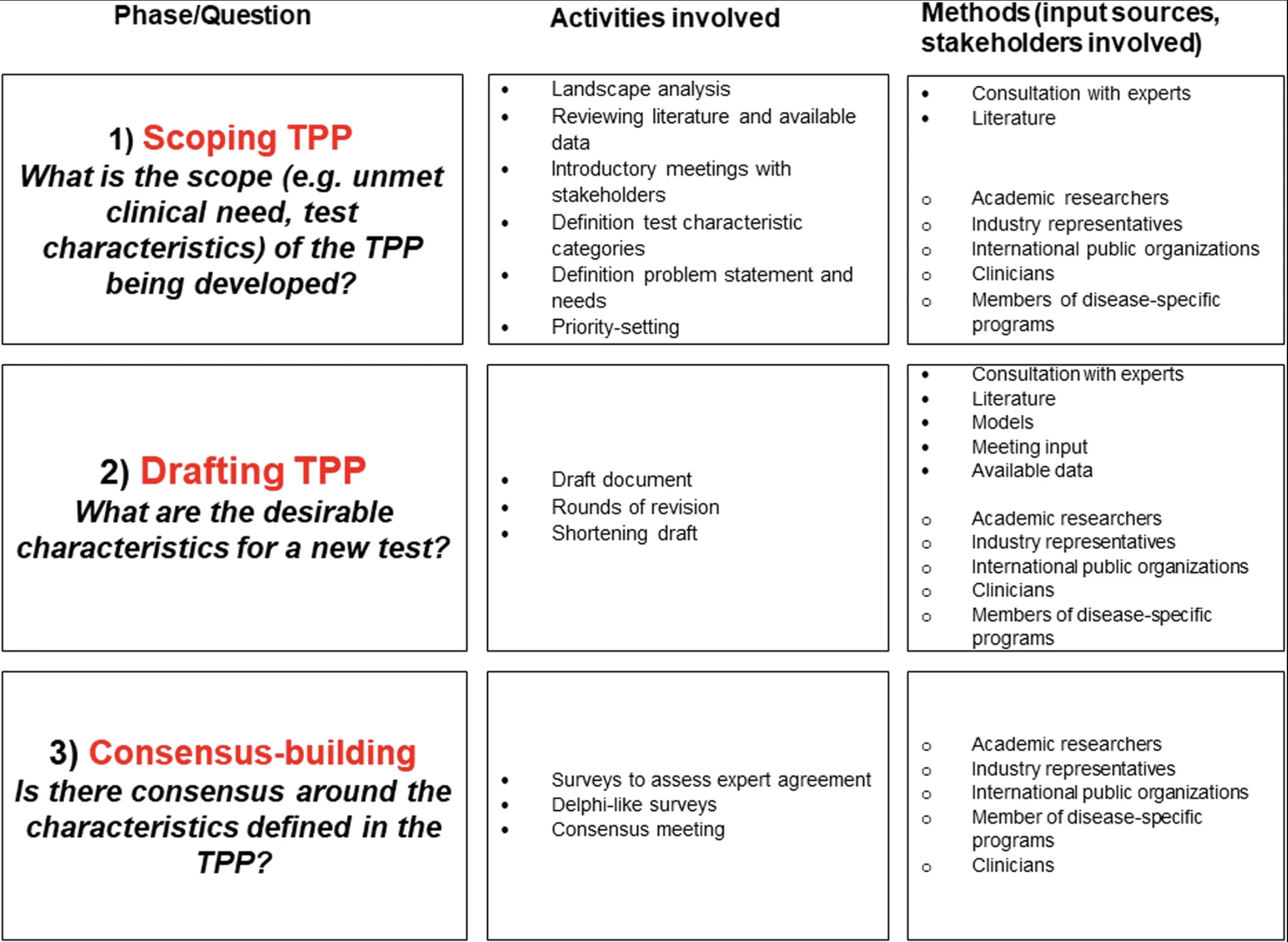
What does the TPP development process look like? The development process itself is critical in fostering a valuable and stimulating discussion between stakeholders. A systematic review conducted by Cocco et al. surfaced three distinct phases for TPP development: scoping, drafting, and consensus-building.
An overview of the activities and methods involved in TPP development | By Cocco et al.
Emerging scientific fields face make-or-break challenges during their early development, when key decisions can determine their long-term trajectory. This playbook identifies levers for catalyzing and influencing field creation to increase the likelihood of success and impact.
Field building refers to a process where a set of individuals and organizations work to address a common challenge that is of sufficient magnitude to necessitate a paradigm shift, and their actions unlock a field’s progress for impact at scale. Fields traverse a life cycle with four stages: latency, growth, maturation (or peaking), and institutionalization (or decline).¹ Emerging ideas at the latency stage are ripe for field creation, where the needs may be distinct from those at later stages.
While there are developed field building methodologies in philanthropic circles, it is not well recognized as a practice amongst many traditional scientific practitioners. Scientific field creation – often the earliest stage of field building – presents a strategic leadership opportunity to unlock broader scientific progress and create a foundation for future work. This can be particularly valuable in emerging fields that are high-risk, high-reward, non-traditional, or require a diversity of actors. New scientific fields are ripe for discovery, where there can be “...golden ages, with fundamental questions about the world being answered quickly and easily.”
The Play:
Creating a scientific field requires early, intentional investments in three key elements:
Actors: Identify and engage the key stakeholders needed to holistically accelerate progress and foster them to succeed, while recognizing that early actors may play a different role than late actors.
Connective tissue: Activate, build, and nurture an ecosystem centered around a shared knowledge base, with the elasticity to evolve and weather controversy.
Resources: Provide risk-tolerant funding that is responsive to rapidly evolving needs, early experimentation, and offers stability as the field takes shape, particularly while there may be stages with scattered or sporadic impact.
Successful scientific field building can:
Rapidly expand the set of key stakeholders contributing to a field
Enable interdisciplinary progress, because many new fields emerge from the intersection of existing scientific disciplines
Develop a strong, trusted scientific base in emerging areas
Edit: The match seems to now be over - the funds were expended in around 35 minutes. But many of these charities are great and should be supported regardless!
***
On October 22nd starting at 10:00am Pacific Time, Every.org is matching donations to select animal welfare organizations at a 2:1 rate, up to $2,000 per donor per nonprofit (so if you give up to $2,000, they will contribute up to $4,000 and the nonprofit will get up to $6,000). The first donation a donor makes to each el...
Crossposted to Less Wrong
‘Like most of life’s dangers, the dangers of artificial intelligence are not easily identified from the armchair.’
J Dmitri Gallow
Epistemic status
I’m not an expert in this field, and herein I make some sweeping generalisations educated guesses about the overall...



Executive summary: Renaissance Philanthropy presents ten open-source “Playbooks” as practical frameworks to help philanthropists translate ambitious, counterfactual goals into coordinated, high-leverage action across science, markets, and policy.
Key points:
This comment was auto-generated by the EA Forum Team. Feel free to point out issues with this summary by replying to the comment, and contact us if you have feedback.