Comments
Summary: Many charitable causes that Effective Altruists have identified as “highly effective” are not things that the median American cares enough about to donate. While people can occasionally be persuaded to donate to global health and development, most do not regularly give to animal welfare or GCRR charities. However, the current US political environment is emotionally salient amongst liberal Americans, and it has the potential to create a substantial negative impact that lasts long into the future. These factors create a unique opportunity for American EAs to convince their family members to make high-impact donations, so I have written an easy-to-use email draft designed to inform and persuade a non-EA audience.
Additional Note: The "impact estimations" in this essay are written with college-age EAs in mind. Still, many of the points are more broadly applicable.
1. High impact in lost hours
Here’s my rough ordering of the most impactful ways to spend an hour[1]:
- Cause prioritization (if you haven’t spent a lot of time thinking about it)
- Random, lucky events that give you special opportunities to do what you want
- Convincing more people to become EAs or running an EA group
- Rare, small, high-impact projects
- Career research (if you haven’t done a lot of it)
- Building career capital
- Working a highly impactful job or earning to give at a high-wage job
- Earning to give at a low-wage college job
Many items on this list require long, continuous blocks of time to complete. Career research and cause prioritization often mean sitting down to read long articles and take careful notes. Running an EA group means attending club meetings and thinking about organizing for continuous stretches of time. Many jobs require employees to maintain their shifts for a few hours at a time. And many of these opportunities aren’t easily available to university students on a school day!
On top of this, life isn’t naturally broken into long stretches that can be used for whatever high-impact activity you want. Our days are filled with gaps I call “lost hours”: time that’s not good for much beyond scrolling Substack or sending a few texts. Normally, your impact in these lost hours is close to zero. However, these times can occasionally be used to complete short[2], high-impact projects, like sending valuable emails. One of the most impactful emails you can write is asking your family members to donate to a high-impact cause they care about.
The math here is simple: much of your time can’t be spent doing impactful things[3], even if you really want to spend your time that way. For example, much of your time is spent on the toilet[4]. However, if you also spend that time[5] sending several richer family members a sincere and compelling proposal to donate to a high-impact cause they already care about, you can increase your impact by several orders of magnitude.
It has recently been argued that, due to the US’s current political climate, donating to moderate candidates in contested states could be highly effective. While you may believe that animal welfare or AI safety is the most important thing to fund at this time, much of your family is likely unsympathetic to those causes. However, your liberal family members may be willing to donate to political candidates. By convincing otherwise disinterested people to donate to a highly impactful cause, you can have an enormous counterfactual impact.
2. “The thought of asking my family for money makes me want to vomit.”
In general, I think this gut reaction is more extreme than justified. What’s the worst-case scenario here? If you send an email to your family, anyone uninterested will likely ignore it. Perhaps your name will become more associated with politics, and maybe the next family gathering will have slightly more political discussion.
Compare this with the expected benefit of doing this. If you send an email to 10 family members, and even if only one follows through, you’ve still caused a decent sum of money (perhaps $100?) to go to an effective cause. The good from this seems far greater than any potential annoyance that arises from the interaction.
Despite the imagined worst-case scenario, in practice, many families will be interested in hearing what their nieces/nephews/cousins/grandkids have to say. Perhaps my family is disproportionately nice[6], but when I messaged them about this, I received generally compassionate responses.
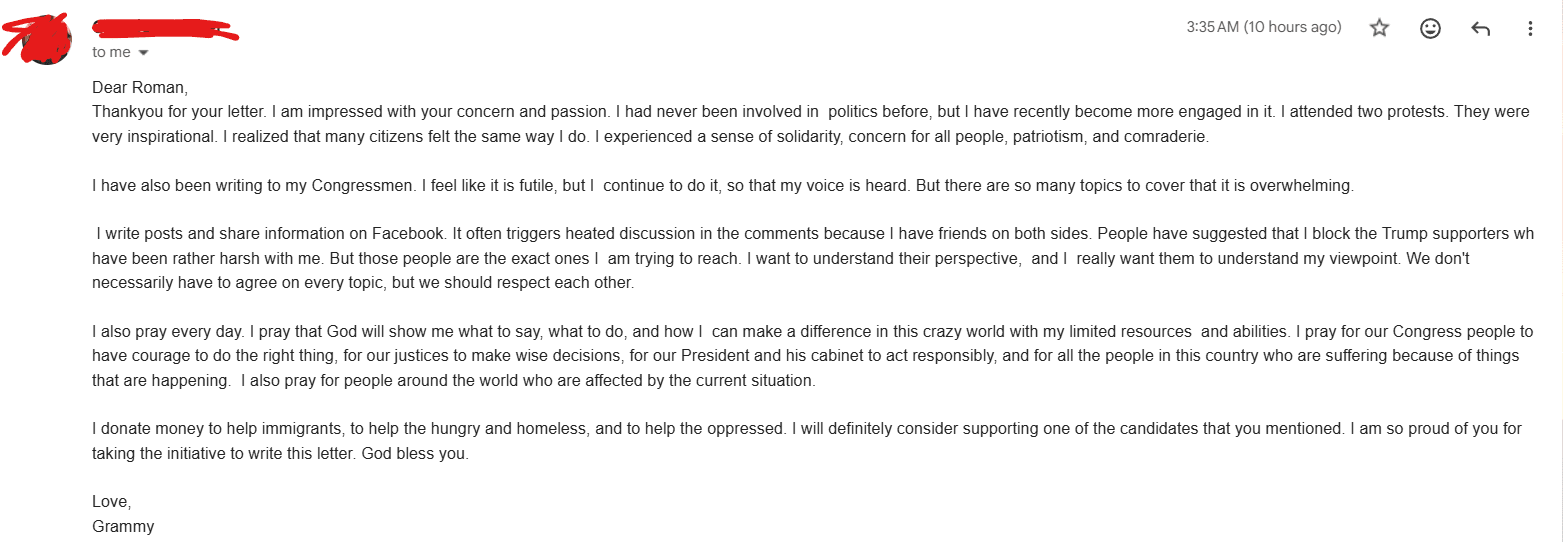
Love you too, Grammy
It can be a little scary to send out an email asking for what feels like a lot, but when it works out, it feels very rewarding. It’s also a good exercise in agency.
3. “Some of my family members are conservative and wouldn’t listen.”
Then don’t ask those family members for money.
4. “What should I say to them?”
To make this process as easy for you as possible, I’ve written an email draft[7] that, with a few minor adjustments[8], you can easily send to concerned family members.
5. Conclusion
You should take a small amount of time to ask your family to donate to effective causes because it's a good, one-off opportunity to increase your impact a significant amount.
- ^
Impact doesn’t necessarily need to be measured from a utilitarian perspective here. As long as you think more good is better than less good, conventionally good things are good, and expected value (even a modified, non-fanatical version of EV) is a good way to make decisions, this probably holds.
- ^
Technically, asking your family for donations doesn’t have to be a short event. You can do this over and over again if you want! However, you can probably expect to experience some pretty extreme diminishing marginal returns.
- ^
This isn’t to say that you need to optimize every second of your life to be maximally good; that is unhealthy. In general, though, I get the sense that many of my peers have room to do more with their time.
- ^
At the margin, using the toilet may be somewhat counterfactually impactful. UTIs, hemorrhoids, and bladder damage seem bad!
- ^
Note: You don’t actually need to be sitting on the toilet to do this
- ^
I like to believe they are, but I recognize that might make my rhetoric less compelling
- ^
This draft and its informational content were heavily inspired by Ozy’s forum post on the same topic. In fact, I probably wouldn’t have done this if it weren’t for their post! The writing is all mine, though, and I included additional information about the candidates to help my family make decisions.
- ^
Insert your own name, include your own personalized paragraph, and maybe change the tone in a few places
4


This post seems to have a liberal bias. It references a previous post that argues that "donating to moderate candidates in contested states could be highly effective." It then exclusively appeals to liberals:
And assumes conservative family members wouldn't be interested in donating to moderate candidates or effective causes.
I recognize that, in practice, there is a real and important difference between pro-Trump conservatives and anti-Trump conservatives, and anti-Trump conservatives also may be willing to donate to these political causes. However, I specifically chose not to elaborate on this as part of my piece for two reasons:
I apologize if this made it sound like I thought that conservatives are a wholly evil and homogenous group. I promise that this is not the case.