Comments
Pedantic comment: the word 'tithe' means 'tenth,' so '20% tithe' is a little bit counterintuitive.
Pedantic comment: the word 'tithe' means 'tenth,' so '20% tithe' is a little bit counterintuitive.
I think most EAs share these premises with you:
1. Some people live in relative material abundance, and face significant diminishing returns to having more material wealth.
2. However, many problems remain, including poverty and catastrophic risk.
3. It would be valuable for funds to go towards reducing these problems, and thus quite valuable to successfully spread values that promote donating towards them.
You also make a couple of interesting claims:
4. We can feasibly cause a 'paradigm shift' in values by convincing people to tithe.
5. The benefits of changing society's values in this way don't depend on us spreading norms around effectiveness, or encouraging donations to effective charities in particular.
which I'm tentatively interpreting as
5A. We should focus on a moonshot-like attempt to paradigm-shift society via promoting tithing to any cause, rather than incrementally spreading effective altruist ideas, because the expected value of effort spent on the former is higher.
Could you explain why you think these are true?
On 4, I think the fact that the donation rate has remained steady, despite the existence of many large charities with competent fundraisers who'd love to increase it, provides some evidence against this being easy. As does, you know, human nature.
On 5, I'm not sure what mechanism will channel within-US donations to benefits in the developing world, or to animals or x-risk. I assume the idea is that people will get less selfish and more altruistic? If you mean 5A, I agree that this mechanism will probably kick in eventually, but then I'm back to asking about feasibility.
Hey all! (Sorry for the annoying title :)
The goal of this post is to outline why Effective Altruists should up-prioritize "tithing"—self-taxing oneself to give to nonprofits/civil society. To give you an anchor from the EA world, you can think of this claim some variant on:
I'll detail my overall argument below (taken from my longer, more "general audience" article which also includes an explanation of my 20% post-tax tithe). Then, at the end, I'll propose some open questions at the intersection of tithing, macro systemic change, and Effective Altruism. If you're bored with the middle, just skip to those questions at the end! One final note: this train of thought is pretty rough around the edges, so I'd love your critical feedback on it. Thanks!
We’re all exploring the idea maze around the question—“How can I have a large positive impact on the world?” After exploring the maze for the past year and a half, I’m strongly in favor of “Universal Tithing”—a “global tax” where everyone gives a percentage of their income to charity/civil society. I think it has powerful emergent properties (and should be prioritized more).
But why? I like to think from the perspective of playing a game. When you begin to play a game, you:
Universal Tithing is a strategy given how I understand the goal+rules+context of the game. For our current technosocietal context, here is how I see the game:
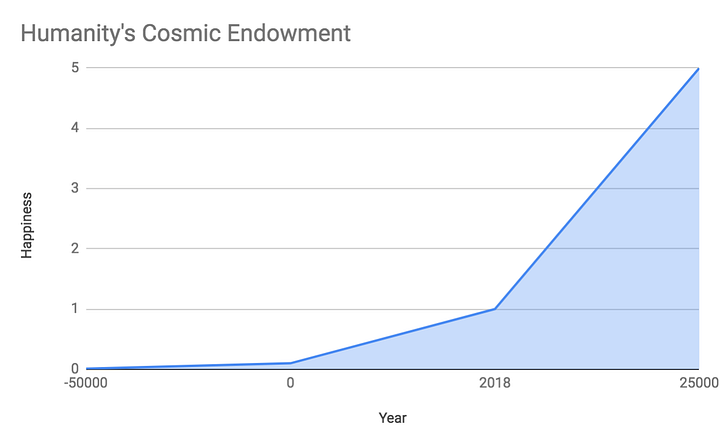
Goal: Maximize humanity’s cosmic endowment—try to make as many people “happy”, including those in the future.
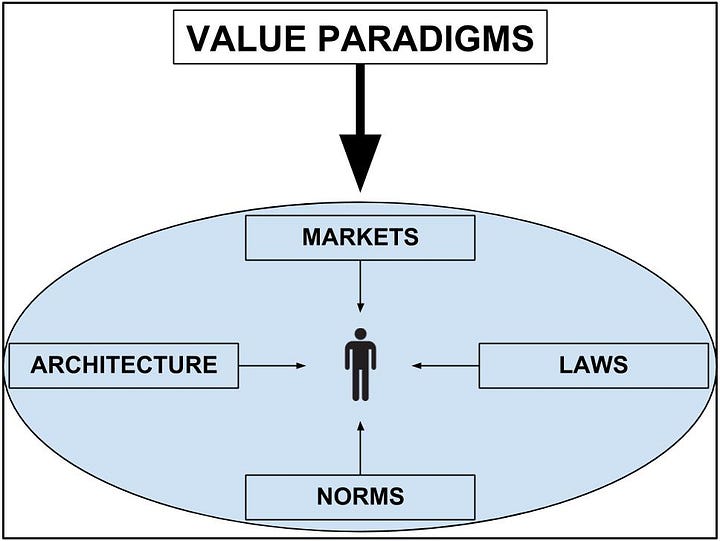
Rules: Aside from physical laws, I think the most helpful way to understand the rules of the game is through systems thinking. More specifically, Value Paradigms (in the Donella Meadows’ sense) are the place of highest leveragewithin a system. You can imagine them as one level above Lessig’s pathetic dot. (i.e. Value Paradigms are manifest through markets, architecture, laws, and norms.)
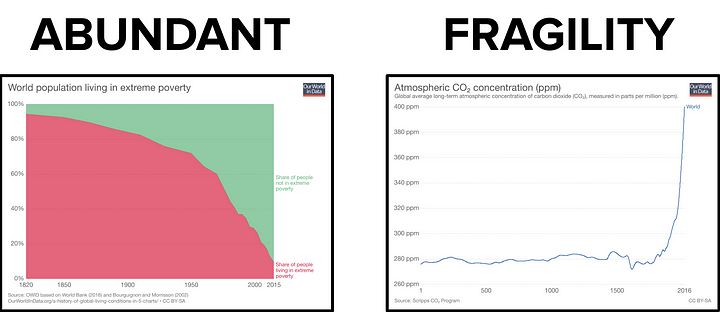
Context: This answers the question—where are we in time? i.e. What is our current global situation, in 2019? We exist in Abundant Fragility. (Things are so much better than 200 years ago and our exponential curves may deeply hurt us.)
Strategies: There are a variety of strategies that folks are attempting to deploy (both at the Value Paradigm level and at the Lessig Dot level). I’m proposing Universal Tithing as a high-impact strategy.
To conclude this in one sentence, I’d say:
Given our macro goal of Maximizing Humanity’s Cosmic Endowment, our 2019 context of Abundant Fragility, and the leverage of Value Paradigms to change systems…I propose Universal Tithing as a high-impact strategy.
Universal Tithing is the idea that (essentially) everyone should give a percentage of their income/wealth to charity. I like to think of it as a variant on taxes. Taxes are a process instituted by nation-states where the government decides how much you give and to whom. Nation-states enforce taxes through law (if you don’t pay your taxes you go to jail). On the other hand, Universal Tithing is a giving process instituted by individuals, enforced by social Norms rather than Law. In short:
Another way to think about Universal Tithing is “what does the money fund?”
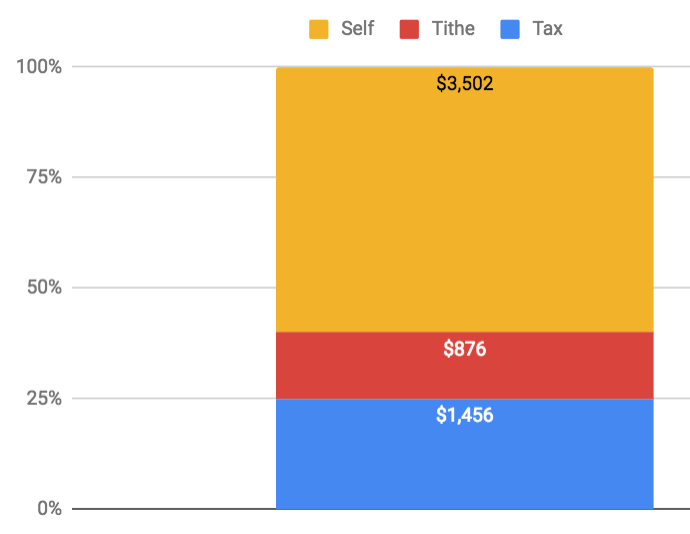
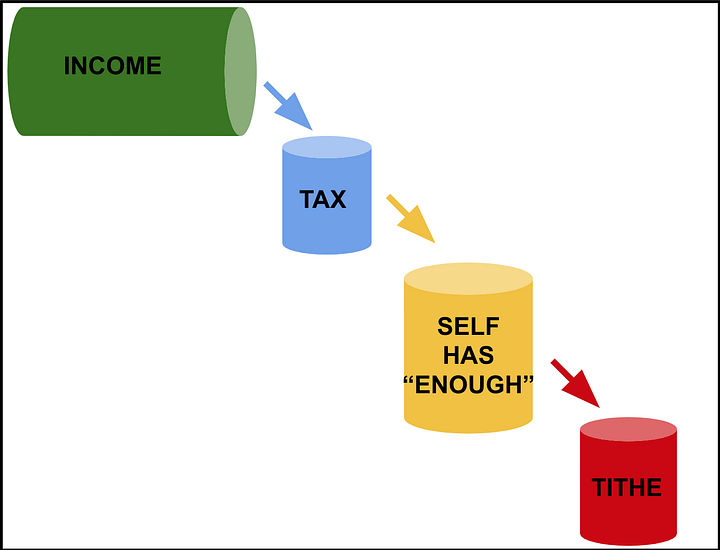
A final way to think of Universal Tithing is: “Of all the money I make/take as input, how much of it goes to Self vs. is Taxed vs. is Tithed?” For example, I make $5,834/month. Of that, 25% ($1,456) is Taxed and 15% (20% post-tax, $876) is Tithed.
There are a couple proto-examples of Universal Tithing (UT) in the world. Most of them come from the Effective Altruist movement, where folks pledge a percentage of their income to charity (FoundersPledge, Giving What We Can Pledge, TLYCS Pledge). e.g. GWWC’s mission is “A world in which giving 10% of our income to the most effective organizations is the norm.” But there are also non-EA organizations like The Awesome Foundation (which has a bunch of city chapters that give out $1,000 grants each month).
UT is an optimal strategy right now for two reasons:
Let’s look at the 1st point—that UT creates a new positive feedback loop. I like to think of this loop as “Stage 2” of a Positive Sum world. Let’s contrast it with Stage 1—“Buyer-Seller Positive Sum Capitalism”. This is what they call the Double Thank-You of Capitalism, “the observation that, when a merchant and a customer exchange money for goods, each thanks the other, showing that the transaction is not only voluntary, but mutually beneficial.” This occurs at the micro level (buyer-seller) and at the macro level (global trade with importer-exporter). Nassim Nicholas Taleb also expresses a similar idea in Antifragile: “Perhaps the idea behind capitalism is…: the system facilitates the conversion of selfish aims (or, to be correct, not necessarily benevolent ones) at the individual level into beneficial results for the collective.” It’s tough to remind ourselves of this, but Stage 1 Buyer-Seller Positive Sum Capitalism is a relatively recent addition to humanity (starting with initial trade, then money-facilitated trade, then an Industrial Revolution + Globalization-fueled world market).

I think of Universal Tithing as a “Stage 2” Positive Sum Game because its mechanics are categorically different from the buyer-seller mechanics in capitalism (and Stage 1 Positive Sum Games). At a high level, here’s the idea:
2. We can give our extra money to poor folks to release them from their scarcity mindset and help us solve long-term problems.
I like to think of it as an overflowing series of cups, where, once one has “enough”, they can tithe to support others in civil society.
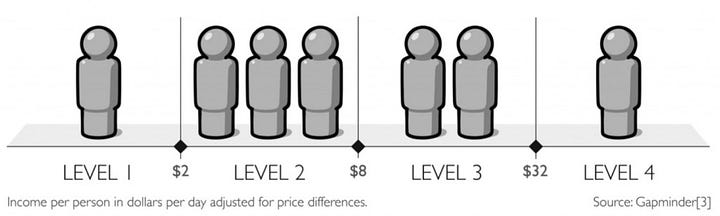
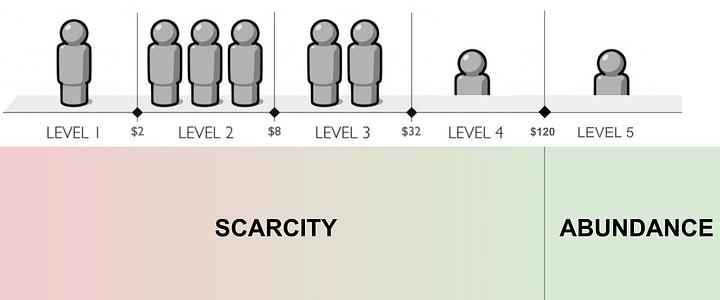
Let’s look a bit deeper at the idea that “We Have Enough” through the lens of global income. In Factfulness, Hans Rosling breaks down the global population into 4 levels based on income. The one billion people on Level 1 make $0–$2/day. The three billion people on Level 2 make $2–$8/day. The two billion people on Level 3 make $8–$32/day. And the one billion people on Level 4 make more than $32/day. This is all expressed in the simple picture below:
True “enoughness” though is expressed by saying that those who make over $120/day (~$44,000/year) don’t get measurably happier when they make more money. We can think of the folks who have passed this point as existing on “Level 5: Abundance”. (Or Level 5: Enough.)
This “enoughness” means that you’ve essentially “reached the limit” of Stage 1 Buyer-Seller Positive Sum Games. i.e. You can’t buy/consume/accumulate much more that would actually increase your happiness.
This “extra money” allows you to begin to play the 2nd game: to help poor folks “level up” so they can help you solve more long-term problems. This is the idea that “The more people that want the same thing you want, the more likely you are to get it.” Giving to Level 1 folks would make me happier because it helps them be more like me (Level 5), increasing the supply and demand for things I want. (If you want to learn more about this, I highly recommend this quick 7min video from Kurzgesagt.)
Here’s a graph of what that looks like on a world scale. Each stick figure represents 1B people. Green represents Level 4 folks and red represents Level 1–3 folks.
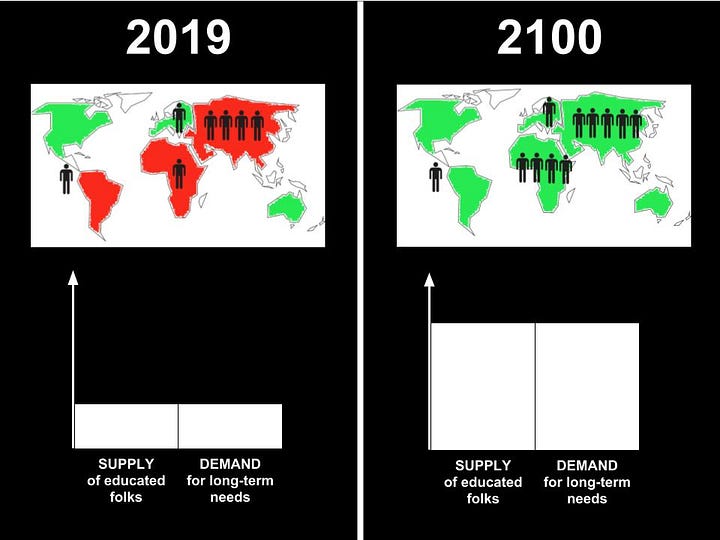
Although this graph is relatively general (it only looks at the continents, billions of people, and two kinds of income buckets), I think it tells a crucial story. Right now, in 2019, we don’t have many Level 4 folks (and they primarily live in Europe and North America), while we have billions of people at Level 1–3 in Africa, Asia, and South America. In this scenario we don’t have great dynamics for “long-term alignment on needs” because there aren’t that many Level 4 folks! (So there are a bunch of Level 1–3 folks who we’d love to help us with stopping climate change, curing cancer, etc., but they’re stuck worrying about their basic needs.)
The hope is that by 2100, we’ll have Level 4 (and Level 5) folks almost everywhere. Imagine a world with almost all educated folks who are aligned around the long-term future of humanity. In other words, we hope the “income levels over time” graph looks something like this:
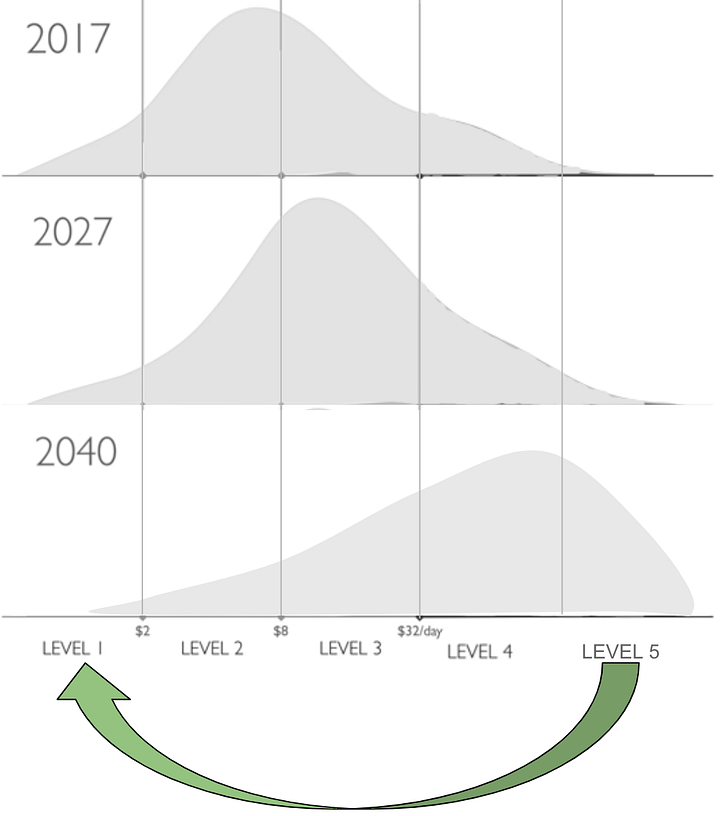
If many Level 4s and 5s actually give, this kind of “mass giving” would be a drastic departure from our current day. Right now, most developed countries donate less than 1% of their GDP to charity (see Graph 27 here). For example, the United States has consistently donated 2% of GDP to charity over the last 50 years:
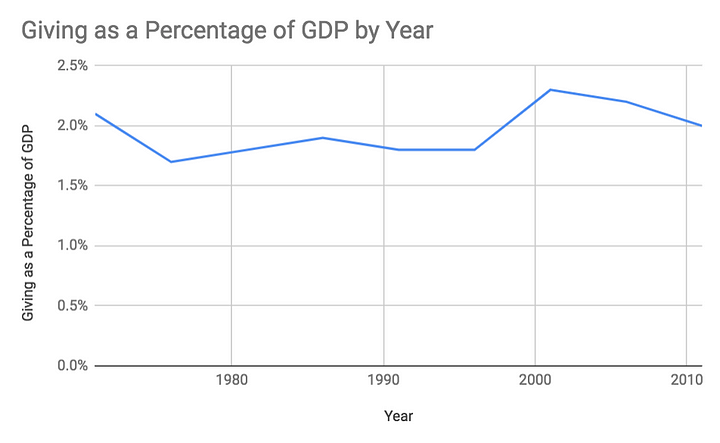
This 2% number has stayed constant even as GDP per capita has risen from $24,400 to $53,000. Wouldn’t you think that, as people get more money (and reach “enoughness”), that they would give a higher percentage of their wealth? Our giving habits haven’t caught up to our level of abundance. The hope is that more Level 5 folks will give, extending the graph above to look something like this as we head towards 2040:

(Or, alternatively, you can think of this in comparison to the federal budget. Right now the U.S. government spends $4T per year and citizens give $400B per year, or 10% of federal spending. Is there a future in which that number is more like 25% or 50%?)
One final way that I like to think of this mechanism is in terms of “return on investment” (ROI). Universal Tithing is a form of “Indirect ROI”, which is different than traditional “Direct ROI”. With Direct ROI, we invest money and get more money in return. Within Indirect ROI, we give money and receive “happiness/meaning” (not financial capital) in return through the supply/demand dynamics described above.

To conclude: now that Level 5’s exist, the best way for them to maximize their happiness is by giving to Level 1’s so they can help us solve humanity’s long-term problems.
In addition, the Universal Tithing process also changes our mindset/values/paradigm. i.e. The action of tithing creates a feeling of abundance in our minds. I’m not sure the best way to describe this, and it’s a bit less well-defined for me. However, here are some starting thoughts:
This idea (obviously) has a lot more fleshing out to do. But the crucial nugget is this—creating a culture of giving is as much about the culture as it is about the giving.
(Note: in addition to the points above, Universal Tithing has a couple other systemically positive properties. However, these ideas aren’t crucial, so I’ve extracted them into a sub-article here. The summary of that article: UT acts as a “synergistic satisfier”, forces individual responsibility, solves the abstracted job-to-be-done of civil society + government [public goods], and helps us solve other emergent problems.)
Hope this is a helpful overview of some of these thoughts! I would truly appreciate your brutal/honest feedback. If you'd like to learn more:
Thanks!
Edit: Thanks to Stefan Schubert for correcting my use of "cause neutrality" (which has this specific meaning in EA). I have removed the direct references to cause neutrality and replaced them with my intended meaning: "non-QALY impact-optimized giving" (or, in Ian David Moss' language, "domain-specific EA"). Thanks for the clarification, Stefan!



You seem to be using the term "cause neutral" in the sense that "all causes are EA causes" (you link to a post by Ian David Moss with that title, seemingly approvingly). However, this is confusing because the term "cause neutral" is usually used for the opposite notion: that we should select causes based on impartial estimates of impact, and not invest in low-impact causes. (Also, note that Moss seems to use the term "cause neutral" in the latter sense, rather than in your sense.)
See this post for a discussion of the notion of cause-neutrality.
Woof! Thanks for noting this Stefan! As you say, cause neutrality is used in the exact opposite way (to denote that we select causes based on impartial estimates of impact, not that we are neutral about where another person gives their money/time). I've edited my post slightly to reflect this. Thanks!