Comments
This may be a bit of a conceptual vs purpose difference, but I would certainly not put insects as a good alternative even on simple moral grounds. Eg, it is likely not the type of alternative protein I'd be looking for.
This may be a bit of a conceptual vs purpose difference, but I would certainly not put insects as a good alternative even on simple moral grounds. Eg, it is likely not the type of alternative protein I'd be looking for.
Thanks for your comment! Personally, I wouldn't consider insects as a desirable alternative protein either, especially on moral grounds. However, they are very frequently included in the scientific literature on alternative proteins, and I think that's actually part of the value of this paper: by explicitly incorporating the ethical dimension (alongside environmental, scalability, and consumer acceptability criteria), it helps highlight why insects stand apart from other alternative proteins in ways that a purely environmental or technical comparison would miss.
More broadly, the paper shows that insects are not a desirable option compared to other alternative proteins across most dimensions considered. I think this also constitutes a good argument for no longer including them in this category, as is still commonly done in the current literature.
Executive summary: In this scoping review, the author argues that when alternative proteins are compared across environmental impact, scalability, consumer acceptability, and animal welfare, plant-based meats clearly deserve priority, single-cell proteins are promising but uncertain, cultivated meat remains constrained by severe scaling and energy challenges, and insects appear least promising despite common assumptions.
Key points:
This comment was auto-generated by the EA Forum Team. Feel free to point out issues with this summary by replying to the comment, and contact us if you have feedback.

Last year, I shared on this forum my growing skepticism about cultivated meat and the case for being more critical about where we direct resources in the alternative protein space. That post focused specifically on cultivated meat but the broader question behind it, one I had actually started working on before writing that post, is: if we look at the full landscape of alternative proteins, which ones actually deserve priority?
This question matters because, as with any cause prioritization exercise, resources are limited. Every dollar, every policy push, every year of R&D directed toward a suboptimal alternative is a resource not spent on a more promising one.The recent collapse of Ynsect despite €600 million in investment is a painful example of misallocated resources in the French alternative protein landscape, but the problem runs deeper than individual company failures. If we systematically back the wrong horses, we slow down the entire protein transition, and with it our ability to act on climate change and animal welfare.
This kind of prioritization thinking, which I'd say was directly inspired by EA principles, led me to write a scoping review that was recently published in npj Science of Food. The rest of this post summarizes what I found. I'll try to keep it accessible and self-contained, so you shouldn't need to read the paper to follow along, though the full text is open access for those who want the details (note: the final formatted version isn't out yet, so you'll need to download the PDF to read the paper).
Two issues plague the existing literature. First, when alternative proteins are compared to each other, it's usually on a single dimension. But evaluating alternatives on just one criterion can be deeply misleading. To take a deliberately absurd example: Soylent Green would score remarkably well on environmental metrics, since it repurposes resources (human corpses) that would otherwise go to waste. Yet I suspect consumer acceptability would be somewhat low, and scaling up production would raise a few ethical concerns. More seriously, a product with excellent environmental credentials but no viable path to scale, or that consumers simply refuse to eat, has no real transformative power. Second, alternatives are mostly compared to conventional meat rather than to each other. This is a bit like evaluating job candidates solely against the worst employee in your company: almost anyone looks good by comparison, but it tells you very little about who you should actually hire.
In the paper, I try to address both problems by comparing four categories of alternative proteins (plant-based meats, cultivated meat, single-cell proteins, and insects) across four dimensions: environmental impact, production scalability, consumer acceptability, and animal welfare.
If you're the type to read the last page of a novel first, here's the ending:
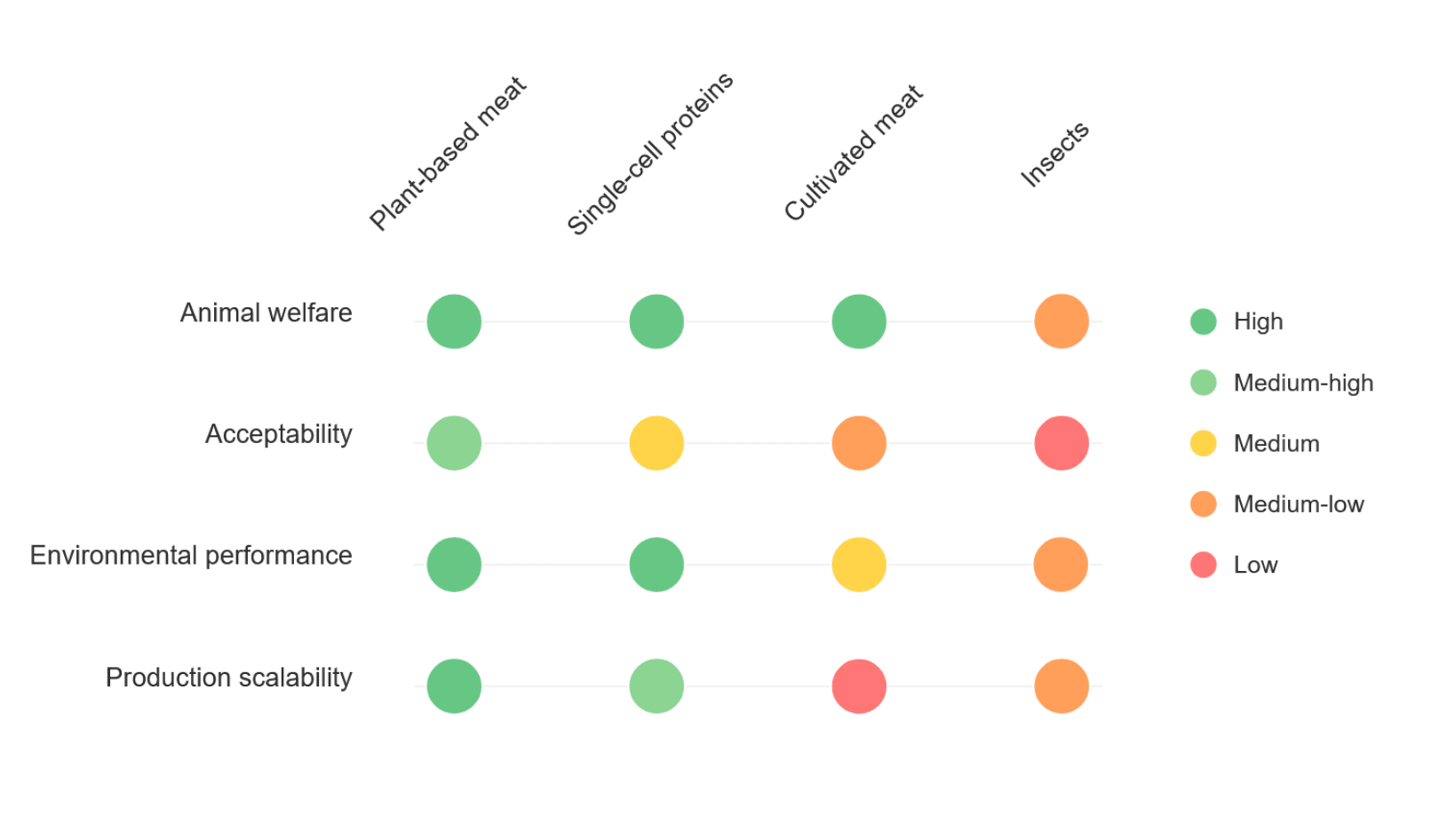
Plant-based meats come out ahead across nearly all dimensions. They have the most established production infrastructure, the strongest and most empirically grounded environmental profile, the highest consumer acceptance among novel alternatives, and obvious animal welfare advantages.
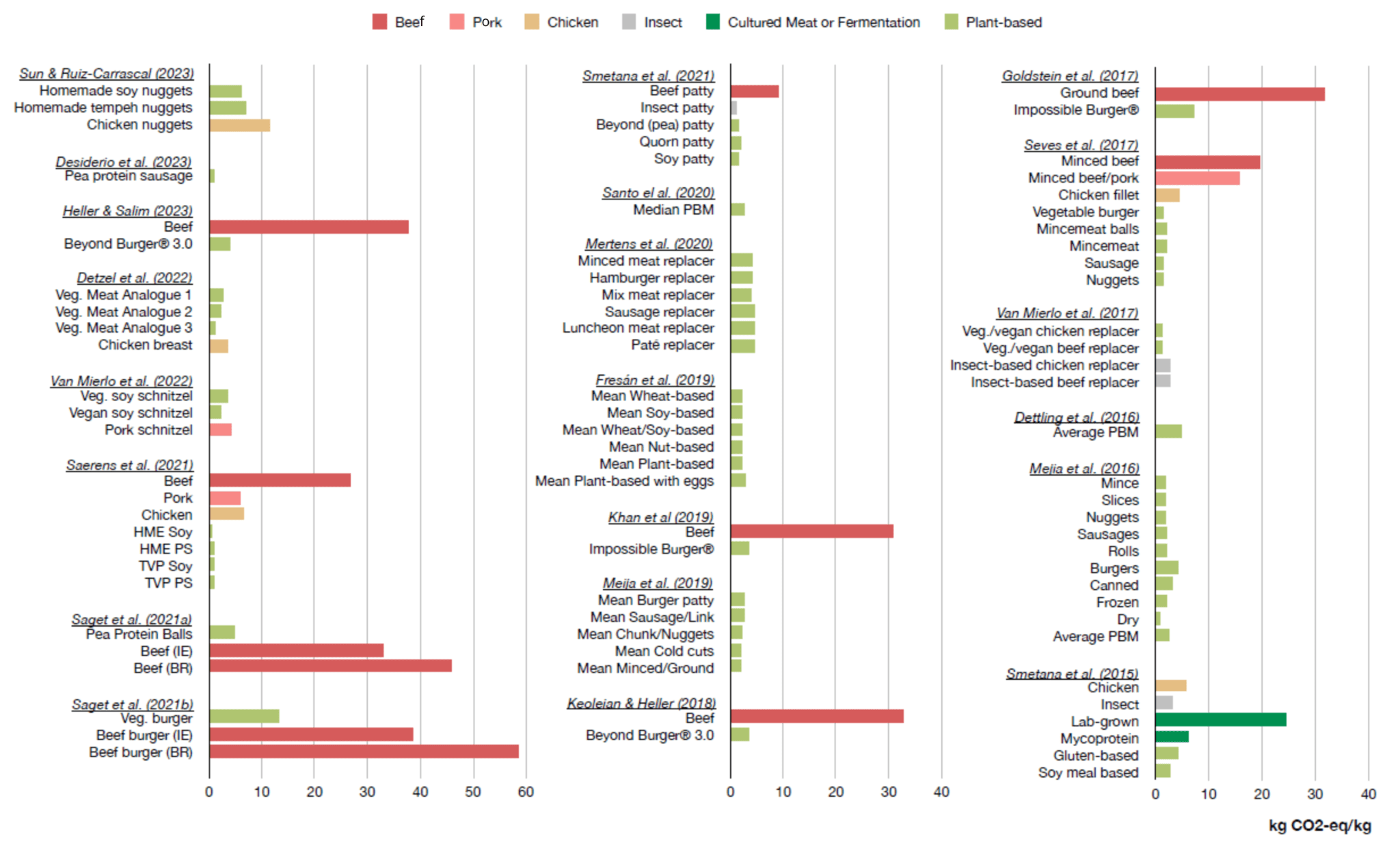
On the environmental side, all available LCAs show lower greenhouse gas emissions than conventional meat, with the gap being largest for beef (up to 10x less). Land use requirements are also dramatically lower, which matters not just for its own sake but because land spared from animal agriculture could support ecosystem restoration and carbon sequestration.
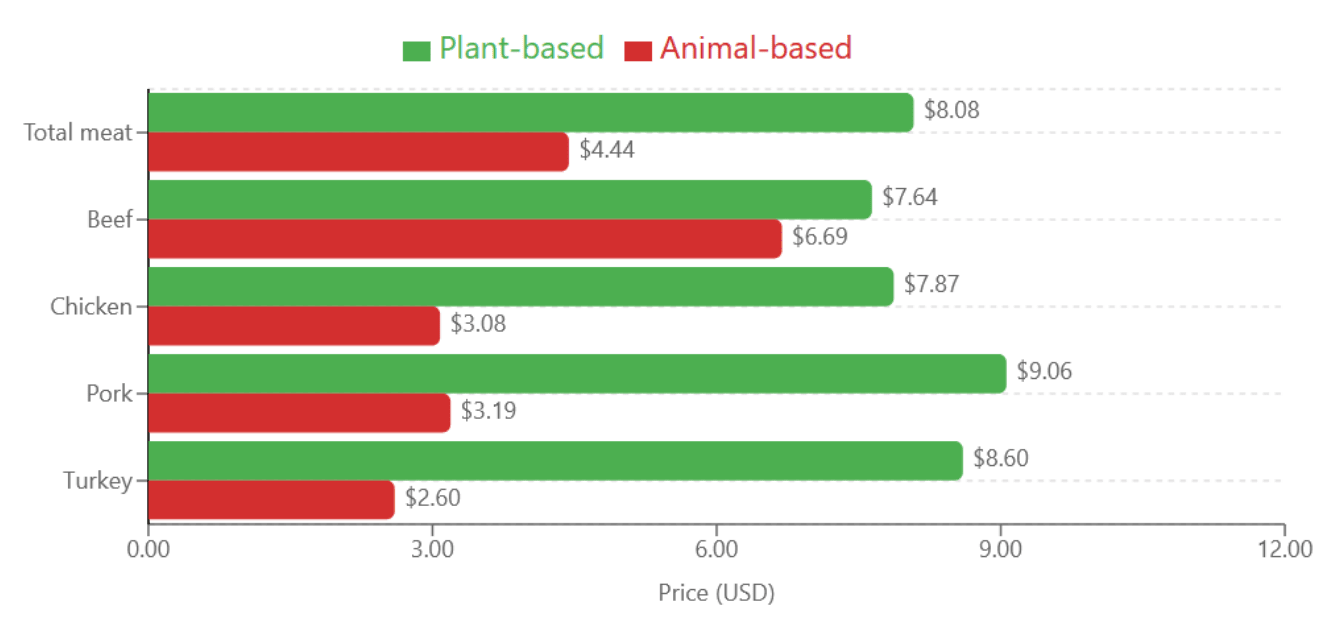
This doesn't mean plant-based meats are without challenges. Taste and price remain real barriers. In 2024, plant-based meats still carried an average price premium of 82% over conventional meat by weight. And the recent market slowdown shows that growth isn't guaranteed. But these are problems with known pathways to improvement: better formulations, economies of scale, new crop varieties. The fundamentals are sound.
Single-cell proteins are the second most interesting category. Mycoproteins (think Quorn) have been on the market for decades and show very low land use requirements compared to both meat and plant-based alternatives. Their climate impact is generally equivalent to or lower than chicken.
The more speculative but potentially exciting subcategory is power-to-food, which converts CO2 into protein through electrolysis and microbial fermentation. On paper, the numbers are striking: 10-50x less land and 50-100x less water than soybean production, with potential emissions as low as 0.81 kg CO2-eq/kg protein. But these figures come from models, not from existing products, and the whole approach is heavily dependent on cheap renewable electricity.
Consumer familiarity is low, which makes acceptability hard to assess. The few available studies show moderate enthusiasm, somewhere between plant-based meats (higher acceptance) and cultivated meat (lower acceptance).
Much of what I wrote in my previous post still holds up. The scalability challenges remain severe: replacing just 1% of the US beef market would require capital investments estimated between $1.6 and $5.5 billion, and bioreactor capacity roughly 22 times that of the global pharmaceutical industry. Cost estimates from published techno-economic analyses range from $17 to $437,000 per kilogram depending on assumptions. There has been some encouraging empirical progress, with a hybrid product (50% cultivated, 50% plant-based) reported at $13.67/kg, but the path to scale remains long.
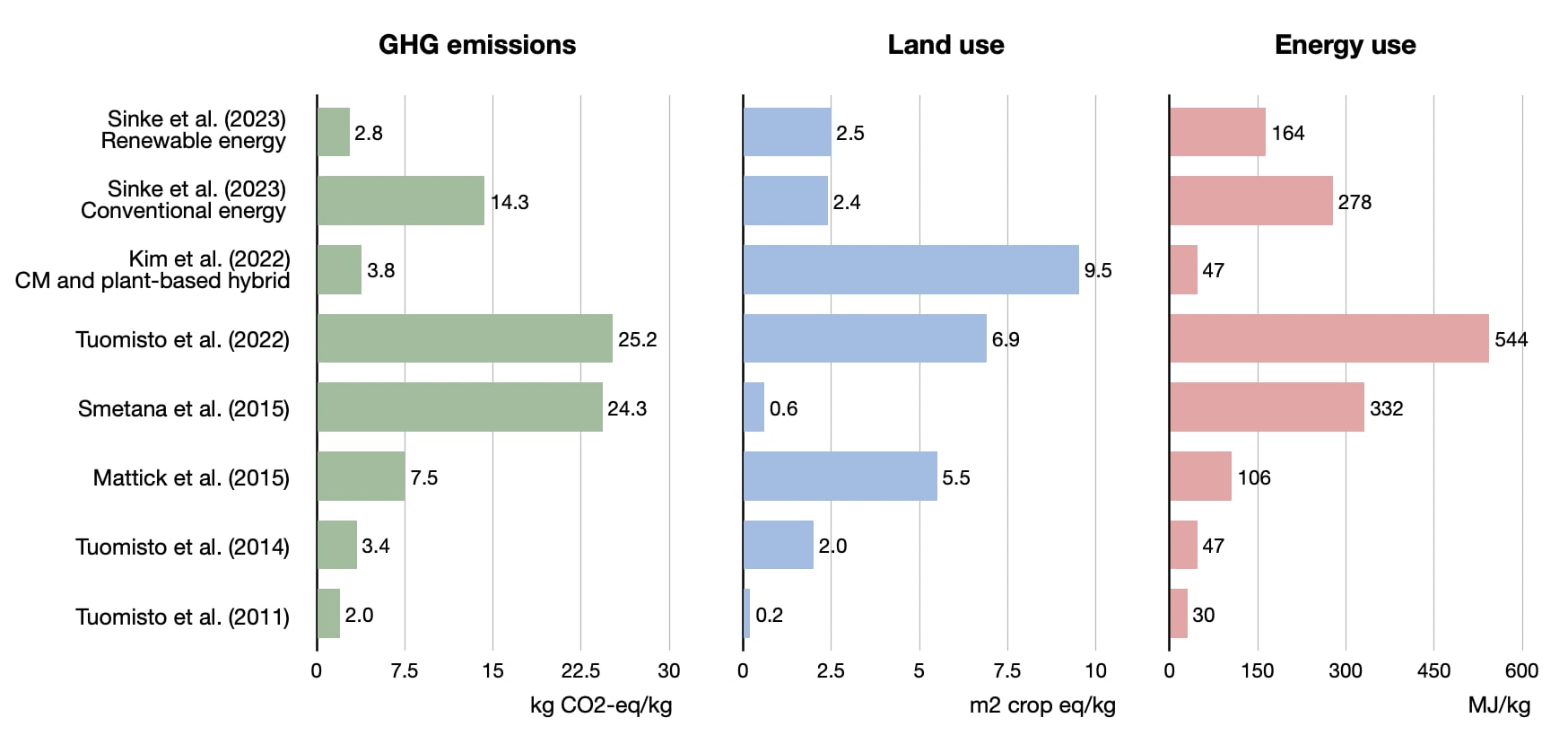
On the environmental side, cultivated meat's performance is heavily dependent on energy sources. With renewable energy, it outperforms beef and can compete with chicken and pork. With conventional energy, it performs worse than chicken due to its massive energy consumption (roughly 5.5x conventional meat). Water use is actually higher than for chicken, pork, and beef from dairy cattle in some assessments.
The cannibalization concern I raised last year hasn't been resolved either way. Some studies show substantial overlap between consumers interested in cultivated meat and those already open to plant-based alternatives, which raises the possibility that cultivated meat could primarily displace plant-based options rather than conventional meat. But we still lack sufficient empirical evidence to settle this question, and it remains one of the more important unknowns in the field.
This is probably the finding that will surprise people most, and one that I think will be of particular interest to this community given the animal welfare implications.
The environmental benefits have been overstated. Early studies relied on optimistic assumptions about using food waste as substrate, but this has proven difficult in practice. EU regulations prohibit roughly 70% of available food waste as insect farming substrate. More recent assessments using realistic production parameters, including heating requirements in temperate climates and reliance on conventional feed, show emissions of 12.9-30.1 kg CO2-eq/kg protein for black soldier fly larvae. These figures are lower than beef but not clearly better than chicken or pork. For a more detailed examination of the environmental limitations of insect farming, I'd point to several other papers I've co-authored on the topic, including Biteau et al. (2024) in Sustainable Production and Consumption, Biteau et al. (2025) in Biological Reviews and Biteau et al. (2025) in npj Sustainable Agriculture.
Consumer rejection is widespread and persistent: less than 30% willingness to try in most Western surveys, with 67% of UK respondents saying nothing could convince them. Scalability prospects in Western markets are considered "negligible" by industry analysts, and the vast majority (nearly 90%) of insect-based food products are things like pasta or protein bars that don't actually substitute for meat.
Then there's animal welfare. It takes about 9,000 mealworms to produce one kilogram of protein. Recent research increasingly supports insect sentience, at least for some species. Over 300 billion yellow mealworms are already farmed annually despite contributing almost nothing to the food system. Welfare frameworks for farmed insects barely exist, and recommendations for humane slaughter are essentially absent.
Some important limitations to keep in mind. The paper does not cover nutrition or food safety, mainly because the data is too sparse for cultivated meat and some single-cell proteins to allow meaningful comparison. Acceptability research is heavily skewed toward Western populations. For emerging technologies, most data comes from theoretical projections rather than commercial operations, so rankings could shift as these technologies mature.
The alternative protein field moves fast. Some of the specific data points in this review will inevitably become outdated.
This paper is somewhat special to me, as it's my first solo-authored thesis paper. Its completion was also a long journey: I had nearly finished a preliminary version by the end of 2023, before experiencing serious health issues for over a year and a half that left me virtually unable to work. For a field that evolves as rapidly as alternative proteins, this meant starting over almost from scratch.
I hope this review can serve as a useful entry point for people discovering the alternative protein space, or as a convenient synthesis for those already working on related projects. Those who are deeply familiar with the field probably won't learn much new, but I hope the comparative framework itself adds some value. I'm happy to discuss any of this in the comments.


Nice! Did you consider seaweed or leaf protein concentrate? The numbers I've seen is that PBM is still twice the price of ground beef - did that source compare to all beef?
Thanks for the comment! I did look into (micro)algae, but ultimately chose not to include them for two main reasons.
First, the vast majority of algae-based products currently on the market are supplements or ingredients (spirulina powder, chlorella tablets, etc.) rather than direct meat substitutes. There is some emerging research on using microalgae in meat analogs through high-moisture extrusion, but these efforts are still very niche.
Second, there is very little LCA literature specifically on microalgae as food protein (or studies on scalability, etc.). The studies that do exist often report high greenhouse gas emissions, primarily driven by the intensive energy requirements of cultivation, harvesting, and drying processes.
I haven't looked into leaf protein concentrates though.
Regarding PBM pricing: the specific figures I cite in the paper and in the graph come from GFI's State of the Industry Report on plant-based meat which indicate: "Plant-based meat prices per pound are based on frozen and refrigerated plant-based meat subcategories from SPINS year ending 12/1/24. Animal-based meat prices per pound are based on data for fresh meat subcategories from the Circana year ending Dec. 2024."
Microalgae is fairly expensive, so I think macroalgae is more promising - most of it is low protein, but there are high protein varieties. Leaf protein concentrate (e.g. Leaft) seems promising as well.
Fresh meat typically costs more, and it seems like this includes whole muscle meat, so I think if you do a fair comparison, PBM is more like double the cost of ground beef.