Comments
Is this very different from $100k/yr of GDP/cap adjusted for purchasing power differences?
Is this very different from $100k/yr of GDP/cap adjusted for purchasing power differences?
i think so. there are parts of my current life that were not accessible to a $100k/yr-earner in 2019, for example, [LMs on tap](https://lydianottingham.substack.com/p/vitae-per-person-vpp-a-new-way-of/comment/197131937). coastal elites also enjoy a large amount of climate-controlled space: i think this is a big deal, & not available to a $100k/yr-earner in texas.
'vitae per person' is apparently similar to [rawls' notion of primary goods](https://substack.com/home/post/p-183800417), with a focus on material ones.
It's a little different, but I'm not sure indexing to the consumption preferences of a certain class of US citizen in 2025 represents a better index, or one particularly close to Rawls concept of primary goods. The "climate controlled space" in particular feels particularly oddly specific (both because much of the world doesn't need full climate control, and because 35m^2 is not a particularly "elite" apportionment of space )
To the extent the VPP concept is useful I'd say it's mostly in indicating that no matter how much it bumps GDP per capita, AI isn't going to automagically reduce costs of land and buildings, and is currently driving the amount of compute+bandwidth an "US coastal elite" person directly or indirectly consumes up very rapidly...
Interesting idea.
As we switch to wind/solar, you can get the same energy services with less primary energy, something like a factor of 2.
We’re a factor ~500 too small to be type I.
- Today: 0.3 VPP
- Type I: 40 VPP
But 40 is only ~130X 0.3.
There is some related discussion here about distribution.
Cool post, a couple of questions for you (or others):
1. Your footnote says:
I think this stands for as long as humans are similar enough to each other that our elite can’t conscience hoarding vitae when some people have <1.
In our current world, some elite (eg. billionaires) hoard vitae whilst many people (perhaps most people) have <1, and most seem to conscience it fine. So I'm sceptical that the "redistributive question" is trivial or likely to happen automatically. Agree?
2. Do you think 1 vitae is the same for everyone? For example, you suggest compute and communications bandwidth as parts of the unit. I think these are really important to some people (the average coastal elite) and really unimportant to others (the type of person who fancies living in an off-grid cabin). So is vitae equivalent for all people (you all need compute, whether you like it or not), or is vitae more like a substitute for 'whatever you need to maintain a high quality of life for yourself personally'? If the latter, would a base level of income work instead of vitae, and then the income could be spent by individuals on whatever their preferences are?
3. How come you picked "average American coastal elite" as your bar for the minimum we should aim to move everyone towards? Why not double that quality of life, or half that quality? Off the cuff, I'd be fairly comfortable with something like 0.7 vitae as the bar to aim for (using your units).

[Crosspost. I care about getting this idea out / having discussions about it. It might already go by another name, which is part of what I'm trying to elicit by posting.]
A lot of people are preoccupied with unemployment resulting from AI-enabled automation.
I’ve never been so concerned about this. What I’m far more concerned about is this:
Do we have enough resources for every person on the planet?
Each person needs to consume some fixed amount of resources each year — food, energy, water, earth metals, … — to live as well as your average American coastal elite.
So I’d like to propose a new unit:
1 vita = {annual energy, clean water, protein, transport, m² climate-controlled indoor space, compute, communications bandwidth, consumer-durables flow}, each specified at 2025 “coastal-elite” service levels.[1]
I am very excited about AI increasing the vitae available to us.
If we live in a world with 10 VPP, I’m not at all worried about whether I personally am employed or not, because I can rely on benevolence and altruism to spot me a vita and help me out.[2]
If we live in a world with 1-2 VPP, I’m a bit more concerned. You can probably buy significant marginal utility in the 1-2 vita range; I don’t think redistribution is automatic in this world.
And if we live in a world with <1 VPP — which it’s my impression we currently do — my top priority is moving us towards a world with at least 8 billion vitae (one for each person alive today).
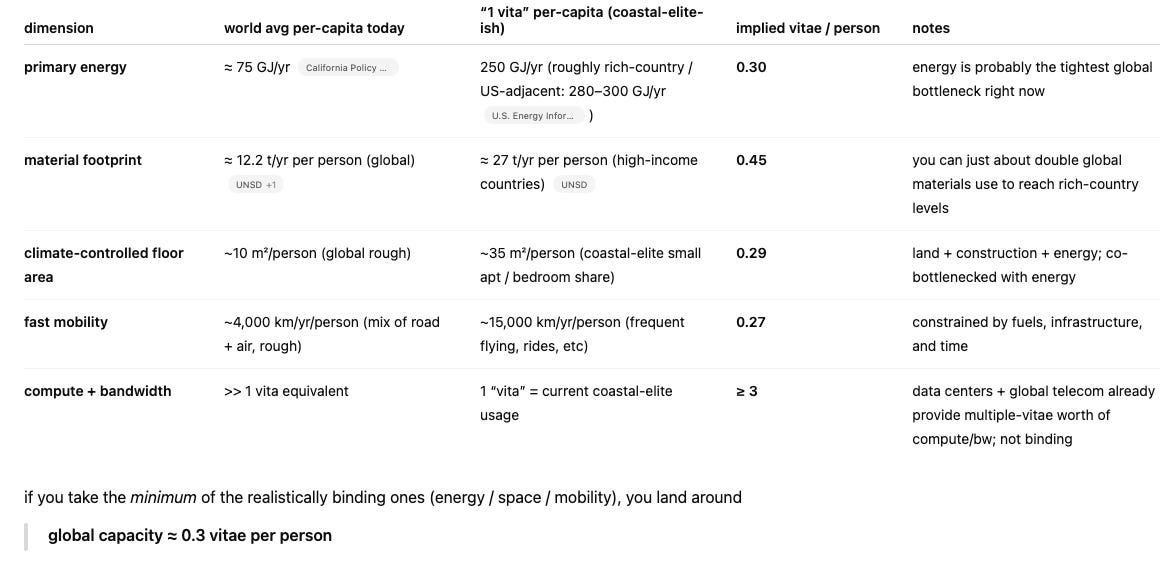
I measure my civilization not by its unemployment figures but by VPP.
If we have abundant VPP, looking after everyone is just a redistributive question.
Since VPP is determined by the scarcest resource, this is one case where you do want to raise the floor![3]
AI deployment and economic policy should be evaluated on:
“What path do they put us on for VPP by 2050 / 2100?”
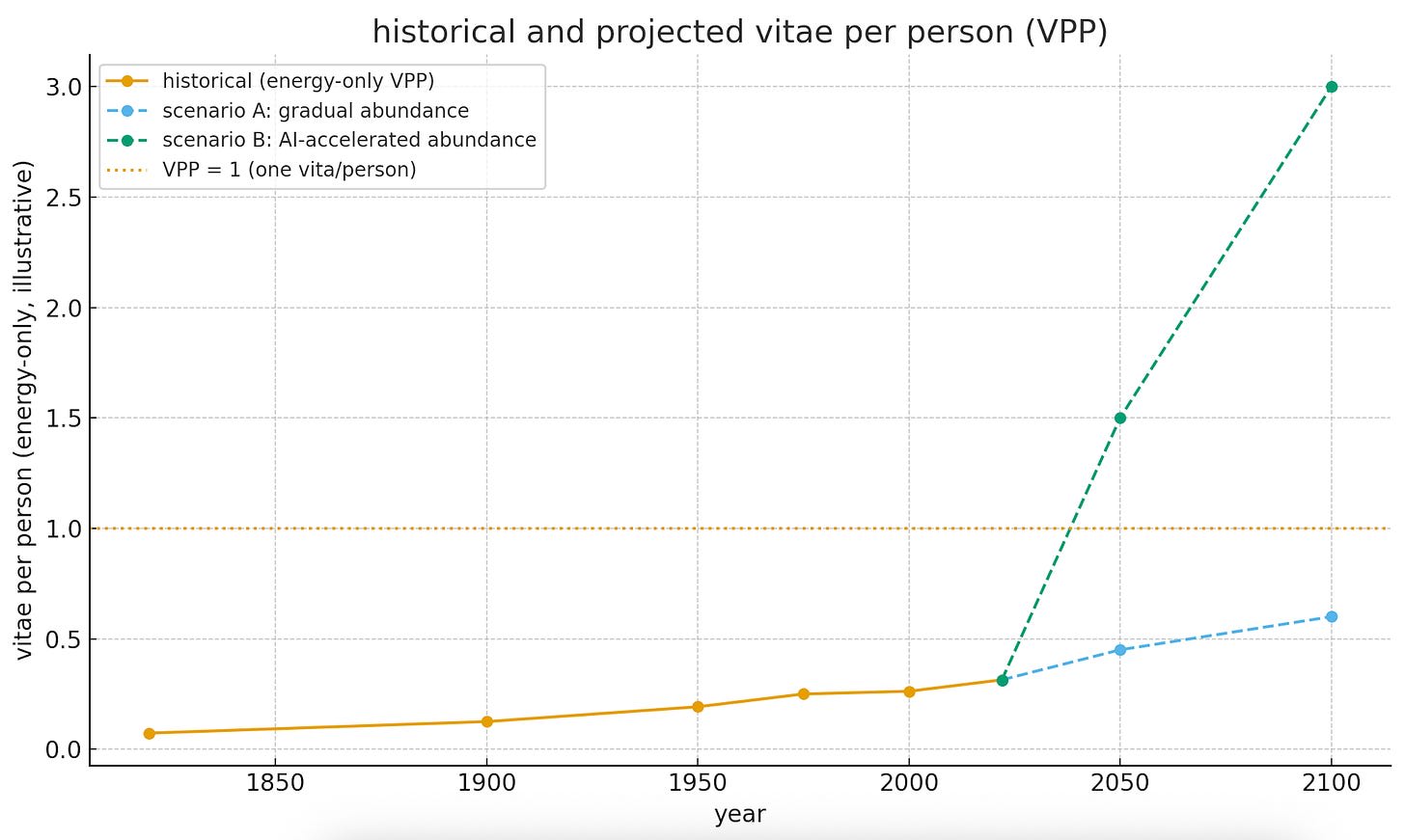
Historically, civilization has operated at well under one coastal-elite life per person. VPP is ~0.3 today. The interesting question is not ‘will there be jobs?’ but “can AI + new energy push us to 3–10 VPP without wrecking the world?’”
This is the per-person analog of Kardashev’s civilizational energy parameter. Currently, humanity is measured on the Kardashev scale at K = ~ 0.72: that’s how far we’ve progressed, on a log scale, from a pre-industrial species (K ≈ 0) to a full planetary-energy civilization (K = 1). We’re a factor ~500 too small to be type I.
I think this stands for as long as humans are similar enough to each other that our elite can’t conscience hoarding vitae when some people have <1.
I’d happily see there be an EA / international org that:


I think that this is a really good idea. I think that we already have transgressed our limits of resources and that a higher VPP won't save the situation. In 1970 the resource use was 30 billion tonnes (23 kilograms of materials used on average per person per day). In 2020, the number was 106 billion tonnes (39 kilograms per person per day) and there is a projected 60% growth in resource use by 2060. 90% of land-related biodiversity loss and water stress comes from extraction and processing of biomass. 44% (48 million km2) of the world’s habitable land is used for agriculture. 33% of all soil is already degraded and 90% is estimated to be degraded by 2050. 4.4 billion people in low and middle income countries lack safe drinking water. The fashion industry uses 80 trillion liters of water per year, causing 20% of industrial water pollution. I hope that this comment is helpful!
Most of these statistics (I haven't read the links) don't necessarily imply that they are unsustainable. The soil degradation sounds bad, but how much has it actually reduced yields? Yields have ~doubled in the last ~70 years despite soil degradation. I talk some about supporting 10 billion people sustainably at developed country standards of living in my second 80,000 Hours podcast.