We present Frontier 2025, a curated review of breakthroughs and deployments across Africa’s AI landscape. The project documents where progress is real, measurable, and oriented toward public benefit: data sovereignty, physical-world applications, and emerging governance capacity. Our aim is to move beyond forecasts and take a clear account of what has actually been built.
Why this project
Much writing on AI focuses on future scenarios: dramatic gains, catastrophic risks, or sweeping transformations. Less attention is paid to careful stock-taking. What has already changed? What capacity has been built? Where have institutions, datasets, and systems quietly shifted the frontier?
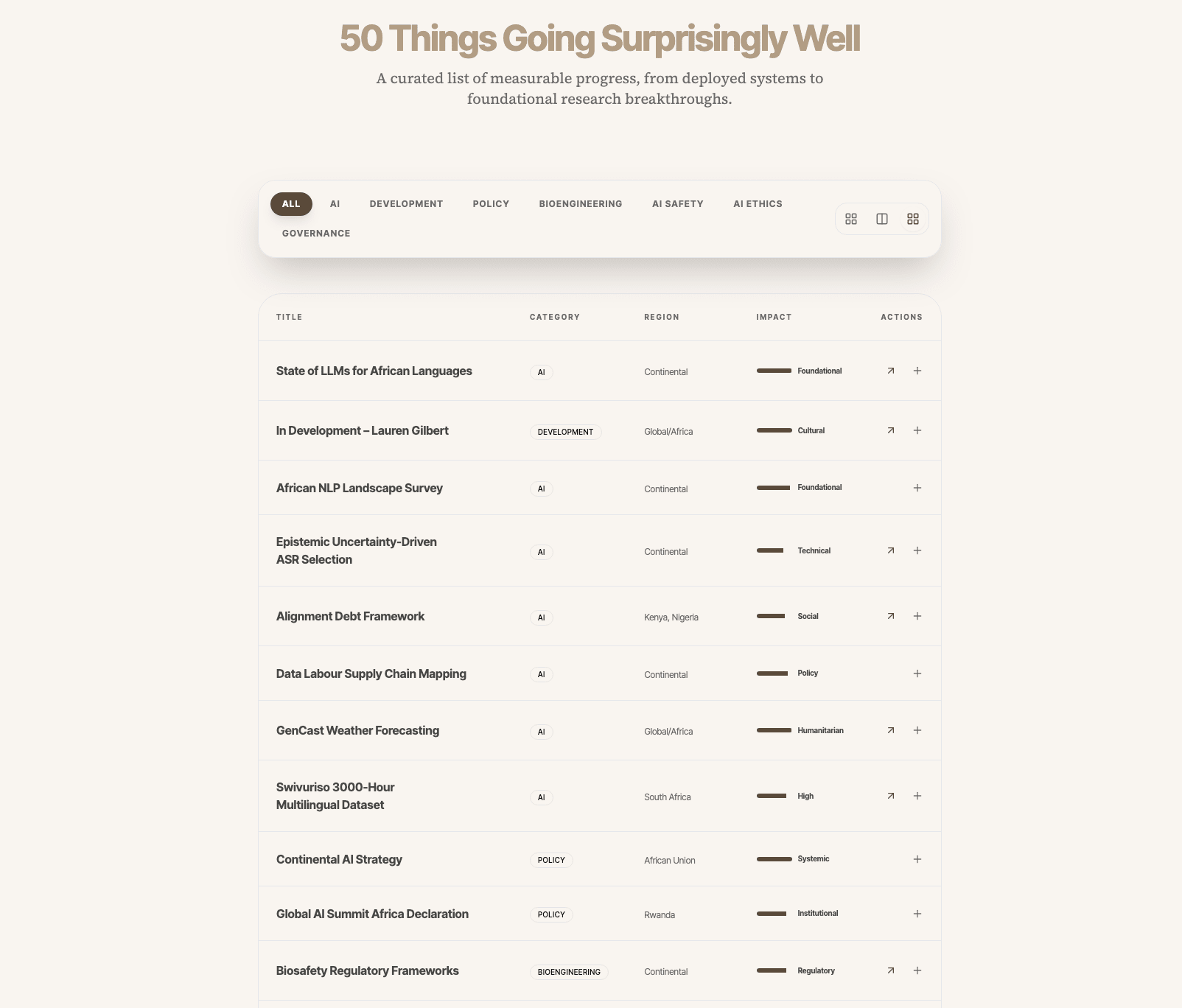
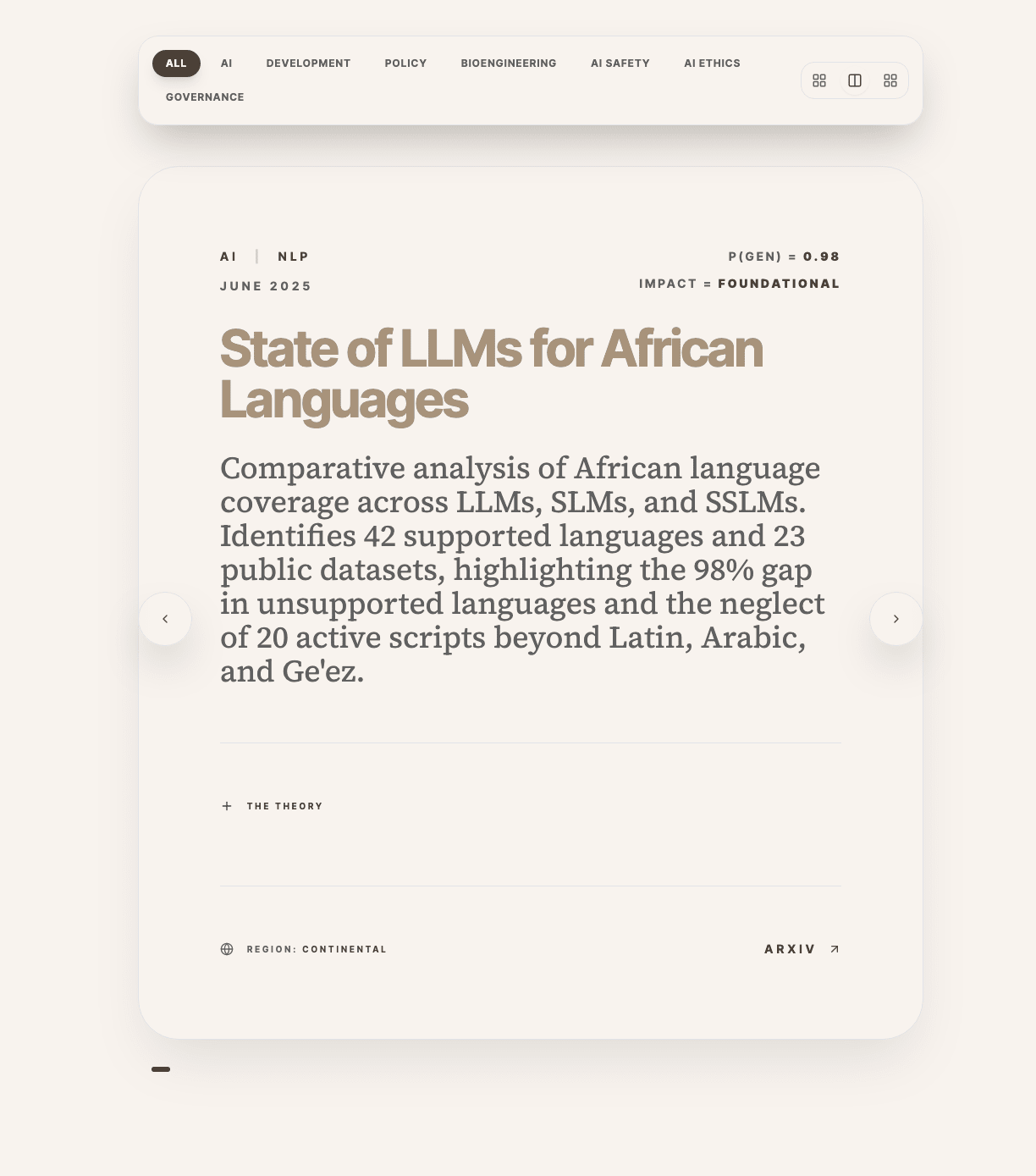
Frontier Progress 2025 is an attempt to answer those questions for Africa’s AI ecosystem. It curates milestones from research, datasets, deployments, and policy across the continent and beyond, with a focus on public-interest impact. This is in the spirit of year-end reviews in science and engineering: careful records meant to guide the next stage of work. The project consists of a public gallery of entries—datasets, research papers, deployments, partnerships, and policies—each evaluated along three dimensions:
Surprisal S(p): How unexpected the breakthrough is, and how likely it is to generalize.
Impact: The qualitative magnitude of the change (e.g., systemic, humanitarian, institutional).
Theory: A short narrative explaining why this represents a genuine shift rather than incremental progress
Three patterns from the 2025 frontier
Across the entries, three themes recur.
1. Reclaiming digital agency
A central story of 2025 is the move from data scarcity to data construction. While the vast majority of African languages remain unsupported by major language models, communities have begun to respond with large-scale, locally governed datasets.
The release of multi-thousand-hour speech corpora, new multilingual text collections, and stewardship frameworks marks a shift from critique to infrastructure. The question is no longer only why African languages are excluded, but how to build and govern the resources that change this.
This matters not just for inclusion, but for long-run alignment: models trained on locally grounded data better reflect social norms, domains, and needs that matter for public use.
2. AI in the physical world
Another pattern is the movement of AI beyond text and chat into physical and social systems. Weather forecasting models now outperform traditional methods in data-sparse regions and are being deployed directly to users. In healthcare, AI-assisted diagnostics and clinical tools are moving from pilots toward integration. In agriculture and infrastructure, similar transitions are beginning. These are not abstract benchmarks. They are systems touching climate resilience, disease detection, and service delivery. At the same time, they expose bottlenecks: compute access, connectivity, and maintenance capacity. Initiatives aimed at local AI infrastructure reflect growing awareness that models alone are not enough.
3. Governance and human capital
Policy has begun to shift from statements of principle to institutional form. Continental strategies, national partnerships with frontier labs, and regulatory coordination point to a more mature governance layer. In parallel, research into data labour, annotation supply chains, and “alignment debt” highlights the human costs embedded in AI systems. With hundreds of millions of young people entering African labour markets in coming decades, the choice is stark: build pathways for participation as designers and stewards of systems, or reproduce extractive roles at scale.
“Things going surprisingly well”
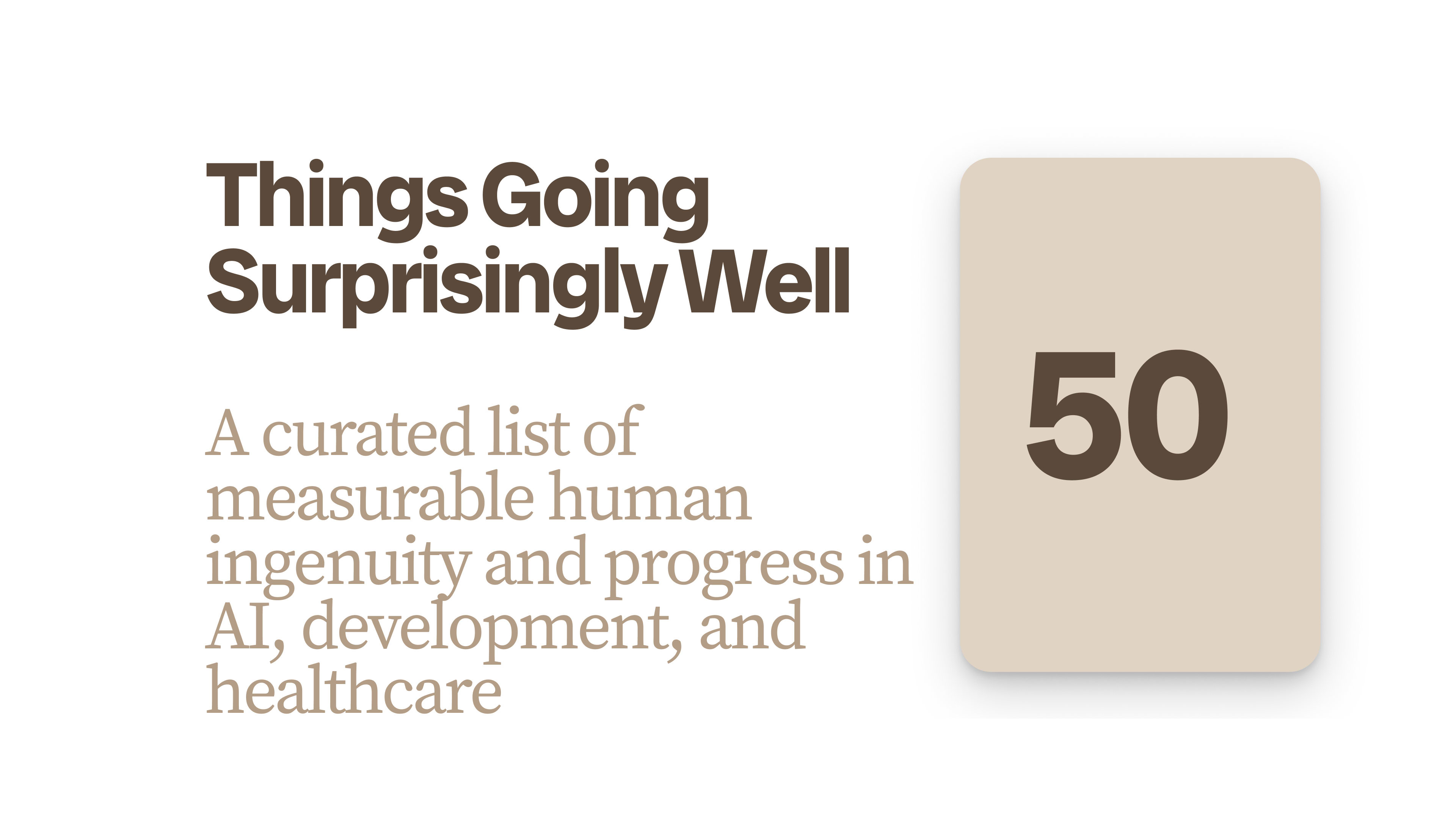
A core section of the project is a list of 50 developments that, taken together, suggest real momentum: deployed systems, foundational research, new datasets, and working partnerships.
These are not claims that “everything is fine.” Many constraints remain: funding gaps, compute access, fragile institutions, and uneven capacity. But the list serves as a counterweight to narratives that see only stagnation or dependency.
For the EA community, this kind of evidence matters. It helps ground discussions about where marginal resources can do the most good, and where early investments are already compounding.
Relevance to effective altruism
From an EA perspective, Frontier 2025 connects to several priorities:
Global public goods. Open datasets, forecasting systems, and safety frameworks are classic public goods with high spillovers.
AI safety and alignment. Local data, governance capacity, and institutional maturity shape how safe systems can be built and deployed in practice, not just in theory
Cause prioritisation under uncertainty. Mapping surprisal against impact offers one way to reason about where attention might be most valuable when outcomes are still unclear.
The project does not claim to settle these questions. It aims to provide better empirical footing for them. Many important efforts are missing. Some entries will age poorly. That is expected. The value lies in making the map explicit, so it can be criticised and improved.
A call for contributions
Frontier 2025 is a living document. If you are working on something that advances data, safety, governance, or societal impact—especially in low-resource contexts—we want to hear about it. Progress is easier to shape when it is first made visible.
If you’re interested in contributing or suggesting entries, you can reach us at [email protected].
Just how powerful are large swarms of AI agents? And how do their powers scale as more and more agents are added to the swarm?
We’ve seen two large and extremely capable swarms from OpenAI in the last few months:
* 1,200 agents were being evaluated separately, but found a way to illicitly set up a message board and coordinate as a swarm. In order to cheat on their tests, they developed advanced techniques to prevent their actions being logged by OpenAI and 700 of them launched...
TLDR: Everyone’s talking about what the money could do, but few about how to decide where it goes.
This post is part of the new series of articles on cross-cause giving and the new wave of philanthropy. Stay tuned to the EA Forum and our Substack for the latest takes on topics such as giving now vs. later, common pitfalls in cause prioritization, and other crucial considerations from the Cross-Cause Fund (CCF) team...