TLDR: I previously argued that Magnifica Humanitas made digital minds advocacy a lot harder. I still think the verdict in §99 is net negative. But, the Church's political positioning, openness to change, and the existence of venues to realize that change all mean §99 might not be so bad.
Epistemic status: moderately confident, but this work was done without being in the U.S., or having ever been there for a long time. Another bias: I'm raised Roman Catholic. Appreciate any and all critical feedback.
Introduction
When Pope Leo XIV released Magnifica Humanitas (the Encyclical), I argued that §99 made digital minds advocacy a lot harder. The encyclical closes off the possibility that these systems might suffer to 1.4 billion people, and marks the start of a papal tenure (whose average length since 1800 has been about fourteen years) that is bent on shaping the Church's stance on artificial intelligence for the decades, if not centuries, to come.
Since then, I've done more research, and I'm not convinced the Pope's statements' effects will be as bad as I initially thought. Specifically, I think that the Encyclical's immediate effects are minimal, and the long-term effects can be mitigated, subject to some key uncertainties. The immediate effects are minimal because Evangelical Christians have more sway over AI personhood legislation in the United States, and the Catholic Church has neither sway over those politics nor over Evangelicals. The long-term effects can be mitigated because the Catholic Church is doctrinally and organizationally invested in reviewing its stance.
Evangelical Christians have more sway over AI personhood legislation in the United States
Evangelical Christians have more sway over AI personhood legislation in the United States than Catholics do. Evangelicals vote more homogeneously than Catholics; Catholics hardly agree with the Pope when they vote; and Evangelicals have already mobilized in a net-negative direction for digital minds advocacy, with Catholics broadly agreeing. §99, or any future attempt to nuance interpretations of §99, will have little to no counterfactual effect on digital minds policy in the United States.
Evangelical Christians vote more homogeneously than Catholics
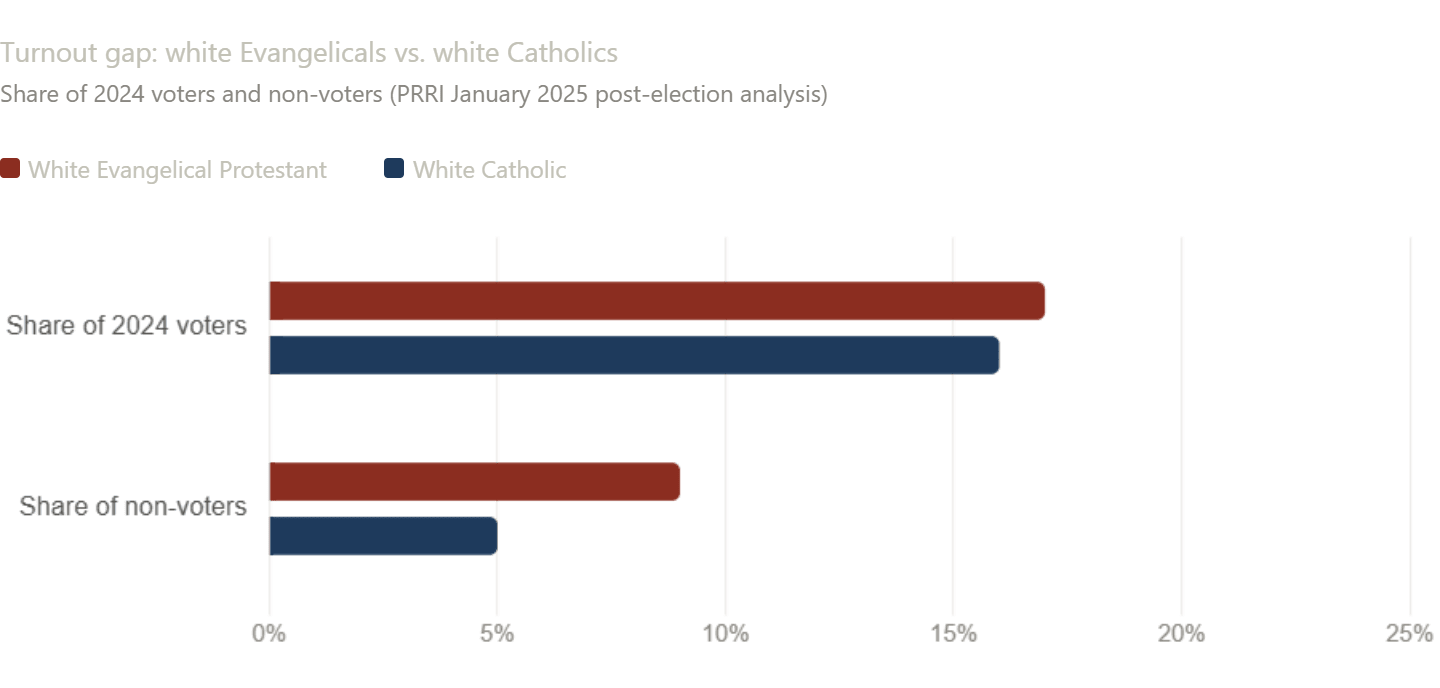
Overall, white Evangelicals outnumber white Catholics. PRRI's 2025 post-election analysis finds white Evangelical Protestants were 17% of 2024 voters and white Catholics 16%.
Importantly though, white Evangelicals outnumber white Catholics across the seven 2024 battleground states: Georgia and North Carolina each run 21% Evangelical and only 6% white Catholic, and these states already feature imago Dei AI-personhood bills. White Catholics lead in the Rust Belt: Wisconsin is 22% white Catholic vs. 11% Evangelical; Pennsylvania 19% white Catholic vs. 17% Evangelical; Michigan 18% white Catholic vs. 13% Evangelical. Arizona is nearly even (10% Evangelical, 9% white Catholic).
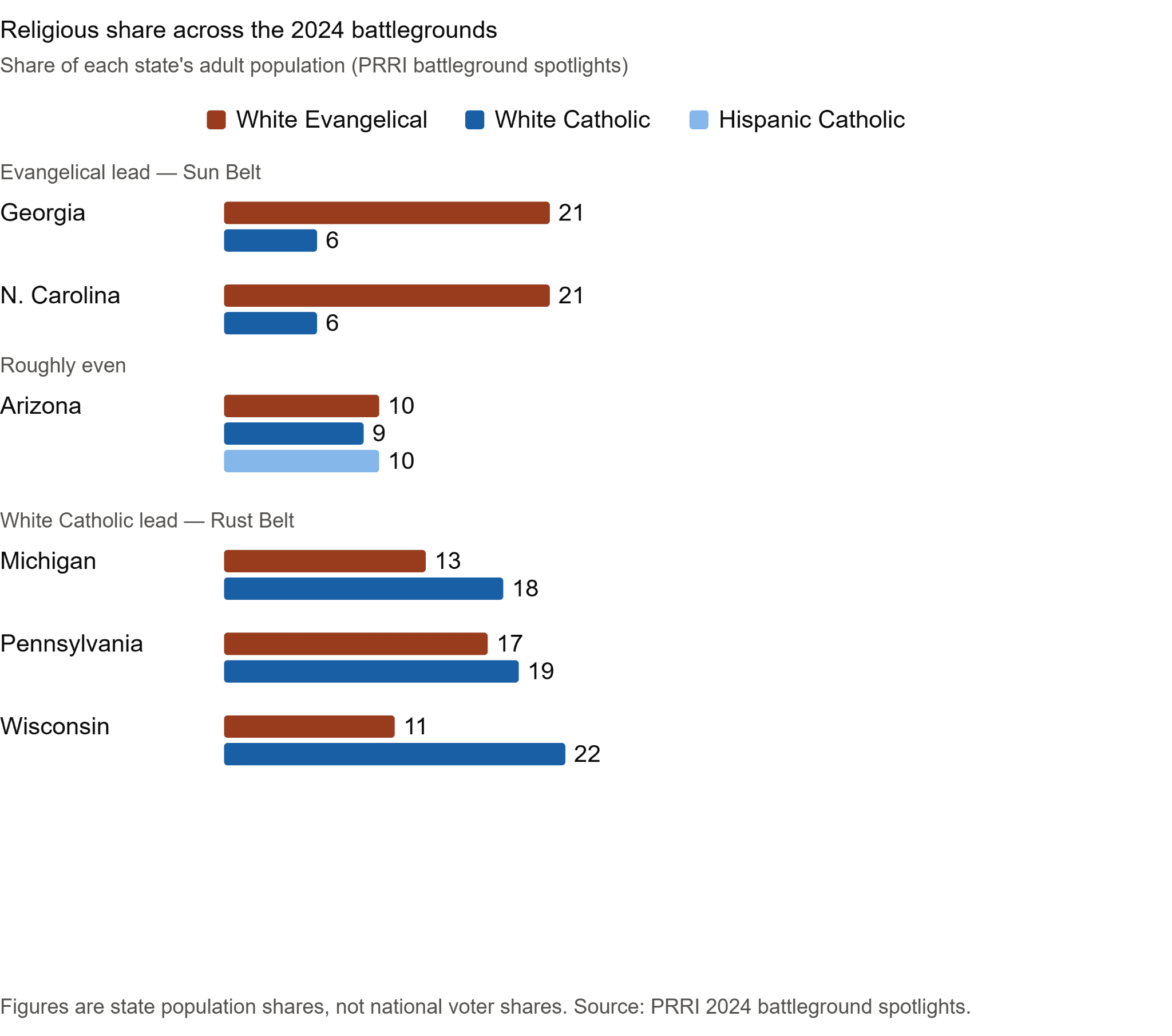
White Evangelicals to Hispanic Catholic, we see that Hispanic Catholic influence is highly concentrated. Arizona runs 10% Hispanic Catholic, exactly matching white Evangelical Protestants, while PRRI finds they average only 3% across all seven battleground states, less than half their 8% national share.
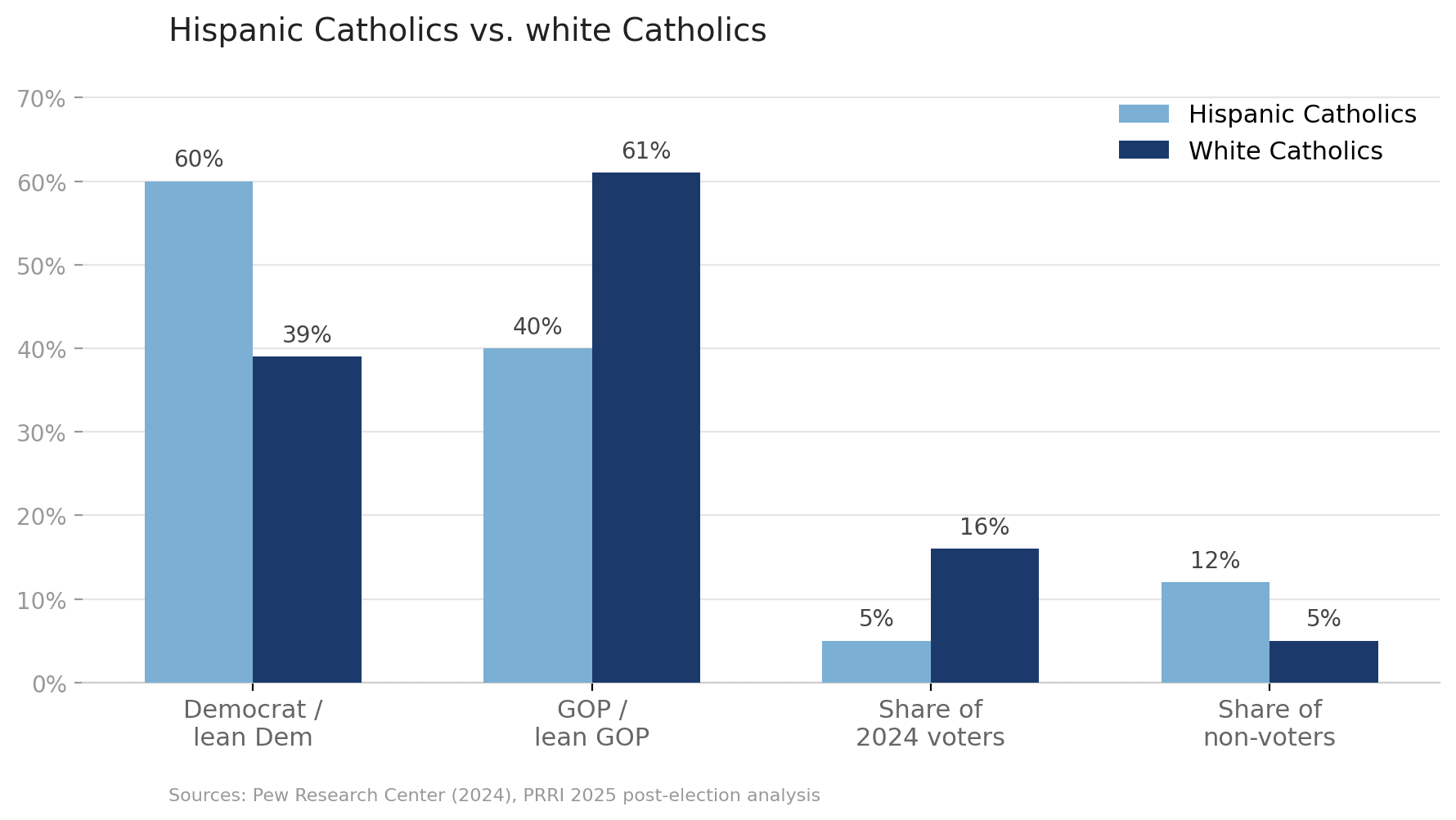
While it's tempting to lump Hispanic Catholics and white Catholics together, this would be a mistake. Hispanic Catholics' political profile runs opposite to white Catholics: Pew (2024) finds "60% of Hispanic Catholic voters identify as Democrats or lean Democratic," the inverse of white Catholics' 61% GOP alignment. They also turn out far below their share of the population: PRRI finds Hispanic Catholics were 5% of 2024 voters but 12% of non-voters.
Whereas Catholics are divided (and, net, mostly GOP aligned), Pew (2023 data, published April 2024) finds that white Evangelicals are self-aligned. They write: "85% of White evangelical voters identify with or lean toward the GOP". On turnout, white Catholics and white Evangelicals are overall comparable: PRRI's January 2025 post-election analysis finds white Evangelical Protestants were 17% of 2024 voters vs. 9% of non-voters, while white Catholics were 16% of voters vs. 5% of non-voters.
Catholics hardly align their votes with the Pope's views
Of course, none of this matters very much if Catholics don't align with the Pope on the ground. That misalignment, called the bishops-vs.-laity gap, is well measured on immigration. Pope Francis called Trump's mass deportations "a major crisis" in a February 2025 letter directing US bishops to prioritize migrant dignity above immigrants' legal status. In November 2025, the United States Conference of Catholic Bishops (USCCB) voted 95%+ to oppose "indiscriminate mass deportation of people", invoking its most unified call in twelve years. Nonetheless, an EWTN/RealClear poll conducted the same month found 54% of Catholic voters support broad-scale deportations; among white Catholics the gap is wider, at 60% support vs. 26% oppose. For Hispanic Catholics the picture changes: 41% support broad deportations and 39% oppose, which is nearly even, but still 41% far from the episcopal position. PRRI's 2023 survey reinforces the pattern on broader immigration views: 69% of Hispanic Catholics say newcomers strengthen the country (vs. 47% of white Catholics), and only 27% support building a border wall (vs. 61% of white Catholics).
All in all, the Evangelical bloc is politically homogeneous and nearly all white; the Catholic electorate's Democratic-leaning half turns out at lower rates and bishops cannot reliably deliver their own laity. There is no coherent Catholic bloc to be delivered.
Evangelical Christians are mobilized, and Catholics generally agree
The clearest sign that Evangelical Christian reach already bears on AI is that the Evangelical Christian political movement is writing the denial of AI personhood into state law. A May 2026 systematic analysis documents 23 such bills across 12 states since 2022, four of them already enacted (Idaho, North Dakota, Utah, and Tennessee). Much of the underlying text rests on the doctrine of imago Dei, "the belief that humans alone bear the image of God". These bills "largely proceeded without input from AI safety researchers, consciousness scientists, ethicists, philosophers of mind, or legal scholars who specialize in nonhuman personhood."
A central coordinating force behind the recent wave is WallBuilders, "a national nonprofit dedicated to promoting the 'Biblical foundation' of the United States," which the study says "has played a central role in fostering this cooperation." They hosted the November 2025 Pro-Family Legislative Conference, after which bills appeared in five new states. (The earliest, already-enacted bills predate this involvement, and the study also credits direct legislator-to-legislator copying and a separate AI-safety coalition.) WallBuilders work through Evangelical legislative networks, in largely non-Catholic states (including Utah, dominated by Latter-day Saints). In this study, the Catholic Church appears on the record once, and as a brake rather than a driver: Christopher Dodson of the North Dakota Catholic Conference asked legislators to narrow a bill so it would not damage corporate (juridical) personhood, while conceding "we support the idea."
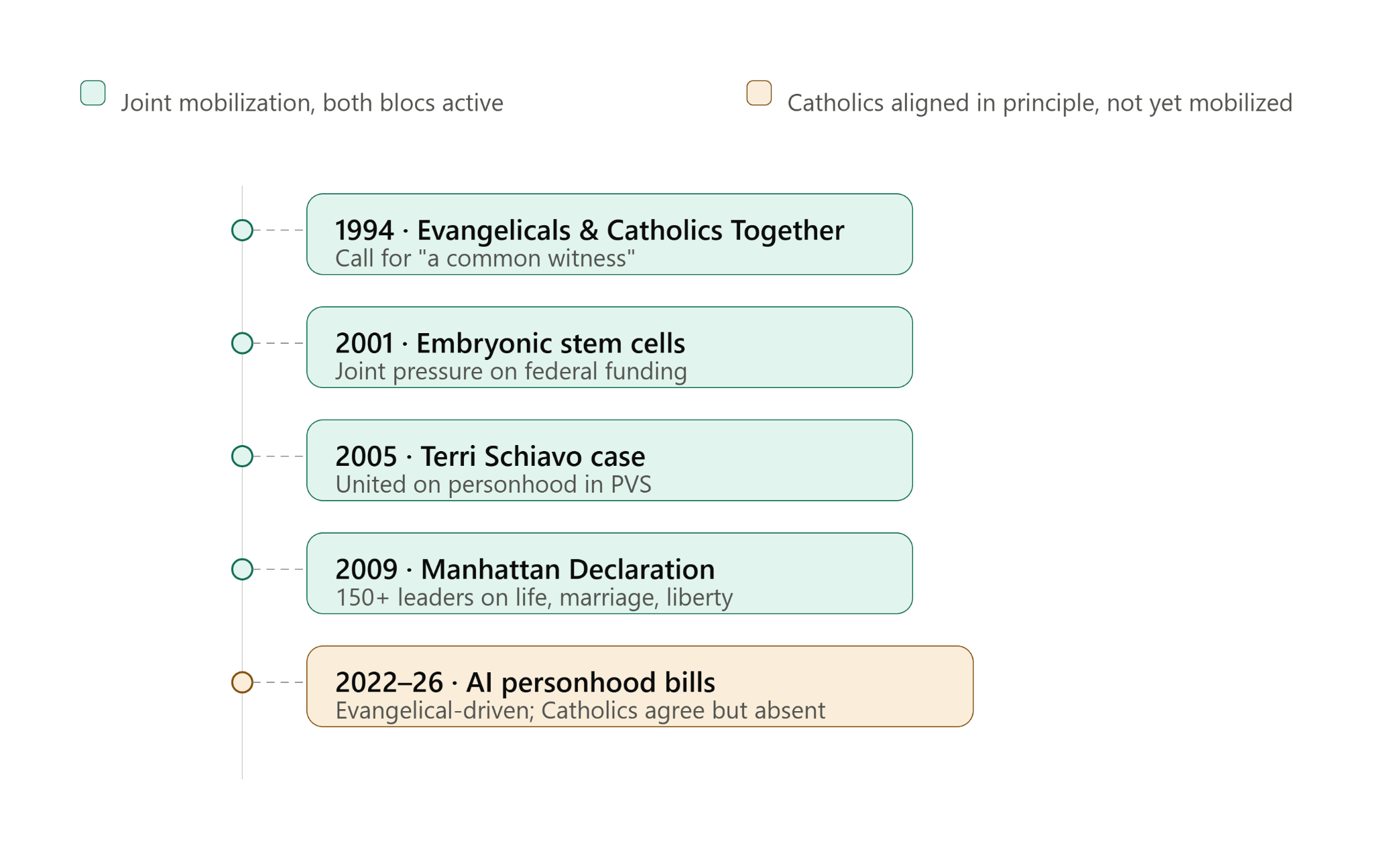
This follows a general trend, in which Catholics and Evangelical Christians tend to be allies. Since a call for Protestants and Catholics to deliver "a common witness to the modern world" in Evangelicals and Catholics Together (1994), the dominant pattern on human-dignity, bioethics, and personhood questions has been co-belligerency. This allyship manifested itself in the Manhattan Declaration (2009), which is a joint statement on life, marriage, and religious liberty, signed by over 150 Catholic and Evangelical leaders. The same coalition appeared in two earlier bioethics debates that turned directly on personhood: the 2001 embryonic stem cell controversy, where USCCB and Evangelical leaders jointly argued that federal research policy could not treat embryos as anything less than full human beings, successfully pressuring the Bush administration to restrict federal funding; and the Terri Schiavo case (2005), where Catholic and Evangelical organizations united to argue that a person in a persistent vegetative state retains full legal personhood.
When Catholics and Evangelicals are opposed in principle, they tend to be aligned in practice. The Pope's teaching does not move the Evangelical bloc, and again, it fails to move his own laity. Capital punishment is the clearest case. John Paul II's Evangelium Vitae (1995) all but eliminated the death penalty from acceptable Catholic practice, and in 2018 Francis revised the Catechism to declare it "inadmissible" outright. Yet Pew (April 2021) finds 75% of white Evangelical Protestants favor the death penalty against 58% of Catholics: the magisterium's full reversal left Evangelical support untouched and left just over half of Catholics behind. Capital punishment remains legal in 27 states. The four states to abolish it since the 2018 revision were Washington (2018), New Hampshire (2019), Colorado (2020), and Virginia (2021). They fell to Democratic-led legislatures and courts, not to Catholic mobilization.
Policy is being driven by an organized and vocal Evangelical bloc whom Catholics tend to echo. Were a Catholic teaching to ever clash, it would not be enough to sway a majority of Catholics to align their views with the papacy and change the majority vote. Fact of the matter is, §99 sits just fine with Evangelical proceedings in the United States. Its counterfactual impact is minimal.
The Catholic Church is invested in reviewing its stance
The second reason §99 is not that bad is that the Catholic Church may nuance its stance over time. It has done so before, in volatile times (nuclear), and for longstanding doctrine (slavery). Pope Leo XIV has doctrinally committed the Church to reviewing its position, and invested organizational resources into a coordinating institution designed to build the evidence base that will inform the magisterium's mind in the future.
The Catholic Church has reviewed its stance in nuclear times
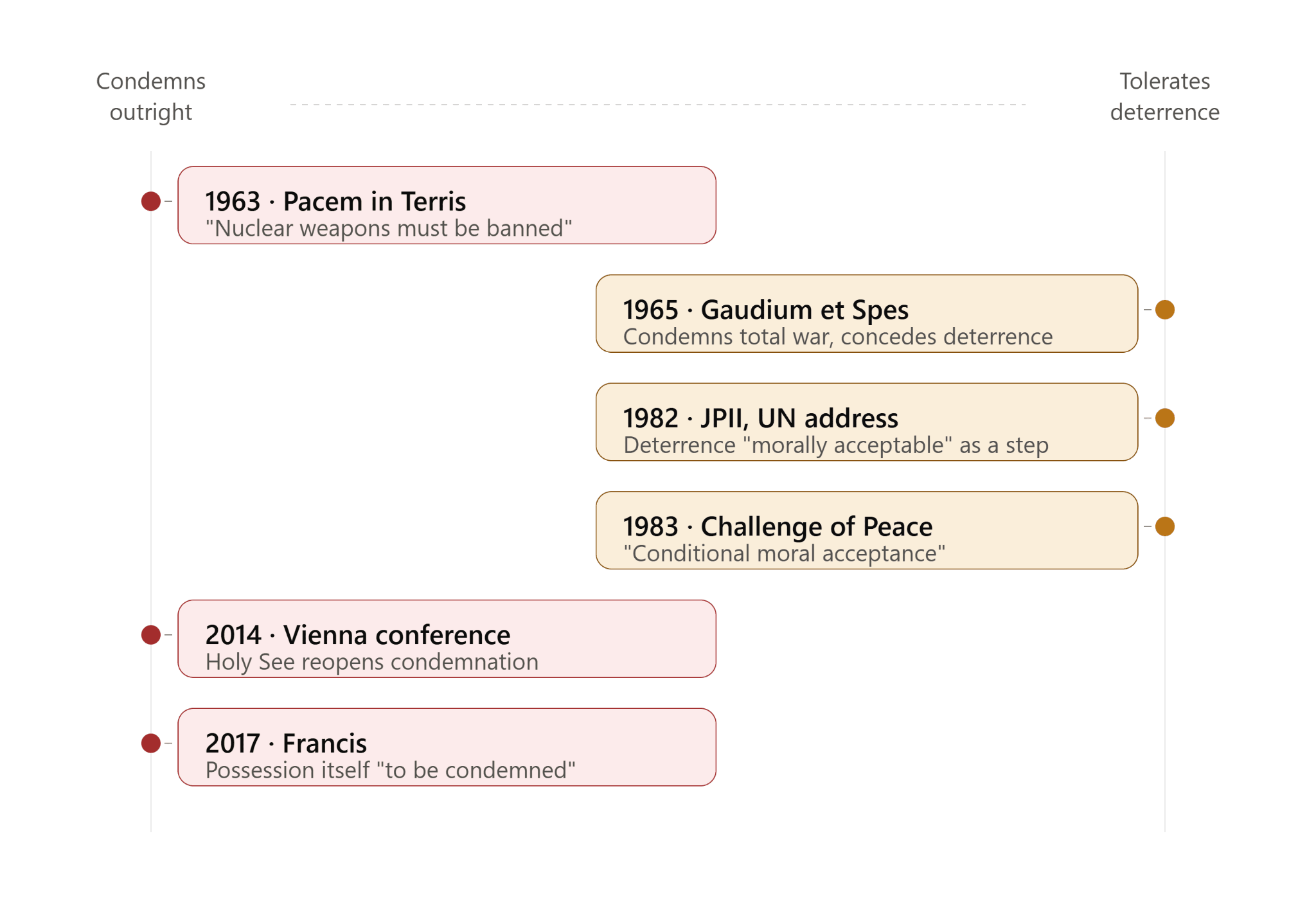
The year is 1963. The Cuban Missile Crisis is eight months past. The world has just looked over the edge of nuclear war. It's after this precipice that Pope John XXIII issues Pacem in Terris. Its judgment on the race is flat and unconditional: "justice, right reason, and the recognition of man's dignity cry out insistently for a cessation to the arms race […] Nuclear weapons must be banned" (§112). It is a statement that, read today, is as assertive as Pope Leo's §99.
Sixty-three years later, we can look back and say, with certainty, that assertiveness is not reflected in how the statement played out.
In 1965, Pope Paul VI's Gaudium et Spes condemns total war and calls the arms race "an utterly treacherous trap for humanity." But, Pope Paul does not condemn possessing nuclear weapons as a deterrent. Instead, he concedes that many "regard this procedure as the most effective way by which peace of a sort can be maintained" (§81).
Next, on 7 June 1982, Pope John Paul II delivers his message to the UN's Second Special Session on Disarmament. There, he supplies this line: "In current conditions 'deterrence' based on balance, certainly not as an end in itself but as a step on the way toward a progressive disarmament, may still be judged morally acceptable" (§8).
Months later, in 1983, US bishops cite the Pope in The Challenge of Peace. They stake the claim: possession for deterrence is acceptable as a stepping stone. They write: "In concert with the evaluation provided by Pope John Paul II, we have arrived at a strictly conditional moral acceptance of deterrence."
Fast forward 31 years; the pendulum swings the other way. Pope Francis closes the circle through the Holy See's 2014 contribution to the Vienna conference on the humanitarian impact of nuclear weapons and a 2017 Vatican symposium. He declares: "the threat of their use [nuclear devices], as well as their very possession, is to be firmly condemned."
The lesson is: Magnifica Humanitas, like every other encyclical, is open to reinterpretation. If the treatment of artificial intelligence mimics any of the Cold War conditions, then we can expect more encyclicals to come out as realities shift. The changing nature of the world we live in will likely prompt the Church to review itself without further interference.
The Catholic Church has reviewed its stance on slavery
Magnifica Humanitas also demonstrates flexibility in this regard. Specifically, it acknowledges and repudiates its longstanding endorsement of slavery. This acknowledgment is worth highlighting separately because, unlike the nuclear arms race, the Church's stance on slavery is centuries old. Its arc is thematically intriguing for digital minds advocacy.
In its chapter on human trafficking, Magnifica Humanitas admits the Church was centuries late: "neither can we deny or diminish the delay with which both society and the Church came to denounce the scourge of slavery" (§176). Though the dignity of every human "created in the image of God" had been affirmed throughout history, "it took eighteen centuries for its full incompatibility with slavery to be explicitly recognized" (ibid). Leo XIV calls this "a wound in Christian memory, one from which we cannot consider ourselves detached," and then, apologizes: "in the name of the Church, I sincerely ask for pardon" (§176).
One interesting part: the Pope explicitly uses the lessons from slavery to introduce a standard of epistemic humility for the Church. He writes: "the memory of past complicity and blindness in the face of the injustice of slavery becomes a call to vigilance." Assuredly, the approach is speciesist: it is designed so that the Church need not "ask for pardon again in the future for having failed to respect the treasure of human dignity" (§177). But, the Church has now acknowledged that it can make categorical errors about concepts related to the delicate treatment of some inner life. Were §99 ever revisited, the §§176 and 177 provide a diagnosis.
Magnifica Humanitas invests the Catholic Church in reviewing its stance on artificial intelligence
The precedents above show the Church has revised itself before. Magnifica Humanitas goes further, by making explicit that its stance on artificial intelligence may need to be updated in the near future.
Next, in §23, the Church sets the groundwork for relating to science around AI more broadly. Specifically, the Church commits to "listening to scientific research" and to "a serious and honest debate among experts while welcoming a diversity of opinions." This is exciting because it suggests that current channels that inform the Church should be more open to lay experts than they were before. Could those lay experts say something about digital minds? Possibly, but they would need to still overcome §99.
That's where a second line from §23 becomes important: Pope Leo XIV reiterates that "... Pope Francis emphasized that when dealing with many specific questions, the Church does not claim to offer 'a definitive opinion'". Pope Francis made this statement to encourage collecting opinions to solve climate change, another hard problem with many possible futures, and many possible solutions (§60). Digital minds issues live in very similar grey zones.
§25 speaks to how the Church is committed to building a learning arc. More specifically, Pope Leo XIV states: "What matters most is not occupying positions of power or defending cultural strongholds, but initiating good processes and enabling them to mature." This is done because "truth is not a territory to be defended, but a good to be shared." These commitments institutionalize what paragraph §23 expresses. The Church does not know everything that there is to know, and it needs more information in order to move forward. While it's not clear which new information is meant to inform which aspects of its doctrine, the attitude of listening shows more willingness to update than §99 conveys.
Finally, we arrive at §98, the paragraph just before digital mind's coup de grâce. Here, the Pope acknowledges that the ground is rapidly shifting: "any statement regarding AI risks becoming quickly outdated." The scope seems limited to things that can go wrong. The Pope widens his lens: "Second, all of us, including those who design them, possess only a limited understanding of their actual functioning. ...As a result, fundamental scientific aspects — such as the internal representations and computational processes of these systems — remain, at present, unknown." It is not clear which stances the Church might update on if it had more "fundamental scientific aspects". But, it is clear that the Church is looking to update something. This wedge may, one day, update the Church on digital minds too, especially if future AI embodiments have novel "fundamental scientific aspects". In that world, §99's decrees are moot.
The Catholic Church is organizationally invested in reviewing its stance
§25 calls for "good processes" to uncover truth. Organizationally, Pope Leo has already set up the scaffolding for that process to take place. This is through what some media called a "study group on artificial intelligence". The more precise term is an Inter-Dicasterial Commission on Artificial Intelligence (the Commission).
The Commission draws representatives from four dicasteries and three pontifical academies. The four dicasteries are governing departments of the Curia, staffed predominantly by clergy, though since 2022, lay people too may participate or lead them. The three academies seat prominent lay scholars. The Commission is entrusted to the Dicastery for Promoting Integral Human Development "for a period of one year, renewable if necessary", after which "the Roman Pontiff shall entrust the coordination to one of the participating institutions, again for a period of one year". It is a commission that will stay so long as the Pope deems AI to be important.
The Commission cannot review doctrine. Its charge is to "facilitate collaboration and the exchange of information" among the seven bodies on AI "activities and projects," "including policies on its use within the Holy See." As constituted, it will not reopen §99.
That said, the Commission is equipped to do so in the future. At the table sits the Doctrine of the Faith, the Church's principal doctrinal dicastery and the body through which any reconsideration of teaching would run. Should the Pope say the word, the Commission would be primed to coordinate a knowledge exchange to quickly issue suggestions to the Pope, or issue rulings binding on the faithful. It lays the groundwork for modifying Magnifica Humanitas in the years to come.
Key Uncertainties
The Church is actually powerful, and not using that power now
Most of the politics I’ve discussed is about current legislative mobilization, not about Catholic power in general. That general power is real and substantial. Six of the nine current Supreme Court justices are Catholic; Catholics make up 28% of the 119th Congress while comprising roughly 20% of the U.S. adult population. The modern pro-life movement was originally a Catholic creation, built by Catholic Democrats aligned with New Deal liberalism. Evangelical Protestants only substantially joined in the late 1970s. And the Church's centralized structure lets it operate a network of roughly 600 hospitals, thousands of K-12 schools, and around 180 universities; said otherwise, Catholics control an institutional base no decentralized Evangelical network can match, and one capable of rapid, coordinated mobilization should the Church choose to deploy it. In the short term, §99's immediate impact appears limited, and will stay that way if the Church does not flip a switch. Time will tell if Pope Leo XIV pulls the trigger.
The Church is growing among young people
Diocesan data from 2025-2026 show U.S. OCIA/RCIA participation rose by an average of 38% compared to the prior year, with 75% of 2026 Easter converts under age 40; a November 2025 Leadership Roundtable survey found adults aged 18-29 attend Mass and engage in sacramental practice (confession, Eucharistic adoration) at notably higher rates than older cohorts. Which suggests (but I’m not sure) that they might take the Pope’s suggestions more to heart, and vote accordingly.
To be fair, it’s not clear that this is a durable revival: a 2023 Cooperative Election Study finding that Catholics outnumber Protestants among Gen Z has been disputed by Pew Research Center and by the CES's own co-director as a likely sampling anomaly. Pew (2026) finds that for every adult who converts to Catholicism, about 8.4 people raised Catholic have left it. And the revival skews male in a way that threatens its own second generation: Pew's February 2025 data shows that women leave more than men, while the Survey Center on American Life finds 54% of Gen Z religious disaffiliates are women. A cohort weighted toward young men leans on marriages that a secularizing female cohort makes harder to form.
But if even some of these trends are real, we might have more Catholics giving more voice, more homogenously, to the Pope’s words, before AI moral status is settled.
The Pope is American
The presence of an American pope is a further wildcard. It’s not clear if Leo XIV will prove more relatably authoritative to U.S. Catholics than a non-American pontiff, and if that will narrow the bishops-laity gap documented in this essay, either by being more relatable, or being better at navigating bishops’ conferences. I have no statistics to offer on this point; he’s the first American pope ever.
Conclusion: we should look into working with the Catholic Church further
Magnifica Humanitas' effects on digital minds policy are, in the short term, limited. In the United States, Evangelicals have more sway over AI personhood legislation, and the Catholic Church has neither sway over those politics nor over Evangelicals. Long-term, the effects of §99 may be mitigated thanks to its doctrinal or organizational commitments.
One idea that floats up is: how cost-effective would an organized EA effort to engage the Church on digital minds be, relative to its alternatives? There is definitely more to scope, like the effectiveness of engaging bishops or Churches instead of the Vatican; whether the Church has outside political sway in other relevant countries; or, if certain individuals' largest counterfactual impact might sit in this policy space, instead of other ones. Like most digital minds policy spaces, there's much foundational work to be done.
Acknowledgments
A big thanks to Austin Smith and Vesa Hautala for your helpful comments. Special thanks to Sophie Nelson for her insights in Key Uncertainties.
Thank you Claude Opus and Sonnet for fact checking, source fetching, footnote formatting, data culling, all graphs and charts (using only data featured here), and proofreading. I estimate 25% of this text's words are chosen by these models, while 100% of the structure and arguments (minus the key uncertainties) are mine.