Interesting ideas! For Guardian Angels, you say "it would probably be at least a major software project" - maybe we are imagining different things, but I feel like I have this already.
e.g. I don't need a "heated-email guard plugin" which catches me in the middle of writing a heated email and redirects me because I don't write my own emails anyway. I would just ask an LLM to write the email and 1) it's unlikely that the LLM would say something heated and 2) for the kinds of mistakes that LLMs might make, it's easy enough to put something in the agents.md to ask it to check for these things before finalizing the draft.
(I think software engineering might be ahead of the curve here, where a bunch of tools have explicit guardian angels. E.g. when you tell the LLM "build feature X", what actually happens is that agent 1 writes the code, then agent 2 reviews it for bugs, agent 3 reviews it for security vulns, etc.)
Very cool. I’m a forever optimist when it comes to the potential of AI tools to improve decision making and how people reason about the world or interact with the world.
There is such a huge risk with any such tools of incentive misalignment (I.e. quality of reasoning and error reduction often isn’t well rewarded in most professional contexts).
For these to work, I strongly believe the integration method is absolutely critical. A stand alone platform or app, or something that needs to be proactively engaged is going to struggle I fear.
Something that works with organisations and groups to build the better incentives would be high impact I feel.
This is really cool - in particular, this reminds me of the resources that are provided by accountancy professional bodies, their codes of ethics and their professional support helpline. Being able to chat through a complex scenario would be helpful.
If someone is interested in building a POC and wants a preexisting set of existing professional standards, here the ICAS Code of Ethics, rules and helpsheets
I'm currently working on a simple recommendation system for posts from Effective Altruism forum, which uses a simple algorithm on top of AI models. I have written a script that scraps posts from EA forum, and then evaluates them based on impact and few others criteria, estimating the expected value of positive impact that the post will have. I plan to share the results on this forum soon.
I think that it will have to base also on information from humans later because AI models can reflect the interest of a company (if recommendation is based on AI models, then AI companies might create AI models that are aligned with interests of the company, instead of the interest of the collective, or if the models are not aligned, then they might work in their own unaligned interest.
I think aligned recommendation systems are very important because currently I believe that some good ideas get overlooked. Better recommendation systems would direct attention to the right posts/papers.
Update:
But if you work or plan to work on it as well, then please don't resign from doing so because of the fact that I'm working on it already. I also work on other projects.
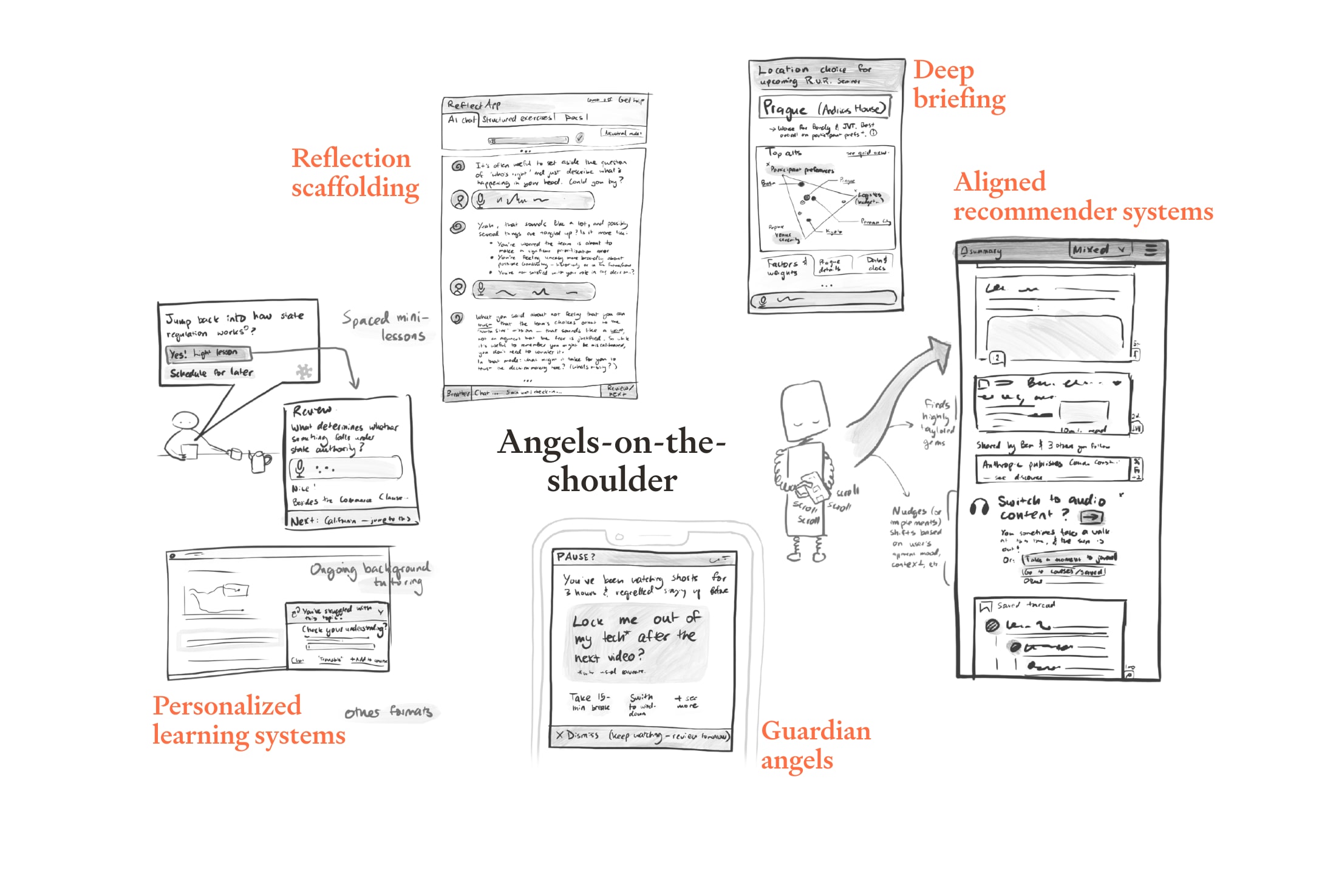
We’ve recently published a set of design sketches for technological analogues to ‘angels-on-the-shoulder’: customized tools that leverage near-term AI systems to help people better navigate their environments and handle tricky situations in ways they’ll feel good about later.
We think that these tools could be quite important:
In general, we expect angels-on-the-shoulder to mean more endorsed decisions, and fewer unforced errors.
In the context of the transition to more advanced AI systems that we’re faced with, this could be a huge deal. We think that people who are better informed, more situationally aware, more in touch with their own values, and less prone to obvious errors are more likely to handle the coming decades well.
We’re excited for people to build tools that help this to happen, and hope that our design sketches will make this area more concrete, and inspire people to get started.
The (overly-)specific technologies we sketch out are:
Aligned recommender systems — Most people consume content recommended to them by algorithms trained not to drive short-term engagement, but to meet long-term user endorsement and considered values
Personalised learning systems — When people want to learn about (or keep up-to-date on) a topic or area of work, they can get a personalised “curriculum” (that’s high quality, adapted to their preferences, and built around gaps in their knowledge) integrated into their routines, so learning is effective and feels effortless
Deep briefing — Anyone facing a decision can quickly get a summary of the key considerations and tradeoffs (in whichever format works best for them), as would be compiled by an expert high-context assistant, with the ability to double-click on the parts they most want to know more about
Reflection scaffolding — People thinking through situations they experience as tricky, or who want to better understand themselves or pursue personal growth, can do so with the aid of an expert system, which, as an infinitely-patient, always-available Socratic coach, will read what may be important for the person in their choice of words or tone of voice, ask probing questions, and push back in the places where that would be helpful
Guardian angels — Many people use systems that flag when they might be about to do something they could seriously regret, and help them think through what they endorse and want to go for (as an expert coach might)
If you have ideas for how to implement these technologies, issues we may not have spotted, or visions for other tools in this space, we’d love to hear them.
Note: This post was crossposted from the Coefficient Giving Farm Animal Welfare Research Newsletter by the Forum team, with the author's permission. The author may not see or respond to comments on this post.
Subtitle: On vegan advocacy, effective altruism, and FIFA
I turn 40 today. Here are some hot takes.
On factory farming
1. Our biggest challenge is salience. If factory farming led the evening news, it wouldn’t last lo...
Impressions from the 21st Annual U.S. Cluster Headache Patient Conference, organized by Clusterbusters.
On the morning of the last day of the conference, E. was hanging out with other “clusterheads” outside the conference hotel when he started having a cluster headache attack. Before he could go back to his hotel room, J. offered E. his DMT v...
TL;DR:
The movement has an evidence problem. To solve it, for each intervention we need to know:
* What types of evidence that intervention needs
* What types of evidence different sources can give us
In this post, we outline a framework for evidencing an intervention through five stages:
...




Interesting ideas! For Guardian Angels, you say "it would probably be at least a major software project" - maybe we are imagining different things, but I feel like I have this already.
e.g. I don't need a "heated-email guard plugin" which catches me in the middle of writing a heated email and redirects me because I don't write my own emails anyway. I would just ask an LLM to write the email and 1) it's unlikely that the LLM would say something heated and 2) for the kinds of mistakes that LLMs might make, it's easy enough to put something in the agents.md to ask it to check for these things before finalizing the draft.
(I think software engineering might be ahead of the curve here, where a bunch of tools have explicit guardian angels. E.g. when you tell the LLM "build feature X", what actually happens is that agent 1 writes the code, then agent 2 reviews it for bugs, agent 3 reviews it for security vulns, etc.)