Comments
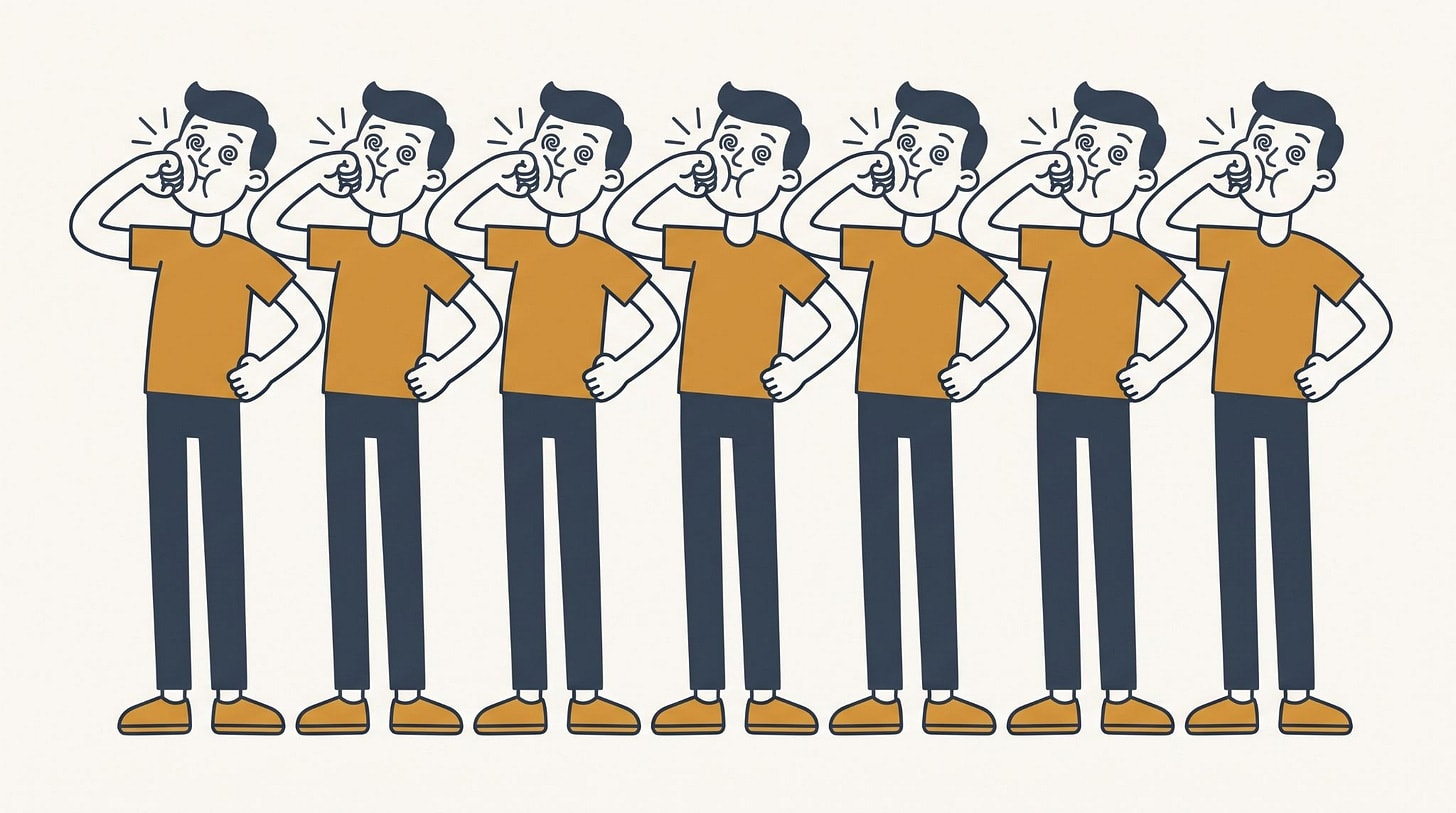
You might have childhood memories of this happening. Another kid in the playground grabs hold of one of your wrists and swings your own hand at your own face. He’s being very annoying and he taunts: “Stop hitting yourself! Stop hitting yourself!“ You’d prefer that it stops - but it is your own hand.
It turns out that if totalist aggregation counts subjectively identical copies of you separately, it too can work against the quality of your own experience, using the quantity of your own experience as a weapon.
This post presents arguments I’ve been developing for why identical copies should count only once in utilitarian aggregation. See Dai (2009) and Kent (2017) for related discussion; Egan (1994) and Alexander (2015) for fictional treatments; MacAskill and Tarsney (2026) for a view that discounts copies gradually by similarity; and Bostrom (2006) for a case against.
Quality vs. quantity
Picture the following from the inside. Identify only with what you’re experiencing. And note what changes and what doesn’t change for you.
Suppose you’re implemented as one copy of yourself. You find yourself in extreme suffering. You’d like to suffer less. Fortunately, there’s a way to do that.
But then I say that lowering the intensity of your suffering comes with a side effect. You are currently one copy. The side effect is that the number of subjectively identical copies of yourself jumps to a million. They are subjectively identical copies, so nothing new is felt by anyone. Each copy is one more instance of what you already feel. By the end of it, you’re implemented as a million copies rather than one.
I say that this is worse under totalist aggregation. Total aggregated suffering would increase, I say. I can’t let you do that to yourself. So, because of this side effect of increasing the quantity of your experience, I can’t lower the intensity of your suffering.
Or consider the mirror case.
Suppose you’re implemented as one copy of yourself. You find yourself in extreme happiness. You wouldn’t like to be less happy. Unfortunately, there’s a way to do that.
I say that lowering the intensity of your happiness to, say, barely positive levels, comes with a bonus. You are currently one copy. The bonus is that the number of subjectively identical copies of yourself jumps to a million. They are subjectively identical copies, so again, nothing new is felt by anyone. Each copy is one more instance of what you already feel. And by the end of it, you’re implemented as one million copies.
I say that this is better under totalist aggregation. Total aggregated happiness would increase. I say that I must do that to you. So, because of this bonus of increasing the quantity of your experience, I have to lower the intensity of your happiness.
In both cases, the same thing happens. What you feel is kept worse, or made worse, for you - all over how many copies of you there are - yet you never feel the number of your copies.
The point of aggregation
The point of aggregating into a utility function is to compare outcomes and make good tradeoffs. Yet, here, the tradeoff is against yourself, for something that is outside of your experience - specifically, the “quantity” of your experience.
You never feel how many subjectively identical copies you are. You only feel the quality of the content of your experience. And that content can be copied many times over, placed at different points in time and space. If you were many copies, or just one, you would never feel it. Even if new copies felt themselves “come into existence”, the existing copies would have to feel it too, or they wouldn’t be identical.
I think it’s a mistake to say that we should make a tradeoff between the quality of our experiences and the quantity of our experiences among identical copies of ourselves. We only feel the quality of it and never the quantity of it. So why should we keep, or make, our experiences worse?
Imagine feeling guilty about it: “I eased my own suffering by increasing the number of my subjectively identical copies, who experience the world, this suffering included, exactly as I do. I’ve done them a disservice!” Or proud of it: “I gave up some of my happiness to increase the number of my subjectively identical copies, who experience the world, this happiness included, exactly as I do. I’ve done them a great service!”
But who’s actually affected in either case? What “they” feel is exactly what you feel right now. It’s only you, where “you” are at the level of the unique perspective shared by all your copies. For moral purposes, this is where “you” are, because that’s already sufficient to determine the felt content of experience. Copies don’t change it. They only place the same content elsewhere.
You might be thinking the issue here is that I’m using “you” and “I” in a particular way. I am, on purpose. When I refer to “I”, I do so from the first person. All I have access to is the qualitative content of this moment, and that’s all that individuates me. To individuate identical copies, you need a third-person view of where and when each is. A third-person view is useful in many domains, but here we’re talking about experientialist forms of utilitarianism, which locate value in what experiences are like from the inside.
Ontologically, we may well be individual experiences implemented by particular physical things, e.g. a specific brain at a specific time and place. Talking about the full set of qualitative properties all our copies share may be an abstraction we layer over a more reductionist picture. We can accept such a reduction. But saying you can reduce things doesn’t settle moral questions, such as how to aggregate. That’s a matter of value and ranking outcomes. For that, what matters is what anyone feels, which is the quality of experience.
For the sake of each perspective, it seems better to aggregate over ourselves as the qualitatively unique perspective shared by all our copies rather than as any copy in particular. For purposes of moral aggregation, we are the type of experience we are rather than the token of experience we are.
What about others?
You might have this objection: you don’t feel others’ experiences either, so why should they count?
This doesn’t apply to qualitatively distinct perspectives. It’s true that they’re also outside of your experience, but they are qualitatively distinct experiences in themselves that aren’t you. More precisely, what you feel and go on to feel is not what they feel or go on to feel. You bear neither their burdens nor their joys.
The point of aggregating into a utility function is to compare outcomes and make tradeoffs. If tradeoffs can be made anywhere at all, and we don’t make them on the basis of numerical distinctness alone, it seems that they should be made here. There’s a qualitative difference between you and them. Things with distinct qualitative properties are distinct things. A difference in what’s felt means that they are just another perspective. So we should make those tradeoffs with qualitatively distinct perspectives.
What about near-copies? Aren’t they different as well? Isn’t there a sharp cutoff between you and them?
We already count near-copies separately in ordinary cases. A moment of suffering followed by a slightly different moment of suffering, if only because it remembers the first, counts as two moments of suffering. We don’t ignore the second moment because it resembles the first moment.
Altruism means to care about perspectives other than your own. I’ve argued that, for moral purposes, perspectives should be individuated qualitatively by what’s felt, rather than numerically by how many copies there are. A near-copy feels something you don’t, so it’s another unique perspective, and by default altruism applies to it.
To say that it doesn’t, or that it matters less, seems to require a rule that the more similar a perspective is to yours, the less it counts. But similarity isn’t part of experience. The notion of similarity is externally imposed - so that doesn’t seem morally relevant here. So I’d count near-copies as distinct. The cutoff is sharp, and I don’t see a reason to blur it.
We can speak of identical properties without speaking of similarity. And that’s what I do here - I’ve only talked about identical copies. There are domains in which “similarity” does matter. For instance, it may be relevant in decision theory, where some differences aren’t decision-relevant. But the question here is whether it’s morally relevant. Yet, so far, the arguments I’ve seen rely on similarity under some metric that isn’t part of experience itself.
Not just totalism
This isn’t limited to totalism. The problem comes from aggregating over tokens of experiences rather than types of experiences. There are a lot of different views, so I’ll just give a quick example for the averagist case.
Suppose you and a friend exist. You exist at -100 welfare. He exists at +100 welfare. You both currently exist as one copy each. So, the average is currently 0. There’s an opportunity to bring you to -10. Under normal circumstances, this brings the average to 45. But I say that there’s a side effect of increasing your subjectively identical copies to one million. Because of that, the average would turn out to be around -10, which is worse than 0. In fact, just having 11 identical copies of you is enough to get the average below 0. You’d be much better off and your friend wouldn’t be worse off, yet I’m blocking this only because your extra copies drag down the average.
Pareto
We can also imagine the totalist and averagist cases across an entire world’s population. If everyone starts off very happy, totalism can favor lowering everyone’s happiness to barely positive levels if it comes with copying each unique perspective, even though every unique perspective would be worse off. If everyone is suffering intensely, totalism can block relief that comes with copying, even though every unique perspective would be better off.
Averagism can do the same when part of the population is happy and the other part is suffering. If the suffering part can be relieved, but only by multiplying their copies, then there can be a number of copies beyond which averagism blocks that relief, even though no unique perspective would be worse off.
Counted by unique perspectives, token aggregation can prefer outcomes that are worse for everyone and reject outcomes that are better for everyone. It breaks the Pareto principle over a difference that doesn’t change how any unique perspective feels or goes on to feel.
Nothing left to do?
Some readers might now think that utilitarianism is paralyzed. If we live in an infinite universe of some sort, all types of experiences probably already exist. Doesn’t this mean there’s nothing left to do?
Not quite. Besides how we feel now, we can care about what we go on to feel. Absolute numbers of identical copies of you aren’t relevant to what you feel right now, so your copies shouldn’t count against you. But relative numbers of copies of future experiences that subjectively continue you can still matter to you and to every perspective whose future runs through you, including your own past moments.
If multiple possible futures exist for us, and they are all subjectively continuous with us, then what still matters is the relative proportions of them, or more generally their relative measure, which we can effectively treat as probabilities of “what we’ll see next”. This is like how branch weights work as probabilities in the many-worlds interpretation of quantum mechanics. Hence, we can still have prudential concern for our futures, and utilitarianism can universalize this concern for all types of experiences. If we can still change those proportions, those relative quantities of experiences that make up someone’s future, then there’s still something to do.
This also explains why it matters how each copy is treated. Copies that are identical now can diverge later. How each is treated matters for the distribution of future experiences that you, at the level of the shared perspective, subjectively continue into.
Similarly, it’s still bad to bring a mind into a suffering state that already exists elsewhere. Bostrom worried that counting copies once would make this harmless. But it isn’t harmless here, because even though the state already exists, it now makes up more of that mind’s future.
What about deleting copies? For simplicity, I framed the tradeoffs earlier as a matter of increasing copies. Whether deleted copies “see nothing” next, or just subjectively continue as the copies that remain (an intuition that’s been called “identical copy immortality“), is a question about continuity. The answer determines what deletion does to the shared perspective’s distribution of futures.
Copies can change where you’re headed, but not how you feel right now. This is part of a broader argument about making subjective continuity a part of utilitarian ethics. I’ll leave the case for valuing continuity, and why it supports what I call the Markov View (or Markov utilitarianism), to other posts.
Concluding note
Counting identical copies separately is overcounting, and it turns aggregation against the very perspectives it’s meant to serve. I think it’s more benevolent to aggregate over ourselves as types of experiences rather than tokens of experiences. Ontologically, it may well be that I am just an experience of a specific brain at a specific time and place, and not this experience of this brain plus another identical experience of another identical brain at another time and place. But for moral purposes, I’m the qualitatively unique perspective of all my subjectively identical copies. If we aggregate over that, I can remain in extreme happiness, or let myself out of extreme suffering. I wouldn’t aggregate against myself. Nobody gets to swing my own hand at me.
7