Comments
Importance: not really important to read this comment
Update: I updated; see my reply
GivingMultiplier's description according to the EA newsletter^1:
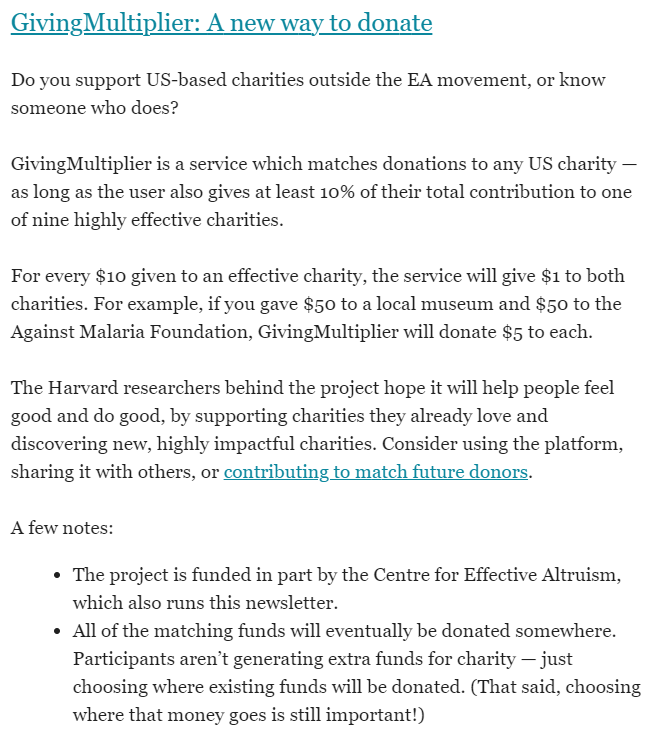
Let's assume Effective_Charity and Local_Charity.
If you were going to give 100 USD to Local_Charity, but instead donate 10 USD to Effective_Charity and 90 USD to Local_Charity, GivingMultiplier will give 9 USD to Local_Charity and 1 USD to Effective_Charity, so there's now 99 USD going to the Local_Charity and 11 USD going the Effective_Charity. GivingMultiplier would give the money to Effective_Charity anyway. So for the donor, this is indistinguishable from donating 99 USD to Local_Charity and 1 USD to Effective_Charity, but it's done in a more obscure way.^2
Also, sure they are rather transparent about their process – at least in the newsletter; it wasn't obvious from the main page of the website –, but still, their scheme mostly works only insofar as people don't understand what's going on.
Potential motives
A bunch of people don't know Why you shouldn’t let “donation matching” affect your giving, and so they will be misguided by donation matches. If EA charities don't use them, then they might be at a disadvantage. So their reasoning might be that the game theory favors also using this technique under a consequentialist moral framework – sort of like a tit-for-tat with other charities, with deceiving donors as an externality.
One could argue that they should link to the piece against donation matching on their website, but maybe both memes are fit to different environments – maybe it would mostly reduce how much people use that specific service to fill their donation matching need, or something like that. I don't know, I'm trying to steelman it.
They might also want to know where people donate money, so they allow people to choose where some money goes among those 9 charities in exchange for knowing where they donate the rest of the money. And at the same time, they signal support for those 9 charities.
Consequences on the donors
If donation matches don't change how much donors give, but just where they give (which seems plausible to me), biasing them equally against all charities might actually help them make decisions that are more aligned with their worldview than if they were less biased with only a subset of them.
Footnotes
1) Their website is actually giving different numbers, but the idea is the same.
2) Sure, there's the real choice of choosing which of the 9 Effective Charities receive the money, but:
a) The part about local charities is a red herring
b) Those charities probably sort-of have reached market efficiency (in the sense that large donors can rebalance their donations according to how much total funding they want each of them to have)
(a) is my main objection.


I'm totally not a mod, but I thought I'd highlight the "Is it true? Is it necessary? Is it kind?" test. I think it's right in general, but especially important here. The Forum team seems to have listed basically this too: "Writing that is accurate, kind, and relevant to the discussion at hand."
I'm also excited to highlight another piece of their guidance "When you disagree with someone, approach it with curiosity: try to work out why they think what they think, and what you can learn from each other." On this:
I agree with everything that Kit has said here. This post might have been in sufficient violation of the Forum's rules to remove (being slightly inaccurate and slightly unkind), but I'm leaving it up (without asking the author to consider changes, as I typically would -- see following comment) because I think Kit's comment suitably addresses my concerns.
EA orgs aren't run by angels. Any community where money changes hands will attract people who want to deceive others, with or without good intentions. But it's really good to reach out to people before accusing them of deception; they could be making an honest error, you could be making an honest error, or the issue could simply be a difference of opinion within a moral gray area. We're working in a field with many complex questions (moral and logistical), and the best first reaction to confusion is communication.
I agree with what Kit said as well.
But that the only reason you're not removing it is because of Kit's comment makes me pretty concerned about the forum.
I also disagree that private communication is better than public communication in cases like this.
I should have been more clear on that point -- thanks for the comment. I've changed my reply to add the phrase "without asking the author to consider changes, as I typically would". I can see how the original reply could have been concerning.
On handling posts that may violate Forum rules:
My first act for any post that seems to violate rules is to contact the author and express my concerns; I've done this ~20 times in the last two years. (The exception to this is for a post that is in stark violation of rules -- e.g. an insult with no further content, or obvious spam.)
If the ensuing discussion doesn't lead me to change my view on whether the post violated a rule, and the author declines to make changes to the content in accordance with the Forum's rules, the post might (again, might) be moved back to "draft" status (we don't delete non-spam content -- we want the author to be able to share things elsewhere even if the Forum doesn't permit them).
Of the aforementioned ~20 instances, I removed content one time when the author never replied (this was a comment that shared provably false and inaccurate information about a named person in a way that was hard to correct with a reply). On one or two other occasions, authors chose to remove their work.
In every other case, I was convinced by the author, the author made light edits (generally of the "softening tone without changing substance" variety), or a discussion developed that seemed valuable enough for leaving the post up to be a net positive.
On private vs. public communication:
The big difference is that, in most cases, you can move from a private to a public discussion more smoothly than vice-versa. Once a public accusation has been made, confusion and concern tends to linger, whatever the substance of the accusation. You can see this in action when a false Tweet gets 50 times as many retweets as the correction.
Public accusations also tend to lead to bitter fights that could have been avoided with a private conversation: Forum User A leaps to defend the accused, Forum User B fires back, and meanwhile the person/org in question would have been happy to clarify their point/edit their website/etc. if only someone had told them.
(On that note, I've sent this post along to Lucius of the GivingMultiplier team.)
Thanks for the clarifications.
I don't want to argue for what to do in general, but here in particular my "accusation" consists of doing the math. If I got it wrong, am sure other got it wrong too and it would be useful to clarify publicly.
Thank you.