Headline finding: I audited 17 AI Safety Talent programmes. Zero of 17 have published any comparison group, rejected-applicant follow-up, matched control or randomisation. Not one. Every programme that mentions a counterfactual does it by asking participants to self-report.
Background
At least $70 million...
Author: Grace Ryba (she/her), Executive Director
TL;DR:
* BluePerch is a new animal welfare grantmaker.
* Grant applications aren't open yet - we're aiming to open applications in roughly mid-2027.
* We welcome early expressions of interest from potential grantseekers so we can notify you when applications open - express your interest here or see further details below.
* We're also seeking boa...
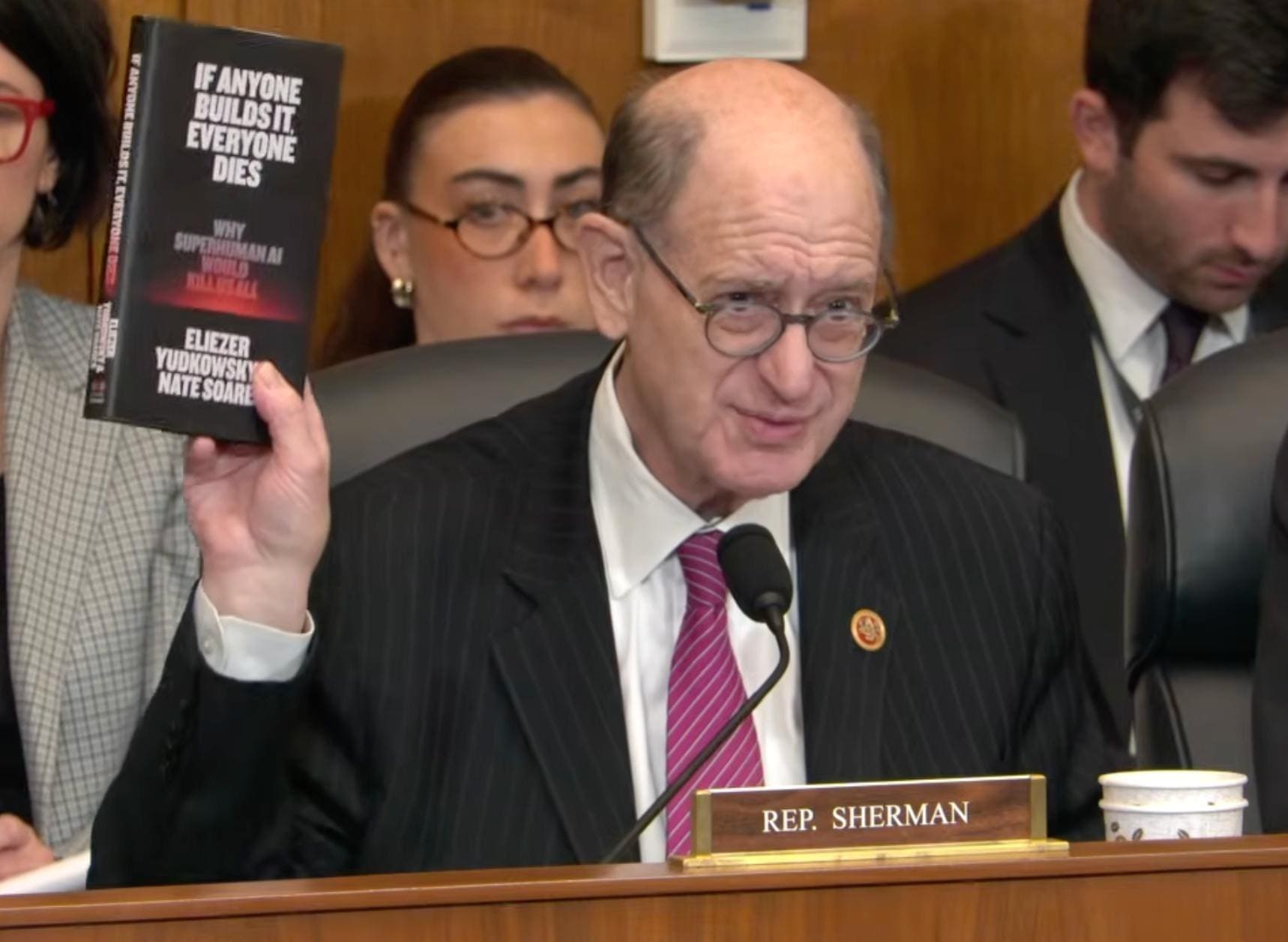
In celebration of still being alive and fighting, we are giving away 1,000 Amazon e-books of “If Anyone Builds It, Everyone Dies”. Feel free to send a copy to yourself, a loved one, or a friend—we need all hands on deck.
Today marks exactly one year since If Anyone Builds It, Everyone Dies: Why Superhuman AI Would Kill Us All, by Eliezer Yudkowsky and Nate Soare...


Summary: Thinking out loud about the J space paper’s implications on future animal welfare research (if there are any). I don’t know much about LLMs or brains or animals but I’d love to chat about this stuff with anyone at my same level of smartness, or learn from folks who know things.
It would be good to have some people thinking about the J-space paper and what, if anything, it has to do with animal welfare. A popular question about animal brains is “what’s going on in there?”. If we get some vague notions about the conditions and size ranges where neural nets act like global workspaces, it might give us some order of magnitude estimates and fuzzy intuitions about what sizes and types of animal brains exhibit those properties.
Some questions that seem interesting:
Maybe effective utilization of J-space requires slack in pretraining in addition to scale. Perhaps you get room to develop this stuff from excess compute when you’ve hit diminishing returns from hardcoding more explicit methods for the tasks you handle.
or (more likely?) the opposite is true - the need to address a broad task range with limited compute forces many workstreams to share computational resources, resulting in abstraction, resulting in segmentation of the abstract stuff from the concrete stuff. Which resource availability helps you grow a good workspace? Lots of free parameters, or not enough? First one then the other?
What model organisms are the most “animal-like” if we want to vary parameters and look at their effect on the usefulness and recognizability of access consciousness? None are great analogues, but what’s the closest we can get?
Do the ablation experiments in the J-space paper map onto lesioning experiments in different parts of animal brains?