Comments
This post is Chapter 8 of my book Compassionate Purpose (free PDF, free EPUB).
Few aspects of the world are as important for us to understand as the human mind itself. My aim in this chapter is to explore some key findings about how the human mind works so that we can better navigate its strengths and pitfalls.
As a preliminary note, it is worth emphasizing that the unflattering aspects of our minds explored in this chapter are not something we should blame ourselves for. As many psychologists have stressed, we all have tricky brains with certain frailties and mischievous tendencies, and none of us chose to be born this way. What we can choose, however, is to courageously face up to any inconvenient truths we may uncover about our tricky brains, and to take responsibility for how we use our minds going forward.[1]
A key fact to appreciate is that our minds are composed of many parts, and these parts often have conflicting aims. Such internal conflicts are familiar to all of us in the struggles between our immediate impulses and our long-term goals. Yet our internal conflicts are not just a polarized struggle between two parts, but rather an ongoing competition and bargaining among many parts.
To mention just a few, we have parts that are driven by motives of compassion, curiosity, mating, social belonging, and reputation enhancement. Of course, these drives and motives are not altogether independent of each other, but they are still distinct, as evidenced by the fact that they can sometimes come into conflict with one another.2[2]
A crucial implication of this diversity of motives is that even if some parts of our minds are genuinely driven by high-minded ideals of helping others and reducing suffering, there are still other parts of our minds that are not. This may seem like a trivial point, yet it nevertheless contrasts with the way we usually talk about ourselves, as though we were a unified blob of singularly focused aims and ideals. Even when we do acknowledge that we are composed of many parts, we still tend to present ourselves as though we have a fairly high level of internal alignment toward the same overarching aim. But this simple narrative obscures the true level of tensions and divergences inside our minds.
When we say things like “I am aiming to help sentient beings as much as I can”, we are really (at most) speaking on behalf of a rather limited part of ourselves. Of course, it may be helpful to speak in this way, as we might give this part of ourselves greater power by actively affirming its goals. Yet even as we rightly affirm and elevate our more ethical and compassionate goals, it is still worth being aware that there are many other parts of ourselves that have decidedly different motives.
Why is it worth being aware of these other parts? A major reason is that we will otherwise have a false view of our own mind and its motivations, which risks derailing our compassionate aims. In particular, if we believe that our compassionate motives reign unchallenged within our own minds, we are unlikely to be sufficiently vigilant toward the influence of our more self-serving motives. Indeed, our self-serving motives may even dictate our behavior under the guise of compassionate motives, such as by prompting us to pursue actions that make us appear compassionate, yet which are not that effective at actually helping others. Given such risks, it is worth being skeptical about our own motives.3[3]
To be clear, the point is not that one set of motives must win out by forcefully beating all others, which is hardly realistic in any case. Rather, the point is to aim for a pragmatic balance in which our different motives work together such that they each add whatever helpful contributions they can. For example, as noted in the previous chapter, our curiosity-based drives probably have unique advantages that are worth harnessing, and the same can likely be said about a healthy concern for our reputation. The challenge is just to prevent any of these drives from becoming excessive such that they undermine our impact.
Beyond being aware of the various parts of our minds, we may also benefit from appreciating and respecting our different parts, including the many parts that are not primarily concerned with reducing suffering. After all, running our minds like a tyrannical government that forces all its constituents into strict submission to a singular goal, without any room for compromise, is probably not a sustainable way to function, let alone an optimal one. Instead, it seems more sustainable to make compromises that properly respect the needs and burdens of our intrapersonal parts, just like we would make respectful compromises and concessions in our interpersonal relations.
For example, when it comes to our protective and anxious parts, we may at times feel like these parts do little more than burden us with too much vigilance and worry. Yet from another perspective, we can see that these parts serve crucial functions in terms of keeping us safe. In the spirit of internal family systems (IFS) therapy, we may find greater inner cooperation and self-appreciation by giving some credit to these parts.4[4]
Our minds not only have many distinct parts, but many of these parts are also largely hidden from our own awareness.5[5] In particular, our minds appear to hide our more selfish and competitive motives: the kinds of motives that are commonly discouraged by our social norms, and which it is therefore in our self-interest to downplay.[6]
But why would we downplay these motives to ourselves? Why not just downplay our selfish motives in our communication with others while being fully aware of them in our own minds? A plausible reason is that we can better convince others of our noble and cooperative motives — and of the relative weakness of our selfish and competitive motives — if we sincerely believe in such a noble and cooperative picture of ourselves. As evolutionary biologist Robert Trivers writes: “We deceive ourselves the better to deceive others.”[7]
For example, when we engage in behavior that helps others, we might tell ourselves that our behavior is purely driven by a motive to help others, in effect downplaying any motive we may have to boost our own reputation and status in the eyes of other people. It is not that we deny that our reputation might get a boost from our altruistic actions, but we generally do deny — or at least refrain from admitting — that this is a significant motive driving our actions. That, after all, would appear more selfish and less praiseworthy than if we were driven purely by the goodness of our hearts.8[8]
Consequently, if we are aiming to appear altruistic and praiseworthy, we have an incentive not to admit that we are aiming for that appearance to any meaningful extent.9[9] And plausibly the best way not to admit to such status-seeking motives is to internally downplay these motives and to sincerely believe that our altruistic motives alone are driving our behavior.10[10]
Yet the truth is that we do possess strong competitive and selfish motives, and these motives often greatly influence our behavior, including our altruistic behavior. We evolved in an environment marked by competition for mates and alliances, and the only way our ancestors were able to reproduce was by succeeding in those competitions — even if that was often best achieved by competing to be the most admired do-gooder.11[11] In other words, our ancestors faced an intense selection pressure to be effective competitors in the social world, and this selection pressure has greatly shaped our basic drives and motives.12[12]
Perhaps the most prominent of our hidden motives is our drive for social status. It can be difficult to pin down what social status is exactly, yet we can broadly understand it as our social standing and esteem in the eyes of other people.
The empirical literature suggests that the desire for status is a fundamental and universal human motive.[13] Moreover, studies reveal that our status drives are deeply competitive in nature. That is, we are not content to merely gain recognition and regard from others, but we specifically want to gain more recognition and regard than other people get, so much so that we often prefer having higher status than others even if it means that everyone will have lower status or fewer resources in absolute terms.[14]
This also appears true in the context of altruistic and moral behavior. For example, studies suggest that our altruistic behavior is often motivated by reputation enhancement — not just so that other people see us as altruistic, but specifically so that they see us as more altruistic than other potential cooperation partners whom they could choose over us.[15]
In line with the claim that we hide our unflattering motives, studies suggest that we tend to conceal our status motives, both from others and from ourselves. For instance, we have a strong tendency to believe that we are less motivated by status-seeking than other people.[16] We are quite aware that status-seeking is a powerful motive for humans in general, but we typically deny that this applies to ourselves.[17] This suggests that we cannot simply trust our internal sense of how strongly we are driven by status motives versus more flattering motives. If we are motivated by both compassion and status-seeking, our mind is inclined to greatly accentuate our compassion while downplaying our status motives.
Another key feature of social status is that it is context-dependent. For example, in some communities, the way to increase one’s status is by wearing a suit and tie, while in others it is by wearing goth clothes with images of skulls. The same goes for accomplishments: in one kind of community, high status may be associated with climbing the corporate ladder, while another community may confer status on those who create anti-corporate indie music. The ways in which we seek status can vary greatly, yet the drive for status itself is remarkably consistent.[18]
The points reviewed above have significant implications for our efforts to reduce suffering. Our hidden drives for social status can bias our priorities toward activities that gain us social status instead of helping others most effectively.
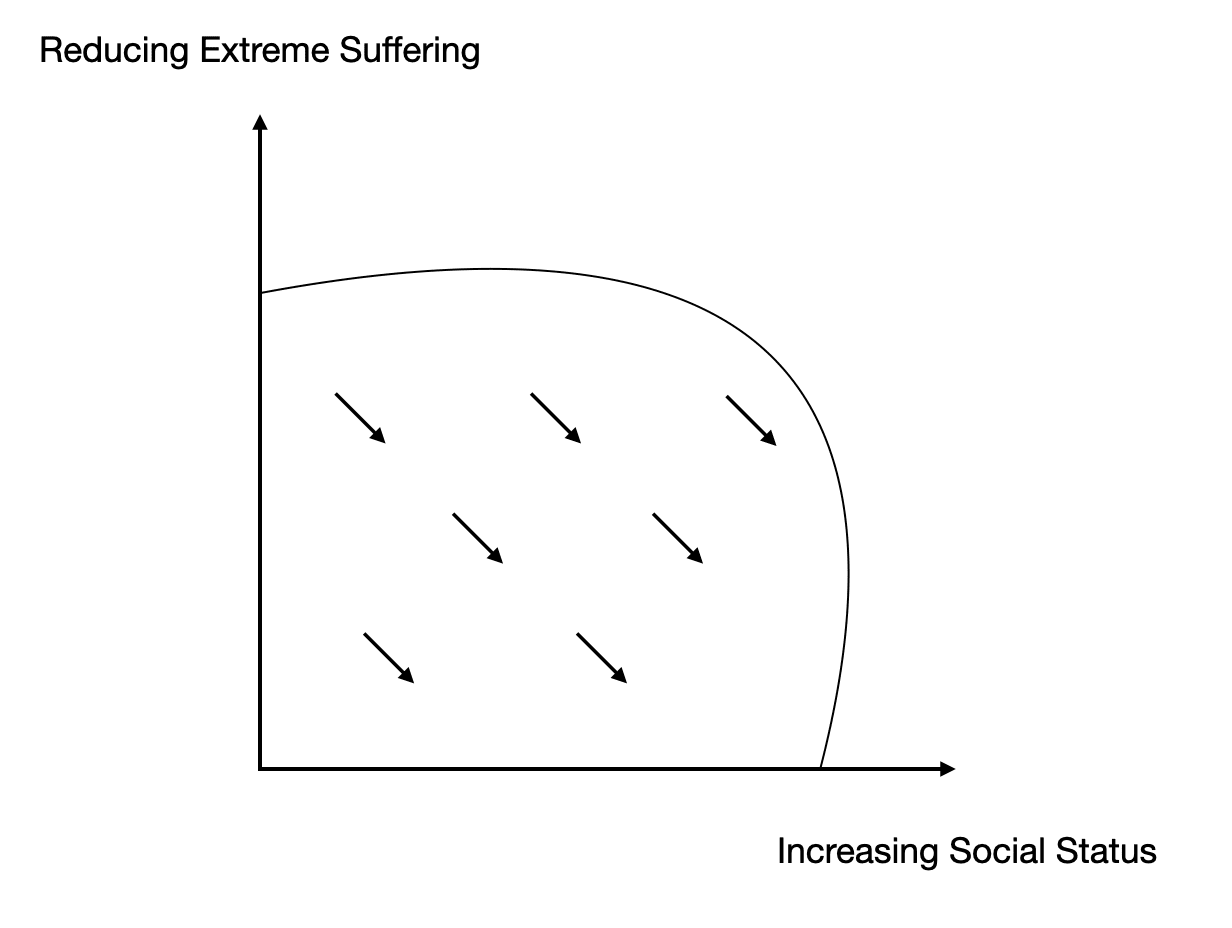
This tension is shown in the figure below, which illustrates the potential tradeoffs between reducing extreme suffering and increasing our social status. Specifically, the figure shows a tradeoff frontier that represents the maximum degree to which our actions can simultaneously reduce extreme suffering and increase our social status. The small arrows symbolize the pull that our status drives tend to exert toward increasing our status and away from effectively reducing suffering. (The arrows point somewhat down rather than straight to the right because there are typically tradeoffs between increasing our social status and reducing suffering.)
Consider John, who genuinely wants to help reduce suffering and is trying to figure out how. One day he comes across a neglected path that could likely spare many beings significant suffering, yet this path is hard to explain to others and involves behind-the-scenes work for which someone else gets the credit. He feels no real pull toward it. Then he notices a more visible path whose impact is less clear, yet which lets him engage with impressive ideas and earn recognition from people he admires. He finds himself energized by the prospect. Without quite realizing it, he begins to build a case for the visible path and eventually convinces himself that it is the better one.
This kind of drift is common. Status motives often pull us toward prosocial actions that are highly visible and that make us look better than other people, rather than toward more helpful actions that fail to make us look impressive.
Further examples of plausible status distortions include a pull away from strong impartiality toward all sentient beings (since it goes against partiality toward our human audience) and a tendency to focus on popular topics at the expense of urgent problems that most people are ignoring (because we can often better gain attention and recognition by reading and talking about the more popular topics). In general, our status motives may bias us to shy away from endorsing unpopular views and priorities, and to adopt widely approved and admired positions.
Additionally, there may be a bias to pursue altruistic actions that show off our intelligence and knowledge, such as by doing work that involves advanced and hard-to-grasp ideas. This might make us reluctant to pursue relatively simple actions and priorities that could perhaps help more overall, yet which fail to show how smart and sophisticated we are.
Relatedly, our drives for social status may push us toward adopting the stance of a teacher, even when it would be more appropriate for us to humbly learn as a student. Being a humble student can be seen as more submissive and lower in status, whereas a teacher is commonly seen as an authority and someone of higher status. (Yes, this point about assuming a teaching or guiding role should absolutely give me pause and make me reflect on my own motives for writing this book.)
Status motives can also bias us toward viewing altruistic endeavors from a single-player perspective that is aimed at individual heroism and leadership, and toward neglecting perspectives that are centered on collective action and collaboration. The single-player hero mentality aligns well with individual status-seeking, whereas being an effective helper in a larger multi-player effort may feel less rewarding for our status drives, even if it is ultimately more helpful.19[19]
Confronting our hidden status motives may feel challenging and uninviting, yet it is worth keeping in mind that there is a lot to gain in this area. Specifically, the fact that our status motives tend to be both strong and hidden suggests that the distortions they create are often both large and unlikely to be corrected by default. In this way, the distorting influence of our hidden status motives can be seen as an exciting opportunity to discover large inefficiencies in our efforts to help others, and thus an opportunity for making large improvements.
When searching for such inefficiencies, it is tempting to mostly look for status distortions in other people’s behavior, and perhaps even to point fingers. Yet as tempting and satisfying as it may be to look elsewhere, it is often more helpful to seek out and reduce these inefficiencies in ourselves.
After all, pointing at other people’s apparent status distortions is likely to trigger defensiveness. Conversely, each of us may be the only person who can shine a light on our own status distortions without triggering a wall of defensiveness — or at least we might be the person best able to minimize our defensive reactions. Moreover, by being humble and open about our own status distortions, we may encourage others to engage in the same self-reflection.
The previous sections have explored how our status drives can distort efforts to reduce suffering. Yet these drives can also be beneficial in some contexts.
For example, if we find ourselves in a community that cares about effective suffering reduction, following our drives for status might sometimes be helpful. In such a community, increasing social status and reducing extreme suffering may be correlated, and hence our status drives may often pull us toward actions that reduce suffering rather than away from them, as illustrated by the upward-pointing arrows below.
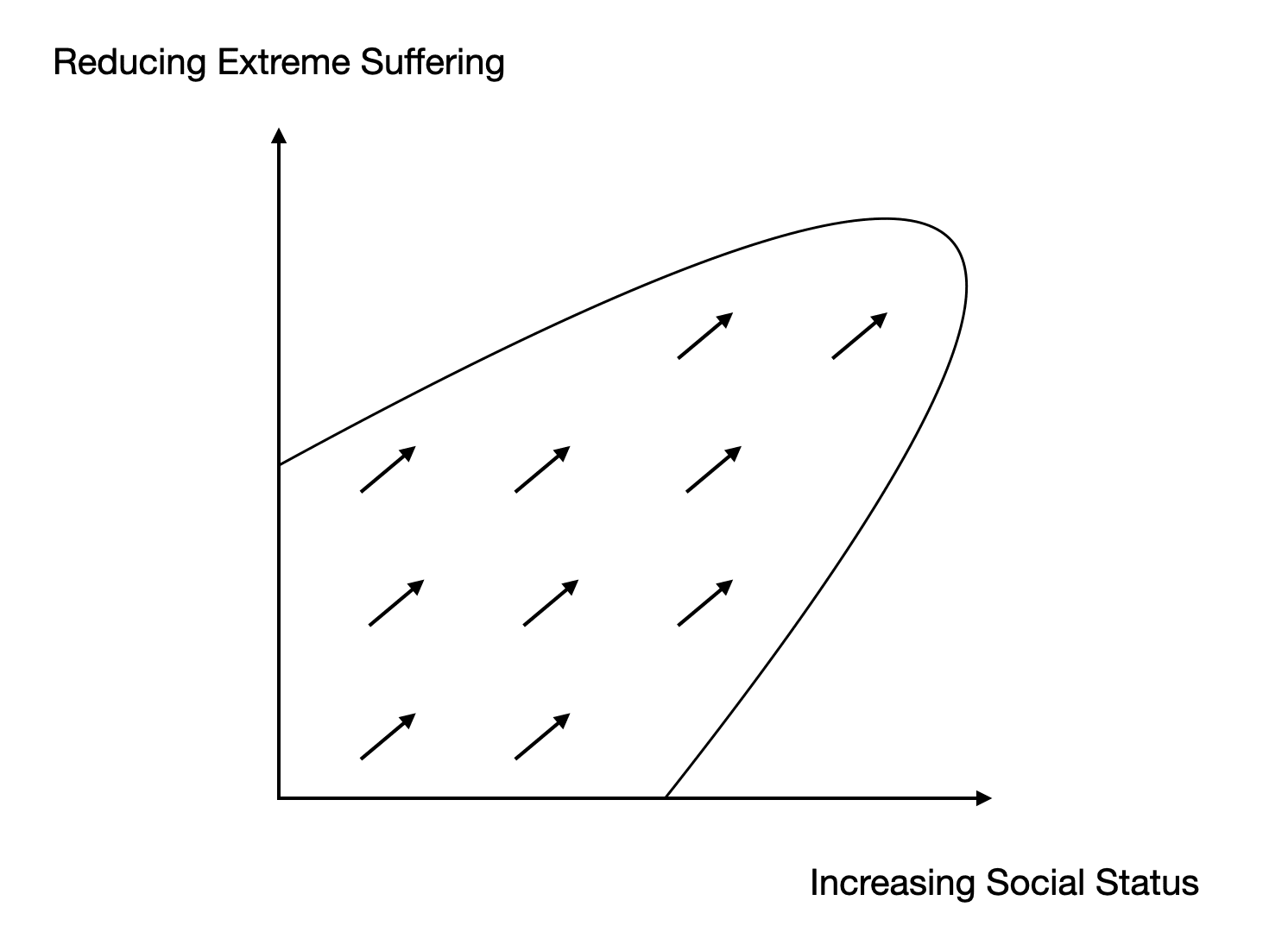
The stark contrast between situations in which our status drives pull us away from rather than toward reducing suffering hints at the importance of creating communities with good incentives. To be sure, there will always be some divergences between the respective aims of reducing suffering and maximizing status, yet moving toward communities and incentives that are at least more aligned with compassionate impact still seems highly beneficial.
There are also strategic reasons to think that our status motives can be worth following to some extent. For better or worse, people tend to judge us based on our perceived social status, and these judgments often influence people’s willingness (or lack thereof) to listen to our perspectives and support our priorities. This does not mean that we should seek to maximize our social status in order to gain greater influence, but it does suggest that it would be a mistake to dismiss social status as altogether irrelevant. Some level of sensitivity to social status is probably helpful.
Yet even if our status drives can be helpful, we should still be careful not to underestimate how these drives can be a powerfully distorting force in our minds, all while hiding from our awareness. Are we using our status drives to advance our compassionate impact, or are these drives using a veneer of compassionate impact to advance our social status?20[20]
Beyond our drives for individual status, we also have drives aimed at forming and maintaining effective coalitions. In the words of psychologist John Tooby, we humans have strong “coalitional instincts” that enable us to navigate social alliances and that make us quietly obsessed with coalitional success.[21]
For example, in politics, we often focus more on supporting our own group and outdoing other groups than on creating better outcomes in impartial terms.[22] Likewise, we often seem highly concerned with signaling loyalty to our own political groups and coalitions — thereby increasing our intra-group status — while being less concerned with improving policies, even when we claim to mostly care about the promotion of better policies.[23]
Moreover, studies suggest that our minds tend to process groups and group members in an emotionally charged manner. In particular, we instinctively paint our political outgroups in an unfavorable light and process them with negative affect, whereas we paint our own groups in a favorable light.[24] A critical point about these emotionally charged processes is that they tend to occur automatically and unconsciously. Before we can form a reflective thought about a given group or person, our minds will already have colored our thinking based on our own coalitional relation to them.[25]
We also tend to show greater empathy toward people in our ingroup. For example, one study scanned people’s brain reactions to a painful stimulus applied to a hand labeled with their own religion (which could include “no religion”) compared to a hand labeled with a different religion. Even with this minimal marker of group status, the researchers found a significantly stronger empathic response when the hand was labeled as belonging to the ingroup.[26] Similar empathy biases have been found in the context of other group identities, including national and racial identities.[27]
In short, our minds are deeply coalitional in ways that influence many aspects of our emotions and cognition. Importantly, this orientation does not require any awareness or effort on our part: our minds automatically shape our perspectives along coalitional lines. Thus, what requires effort is to become aware of our coalitional instincts and to reduce their biasing influence.
Just like our individual status drives can distort our efforts to help others, so can our coalitional instincts, and hence we likewise have good reason to reduce such coalitional distortions.
A helpful first step might be to reflect on which groups and coalitions we instinctively perceive as our own, as well as which groups we perceive as our rivals. For example, we may naturally feel a stronger sense of group identity with people who share our geographical location, belong to our social circle, or agree with our moral and political views.
Having gained greater clarity on our instinctive allegiances, we may seek to actively control for the ways in which our minds skew our outlook in favor of our own coalitions and against rival coalitions. For instance, it might take effort to be able to see the mistakes and misdeeds of our fellow group members, let alone to be willing to criticize them. Similarly, it may require effort to see the potential merits of the views and activities of our outgroups, and not least to be willing to openly acknowledge these merits. In general terms, our coalitional distortions suggest a heuristic of trying to be more critical toward our ingroups and more charitable toward our outgroups.
A related distortion to control for is our tendency to focus too much on gaining prestige and power for our own coalitions, as opposed to focusing on how we can create better outcomes in impartial terms. To be sure, increasing the prestige and influence of our own coalitions can sometimes help create better outcomes, but as tribal creatures, we probably tend to overestimate how convergent these aims are.
The same applies to our instinctive tendency to signal loyalty to our coalitions. For example, when engaging in polarized discussions, are we trying to create better outcomes on behalf of all sentient beings, or are we trying to signal our loyalties and increase our personal status among our allies?
In general, it may be helpful to be aware of our tendency to be strongly interested in group-related labels and identities, while being less interested in more identity-neutral questions about how we can best reduce suffering. To our coalitional brains, such questions may feel boring by comparison. It may thus be helpful to dampen the sense of importance that we naturally assign to group-related labels and identities, while increasing the importance we give to questions about how we can create better outcomes from an impartial perspective.
Another coalitional distortion is excessive conformity with our peers. Specifically, our coalitional minds may have little motivation to question core assumptions that are shared among our allies, and we might also copy the behavior of our peers without giving it much thought. This can result in echo chambers and groupthink, limiting our thoughts and actions to an unduly narrow range, and it might even lead us to copy unethical behavior due to a lack of critical reflection.
Such patterns of conformity and imitation also apply to perceived thought leaders. For instance, if we come to see a given intellectual as being part of our coalition, such that we in some sense identify ourselves as being on their side, we may instinctively jump to their defense when their views get criticized and generally be less open and fair-minded toward critiques of their views. This is a potential downside of having intellectual heroes: we may become blind to their shortcomings.
Lastly, similar to how our drives for individual status are not all bad, it is worth noting that our coalitional instincts can also serve helpful functions. After all, skillful coalition-building is key to creating a healthy and effective community aimed at reducing suffering, as well as for gaining support for compassionate policies among the broader population. The challenge, again, is to use the advantages of our coalitional instincts while reducing their potential distortions.
Our beliefs form the map by which we steer. This makes it crucial that we get our beliefs right. A problem, however, is that our beliefs often serve functions other than just the epistemic function of representing the world: they can also serve as badges that signal certain features about ourselves.[28]
A helpful analogy is to think of the many functions of clothes. Our clothes serve the functional purpose of keeping us warm and covering our bodies, yet they also tend to serve social functions. For example, someone who wears a sports jersey may show loyalty to their team, while someone who wears merchandise from an obscure band may signal a unique and discerning taste.[29]
The point of the analogy is that our beliefs often serve similar social functions. For instance, in contentious discussions, we may express beliefs that serve as clear signals of our coalitional allegiances, while withholding beliefs that could be construed as expressions of disloyalty.[30] Similarly, to sound impressive in intellectual discussions, we may express an opinion on the promise of string theory, or on the consequences of a given economic policy, even if we barely understand the basics of these topics.[31]
Unfortunately, the social functions of beliefs can cause severe distortions in their accuracy, in ways that we are often unaware of. We may just feel a strong urge to endorse beliefs that align with those of our group, or which portray us as smart and virtuous individuals. We rarely have an internal red flag that warns us that our urge toward socially desirable beliefs likely pulls us away from accuracy.
A natural recommendation is thus to become more aware of these social pressures on our beliefs. Even if we imagine that we are uniquely rational and that we belong to the “rational tribe”, we are still human and hence still subject to these pressures. In particular, it is useful to become alert to the potential divergence between beliefs that are socially desirable and beliefs that are factually accurate.
One of the key social functions of beliefs is that shared beliefs can promote affiliation and mutual support. For example, studies have found that we perceive people who share our moral and political views as being warmer and more competent.[32] Indeed, even sharing trivial labels of social categorization, such as being randomly labeled as an “underestimator” or “overestimator” in an estimation task, can be enough to elicit ingroup favoritism.[33]
This may help explain our eagerness to signal shared beliefs with our peers: if shared beliefs are a path to ingroup support and cohesion, we might instinctively fear losing out on this resource if we fail to publicly affirm those shared beliefs. Moreover, this affiliative function may help explain cases in which people suddenly change their beliefs and start criticizing the views they used to hold after falling out with their peer group: if a person is no longer socially bound to a given group, the pressure to conform to the defining beliefs of that group may disappear, and the person might even start criticizing those beliefs as a signal of defiance and opposition.
The human mind evolved to succeed in domains that were relevant to reproductive success in our ancestral environment. We did not evolve to be effective at reducing suffering in an impartial manner, but rather to elevate our personal status and navigate coalitional struggles, among other parochial aims. It is thus to be expected that our minds possess strong biases that work against the aim of reducing suffering, and that serious effort is needed if we are to reduce these biases.
This may seem like a daunting task. Yet by becoming more aware of our drives for status and coalitional success, there is hope that we can temper these drives and orient ourselves — at least to a greater extent — toward compassionate impact.
This point about our tricky brains is often made by Paul Gilbert, see e.g. Gilbert, 2014. For more on the natural frailties of our minds, see e.g. Nesse, 2019, ch. 3.
For some sources that explore the many distinct and often competing parts of our minds, see e.g. Ainslie, 2001; Haidt, 2006, ch. 1; Kurzban, 2011; Kenrick & Griskevicius, 2013, ch. 2; Schaller et al., 2017; Simler & Hanson, 2018, ch. 5.
For more on reputational concerns as a driver of moral behavior, see e.g. Barclay & Willer, 2007; Sperber & Baumard, 2012; Barclay, 2015; Wu et al., 2016.
For an introduction to IFS, see Schwartz, 2021. In my view, a major shortcoming in IFS as presented by Richard Schwartz is that he seems to portray our compassionate self as some core “essence of goodness” or some core Self, Schwartz, 2021, pp. 68, 100–101. For contrasting perspectives that understand our compassionate self and identity as something that we develop, see e.g. Gilbert & Choden, 2013, ch. 10; Wayment et al., 2015; Matos et al., 2022.
Nisbett & Wilson, 1977; Wilson, 2002.
Haidt, 2006, ch. 4; Trivers, 2011, ch. 7; Tuschman, 2013, ch. 22; Simler & Hanson, 2018, ch. 5; Thielmann & Burghart, 2025.
Trivers, 2011, p. 3. See also Simler & Hanson, 2018, ch. 5. Some critics argue that self-deception is not the ideal term for describing this phenomenon, as they dispute whether there is outright deception going on (see e.g. the commentary in von Hippel & Trivers, 2011). However, many of these critics still seem to agree with a modified framing like “we strategically hide information from ourselves the better to hide it from others”.
Bai et al., 2020a. See also Kim & Pettit, 2015; Pinsof, 2023; Thielmann & Burghart, 2025.
Such apparent paradoxes involved in being unable to admit to our motives are explored in Pinsof, 2023.
Cf. von Hippel & Trivers, 2011; Kim & Pettit, 2015; Simler & Hanson, 2018, ch. 6.
Cf. Hardy & Van Vugt, 2006; Bai et al., 2020b.
See e.g. Cheng et al., 2014; Anderson et al., 2015; Anderson & Hildreth, 2016; Simler & Hanson, 2018, pt. I.
Anderson et al., 2015. See also Wright, 1994/1995, ch. 12; Henrich & Gil-White, 2001; von Rueden et al., 2011; Cheng et al., 2013; 2014; von Rueden & Jaeggi, 2016.
Solnick & Hemenway, 1998; Anderson & Hildreth, 2016; see also McClendon, 2018, pp. 23–28. People often display similar rank-focused preferences at the group level, Tajfel, 1970; Tajfel et al., 1971; Mutz & Kim, 2017.
Barclay & Willer, 2007; Sperber & Baumard, 2012; Barclay, 2015; Wu et al., 2016. See also Hardy & Van Vugt, 2006.
Kim & Pettit, 2015.
Kim & Pettit, 2015; Anderson et al., 2015. See also Haidt, 2006, ch. 4; Tappin & McKay, 2017; Simler & Hanson, 2018, ch. 5.
Anderson et al., 2015, p. 575.
For more on the distinction between single-player and multi-player perspectives in altruistic endeavors, see Todd, 2018.
Again, for more on the hidden nature of our drives for status, see e.g. Kim & Pettit, 2015; Simler & Hanson, 2018, pt. I.
Tooby, 2017. See also Tooby & Cosmides, 2010; Boyer et al., 2015; Hanel et al., 2018; Clark et al., 2019; Pinsof et al., 2023.
See e.g. Cohen, 2003; Achen & Bartels, 2016, ch. 8; Mutz & Kim, 2017; Van Bavel & Pereira, 2018; Pinsof et al., 2023.
See e.g. Simler & Hanson, 2018, ch. 16; Marie & Petersen, 2023. See also McClendon, 2014; 2018; Hanel et al., 2018; Page, 2023; Robbett & Matthews, 2025.
Lodge & Taber, 2005; Iyengar & Westwood, 2015.
Lodge & Taber, 2005; Iyengar & Westwood, 2015. See also Kunda, 1990; Vinding, 2022a, sec. 3.2; Pinsof et al., 2023.
Vaughn et al., 2018. See also Montalan et al., 2012; Eres & Molenberghs, 2013.
See e.g. Molenberghs, 2013; Bruneau et al., 2017; Han, 2018. The extent to which racial identities give rise to empathy biases seems to depend strongly on cultural factors, cf. Boyer et al., 2015, p. 439.
Hanson, 1997; Simler, 2016; Funkhouser, 2017; 2022; Hanel et al., 2018; Van Bavel & Pereira, 2018; Williams, 2021a; 2022; 2023a; Page, 2023; Westra, 2023; Robbett & Matthews, 2025.
Hanson, 1997.
Marie & Petersen, 2025; Robbett & Matthews, 2025. See also Kahan, 2017; Hanel et al., 2018; Van Bavel & Pereira, 2018.
Cf. Fernbach et al., 2013; Williams, 2021a.
Byrne, 1961; Fiske, 2015.
See e.g. Tajfel, 1970; Tajfel et al., 1971; Montalan et al., 2012.


Executive summary: The author argues that human minds are fragmented, self-deceptive, and strongly shaped by hidden status and coalitional motives, which systematically bias our efforts to reduce suffering unless we actively recognize and mitigate these influences.
Key points:
This comment was auto-generated by the EA Forum Team. Feel free to point out issues with this summary by replying to the comment, and contact us if you have feedback.