At a first glance, this seems to only track how much money was raised, not how much impact was generated.
It also seems that the hard-coded percentages remove some of the advantages of impact markets (but maybe I looked at the demo too much and your actual proposal is different from that).
What I like about traditional impact markets is that it can be modeled with VCs as selfish actors and final oracular funders as altruistic actors. Mixing these two makes the proposal confusing to me, for example it is not clear to me why a later (altruistic) donor would buy out an earlier donor, instead of giving the money directly to the project.
Yep, it's currently tracking how much money was raised. I think this isn't a useless signal, because big funders are evaluating projects' impact when deciding how much to fund them, but it's definitely not the only signal we want. I think a cool next step (for Manifund or for anyone else, and hopefully in the long term to be done by many people) would be to do some rough cost-effectiveness analyses of these orgs and then make markets around those estimates.
This article was brought to my attention by a discussion with @Austinhere. My main critique is in line with @harfe, cross-posting here:
[In the proposed impact market model] An org's valuation is implied by how much money it raises later. This measures how well a funder anticipated other funders, not the actual impact.
At a surface level this appears congruent with how the for-profit world operates. Startup valuations are also set by the money raised in later rounds. However there's a crucial difference - the value of firms is ultimately grounded in the expectations of future output in a way that value of non-profits can't be. Equity prices are guesses about very concrete future cash flows from people buying things the firm offers. The accuracy of those guesses can be ultimately checked against something that isn't another investor's opinion. The output is uniform - a dollar earned on a grocery store chain is the same as a dollar earned on an AI company[1].
In contrast, EA orgs aim for "positive impact" which can be quantified only by a very subjective evaluation with multiple assumptions, not by any market mechanism. The output is not uniform. Even if we had perfect measurement (we don't) I might value 1 human QALY above 1000 shrimp QALYs while you do the opposite.
This results in money invested being a much worse proxy for outcomes in a non-profit world than in the for-profit one. If I invest $1 M in Uber instead of Intel, I signal to everyone that I believe Uber is more likely than Intel to be worth more in some time horizon. If I invest $1 M in AMF instead of AWF, the signal is not clear. I might consider AMF to be more efficient than AWF but I might instead assign a higher value to human lives or simply have funds which are earmarked for GHD.
At least to a good approximation. Individual investors may choose to price in externalities, e.g. treat a grocery store dollar as "better" than the same dollar coming from an oil or tobacco company.
I agree this is a difference and it makes it a worse signal than in the for-profit world, but I still think it has the potential to be a good signal. Our opinions of how much good was done by something or something converge somewhat over time, both because of changing morals and because time simply allows us to better see the retrospective impact of something. We may not have a perfect estimate down to the dollar of how much good a past project did, but I think our estimates do get better over time, which is the motivation behind retroactive funding.
If I understand the 1/(t+5) schedule correctly, it means the price of capital can't move in response to supply. In the for-profits investment markets it does: more investors competing to invest = less equity for the same dollars, because capital that's easy to replace has less counterfactual value.
If AI money suddenly makes funding abundant while vetting capacity doesn't grow accordingly (which seems to be the most likely scenario right now), we end up precisely in this sort of demand-constrained market. I'm curious how you'd adjust to account for that.
Even if the fraction of equity sold doesn't change, the price can still move. So if more funding comes in, you'd expect to see the price per share of equity to increase--maybe previously a charity would have sold 20% of their impact for $1 million, but now they sell it for $5 million because lots of impact investors are competing.
The 1/(t+5) schedule is just meant to be a suggested default, though--charities would also be able to set their own terms, so they could choose between selling 20% for $5 million or a smaller amount for $2 million.
maybe previously a charity would have sold 20% of their impact for $1 million, but now they sell it for $5 million because lots of impact investors are competing.
What you are describing here is demand for funding shifting due to increased supply. But that demand isn't infinitely elastic. Scaling an organization is much more complex than just throwing money at it (this recent article has a good overview of the problem). That's why I'm talking about a demand-constrained market.
charities would also be able to set their own terms, so they could choose between selling 20% for $5 million or a smaller amount for $2 million.
I don't understand that part. How would they pick the number? To my understanding the "impact credits" are internet points with no inherent value.
In 2022 the Long-Term Future Fund donated $343,000 to MATS; on our impact exchange, that would now be worth over $4 million.
Back in 2017, EA Grants (run by CEA) made an $86,000 donation to what became Lightcone Infrastructure; on our exchange, that donation was worth $6.5 million at its peak.
“Wait”, you might ask. “How are you calculating the return on a donation?”
The problem
We’ve talked before about some reasons we want to bring impact markets to the AI safety funding ecosystem:
markets incentivize funders to act on good opportunities, rather than playing chicken
markets have feedback loops, rewarding wise funders with more capital
There are a lot of different ways you could design something along these lines — how would it work in practice? Scott Alexander previously explored ”the annoying details”; this post is our attempt to respond to those and make our vision for impact markets more concrete.
Our proposal
We’d like an impact market system that mirrors how startup funding works:
Donating to an organization becomes buying impact equity in an organization.
Early donors to an org can hold onto their equity and watch its value go up as the organization does great things, or go down as it fizzles out. Or they can sell to a later funder.
The existence of markets gives us real-time info on how funders value the impact of orgs.
It also lets us measure the records of funders by the value of their impact portfolio.
In this world, people who made prescient early donations would be able to sell out and have a lot more to donate. And the first funder in would get impact equity at a lower price.
How the demo works
It would be great if we had been running an impact market for several years and were now able to look at the results. Sadly, we haven’t. But in our demo, we imagine we had.
The system we use:
Pick an AI safety nonprofit.
Compile all public donation records.
Group into annual rounds.
Say that the charity did the following:
Started with 1m shares of impact equity.
In year 0, sold 1/5 of its post-round equity.
In year 1, sold 1/6.
And so on, selling 1/(t+5) each year.
Allocate the impact equity proportionally to donors that year.
If an organization raises $1 million in a round in exchange for 20% of its impact equity, that implies a $5 million impact valuation. Existing shareholders’ portfolios are marked at that valuation.
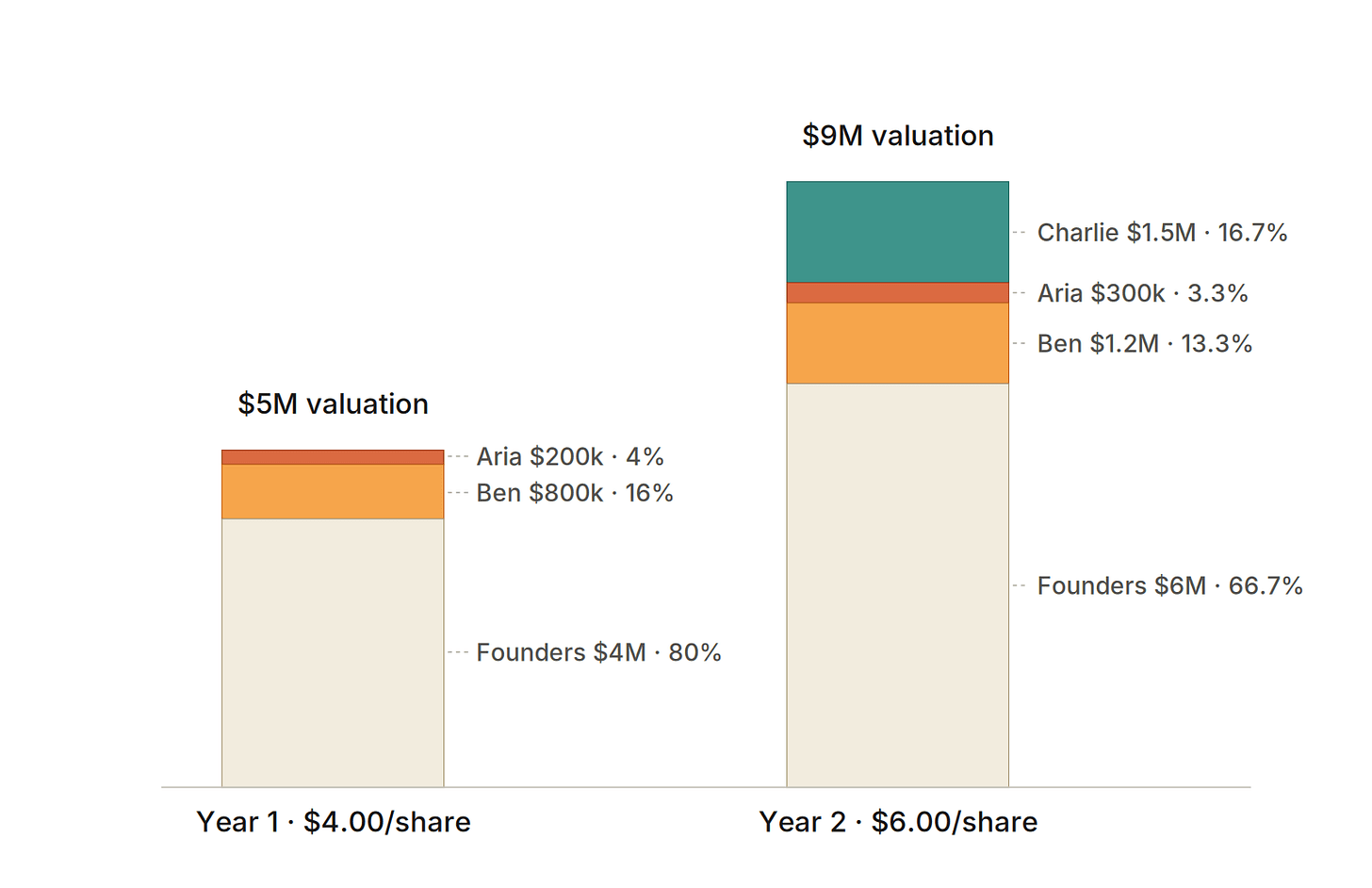
Say that the Widget Research Institute raises $1m in its first year, $200k from Aria and $800k from Ben. In our retrospective model, we say that WRI started with 1 million shares, created 250k for the round, sold 50k to Aria and 200k to Ben. Its current valuation is $5m, because it sold 20% of its equity for $1m.
If WRI raises $1.5m from Charlie the next year in exchange for 1/6 of its equity, its new valuation will be $9m. 250k more shares will be issued and sold to Charlie. Now Charlie owns 17% of the equity. Aria and Ben have been diluted from 4% and 16% stakes down to 3% and 13%, but the value of their holdings is up to $300k and $1.2m respectively, since the valuation has increased.
A system like this is obviously an oversimplification, since in practice orgs and funders would be able to trade at any terms (valuation and amount) that were mutually agreeable. In practice though, in the startup ecosystem, terms for early funding rounds are often fairly standardized. If this becomes an actual market, this could be a reasonable default for new orgs to start your pricing from.
Results
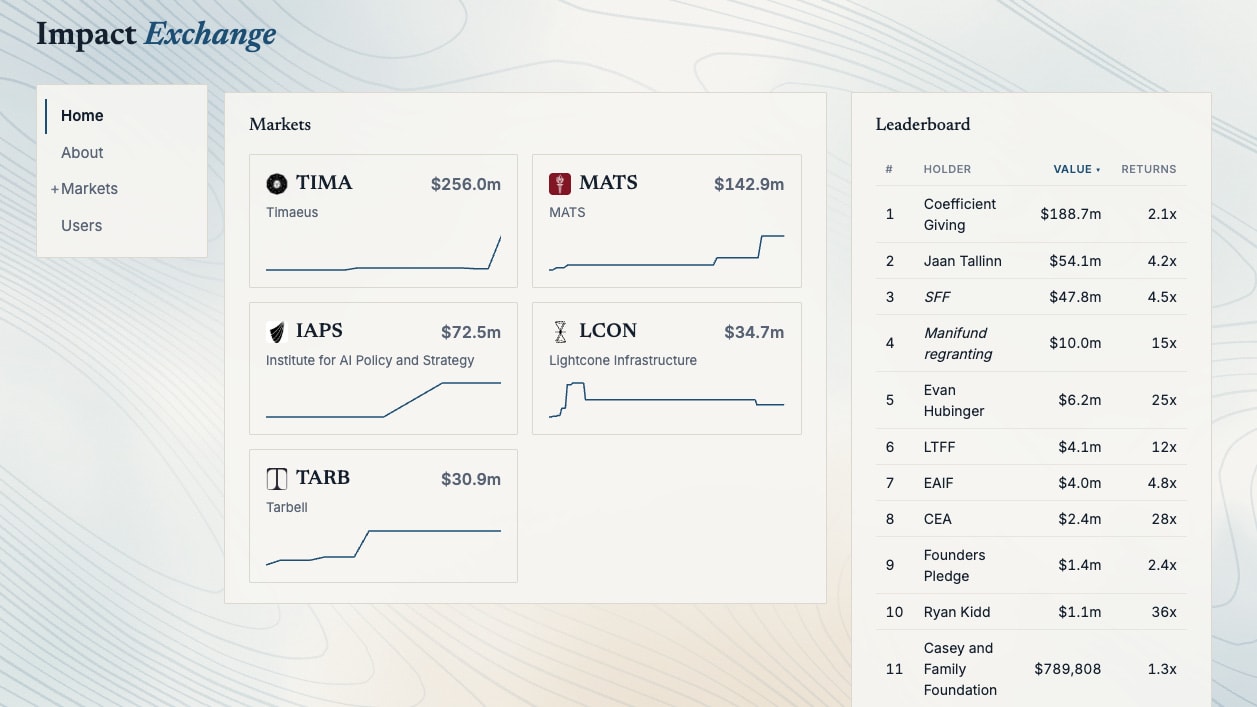
We created a website that does this for five orgs on impact-exchange.org! Right now you can see the markets, leaderboard, and users’ donation records.
You can see the valuation of most of them go up over time. Lightcone’s funder-implied valuation has gone down over the past few years, as Coefficient Giving pulled back from funding them—someone watching the market might see this as a good buying opportunity.
The leaderboard is topped by Coefficient Giving and Jaan Tallinn. You can also see many smaller individual donors who have done well—this includes many Manifund regrantors, as well as Eric Rogstad who made one of the earliest donations to LessWrong 2.0 (which became Lightcone Infrastructure).
Of course, since this only has five orgs, it’s far from showing the full portfolio of donations. We started with Timaeus, MATS, Lightcone, Tarbell, and IAPS to cover some orgs that we had good data on, and are well known in the AI safety space. We’ll be adding more as we refine our approach.
(You can also see this spreadsheet for the data behind the website. Some funders like Longview and Macroscopic don’t generally publicly release their donations, so we don’t have their information for the leaderboard.)
Next steps
We’re hoping this demo gives people a better idea of what an impact marketplace would look like. Here are the next steps we imagine:
Feedback.
This is a first draft; we’re super interested in people’s thoughts on how this should work!
Good donation data.
It was surprisingly hard to get good, complete donation data for this demo, which is the bottleneck to adding a lot more charities. We appreciated grantmaking.ai and Vipul Naik’s donations database, but neither were complete, and the rest of the information was scattered across different websites in different formats.
Paper trading.
We hope to soon have a Manifold-like system allowing people to start placing bids/offers on impact equity, denominated in charity dollars (or completely fake internet points).
Funder collaboration.
We’d like to work with all kinds of funders, from individual angels and donors to large philanthropies, to register their donations on our platform and get credited for their good choices.
Buy-in from charities.
The best test of this model would be charities using a platform like this to conduct their fundraising rounds. This would provide a lot of useful data on how the process goes, whether it makes it easier to find funding, and whether secondary trading emerges.
If you own 1 share of a charity, that means you own 1/(shares_outstanding) of its impact, past and future.
Why 20% in the first year?
The norm for startups is similar to this, and it seemed like a reasonable starting point. If someone funds a charity for $1m in the year it’s founded, and the charity exists for 5 years doing $1m worth of good per year before shutting down, then the initial funder makes back their investment, which sounds about right.
Longer term, we hope that funders and charities can negotiate on what % impact is being sold, and report that value to us.
Why does the fraction of equity sold decrease every year?
We think this makes sense for a charity that banks impact over time: the longer it’s been running, the less your donations this year are going to do for its total impact.
How does this work under a 501c3?
In our model, buying into the impact funding ecosystem would be a tax-deductible donation to Manifund. From there, traders can grow their charitable dollars, analogous to investing within a DAF.
Sadly, this means that any amazing forecasters out there who want to speculate on impact equity and blow the proceeds on expensive wine won’t be able to. You won’t be able to get rich in the sense that translates to consumption. But if you invest well, you can get rich in the sense of having lots of funds to redirect to charities! And not having to appeal to purely profit-driven investors makes things easier in various ways.
Who are the final oracular funders?
Idk, who are the final oracular funders in the stock market?
In our vision, there isn’t necessarily one final funder. As we learn more, valuations can get more and more accurate over time. If a funder thinks an org is undervalued at any point in time, they can express that by buying on the market. In our vision, if an org does some research that 10 years later unexpectedly pays off in some way, then 10 years later their valuation will shoot up.
Making the entire ecosystem charitable means there’s less of a need for kickstarting it with final oracular funders already in place. Purely selfish investors might be unwilling to invest without confidence that someone will buy their shares later, but if you’re a donor who wants to maximize their impact, you’re also happy to end up holding impact equity that is worth far more than you bought it for. And in a public market, this can also get you bragging rights.
Of course, we do hope for retrospective funders to provide liquidity, since that’s what allows good early grantmakers to redeploy more capital. (And speculatively, we think the future aligned ASI will be quite happy to pay for your impact.)
How will trades actually happen?
Impact shares can be traded on an exchange or directly between counterparties. Given the analogy to early-stage startups, it’s probably unrealistic to expect impact equity to trade super-liquidly on an exchange. But we think having all trades print on a public exchange would be valuable for dissemination of information.
Will this cause negative-EV projects to get funded?
Because the profits can only be used for more charitable donations, we think this is less of a worry. Someone who is primarily focused on impact won’t want to fund a project they think is net negative. Impact equity could even trade at negative prices.
Of course, normal charitable donations can and do end up funding a lot of things that turn out to be bad for the world. We just don’t think this design particularly exacerbates that problem.
Note: This post was crossposted from the Coefficient Giving Farm Animal Welfare Research Newsletter by the Forum team, with the author's permission. The author may not see or respond to comments on this post.
Subtitle: On vegan advocacy, effective altruism, and FIFA
I turn 40 today. Here are some hot takes.
On factory farming
1. Our biggest challenge is salience. If factory farming led the evening news, it wouldn’t last lo...
On October 22nd starting at 10:00am Pacific Time, Every.org is matching donations to select animal welfare organizations at a 2:1 rate, up to $2,000 per donor per nonprofit (so if you give up to $2,000, they will contribute up to $4,000 and the nonprofit will get up to $6,000). The first donation a donor makes to each eligible nonprofit will be matched, and donors can get the match for multiple $2,000 donations. So, you can get more than $2,000 matched by donating $2,000 one time to multiple...
When speaking to candidates who are considering working with us at 80,000 Hours, I often hear people worry about replaceability.
The familiar version of the worry is about whether the organisation will hire someone else in your place. If it will, then the difference you make by taking the job is only the difference between you and them.
There are a couple of well-known answers to that. The person hired in your place probably cares about the world too, and would go on to do somethi...
At a first glance, this seems to only track how much money was raised, not how much impact was generated.
It also seems that the hard-coded percentages remove some of the advantages of impact markets (but maybe I looked at the demo too much and your actual proposal is different from that). What I like about traditional impact markets is that it can be modeled with VCs as selfish actors and final oracular funders as altruistic actors. Mixing these two makes the proposal confusing to me, for example it is not clear to me why a later (altruistic) donor would buy out an earlier donor, instead of giving the money directly to the project.
Yep, it's currently tracking how much money was raised. I think this isn't a useless signal, because big funders are evaluating projects' impact when deciding how much to fund them, but it's definitely not the only signal we want. I think a cool next step (for Manifund or for anyone else, and hopefully in the long term to be done by many people) would be to do some rough cost-effectiveness analyses of these orgs and then make markets around those estimates.
This article was brought to my attention by a discussion with @Austin here. My main critique is in line with @harfe, cross-posting here:
At least to a good approximation. Individual investors may choose to price in externalities, e.g. treat a grocery store dollar as "better" than the same dollar coming from an oil or tobacco company.
I agree this is a difference and it makes it a worse signal than in the for-profit world, but I still think it has the potential to be a good signal. Our opinions of how much good was done by something or something converge somewhat over time, both because of changing morals and because time simply allows us to better see the retrospective impact of something. We may not have a perfect estimate down to the dollar of how much good a past project did, but I think our estimates do get better over time, which is the motivation behind retroactive funding.