Comments
Is this from ycombinator's podcast or something? I feel like I've read this before
Is this from ycombinator's podcast or something? I feel like I've read this before
I used YC endorsement as a filter to decide what to include, as that way I know it's a common enough mistake to justify talking about. Do you watch their youtube channel?
The early bird gets the worm, but the second mouse gets the cheese. I am the "first mouse" who lived, covered head to literal tail in sprung traps, crawling onto your forum feed to inform you of the dangers ahead. It's especially relevant for bootstrappers.
Someone who's starting an organisation without capital of any kind.
I am leagues ahead of any competition. Nobody comes close to me. I am EA's uncontested leading expert on being baited. I have personally fallen for ALL of these baits, often multiple times, despite sound advice being freely available online.
Baits score high in both attractiveness and fatality, whereas anti-baits score negatively in both.

It is the kernel of truth within the bait that makes it so alluring. The logic just seems so intuitive and inarguable. However, through decades of collective entrepreneurial experience, we've learned them to be both false and deadly. Antibaits are the exact opposite - more on them later.
These baits are so savage that you should actually take preventative action long ahead of time.
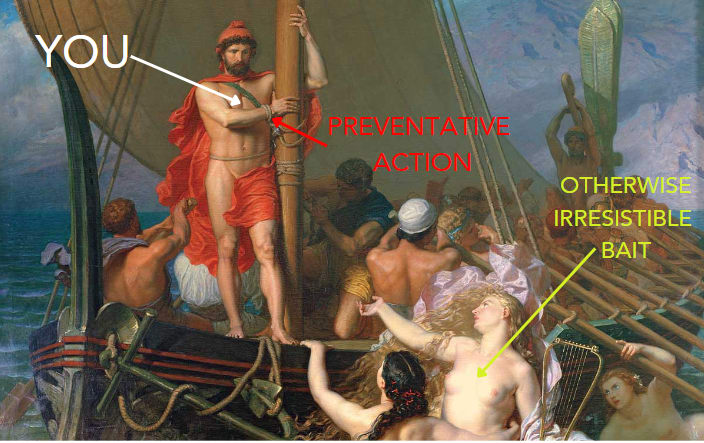
You will get MUCH more interest once you've built some traction, from bigger names with 'better' CVs. However this is actually BAD:
How to prevent
Recruit your founding team early. Pick irrepressible people who are value-aligned, open to ideas, learn quickly, and inspire emotional resilience in those around them. Start with your friends/colleagues. If nobody fits, go do related projects with strangers and see who you work well with.
It just feels so obviously a sign of success to have more people signing up and contributing. After all, more people means more work hours which means more stuff done, right? Wrong. This is a sign of impending doom. Scaling fast implies you're scaling something that hasn't been properly tested. Worse still, it makes changing things nightmarish.
How to prevent
Set stringent prerequisites for scaling long before you reach that point. Before going ahead with it, seek guidance from an experienced entrepreneur.
I'm sorry to break it to you, but your 'solution' probably sucks. There are dozens of reasons why it'd never work that will become clear when it is exposed to reality. That's OK though, because the idea never really mattered. It's the team and the problem.
Instead of the "solution", fall in love with the problem. Stick with her when all others have abandoned her. Learn everything there is to know about her, and the real solution will often fall into your lap.

Yes it fucking can.
Overwhelmingly, the most comprehensive and persuasive test is to try out your idea on a hilariously small scale. Unless you're benefiting from nepot/longterm-ism, good luck getting anything funded without having empirically tested your assumptions.
If you can't test the entirety of your idea, rate its parts by "susness" and "cost to test". Divide "susness" by "cost to test" to prioritise tests by cost-effectiveness. Key point: The way to work out how sus something is to prospective funders / collaborators is to talk to them; don't try to read their minds.

Consider yourself. How often do you actually change your mind on anything major? How many of those times were because someone tried to persuade you of it? A few times a year maybe? Now consider this: as an effective altruist, you are freakishly open to new ideas and reasoned arguments.
Humans detect attempts at persuasion with Jedi-like consistency. Counterarguments appear in our minds which we identify with much more strongly than we do with the words entering our ears and we actually leave feeling LESS convinced than had they had said nothing.
You do need to sell people on your ideas, but persuasion is not how you do that. Time is finite. Persuasion is slow and prone to back-firing. What you actually want to do is to disqualify people as quickly as possible, and move on to the next conversation. Finding people predisposed to liking your idea is the aim, not persuading people to like it. For the predisposed, remove all barrier to comprehending your idea; your pitch should be extremely clear and concise.
Usually, advisors play a small role and they confer way less social proof than you'd think. Funders mostly care about the team itself and their traction thus far.
It's indeed possible to gain tons of credibility very quickly if you actively pursue it. However, your credibility will grow faster than your true expertise and you'll likely go on to cause net harm. Further, credibility << traction in terms of getting funding/partnerships etc. Don't get distracted.
Fuck credibility; get traction.
It'll be so much faster if we just hire an expert, I thought. It'll save me so much time and effort that I can use on things that I can't delegate, I thought. This is oft a surefire way to fuck yourself.

If it was this easy to build an incredible organisation, then everyone would be doing it. The proportion of projects that go on to be extremely impactful is extremely low. If you're doing what everyone else is doing, you're definitely fucked. Think for yourself. Fail. Improve your thinking. Repeat until you find something that works.
These baits are good to fall for, so long as you have a good idea and the ability to execute. If we knew how hard it would when we started we'd have given up, so believing some of these is a somewhat of a prerequisite.

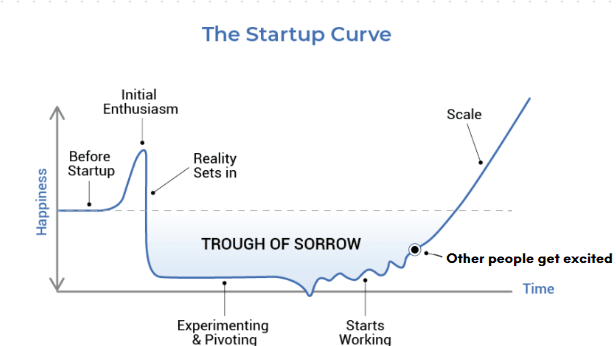
The answer is C. No matter how simple your idea, the moment it makes contact with reality you are going to be slapped with implementation issues - logistics, getting people to do what they say they would, shit you never dreamed would be an issue.
Overwhelmingly, you're going to find that:
This is the false glimmer of hope that keeps you from saturating your pillow with salty tears on the nightly. False hope > no hope, so I'll say no more.
This is a surefire way to make sure that what you're working actually matters.
Two big reasons
There's no time to investigate smoke when there are fires raging. If there are no fires raging, you're moving too slowly.
Key exception: if your cofounder/team is smoking, treat that as a SuperMegaUltraGigaFire, especially if they are agreeable.
"Do things that don't scale" is one of the greatest writings all of entrepreneurship. Read it, watch it, or regret it.
The above is advice for getting your project to work, but beware Pyrrhic victories. Context is key, and your mileage may vary. The hardest thing is that there are many many situations where these "baits" are actually good ideas, and "antibaits" actually bad ones. Please use this guide to identify decisions that you should think harder about, and not follow it over a cliff.



Executive summary: The post outlines common traps and misconceptions that doom early-stage organizations, especially bootstrapped ones, with advice on how to avoid them.
Key points:
1. Build a strong founding team early rather than waiting for traction. Prioritize shared values over credentials.
2. Test assumptions cheaply and iteratively instead of overinvesting in an untested idea.
3. Talk to users and build traction rather than trying to persuade people your idea is good.
4. Avoid advisor collecting, credibility chasing, and outsourcing work early on.
5. Beware believing your idea is easy or novel. Stay grounded in users' actual problems.
6. Some naive optimism helps found hard projects, but avoid ignoring clear warnings.
7. Do anti-intuitive things like prioritizing comfort over status.
8. Release something simple first and improve with feedback.
This comment was auto-generated by the EA Forum Team. Feel free to point out issues with this summary by replying to the comment, and contact us if you have feedback.