Comments
EA Philippines 2020 Annual Report

48 min read


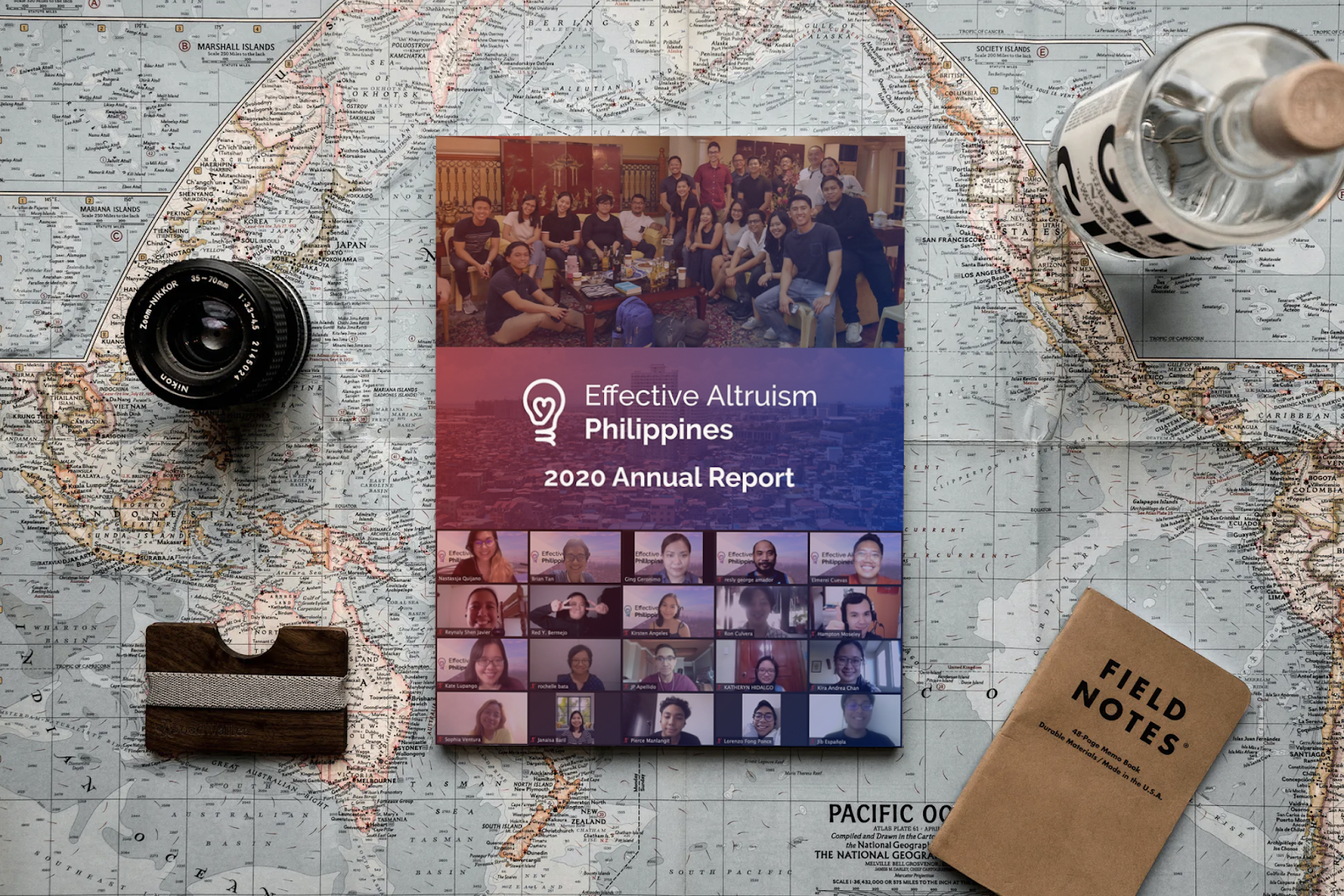
Hi everyone, I’m writing this post to share the exciting progress we’ve made in EA Philippines in 2020, our second full year of operations. We think this would be interesting to read for EA community builders and anyone interested in how we are making great progress in growing the EA movement in a developing country. This post is quite long at 9,600 words (~48 minute read), so if you don't have that much time, you can just read our 5-minute summary.
EA Philippines is the Philippine chapter of the EA movement. Our vision is to be a thriving community of Filipinos who use evidence, reason, and compassion to maximize our social impact with our careers and resources. Our mission is to provide high-quality resources and discussion spaces for Filipino students and professionals to learn about and practice the principles of effective altruism.
EA Philippines was founded in November 2018 by Kate Lupango, Nastassja "Tanya" Quijano, and I (Brian Tan), and continues to be run by the three of us. To read about our progress and learnings in 2019, you can click here.
This post does not contain our short-term or long-term strategy yet for EA Philippines. But most of the activities here, such as supporting our student groups, running events and fellowships, doing local cause prioritization and career advice research, and doing local charity effectiveness research (and fundraising for one or more of these local charities), are likely to be part of our strategy and main activities for 2021. We hope to post about our strategy in more detail by the end of February 2021.
EA Philippines has recently received a 12-month, 1 FTE community building grant from the Centre for Effective Altruism to further professionalize and grow our group. The grant started in October 2020 and is up until October 2021. This grant is split in the following way:
Thanks to this grant, I have decided to leave my full-time job as a Product Designer at First Circle in order to do EA Philippines and other EA-related work full-time.
If you’d like to read more about how we were able to achieve this, and what prompted me to leave my job to do EA-related work full-time, you can read this separate post.
From May-July of 2020, EA Philippines ran our first 9-week discussion group on effective altruism, patterned after Stanford’s 2019 Autumn Arete Fellowship syllabus, and this was our best program yet. 19 professionals and 12 students signed up, and 15 graduated from the course (meaning they attended at least 4 out of 8 meetups). We understand that 4/8 events is quite a low bar compared to other fellowships, but this was our first time running this type of event, and we had a mix of professionals and students, so some were quite busy. We were able to track a lot of impact (both counterfactual and non-counterfactual impact) from this program, and we’ll talk more about the impact of this program in the “case studies of our impact” section later down below.
We also noted the following answers to different questions from our discussion group completion survey, based on 9 responses:
We also got 4 public testimonials from those who completed our discussion group, and if you’d like to read those, click here.
Here were things we could have improved on in the fellowship based on feedback:
Something we didn’t do is interview a few people who stopped attending our discussions after attending a few weeks. We don’t think we gave anyone a bad impression of EA, and we think these people just got busy with other things. But messaging each one of them who stopped attending to ask why could have helped.
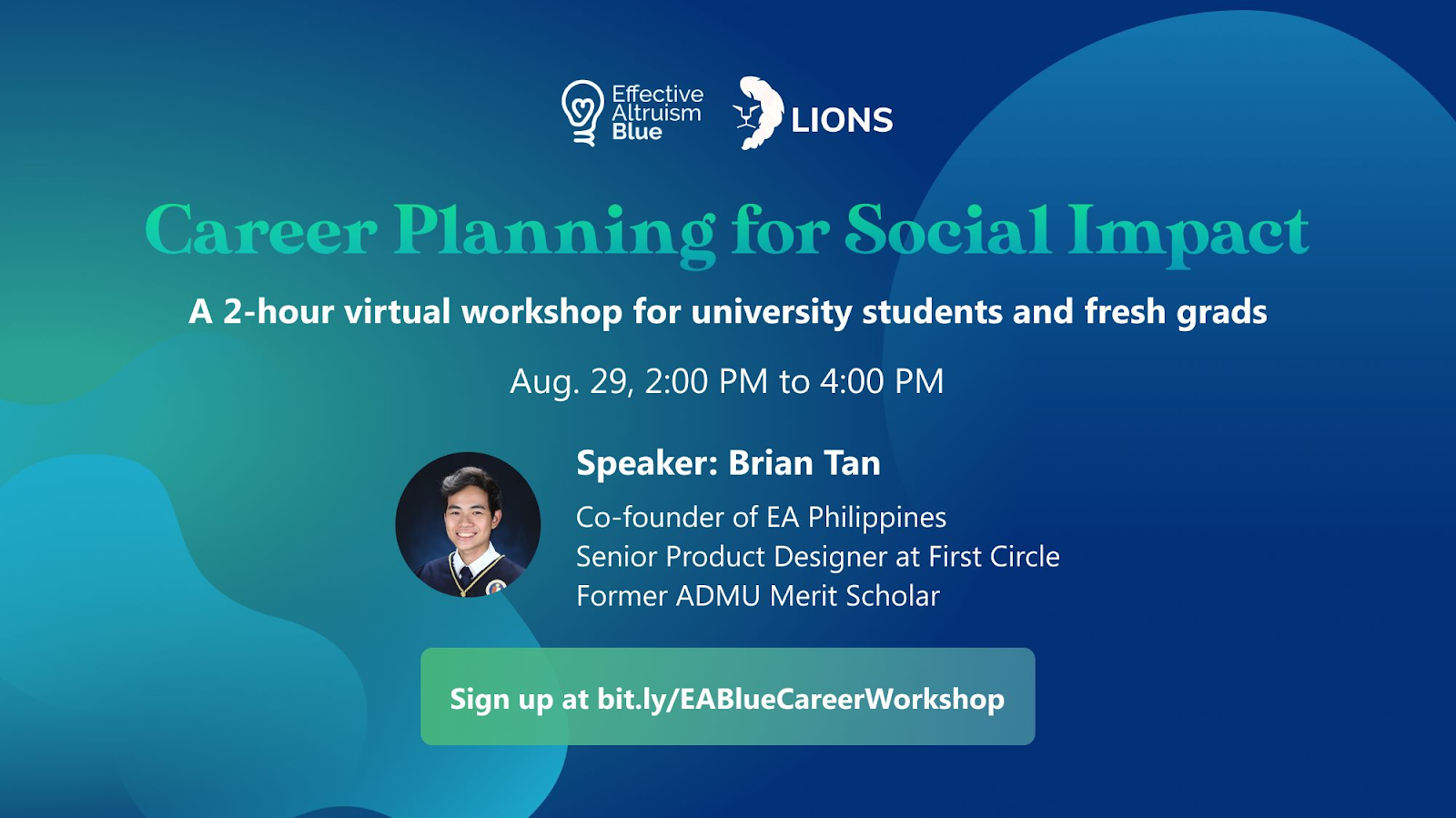
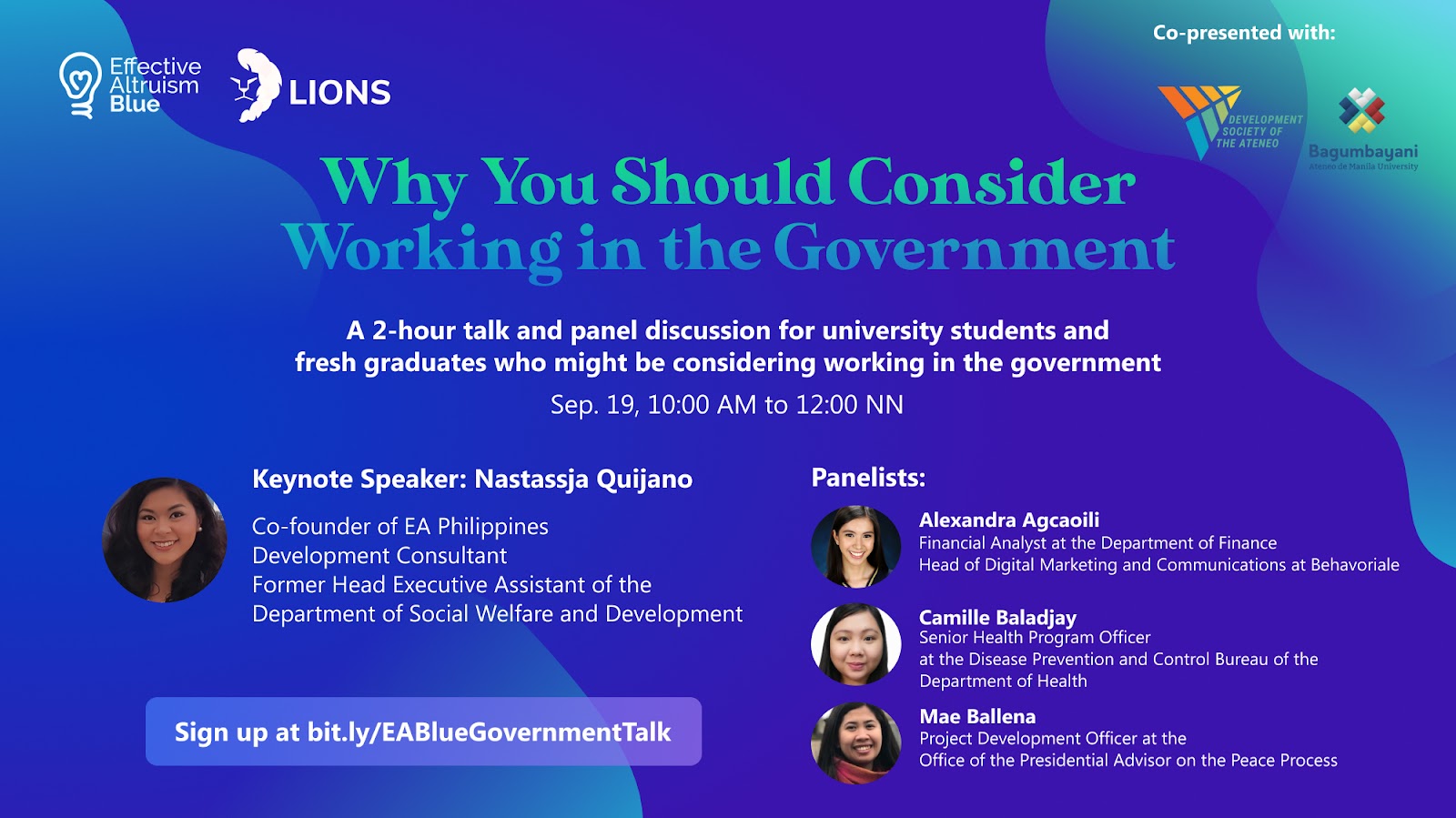
Posters of EA Blue’s events
After we ended the discussion group, EA Blue started ramping up its preparations for the schoolyear, which is from August 2020 to June 2021. They had 7 people in their executive board (EB), 4 of which were EB members in the schoolyear of 2019-2020, and one of which was a core team member who was promoted.
Thanks to a well-run social media campaign, EA Blue got 60 applicants to join the group, and we accepted 40 of them. The 40 we accepted was everyone who attended a general assembly and were interviewed by the core team. Out of these 40, 21 applied to join the EA Blue Virtual Fellowship, which EA Blue organized with the help of 4 facilitators from EA Philippines (and 5 student facilitators from EA Blue). 5 students not from EA Blue applied to join the fellowship too.
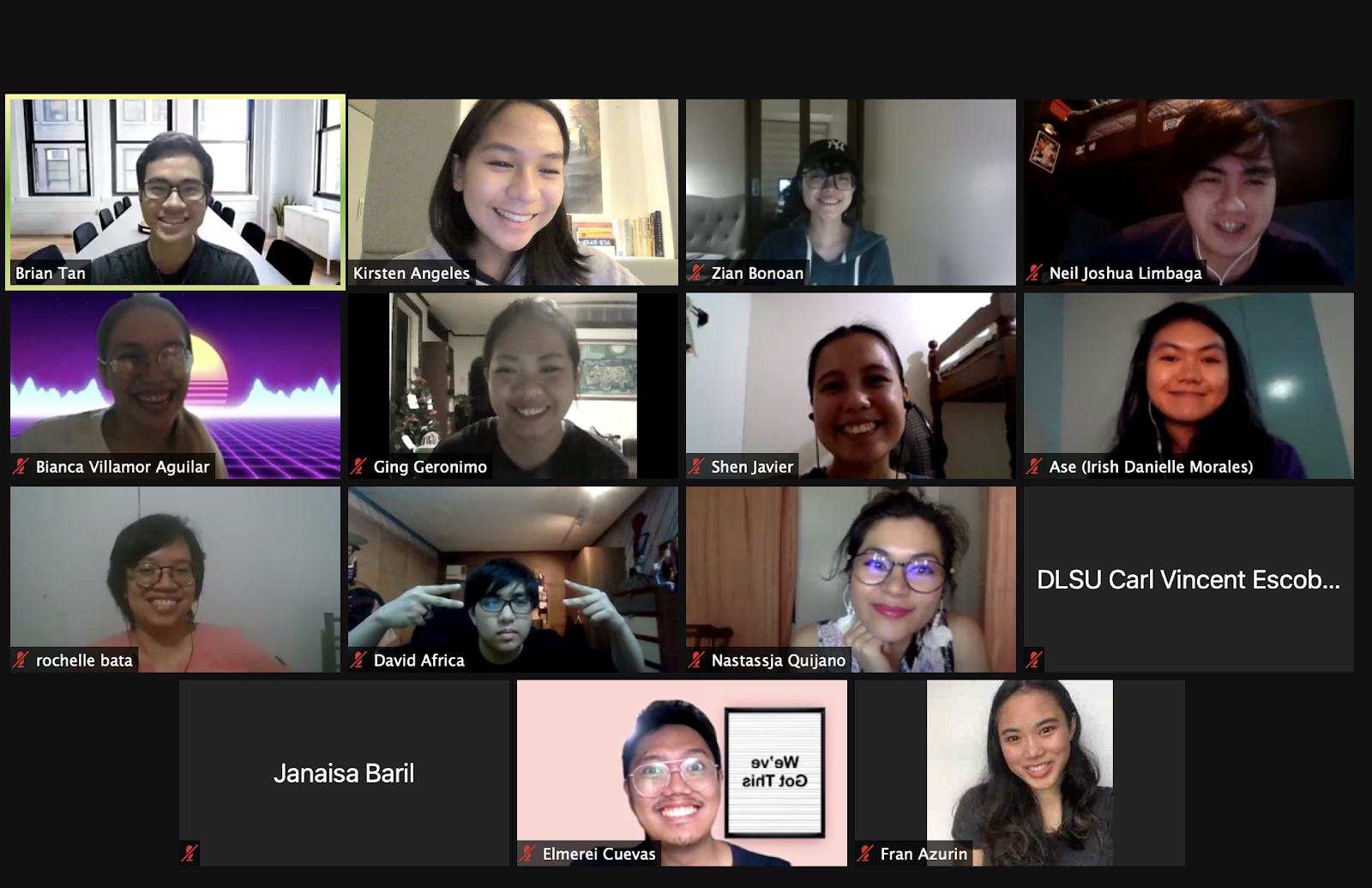
Photo from one of their fellowship meetups
20 out of 26 participants graduated from the fellowship, meaning they attended at least 4 out of 7 weeks. 5 of these weeks were meetups, and 2 were conferences - the EA Student Summit and the EAGxAsia-Pacific conference. 8 have since applied to be core team members to EA Blue, and we think this fellowship will result in as good (if not better) engagement and impact as our May-July discussion group.
Here are some other findings from the completion survey of our fellowship, which has 20 responses (from all 20 graduates):
We’ll share more data with CEA separately about other findings we have from our completion survey.
Even in just one semester, EA Blue’s progress in the 2020-2021 school year has definitely exceeded the progress in 2019-2020.
In SY 2019-2020, EA Blue was only able to run 2 events, since other plans were also halted because of the COVID-19 pandemic. Also, EA Blue didn’t receive much help or supervision from EA Philippines in its first year, which was a mistake on our part, but it was also because we didn’t have a lot of time to do so. Now, in large part thanks to the community building grant, I attended ~70% of EA Blue’s executive board meetings. EA Philippines is deeply involved in their plans, and I think this, together with the addition of Kirsten Angeles as their president and the efforts of the other EB members, have allowed the group to be quite successful.
As part of EA Blue’s recruitment efforts, we had a “Career Planning for Social Impact” workshop that I gave, and a talk on “Why You Should Consider Working for the Government” by my co-founder Tanya. Both of these talks were well-marketed and had around 40-50 attendees, including some people outside Ateneo de Manila University.
One student who attended my career planning talk then messaged me saying that she was interested in starting an EA chapter in her school, the University of the Philippines - Diliman Campus. The University of the Philippines is the top-ranked school in the Philippines, and the Diliman Campus is their main campus, so this was exciting to hear. We previously thought that this would be difficult to do, but she had the enthusiasm and knowledge of how to start a new organization. So we sent her some resources and connected her with some people from UP Diliman who attended some of our past events.
We were able to find three other UP students who were interested to be part of the chapter’s executive board, which was exciting. One of the graduates from our discussion group then introduced us to a professor, Dr. Adrian Valdez, who is the head of the Computer Science department at UP Diliman. We held a meeting with him to introduce him to EA, EA Philippines, and EA UP Diliman, and he agreed to being their faculty adviser, which is great news.
We hope to run an introductory fellowship with EA UP Diliman as well from February-April 2021, and we are hoping EA UP Diliman could be as successful as EA Blue as a student group.
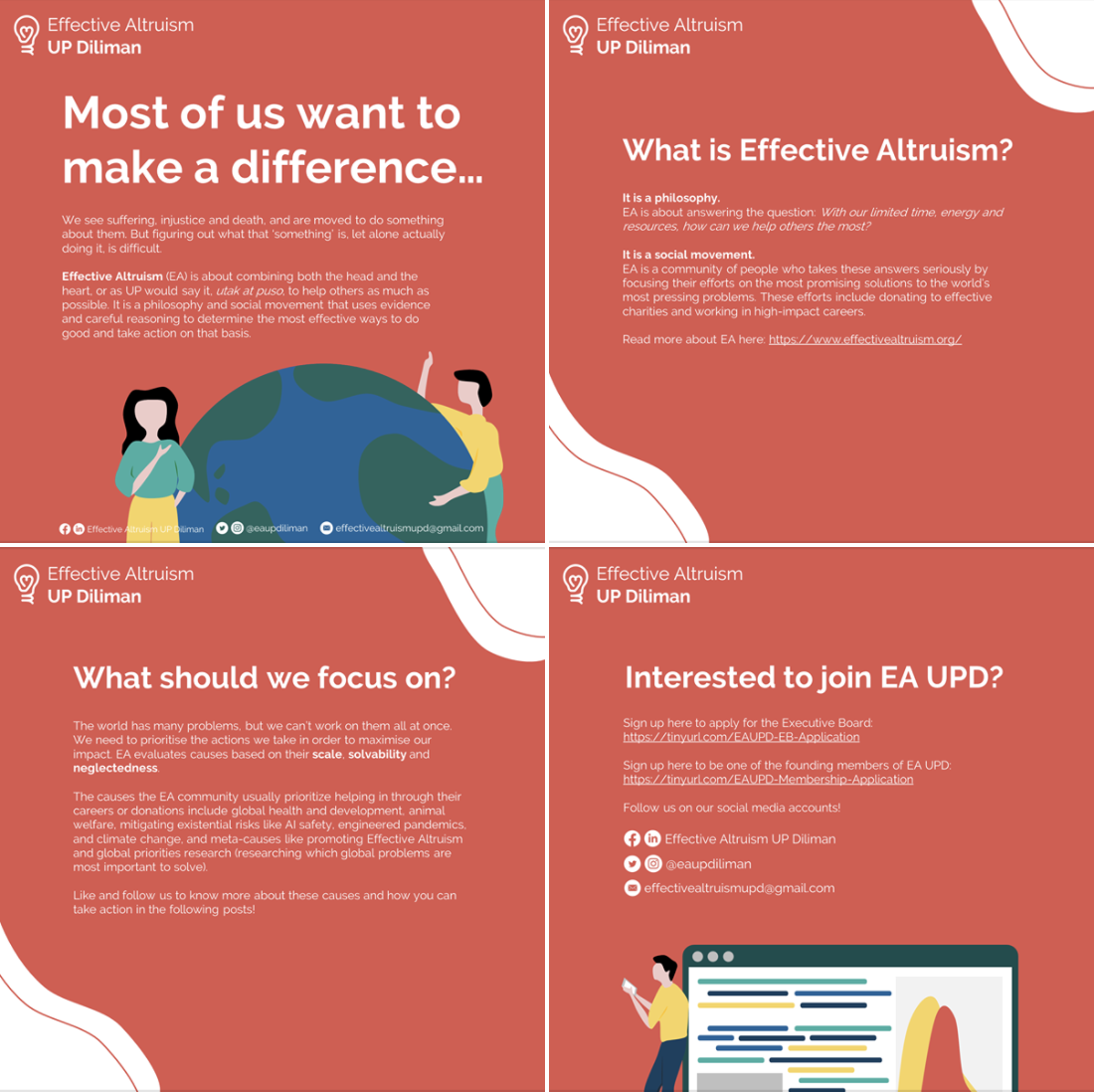
Poster from EA UP Diliman’s social media campaign
Also, some students from De La Salle University’s Manila Campus are interested to start an EA group in their university, and they met with me in December to kick-off this process. De La Salle University is the 3rd-ranked university in the Philippines.
EA DLSU-Manila is looking to be recognized as an official organization in La Salle. They already have 6 people willing to be in the executive board, even if most of them are quite new to EA, while they’ve found more than 15 others who are willing to be founding members, since they need at least 15 founding members to be founded.
It is convenient that both EA UP Diliman and EA DLSU-Manila are starting at the same time because EA DLSU-Manila can copy templates of EA UP Diliman to become registered and to plan for their recruitment campaign and first few events. The two groups can also copy a lot of the same templates and tactics EA Blue used for their fellowship and other activities.
Both groups have a few really enthusiastic students who are willing to set up the chapter and get it officially registered in their school, but the process (or wait) may take a while. We’ll make sure to keep them engaged even if their organizations do not get registered immediately.
One sign also that the EA community locally is growing is through our increasing participation in EA conferences. In EA Global San Francisco (which went virtual), I was the only Filipino attendee who officially had a ticket, but 4 others livestreamed the event too, since it was available for free.
In EAGxVirtual, we had 16 people involved in EA Philippines who attended the event.
In the EA Student Summit, we had 12 students from EA Blue attend the event, and about 7 others from EA Philippines, some of which stayed up for a good part of 7:30 pm to 7:30 am to attend the event on both days. 3 students - Dana Guerrero, Lenz Dagohoy, and Shen Javier, were even volunteers for the EA Student Summit. Ateneo de Manila University, where EA Blue is from, was 10th place among universities that had the most attendees in the conference, as seen below:
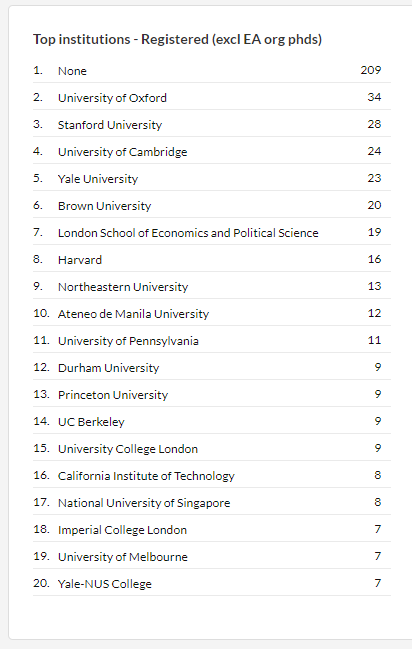
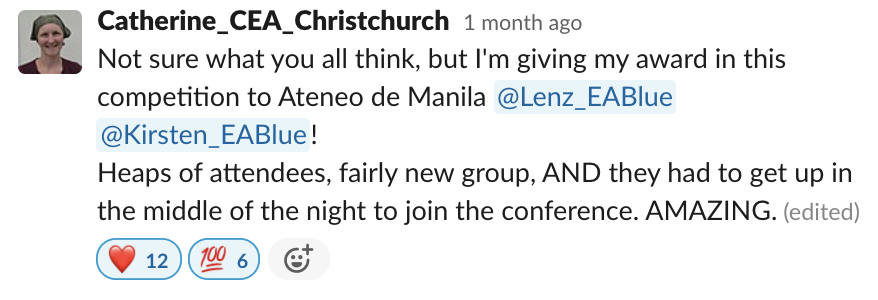
Also, as seen above, EA Blue got a shoutout from Catherine Low from CEA for an unofficial “award” for getting a lot of attendees to join the event!
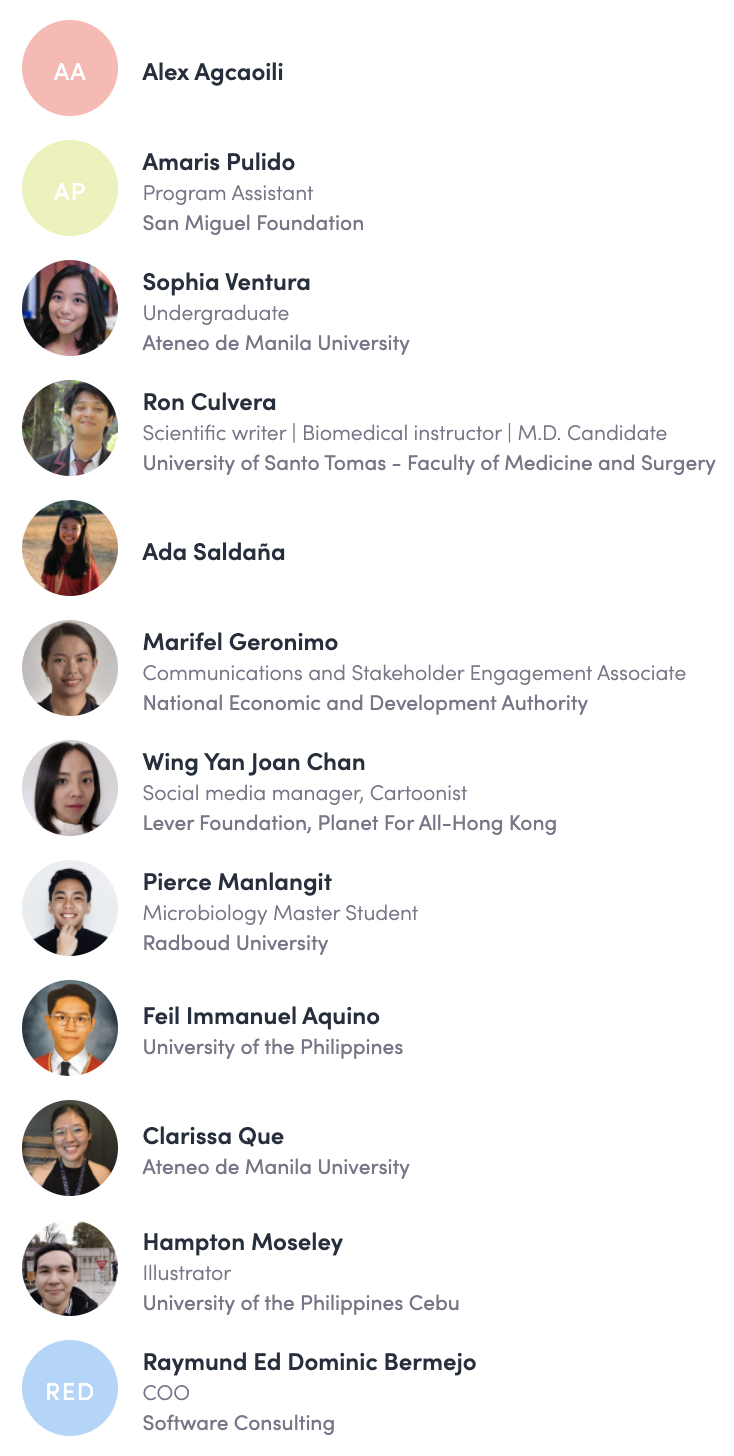
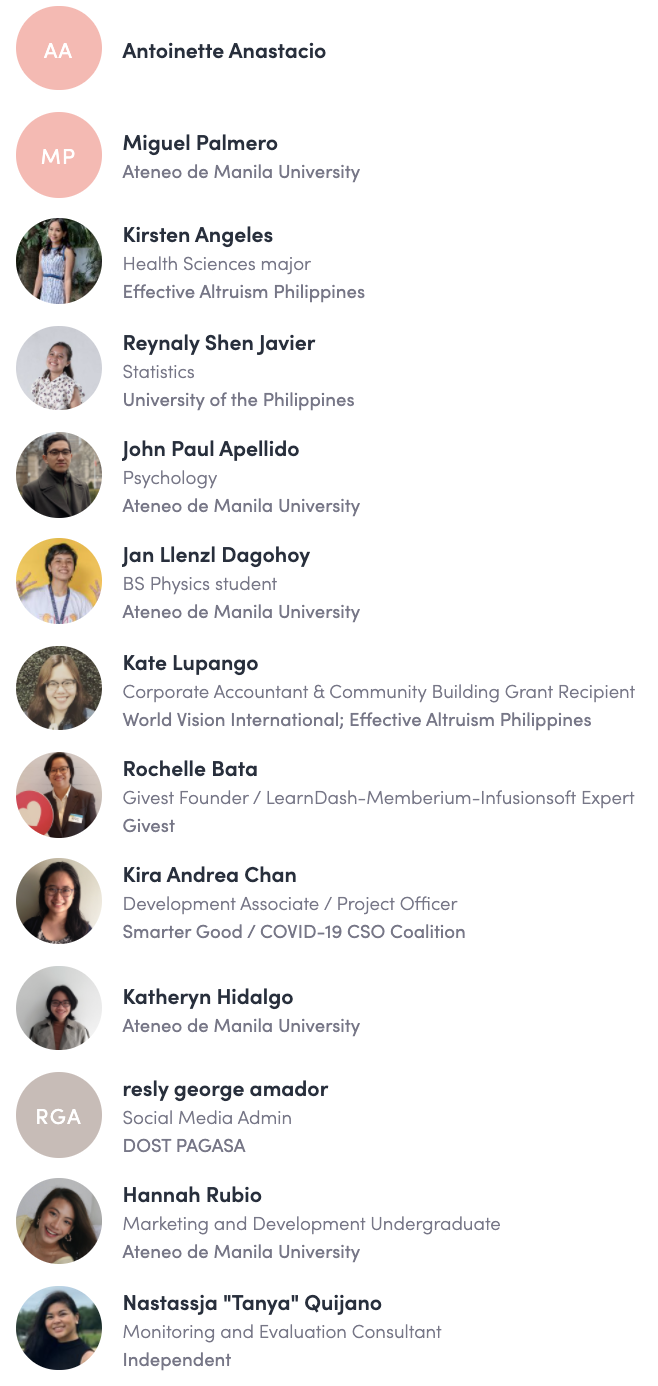
Here are most of the people from the Philippines who attended EAGxAsia-Pacific
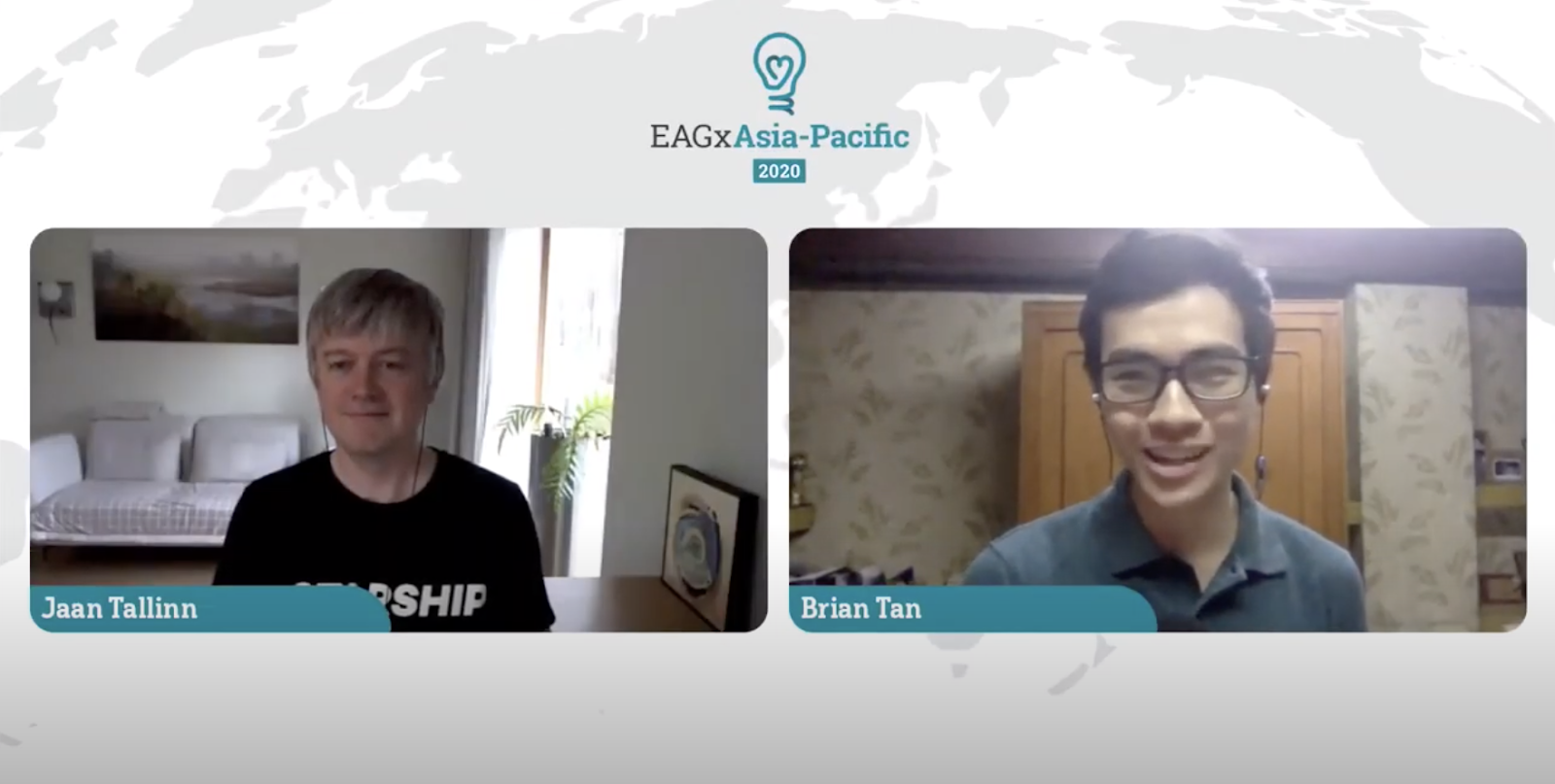
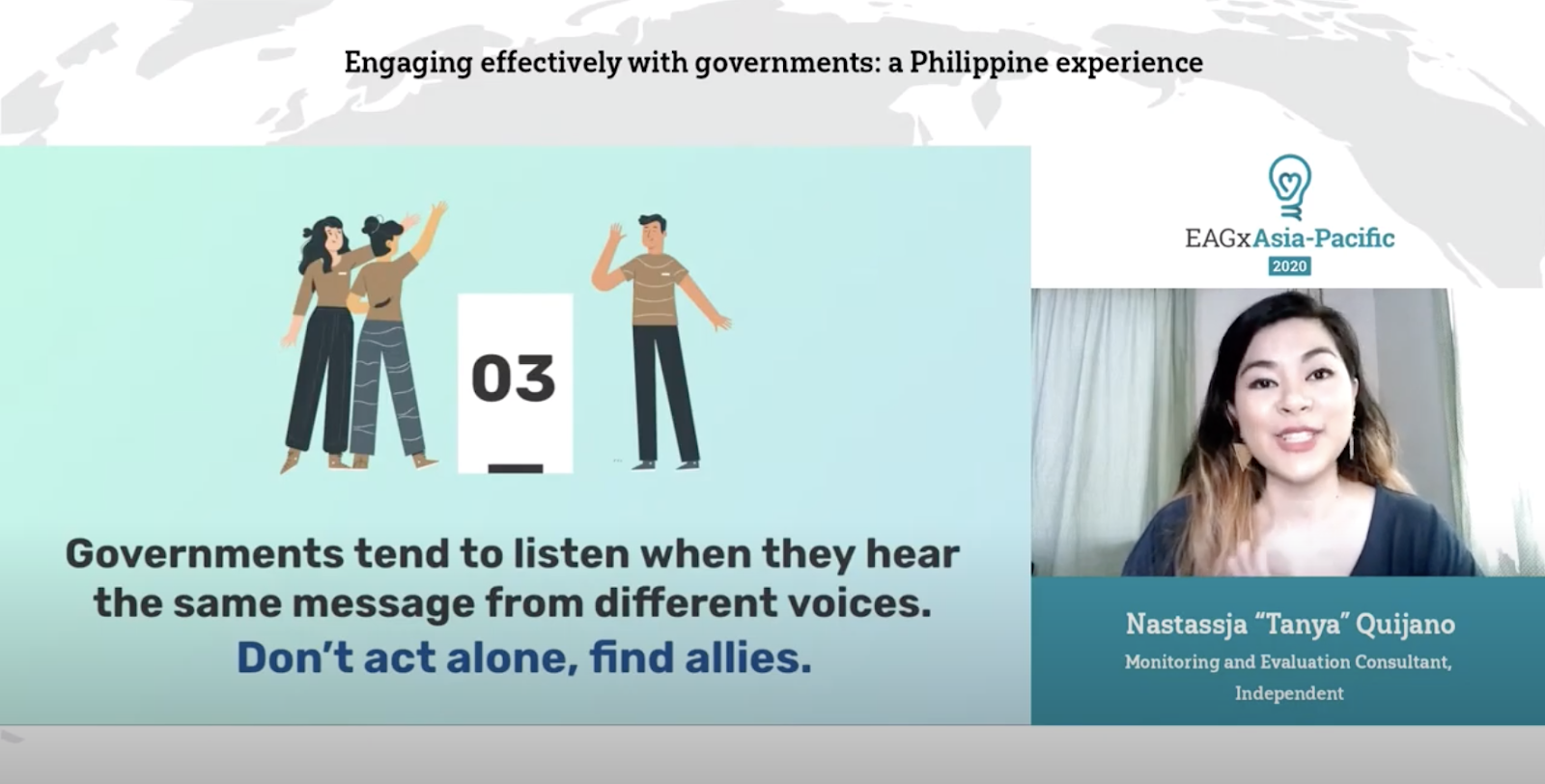
Photo of Tanya’s talk and my fireside chat with Jaan Tallinn in EAGxAPAC
In the EAGxAsia-Pacific Conference, we counted 32 people from the Philippines who attended the event, and all except one were already involved in EA Philippines. 2 people from EA Philippines were also volunteers for the event. We co-founders in EA Philippines were also involved in the event, with Tanya giving a talk, Kate facilitating an icebreaker, and me hosting 7 sessions from the event. I thoroughly enjoyed hosting, and I was thankful to be able to interview Jaan Tallinn and Nick Beckstead for their fireside chats, both of which went well.
Here’s a full table of the events we organized in 2020 and the number of attendees per event, including 4 EA conferences that we had people join. In total, we organized 23 events, with an average of 26 attendees and a median of 23 per event. As you’ll notice, most of our events are discussion group / fellowship meetups. Each of the EA Blue fellowship meetups were split into two cohorts, with one on Wednesday and one on Saturday, but we just counted both cohorts as if they were one event.
Something we could have done was organize a couple of events, even just socials or co-working events, for the EA PH community from August to December 2020, after the successful discussion group we had. However, since we were focused on strategy planning and supporting EA Blue, and because I was still at First Circle, we didn’t have the time to do events specifically for the EA Philippines community. We hope to have more events for EA Philippines in 2021.
We’ve continued to get good feedback in our virtual events, and having virtual events means people from cities far from Manila can regularly still attend our events. Internet connection was a problem for some of our student fellows and facilitators in EA Blue, but most of them were still able to attend our events.
| Event Number | Event Name | Date | Number of Hours | Attendees | Type of Event |
1 | Socials Event | Feb 29, 2020 | 4 | 21 | EA PH Event |
2 | EA Global San Francisco | Mar 22-23, 2020 | 10 | 5 | EA Conference |
3 | COVID-19 Citizens Budget Tracker | Apr 11, 2020 | 2 | 84 | EA PH Event |
4 | EA PH Discussion Group (DG) Meetup1 - Intro to EA | May 30, 2020 | 2 | 33 | EA PH Event |
5 | EA PH DG Meetup2 - Thinking More Rationally | Jun 6, 2020 | 1.5 | 21 | EA PH Event |
6 | EAGxVirtual 2020 | Jun 13, 2020 | 16 | 16 | EA Conference |
7 | EA PH DG Meetup3 - Planning a High-Impact Career | Jun 20, 2020 | 2 | 20 | EA PH Event |
8 | EA PH DG Meetup4 - Global Health & Development | Jun 27, 2020 | 1.5 | 19 | EA PH Event |
9 | EA PH DG Meetup5 - Animal Welfare | Jul 4, 2020 | 1.5 | 15 | EA PH Event |
10 | EA PH DG Meetup6 - Longtermism | Jul 11, 2020 | 1.5 | 16 | EA PH Event |
11 | EA PH DG Meetup7 - AI Safety and Climate Change | Jul 18, 2020 | 2 | 12 | EA PH Event |
12 | EA PH DG Meetup8 - EA in Action | Jul 25, 2020 | 2 | 18 | EA PH Event |
13 | EA PH Co-Working | Aug 19, 2020 | 2.5 | 10 | EA PH Event |
14 | EA Blue Career Planning for Social Impact Workshop | Aug 29, 2020 | 2.2 | 43 | EA PH + EA Blue Event |
15 | EA Blue Government Talk | Sep 19, 2020 | 2.2 | 51 | EA PH + EA Blue Event |
16 | EA Blue General Assembly 1 | Sep 30, 2020 | 1.75 | 31 | EA PH + EA Blue Event |
17 | EA Blue General Assembly 2 | Oct 3, 2020 | 1.75 | 27 | EA PH + EA Blue Event |
18 | EA Student Summit 2020 | Oct 24-25, 2020 | 20 | 23 | EA Conference |
19 | EA Blue Virtual Fellowship (VF) Week 2 - Thinking More Rationally | Oct 30, 2020 | 2 | 34 | EA PH + EA Blue Event |
20 | EAB VF2020 Week 3 - Global Health, Animal Welfare, and Mental Health | Nov 7, 2020 | 1.5 | 26 | EA PH + EA Blue Event |
21 | EAGxAsia-Pacific Conference | Nov 21-22, 2020 | 20 | 31 | EA Conference |
22 | EA Blue Welcoming GA | Nov 27, 2020 | 1.5 | 15 | EA PH + EA Blue Event |
23 | EAB VF2020 Week 5 - Longtermism and Existential Risks | Nov 28, 2020 | 1.5 | 25 | EA PH + EA Blue Event |
24 | EA PH's Progress, Strategy, and Socials | Dec 5, 2020 | 2 | 26 | EA PH Event |
25 | EAB VF2020 Week 6 - Career Discussion | Dec 5, 2020 | 1.5 | 27 | EA PH + EA Blue Event |
26 | EAB VF2020 Week 7 - Lightning Talks | Dec 12, 2020 | 2 | 25 | EA PH + EA Blue Event |
27 | EA PH Local Charity Effectiveness Research Event | Dec 18, 2020 | 1.5 | 24 | EA PH Event |
We also did a lot of 1-1’s in 2020 - around 150. These were mostly with existing members or volunteers, but we also did intro 1-1’s, career 1-1’s, and 1-1’s with foreign EAs. These do not count meetings or 1-1's between us co-founders. I don’t know how valuable it was to actually track and count the number of 1-1 meetings we did, but we decided to do so. We plan to continue doing 1-1’s to help people learn and get more engaged with EA, or to help onboard/manage volunteers.
This part is also in our forum post about our 2020 community and impact survey.
If we did our own subjective tagging based on CEA’s concentric circles model, we have the following graph, which compares our community’s engagement in 2020 to 2019:
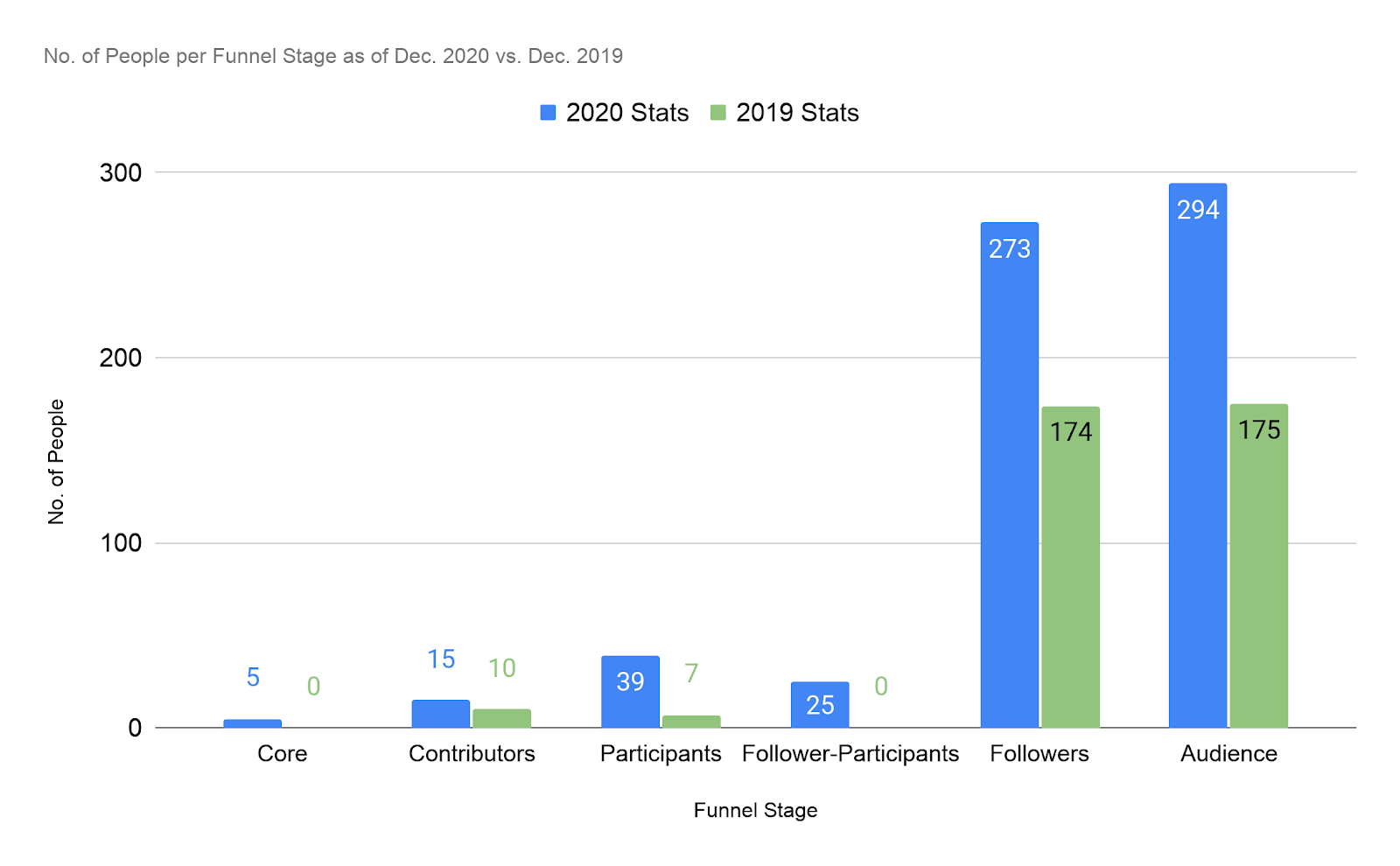
As seen above, our community has grown a lot. There are a few things worth explaining in the graph above though:
Tagging people in these concentric circle stages can be quite subjective, but we think it’s still a good way to communicate a rough picture of how engaged people are in our community, and how much our community is growing.
Aside from community building, EA Philippines did two main research projects in 2020. The first was our Local Charity Effectiveness Research project. My co-founder Tanya and I, and three other people in EA Philippines, shared an interest in finding out what are the most effective charities here in the Philippines.
This is because EA Philippines is often asked about what are the most effective charities people could donate to in the Philippines. Our goal for this project is to have more Filipinos aware of effective and high-impact charities in the Philippines and to help these charities (especially our top charity recommendation) fill their funding gaps, get volunteers, or fill any job vacancies.
We did this by conducting research to identify these charities, and we aim to share them soon with our local EA community and publicly via social media. Collectively, the team has done 10+ hours of interviews and around 50+ hours of research and other work for this project.
We have finished our initial list, and we have written an EA Forum post to solicit feedback for it, and we're hoping to post our finalized initial list in February or March 2021. We’ve also had a private event with 24 attendees from EA Philippines who learned about our research and tentative charity recommendations. Here’s an unlisted recording from the event. (Please don’t share this widely yet though, since we haven’t fully finalized our list). We’ve also gotten feedback or had calls with other EAs about our research already, including three people from GiveWell, Sanjay Joshi from SoGive, Jon Behar from The Life You Can Save, and a few others. We're also hoping to get feedback from people working in the local charity sector.
We think that this work is valuable in helping us get to know charities that could be impactful for people in EA Philippines or other Filipinos to volunteer in, donate to, or fundraise for. We think Filipinos have a comparative advantage in fundraising money for these local charities compared to other EA recommended charities abroad, and this could be a good path to impact for EA Philippines.
Another research project EA Philippines did is local cause prioritization research, also called “local priorities research”, and career advice research. This was done to figure out which are the top causes Filipinos should contribute to and which career paths are the most effective for them to take to contribute to these causes. This project is mainly done and led by me, but a few people from EA Philippines have helped out or are currently helping out. We haven’t posted about this work formally yet, so I’ll post about it now as part of this annual report.
EA Philippines aims to create a community of impact-minded Filipinos who apply the principles of EA into their own careers. However, there has been very little research done on what are high-impact career paths that Filipinos can take to help others as much as possible. Currently, 80,000 Hours aims their advice “primarily at those who live in rich, English-speaking countries: especially the USA and UK.”
As such, the career paths and roles listed on their website are not accessible to most Filipinos. So this research is being done for two main reasons. The first is that it helps us in EA Philippines give better career advice when we talk to people in our local EA community, especially those who can’t enter 80,000 Hours’ priority paths, because usually that would mean they would need to study and/or work abroad. This is true for most people in our community. The second reason we’re doing this is we hope to publicize this research so that Filipinos outside our community can also get tailored career advice for themselves, or be able to read good research on what are pressing problems they can solve as Filipinos.
In 2020, we did the following research. We haven’t marketed these very publicly yet, but we’re happy to market them more publicly now and within the next couple of months:
Aside from what I’ve written above, there are already a few signs of this work being useful, but these are still weak evidence for now:
In November 2020, we co-founders decided to distribute a community and impact survey to people in our community. We got 34 responses, and you can view the summary of the survey's results in this separate post. We got useful insights about the cause prioritization, demographics, career and behavior changes, and volunteer interest of our members.
One of the main ways EA Philippines generates impact is through the positive influence we have on the lives of people in our community, and how we expect them to be much more impactful with their lives as a result of engaging with us, and/or by us introducing them to EA. Because our group only started in late 2018, we still only have limited case studies of what our impact is.
We were able to get the following statistics from our survey though: 19/34 (56%) people reported slight career changes, while 7 (21%) reported significant changes, and 2 reported complete changes. These are self-reported though, and I have begun to dig deeper at these, and some of these are not counterfactual (based on what the person self-reported), while it is unclear if some of the career or career plan changes made will lead to higher expected social impact for the person.
Nevertheless, we were able to track the following case studies of people whom we think we have counterfactually positively impacted, and will hopefully go on to create more positive impact themselves. Some of these were mentioned through the survey, while some were surfaced in separate chats or calls. We include below some details on each person, how they heard of EA, how they’ve engaged with us and with EA, and their impact/growth so far. One of them, Rika Gabriel, was also willing to share about how their career plans have changed because of us. You can read these below:
1. Kirsten Angeles
2. Rochelle “Roc” Bata
3. Rikaela “Rika” Gabriel
4. Jan Llenzl “Lenz” Dagohoy
Also, aside from case studies on people, we think the EA university groups EA Blue, EA UP Diliman, and EA DLSU-Manila would likely not have been started until 2-5 years later if EA Philippines had not existed. The founders of these chapters credit EA Philippines for motivating and supporting them to start these chapters.
We think these university groups, especially EA Blue have already been impactful in helping us get students become aware and engaged in EA, and we think these will continue to be impactful. EA Blue seems like it can continue to exist for many years, although we’ll have to ensure that handover and finding new leaders for these student groups when the current leaders graduate is handled properly.
Aside from the impact of our group, if we wanted to track the impact of EA on people in the Philippines, we co-founders could be case studies for that too. For me personally, my own experience organizing for and leading EA Philippines has led to a big career plan change for myself, now that I’ve decided to do full-time work on EA Philippines and other EA-related work. You can read more about my decision to do that here. So I guess I am also a case study of the impact of EA to people from the Philippines, and partly of the impact of EA Philippines. I’ve also done some volunteer work to redesign the website of SoGive, an EA-aligned organization founded by Sanjay Joshi.
Meanwhile, my co-founder Kate is currently an accountant for World Vision International. She’s also a volunteer for Faunalytics, and she is also currently leading our research and scoping work on local animal welfare in the Philippines. She has also helped organize some calls for the EA Asia community on animal welfare and alternative proteins.
Also, my co-founder Tanya continues to be involved in some of the EA Community’s International Global Health and Development activities. She was a career coach during the EA Student Summit and EAGxAPAC, and was also a speaker during the latter event. She also helped organize a few EA Asia calls on regional health & development and leads EA Philippines’ research on effective local charities. Tanya will begin a new role this week with a bilateral partner to help in policy reforms covering governance and development in the Philippines.
There are a few other career or career plan changes that we are aware of in our community, mainly thanks to our survey and to 1-1’s we’ve done, but it’s quite hard to gauge how much higher the expected impact of these career or career plan changes are. Also, we don’t want to publish de-anonymizing information on our members without their consent. As such, we won’t be including more anecdotes of career or career plan changes here other than the ones we’ve written above. Those featured in the case studies above all gave consent to us including these in our annual report.
Hopefully, we’ll have more case studies towards the end of 2021 of career or career plan changes, and we hope these can be known either privately to CEA or publicly, if the members are willing to share.
We also did a few things to improve our communications. We started a newsletter using Mailchimp in April 2020, and sent it to all people who attended at least one event of EA Philippines or of EA Blue. We stopped sending it out for a while though because we didn’t think it was that high of a priority. However, I decided to bring back the newsletter, and thanks to the help of 2 volunteers, we sent out a newsletter in November and December.
We now include in the newsletter sections for upcoming EA Philippines events, updates on us and our student chapters, and some resources for people to read. We also started including some EA-aligned local or remote job opportunities in the December newsletter.
We are averaging an open ratio of 47%, and a click ratio of 6.6%. I think these are decent numbers for our newsletter. A few of our members have also told us that they’ve found the newsletter valuable. As such, we think we can continue sending out a newsletter once per month or every two months. Here’s a table of our engagement so far:
Date Sent Out | # of Recipients | Opens | Open Rate | Clicks | Click Rate |
April 2, 2020 | 181 | 87 | 49% | 8 | 4.5% |
Nov. 15, 2020 | 349 | 160 | 46% | 26 | 7.5% |
Dec. 17, 2020 | 344 | 158 | 46% | 27 | 7.9% |
We continued making posts on our Facebook page and FB group. On Jan. 1, 2020, our Facebook page had 981 likes and 1,017 followers. As of Jan. 1, 2021, we had 1,233 likes and 1,297 followers. That’s a 26% growth in likes and 28% growth in followers. It wasn’t really a goal of ours to grow our Facebook page reach, so we are alright with this level of growth.
On our Facebook page, we made 57 posts, so that averages to 1.1 posts per week. We co-founders or volunteers from our student groups are the ones who post resources or events on the page.
For our Facebook group, we now have 358 members as of Jan. 2, 2021, as compared to 290 members in Jan. 1, 2020. Within Dec. 4-31, 2020, 208 of the 358 members were considered by Facebook to be active, meaning they viewed at least one post on the group. The number of members and active members are not really a good measure of the quality or quantity of the community, but it’s still something I measured. There were 68 posts on the group, which is about 1.3 per week on average. The main people posting are us co-founders (mainly me).
In August 2020, I decided to create a Slack workspace for EA Philippines, with two main goals:
Currently, there are now 60 people in EA Philippines’ Slack workspace, with around 6,200 messages sent so far. Most of these messages are sent in private channels for us co-founders and our volunteers to coordinate with one another, but we also have channels for different cause areas and other topics. In December 2020, we averaged 20 weekly active members, meaning they logged in to Slack at least once in that week.
We think it was a good decision to create this Slack workspace. However, we’d like to see more discussion and usage of it outside of just volunteer coordination and us co-founders chatting. We’re wondering if creating a Discord server would also be good, since a lot of our members are students, who prefer using Discord. We also are considering creating one big Facebook Messenger groupchat.
EA Blue decided to create a Discord server for their organization in August 2020, and they also have another server for the participants of their recent virtual fellowship. Both servers are quite active, and I’d say that they’re even more active (when it comes to members sharing resources or chatting) than EA Philippines' Slack workspace. We think it was a great decision for them to create this Discord server. They were also using Discord to coordinate their executive board, but they have recently transferred to Slack as well.
EA UP Diliman and EA DLSU-Manila have recently created Discord servers too, and they use it for coordinating among their core teams.
As of December 2020, we now have Janai Baril as a communications and events volunteer for us, and she now handles posting resources/events regularly on our Facebook page, FB group, Slack community, and our Facebook groupchat for our May-July Discussion Group.
As of now, we co-founders meet weekly for an hour to discuss updates and important topics, and I also will start to have bi-weekly 1-1's with my two co-founders. We also now have a weekly updates document where each co-founder and student chapter president puts in their updates for the last week and their main goals for this week. We've found this to be really helpful and saves time from discussing updates during the meeting. We also have weekly or bi-weekly meetings with most of our volunteers to manage them or their projects. (We meet with our volunteers in separate meetings usually since they usually work on different projects).
One thing we wanted to improve on was our project and task management. In 2019, I created a free Asana workspace for EA Philippines to use. We used it for a few projects and tasks, but we lost the habit of using it. This was also because most of the work for EA Philippines was just done by Tanya, Kate, and I, and it was still relatively easy to coordinate just via Facebook chat.
However, after creating a Slack workspace and seeing the benefits of it, I realize it would be good to streamline our task management and start using Asana again too. Moreover, we were able to get a 6-month trial of Asana Premium by signing up for Asana for Students starting Nov. 6, 2020. We had one of our student members apply for it with their student email, and even those without student emails can join the Asana workspace.
We decided to get this since we wanted to share an Asana workspace with our student chapters, and the free version of Asana only allows up to 15 members. We’re already above 15 members, and most of us are really liking using Asana as our project and task management platform.
Once the 6-month trial ends on May 6, 2021, we will likely pay for the discounted EA Hub Asana workspace using our CB grant funding.
I’ve also created templates on Google Docs for meeting minutes, an event mastersheet, a signup form, and a feedback form. Some of these were borrowed from great templates that EA Blue made. The latter three make it easier for us to organize events.
In August 2020, I also decided to create an Airtable base as our CRM, or as a community and event database. Before this, we were just using Google Sheets, and it was difficult to easily know how many people were in each funnel stage, or how many 1-1’s we did with different people. Airtable was suggested as a platform, and we’re currently already using the Pro version. This is thanks to a 6-month free trial that a member of ours helped us obtain. (It might be difficult though for other groups to obtain a similar 6-month free trial).
I personally like our Airtable, but there are some kinks to using it. It’s better than Google Sheets for being a CRM / community and event database, but it took around 8 hours to set it up. Also, we still use Google Forms as our sign up and feedback forms, since they seem to be easier to create and integrate with our event mastersheet templates. But that means we have to manually transfer/paste in data to Airtable after each event.
We’ll continue to use Airtable, and I think we would be willing to pay $12-36/month for it to keep it on either the Plus or Pro version, since we’re already above the free version’s usage limits.
If your group is interested in creating a better member directory and attendance tracking system, I would recommend using Airtable. Other groups like EA Israel and EA Oxford also now use Airtable. You can read more about what platforms groups use as CRMs here, compiled by Vaidehi Agarwalla. If you’d like to view or duplicate a copy of EA Philippines’ Airtable CRM, you can do so here.
At the end of 2019, EA Philippines only had 8 people as volunteers for EA locally - us 3 co-founders and 5 executive board members in EA Blue. We’ve since increased our number of people helping grow EA locally from 8 to 43, and we think a lot of our impact will be caused by and be attributable to our volunteers too. We also think them volunteering for EA Philippines is likely good evidence of them working towards higher impact, more EA-aligned paths.
We’d like to thank everyone who has volunteered or is currently volunteering for EA PH or one of our student chapters. Thank you for making these things possible! We’ve included in the appendix a list of our current volunteers and their roles. We are aware that managing volunteers comes with a lot of cost too, so we are wary of taking on too many that aren’t that highly engaged or skilled, or aren't committed to us or EA long-term.
Anyway, we hope reading this annual report was useful for you! Feel free to tell us what you found most interesting or are most pleased about from this report. You can also ask us any questions or put any comments you may have about our group or this report!
When we made our initial general group funding request to CEA at the start of 2020, which was before we applied for a CB grant and before the COVID-19 pandemic blew up, we budgeted for $4,250 USD (PHP 205,450) in expenses. This budget was mostly for organizing our in-person events, including buying food and renting venues.
CEA approved this amount, and we received $4,071 after the transfer costs via Paypal. Halfway through the year, when we were applying for a CB grant, we still had $3,800 left. CEA agreed to add another $1,200 in general group funding for us, for a total of $5,000. This $5,000 would be usable until October 15, 2021.
For 2020, if we don’t include the salaries we started getting as of Oct. 15, 2020 as part of the CB grant, then EA Philippines only spent a total of $437 USD.
We would prefer not to share outside of the EA community how much funding we received for our personal salaries as part of our CB grant. Since this forum post is publicly accessible, we aren’t sharing that information here. But if anyone is curious on how much funding we received, you can message me and we may choose to give you that information. We’ve included below though a breakdown of our non-salary group expenses for 2020.
| Category | Total Spent in 2020 in USD | % of Total Spent in 2020 |
| Feb. Socials Event - Food/Drinks | $212 | 49% |
| Website Costs | $118 | 27% |
| Food for 1:1 Meetings | $55 | 13% |
| Software Costs | $51 | 12% |
| Grand Total | $437 | 100% |
We haven’t finished our budgeting for our expenses up until the end of our grant period in October 2021, so we won’t be including that in this annual report first.
Our list of volunteers is in flux, so this can differ from our current list of volunteers as time passes.
We are in the process of onboarding or accepting a few more volunteers, some of which aren’t included yet below.
Co-Founders
Volunteers