Comments
More from the author
Curated and popular this week
Note: This post was crossposted from the Coefficient Giving Farm Animal Welfare Research Newsletter by the Forum team, with the author's permission. The author may not see or respond to comments on this post.
Subtitle: On vegan advocacy, effective altruism, and FIFA
I turn 40 today. Here are some hot takes.
On factory farming
1. Our biggest challenge is salience. If factory farming led the evening news, it wouldn’t last lo...
63
On October 22nd starting at 10:00am Pacific Time, Every.org is matching donations to select animal welfare organizations at a 2:1 rate, up to $2,000 per donor per nonprofit (so if you give up to $2,000, they will contribute up to $4,000 and the nonprofit will get up to $6,000). The first donation a donor makes to each eligible nonprofit will be matched, and donors can get the match for multiple $2,000 donations. So, you can get more than $2,000 matched by donating $2,000 one time to multiple...
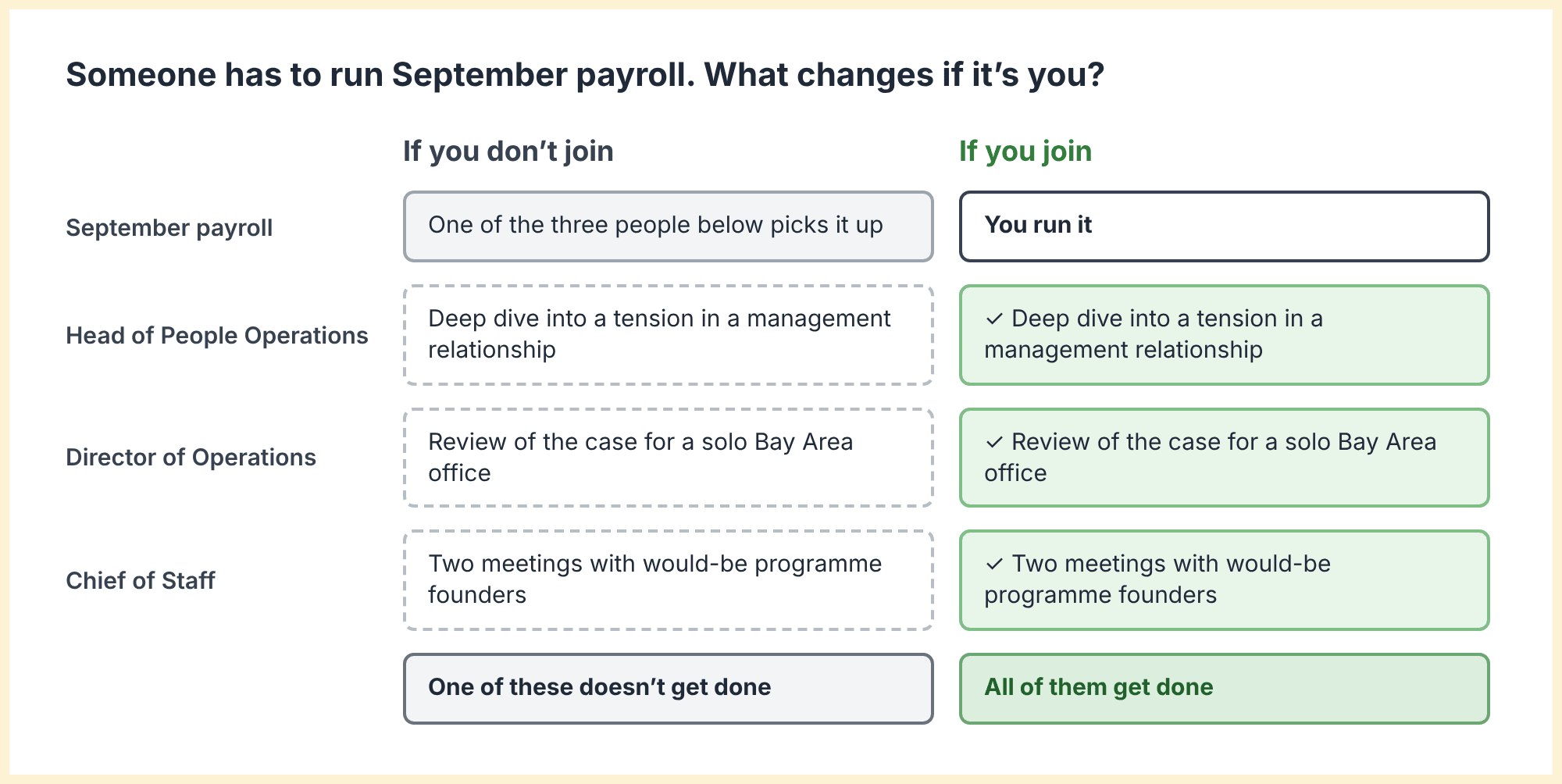
When speaking to candidates who are considering working with us at 80,000 Hours, I often hear people worry about replaceability.
The familiar version of the worry is about whether the organisation will hire someone else in your place. If it will, then the difference you make by taking the job is only the difference between you and them.
There are a couple of well-known answers to that. The person hired in your place probably cares about the world too, and would go on to do somethi...
Recent opportunities to take action
Whenever I talk about Effective Altruism (EA) to someone new, I talk about EA-the-Movement and EA-the-Philosophy. EA-the-Movement draws a specific kind of person (quantitative, techy, philosophical) and has selected a few causes it has determined to be the most effective. EA-the-Philosophy is about asking whether our donations and volunteering are going to places that get the most bang for our buck and those questions can be applied to anything we care about.
It's a way of easing people into our way of thinking without insisting that they join our particular group or adopt our priorities. I find it's especially useful if the quantitative or strong recommendations from EA-the-Movement to be offputting, or if they have previous associations with the movement. I think it's worth making people who are doing good in some way more effective, even if it doesn't end up getting them to do what we'd consider the most good. Although if someone spends enough time thinking with the EA Philosophy, it might end up leading the straight back to the EA Movement.
So, for example, if you're talking with a feminist you can ask them where their donations or volunteering could do more or the most good, and they could think about that and come up with answers. And you could give suggestions, e.g. charities that focus on girls education in LMICs, or reproductive health for women, or maternal health charities.
If you're talking with MRAs, you could ask them what are the more effective ways to help men and boys, and they could research ways to help in cases of IPV or MGC, etc.
And the same goes for environmentalists, civilisation collapse doomers, vegetarians and vegans, liberals, conservatives, proponents of free and open source software, people suffering from specific physical and mental health disorders, and so on.
Do you think it's useful to talk with people online (e.g. on YouTube, X, other social media, forums) about EA-as-philosophy? Although I think that EA-as-philosophy still requires some quantitative analysis of data, research and ethics to find better ways to help, people can still simply ask each other about how they can better help people.