Comments
TL;DR
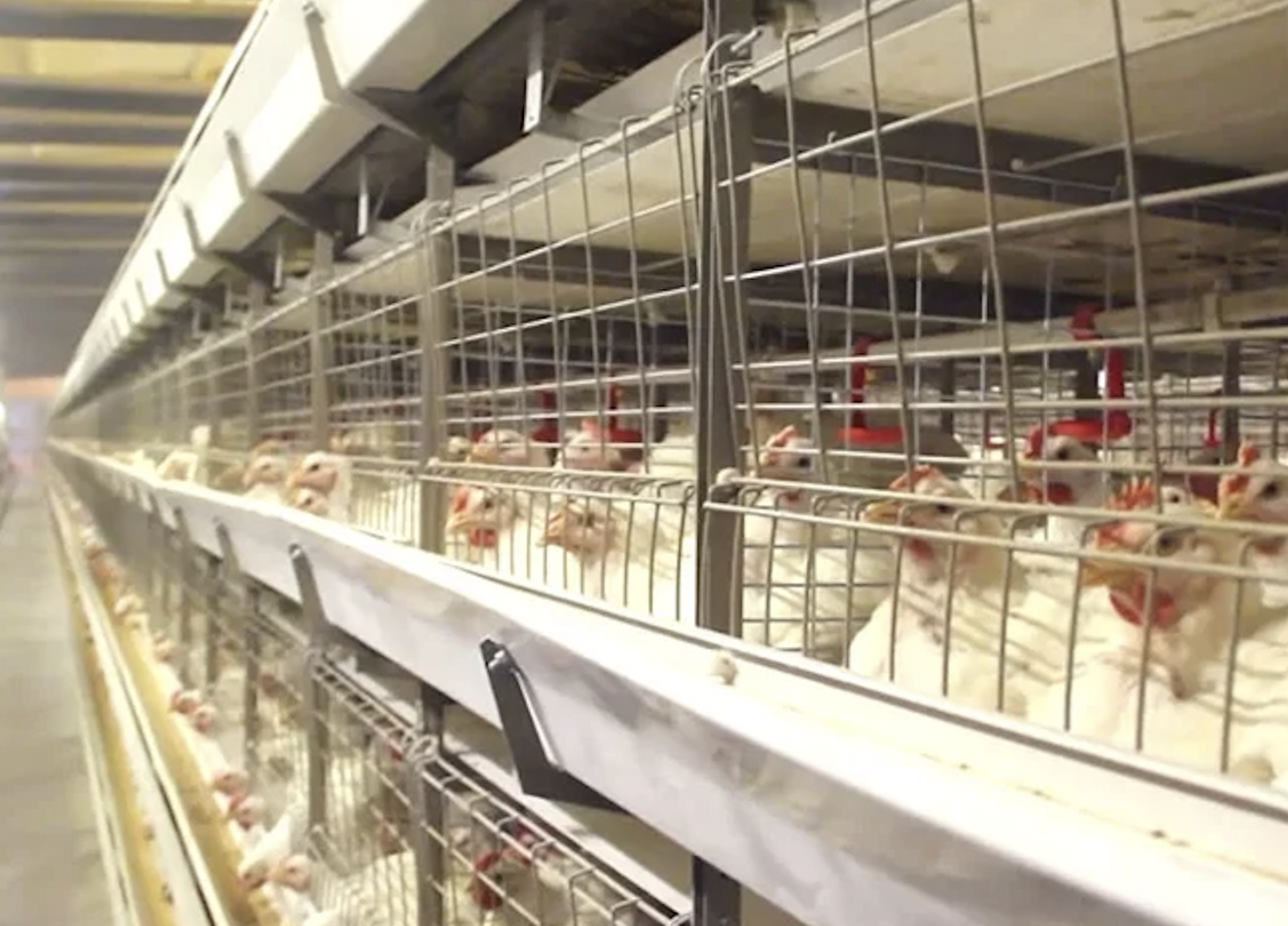
Cage-free layer campaigns are one of the most celebrated success stories in animal welfare and in EA-aligned work, improving the lives of hundreds of millions of hens and reshaping entire global supply chains. But alongside that incredibly important work, few people realize that an even larger and far more neglected confinement system exists almost entirely out of sight: broiler (meat) chickens kept in stacked wire cages, primarily in China.
- Scale: China raises ~15 billion broiler chickens annually, and ~10 billion (60–70%) spend their lives in cramped cages with even less space than battery-caged layers. This is 2x the total number of caged laying hens worldwide, with severe welfare implications.
- Neglectedness: Despite the enormous scale, this issue has received virtually no attention from the animal-welfare or EA communities. Broiler cages in China were almost entirely unaddressed, with effectively no corporate commitments on record before this year.
- Tractability: This may be one of the most overlooked high-impact opportunities in farmed-animal welfare.
- Roughly half of major Chinese producers already offer cage-free broiler chicken.
- Cage-free broiler meat is at price parity with caged meat.
- Major restaurant and retail chains have already begun committing to cage-free sourcing.
These conditions create a rare window where modest additional resources could shift hundreds of millions of birds out of extreme confinement each year and help prevent broiler cages from spreading globally.
Lever Foundation is currently leading this work. We have been working on the cage-free egg issue in China and Asia generally for the past seven years, and have been able to secure around 300 corporate policy commitments and producer shifts on that issue. While we continue to work on that issue, this year we expanded our corporate campaigns work to also include broiler chicken cages for the first time. Since the start of the year, we have secured seven cage-free broiler chicken commitments from major Chinese restaurant, retail, and packaged food companies. These initial broiler chicken commitments are expected to move roughly 15 million chickens per year out of cages once fully implemented, and early results indicate that with additional capacity, we could scale this impact to hundreds of millions of birds annually. The combination of broad market availability, negligible cost differences, and strong initial corporate receptivity makes this a uniquely leveraged moment.
The Scale of the Problem
China produces roughly 15 billion broiler chickens per year. An estimated 60-70%— around 10 billion birds annually—spend their whole lives in stacked wire cages.
For comparison:
- This is twice the number of caged egg-laying hens globally (~5 billion).
- Broiler cages remain almost entirely a China-specific phenomenon today.
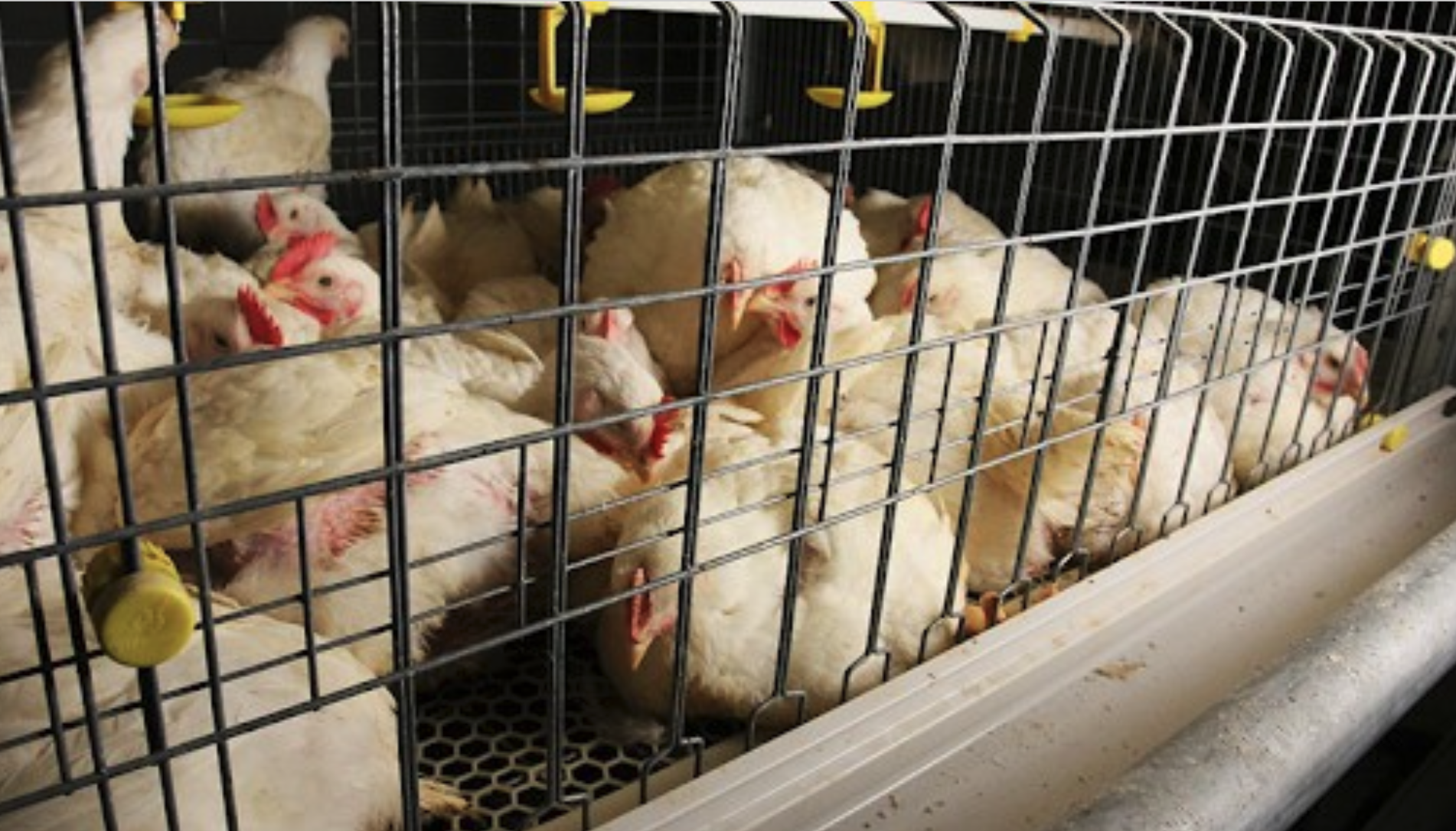
Cage dimensions are extremely small, with the two most prominent types:
- Type A: 24 × 20 × 14 inches
- Type H: 26 × 25 × 17 inches
This provides around 59 square inches per bird, often less space than battery cages for hens (typically 67+ sq in). Birds cannot walk, spread their wings, rest comfortably, or express any natural behavior.
Welfare effects include:
- High mortality and disease
- Neuromuscular strain and constant discomfort
- Behavioral disorders
- Chronic suffering throughout their short lives
Although broiler cages are currently concentrated in China, producers and equipment companies are already piloting them in Thailand, Indonesia, the Philippines, Japan, and Brazil. Without intervention, this system may spread globally.
Why This Looks Unusually Tractable
Despite the scale and severity, this is a rare case where the path to change is unusually straightforward.
1. Cage-Free Broiler Chicken Is Widely Available
China’s broiler market has two segments:
- White-feather chickens (75-80% of all chicken, used for Western-style fast food and processed products)
- Yellow-feather chickens (used for traditional cuisine)
An analysis of the 64 largest poultry producers found:
- 8% produce only cage-free
- 41% produce both caged and cage-free
So about half of large producers already offer cage-free broiler chicken at scale. This holds true even looking only at the top five or top ten producers.
Most producers and distributors serving large chains already have cage-free lines.
2. Price Parity: Switching Costs Are Essentially Zero
One of the biggest hurdles in campaigning for cage-free eggs campaigns has always been meaningful cost differences. Cage-free egg production typically carries operating costs around 15% higher than battery-cage systems, which slows corporate adoption and requires sustained pressure.
By contrast, caged vs cage-free broiler chicken sells at effectively the same price.
Examples from a major commodity chicken marketplace:
- Cage-free producer white-feather drumsticks: 103 CNY / 9.8 kg
- Caged producer white-feather drumsticks: 105 CNY / 9.8 kg
For yellow-feathered chickens, price differences are similarly negligible, and in some markets the cheapest products are cage-free.
This parity is not theoretical. When McDonald’s China transitioned to 100% cage-free chicken, the company reported zero increase in cost.
The absence of a price gap removes one of the biggest historical barriers in animal-welfare transitions and is a major reason why progress on broiler cages is unusually tractable.
3. Early Market Momentum
McDonald's China reached 100% cage-free chicken sourcing by 2024 and heavily publicized it. IKEA China followed with a similar commitment.
Building on this momentum, within just the first year of focused broiler-cage campaigning (starting in 2025), we have already secured seven cage-free chicken commitments from major domestic restaurant, retail, and packaged-food companies, including:
- Steel Pipe Factory (1,000 locations)
- Wagas (350 locations)
- Big Pizza (400 locations)
- Fan Shushu (500 locations)
- Wang Shun Ge (50 locations)
- Epermarket (major retail/e-commerce)
- Du Feng Xuan (one of China’s largest sauce & spice companies)
These pledges are expected to move ~15 million birds per year out of cages once fully implemented.
While this is only 0.1% of China’s caged broilers, the combination of:
- price parity
- existing supply of cage-free chicken
- early corporate momentum
suggests that scaling could plausibly move hundreds of millions, and potentially ~1 billion birds per year, out of cages.
Who We Are and What Additional Funding Would Enable
Lever Foundation is a US-based 501(c)3 public charity working to eliminate the most harmful factory farming practices across Asia, with operations across Greater China, Indonesia, the Philippines, Thailand, Korea, Malaysia, and Singapore. Since 2019, we have focused heavily on securing corporate commitments for cage-free eggs and supporting producer transitions toward higher-welfare systems. This work has led to around 85 commitments from domestic companies in China and around 300 commitments in total from companies based in or operating in Asia.
In 2025, we expanded our corporate policy work to include cage-free broiler chicken sourcing. Since then, we have secured the first seven broiler cage-free commitments in China—from major restaurant chains, retail groups, and packaged food companies—and early indications suggest that the combination of existing cage-free supply, price parity, and buyer receptivity makes this an unusually tractable opportunity.
Right now, this work is funding-constrained, and additional resources would meaningfully accelerate progress. We estimate that we can productively deploy $500,000-$800,000 in additional annual funding toward this work over the next 24 months, with clear opportunities to convert marginal dollars directly into additional commitments and producer shifts.
Specifically, additional funding would support:
- Salary and related costs for additional team members to carry out corporate outreach work (there are currently only two staffers working on this issue); this would be the primary use of additional funding
- Hiring one new team member to work on producer-side outreach (this has worked very well on the cage-free egg topic, where we have been able to persuade ~20 egg producers to shift 3-4 million hens into cage-free production, and it helps facilitate buyer-side commitments as well as implementation of commitments)
- Media and industry conferences (generating consistent trade industry media coverage on the momentum toward cage-free chicken, and presenting on the topic at large national and regional food and producer conferences, both of which have worked well in advancing the cage-free egg topic)
Given the scale of the issue (10 billion birds in cages annually), the lack of attention it has historically received, and the unique market conditions that make progress unusually tractable, we believe this area has substantial room for more funding and can deliver very large welfare gains per dollar.
If you are interested in learning more or exploring support, feel free to reach out to:
- Lily Tse, Program Director, Lever Foundation: [email protected]

Thanks for the post, Whitney and Lily, and welcome to the EA Forum! I did not know there were lots of broilers in cages.
What are your sources for this? I only found 2 links to the Lever Foundation across the whole post.
According to the Food and Agriculture Organisation (FAO), only 11.6 billion chickens were slaughtered for meat in China in 2023. This includes broilers and laying hens, and is 77.3 % (= 11.6*10^9/(15*10^9)) of your number for broilers.
FAO says there were 8.44 billion laying hens alive globally in 2023. Your numbers above imply 5 billion (= 10*10^9/2) laying hens alive in cages globally, which would mean 59.2 % (= 5*10^9/(8.44*10^9)) of laying hens globally in cages. I think the actual fraction of laying hens in cages is much higher. Even in the European Union (EU), there is still 38.1 % of hens in cages.
Maybe you meant 5 billion laying hens raised in cages are slaughtered per year globally, as you made a comparison with the number of broilers raised in cages in China that are slaughtered per year. However, as far as I know, the FAO does not provide data for the number of laying hens slaughtered per year.
I think the number of animals alive is a better proxy for the scale of the problem than the number of animals slaughtered. All else equal, the scale is larger for animals living longer, and only the number of animals alive accounts for this. This means using the number of animals alive underestimates the suffering of laying hens relative to broilers, which live shorter lives. The Welfare Footprint Institute (WFI) assumes laying hens live for "60 to 80 weeks" (including the pre-laying phase), and says the "average slaughter weight of broilers in the EU [European Union] and the US [United States] is, respectively, 2.5 Kg and 2.9 Kg, reached at 42 and 47 days".
Ideally, one would also account for different welfare per animal-year. I estimate that broilers in a conventional scenario have a (negative) welfare per animal-year equal to 1.34 (= -2.40/(-1.79)) times that of laying hens in conventional cages. In other words, only accounting for effects on chickens (not on soil animals), I believe 1 conventional-broiler-year less is as good as 1.34 conventional-layer-years less. Accounting for different conditions and population size, I calculate the total (negative) welfare of broilers globally is 2.99 (= -2.16*10^9/(-7.23*10^8)) times that of laying hens globally.
Hi @Vasco Grilo🔸 , thanks for your comments! Below are some sources for those data points, and replies:
RE: The number of broiler chickens raised in China annually:
China’s Ministry of Agriculture reported there were 14.8 billion broiler chickens raised in 2024. You can see a news article on this here: https://zootecnicainternational.com/field-reports/middle-far-east/chinese-broiler-production-reaches-record-high-amid-challenges/
Similarly, you can also see here China’s National Bureau of Statistics report here on 17.4 billion poultry raised for meat: https://www.stats.gov.cn/sj/sjjd/202501/t20250117_1958344.html. (Note, this number combines both chickens and ducks, thus the discrepancy with the 14.8 billion broiler chickens noted above.)
15 billion therefore appears to be the correct approximate number of broiler chickens raised per year, at least according to Chinese government statistics (which may not be perfectly accurate, but are likely more accurate than FAO estimates).
RE: the number of egg-laying hens in cages globally:
Our comment that there are twice as many chickens in broiler chickens in China as egg-laying hens in cages globally is certainly meant as a very rough estimate, and you’re right that that estimate did indeed account for the fact that egg-laying hens typically are raised for close to 18 months. (That estimate was meant to be “number of lives per year of production”, so egg-laying hen years were pro-rated by 2/3).
If instead we calculated on the discreet number of animals in cages per year, we estimate it would look more like 6.5 billion egg-laying hens are in cages each year globally and 10.5 billion broiler chickens in cages in China each year, and thus 1.6x as many broiler chickens in cages, as opposed to roughly 2x as many.
RE: Comparing number of animals vs number of animal years
Yes we would agree with you - ultimately, what matters is the number of animals impacted each day, and thus 1 egg-laying hen in a cage is equivalent to (in China, where broilers live a bit longer than in the West) about 6.5 broiler chickens in a cage. In terms of then adjusting for how much each animal suffers, we haven’t looked into your calculations of broilers vs egg laying hens, but agree on the importance of factoring that in.
General note:
The post was not meant to suggest that the caged confinement of broiler chickens is overall worse than the caged confinement of egg-laying hens, or to provide a quantified comparison of the suffering involved with each. We think that, overall, the suffering of egg-laying hens is surely a bigger problem, and as an organization, we spend more time and resources on ending the caged confinement of egg-laying hens. (We generated approximately 60 corporate commitments to end the use of caged eggs this year).
The goal with the post was to give a general overview of the situation for caged broiler chickens because it is relatively unknown; because it appears uniquely tractable (for the reasons described in the post), and because any way you cut it it is a very major problem (ie even if you look at it on the per day level, on any given day there are ~7 times as many broiler chickens in cages in China as there are egg-laying hens in cages in the US and EU combined.)
Thanks for the follow-up, Whitney! I strongly upvoted it.
I have shared the estimates you provided with one person from the FAO.
Nitpick. "/" at the end has to be removed for the link to work.
This implies 23.0 % (= 1 - 6.5*10^9/(8.44*10^9)) of all laying hens outside cages assuming 8.44 billion laying hens as reported by FAO. I believe this fraction is too high. How did you get the 6.5 billion laying hens in cages globally? Do you think there are more than 8.44 billion laying hens globally?
Makes sense!
Thank you for your response, Vasco, and appreciate the attention!
23% is a roughly accurate percentage of laying hens outside of cages globally. Numerically, this would be ~2 billion hens outside of cages. Factors that build to that number include the sizable proportion of modern cage-free production in the US, Europe, and a few smaller by volume regions (ex Oceania); sizable cage-free production in India; a large number of cage-free hens in China, even though the percentage of overall production is only ~10%; and, most importantly, in a number of countries in Asia (including major egg producing ones like Indonesia and Bangladesh) and most countries in Africa, a sizeable portion of egg production being cage-free because it is small backyard/local production that is free-range or similar.
For what it's worth, we are not trying to make a precise numeric calculation here, just give a sense of the size of the issue of caged confinement of poultry in China. That ratio of 2x or 1.6x (depending on how you calculate it) would go down if you estimate a lower percentage of global egg production is cage-free, but it would go up if we factor in say ducks raised for meat in China, of which approximately 2 billion are also raised in similar cage systems each year and for which the same logic and opportunity described above also applies.. That ratio would also go up if we project current trends and commitments forward several years (factoring in the trend toward cage-free systems in some markets and the continued shift to caged confinement of broilers in China). Depending on which of these things we do or don't factor in here, maybe you get 1.3x on the lowest end or 2.5x on the high end. 2x is a very loose average.
But regardless of the specific assumptions and whether that leads to 1.3x or 2.5x more birds in cages in China for meat than birds in cages for eggs globally, it probably doesn't really matter in terms of the general purpose of the post.
Thanks for the additional context!
Agreed.