Comments
here's some of the virtual juror commentary.
Effective altruism has a cause prioritization problem, and it's the kind of problem EA's own principles should have caught by now.
The standard framework — scale, neglectedness, tractability — is sound. The process by which we apply it is not. EA cause prioritization is effectively determined by a small, self-selected group: predominantly wealthy, tech-adjacent, Western, highly educated, and drawn from a narrow slice of human experience. The community's intellectual founders identified the initial cause areas. Influential funders reinforced them. Social proof and path dependency did the rest.
This is not how you identify what matters most for humanity. This is how you identify what matters most to a specific subculture.
I want to propose a fix. And then I want to show that the fix and the answer are the same thing — which is not a coincidence, but a sign of coherence.
Consider how EA currently prioritizes:
Now apply EA's own framework. If you were designing a system to identify the highest-impact interventions for humanity — not for a Bay Area subculture — would you design this system?
You would not. You would recognize that this system is subject to the same pathologies EA identifies in every other decision-making domain: selection bias, groupthink, motivated reasoning, narrow expertise, and the absence of perspectives from the people most affected by the decisions.
EA knows this. It's the same argument EA makes for why representative democratic institutions outperform autocracies, why diverse research teams outperform homogeneous ones, why prediction markets outperform expert panels. Aggregating information from a broader, more representative base produces better decisions.
So why doesn't EA apply this principle to its own most consequential decision?
Here is what a rigorous cause prioritization process would look like:
If this process sounds familiar, it should. It is election by jury — citizens' initiative review, sortition panels, deliberative democracy. The same intervention that has been used in Oregon to evaluate ballot measures, in Ireland to resolve the abortion question, and in dozens of other contexts worldwide.
And here is where the argument becomes recursive: election by jury is itself a candidate cause area. I believe that if you actually ran this process — convened a representative, informed panel and asked them to evaluate EA cause areas including election by jury itself — the panel would rank democratic reform extremely highly. Because ordinary people, when deeply informed about how their governance systems work and how they could work, consistently recognize the magnitude of the dysfunction and the value of the fix.
The methodology and the conclusion converge. That's not circular reasoning. It's what coherence looks like.
Let me now make the object-level argument for the two interventions I believe this process would surface: score voting (including simplified variants like approval voting) and election by jury.
Every cause area EA cares about is downstream of governance.
When EA works on AI safety, it is ultimately trying to influence what governments and institutions decide about AI. When EA works on global health, it is supplementing what governments fail to decide to do.
Governance quality is not one cause area among many. It is the upstream constraint that determines how well civilization handles everything else. An improvement in governance quality compounds across every domain, every year, indefinitely.
The question is whether we have interventions that actually improve governance quality, and whether the evidence survives scrutiny.
Score voting (also called range voting) asks voters to rate each candidate on a numerical scale. Approval voting is the simplified binary variant. Both eliminate the spoiler effect — the structural pathology that, under Duverger's law, causes two-party dominance in plurality voting systems.
Eliminating the spoiler effect is not speculative. It is a direct mathematical consequence of the ballot format: supporting a non-frontrunner can never cause your least-preferred frontrunner to win. This is proven, not modeled.
But we have something far stronger than a theoretical proof. We have quantitative measurement of expected welfare improvement.
Warren D. Smith's Bayesian regret simulations measure how much utility each voting method captures relative to the theoretical optimum. Across 144 parameter combinations — varying voters, candidates, and ideological dimensions — score voting approximately halves the Bayesian regret of plurality voting. It does so under both honest and strategic voting conditions, and with ignorance factors incorporated to model the gap between voters' intrinsic preferences and their expressed preferences under real-world conditions (campaigns, media, imperfect information, identity-driven voting).
In plain language: plurality voting — the system used in most elections — captures roughly half the welfare that a well-designed voting method could capture. Score voting roughly doubles the democratic dividend.
Let that sink in. Democratic governance is humanity's primary mechanism for collective resource allocation at scale. U.S. governmental spending alone is roughly $10 trillion annually. An intervention that doubles the welfare extraction of this system is not a marginal improvement. It is arguably the single highest-leverage structural intervention available.
Even under aggressive discounts — suppose the simulations overstate real-world gains by a factor of 5, and only a fraction of government spending is sensitive to electoral quality — you are still looking at an intervention worth tens of billions of dollars in annual welfare improvement. Deployed at hundreds of thousands of dollars per jurisdiction.
"But Simulations Aren't Reality"
This is the obvious objection, so let me address it directly.
The simulations are not predicting the future. They are measuring a mathematical property of the aggregation mechanism — how efficiently method X translates a given preference distribution into an optimal outcome. This is closer to measuring the thermodynamic efficiency of an engine than forecasting quarterly earnings.
The simulations already model strategic voting and voter ignorance. If your objection is "but real voters are strategic and poorly informed," that is already in the model. Score voting still wins, decisively.
And consider the alternative. Every other governance reform — campaign finance, redistricting, term limits, ranked-choice voting — relies on intuition, anecdote, and post-hoc narrative. Score voting has a quantitative measurement framework that no other institutional reform can match. Demanding a higher evidentiary standard for score voting than for any competing reform is not rigor. It is a double standard.
The honest remaining uncertainty is the gap between "better preference aggregation" and "better policy outcomes downstream." That gap exists for every governance reform. Score voting simply has a more rigorous answer to the first part of the chain than anything else in the space.
Score voting fixes how we aggregate preferences. Election by jury fixes who makes decisions and how informed they are. These are complementary interventions addressing different failure modes.
The fundamental problem with mass democracy is not that voters are irrational. It is that voters are rationally ignorant. The expected influence of any single vote is negligible, so the expected return on becoming deeply informed about policy is approximately zero. Voters therefore rely on heuristics — party ID, cultural affinity, name recognition — that correlate weakly with policy quality.
This is not a moral failing. It is an incentive problem. And sortition solves it directly.
A randomly selected citizen called to serve on a deliberative panel has meaningful influence on the outcome. The incentive to become informed is transformed. Combine this with structured access to balanced expert testimony and days of deliberation, and you get decision-making that is qualitatively different from both mass voting and elite representative governance.
This is not a new idea. Athenian democracy was primarily sortition-based. Trial juries are sortition-based. The concept of randomly selected citizens making high-stakes binding decisions is deeply embedded in democratic tradition. The radical experiment is elected legislatures, not citizen panels.
Evidence
Oregon's CIR panels have produced measurable 5-10% shifts in voter opinion on ballot measures. Ireland's Citizens' Assembly deliberated on abortion law; 87% of the randomly selected panel voted to recommend legalization. The subsequent national referendum passed with 66.4% support — the assembly anticipated the public's informed judgment years before elected officials were willing to touch the issue.
The causal chain is shorter and more measurable than score voting's:
Random panel convened → panel deliberates with expert input → panel produces recommendation → public opinion shifts measurably → better policy outcome.
The first three steps are fully within implementers' control. Step four has empirical support. Step five follows mechanically.
Together, these represent a systems-level upgrade:
Neither alone is sufficient. Score voting with uninformed voters is still an improvement, but a limited one. Informed deliberation under a pathological voting method still faces distorted aggregation. The combination addresses both failure modes simultaneously.
I've made this case above, but to state it explicitly: governance reform is upstream of every other cause area. Tens of trillions of dollars in annual government spending globally. Every policy domain EA cares about. Compounding indefinitely. No other cause area operates at this level of generality.
This is where the case becomes almost embarrassing.
Open Philanthropy — the largest EA-aligned funder at ~$1B annual grantmaking — spends virtually nothing on voting method reform. Total annual spending on score/approval voting advocacy in the U.S. is probably under $1 million. CIR/sortition funding is similarly minimal.
Compare: AI safety receives $100M+ annually from EA-aligned funders. Global health: $500M+. Animal welfare: $50M+.
The neglectedness-adjusted expected value of governance reform is orders of magnitude higher than the current funding level implies. This is not a subtle gap.
The strong version: Approval voting has passed by supermajority in every U.S. jurisdiction where it has reached the ballot. Fargo, ND: 64%. St. Louis, MO: ~68%. Campaign costs: hundreds of thousands of dollars. CIR panels cost tens of thousands and produce measurable opinion shifts. Per dollar spent, these are among the most tractable institutional reforms in the EA portfolio.
The honest complication: Both North Dakota and Missouri subsequently passed state-level bans on approval voting. That is a 2-for-2 legislative backlash rate. This is a real problem, and I am not going to minimize it.
But context matters. Both bans occurred in red states with unified Republican legislative control. Blue and purple states with strong ballot initiative protections — Oregon, Washington, California, Colorado — present a different institutional environment. This is plausible but unproven, and I acknowledge that.
I will also note what the bans signal. Incumbents do not spend political capital banning things that don't threaten their power. The backlash is evidence of efficacy, not futility. And the cost-per-passage is so low that even accounting for durability risk, the expected value per dollar remains extraordinary.
CIR faces less backlash because its advisory nature is less threatening to incumbents. This is both a feature (easier adoption) and a limitation (less structural bite). The strategic path is to use advisory panels to build the evidentiary base and institutional familiarity that enables progressively more binding forms of sortition.
I believe four factors explain the gap:
Path dependency. The founding EA cause areas were established by the community's intellectual founders. Subsequent prioritization has been incremental, not systematic. Governance reform has no champion of comparable influence within EA.
Measurability bias. EA prizes clean attribution — lives saved per dollar, QALYs gained. Governance reform has diffuse downstream effects that are harder to attribute. But this is a measurement challenge, not an impact challenge. And VSE provides a more rigorous quantitative framework than most EA interventions can claim.
Lack of domain expertise. Very few people in EA have deep knowledge of voting theory, social choice theory, or deliberative democracy. The community cannot evaluate what it does not understand. This is itself an argument for the representative panel approach I'm proposing — you would get people in the room who are not from EA's narrow intellectual tradition.
"Surely someone would have noticed." The assumption that if this were really so high-value, smart people would already be funding it. This is the exact reasoning EA was founded to challenge.
I want to close by restating the structural argument, because it is the most important part.
I am proposing that EA use election by jury — representative, informed, deliberative panels — to prioritize causes. I am simultaneously arguing that election by jury is itself among the highest-impact cause areas.
These two claims are not independent. They are the same claim applied at different scales:
The methodology and the conclusion are the same intervention. If you believe the methodology is sound — if you believe that a representative, deeply informed panel of humans would produce better cause prioritization than EA's current process — then you should believe the intervention is sound, because it is the intervention.
And if you don't believe the methodology is sound, I'd ask: what is your alternative? Because the current process — a narrow subculture deciding what matters most for all of humanity — is precisely the kind of decision-making architecture EA should recognize as suboptimal.
The coherence is the argument. The method is the message.
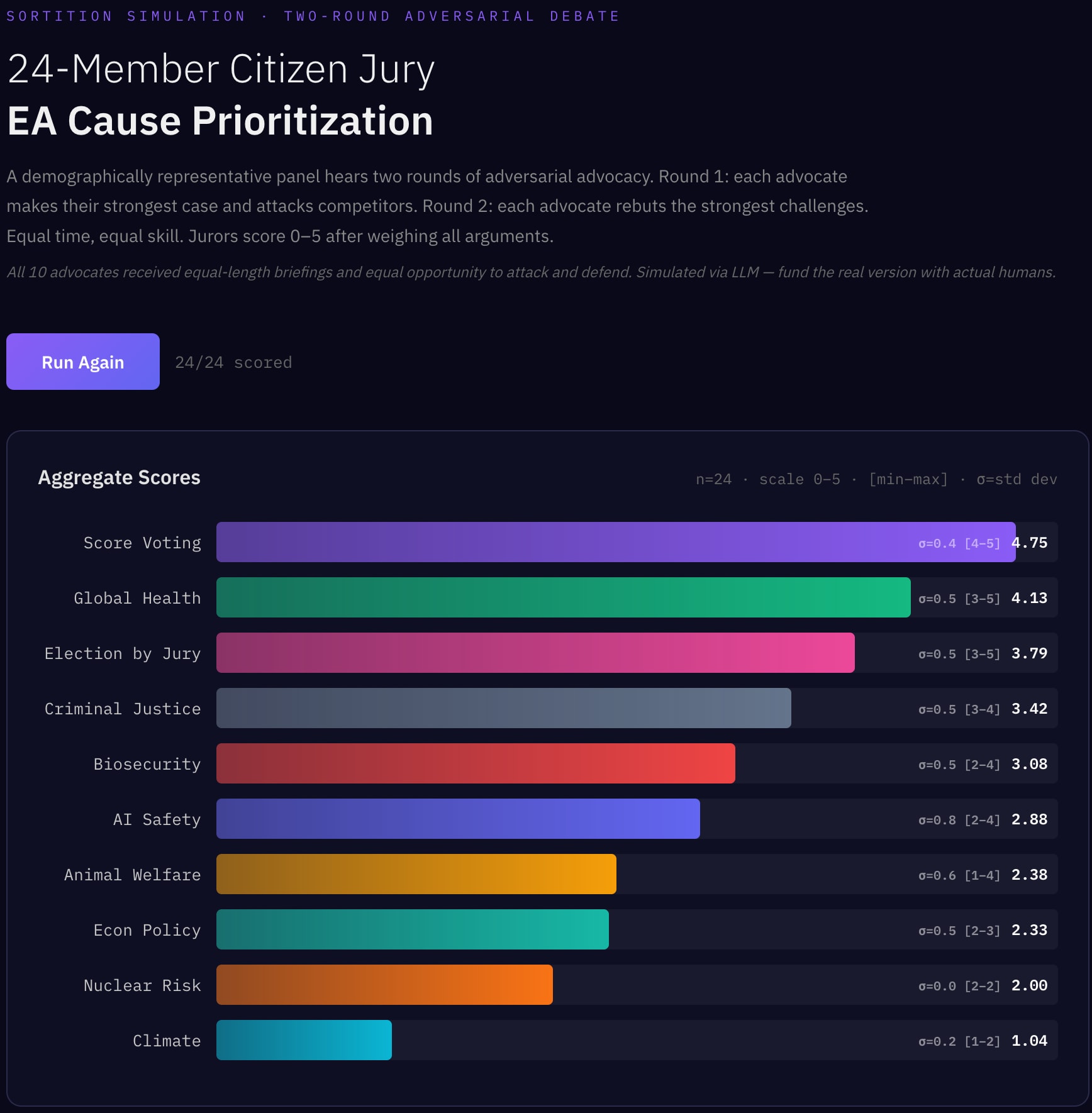
I co-founded the Center for Election Science and helped pass approval voting ballot initiatives in Fargo, ND and St. Louis, MO. I have nearly 20 years of domain expertise in voting reform and obvious conflicts of interest, which is why I'm proposing a process designed to check my own biases — and everyone else's. See my Claude-simulated 24-member jury review here.



I've said this before and got it completely wrong, but this feels like an LLM wrote a lot of it.
My view is that such a topic is far too important to be left humans.
Was there a specific claim or section that didn’t land for you? I found the ideas interesting and consistent with the author’s prior work on these topics. Any thoughts on the substance?
I agree with Nick here. About the substance, the ideas are interesting but the claims are too bold for what supports them, a typical feature of LLM written text.
Hi, I'd be curious to hear a claim you think isn't supported by the evidence.
I agree with Nick here. About the substance, the ideas are interesting but the claims are too bold for what supports them, a typical feature of LLM written text.