Cross-posting from Substack. It's written for a broad audience not necessarily familiar with effective giving or altruism, so some of it may be a bit introductory for an EA audience. That said, I expect most of the points and examples will be new (and hopefully useful) to many.
Can we do better than traditional philanthropy and impact investing?
Nan Ransohoff argues that AI wealth is about to bring a “third wave” of tens of billions of dollars a year into philanthropy, and that we’ll need many more capital allocators and builders to make sure this money is deployed well.
I agree, but not with her underlying claim that “The real question is whether there are $50B worth of initiatives that are compelling to these funders. If not, the dollars won’t get spent.”
The track records of both philanthropy and its sister impact investing show us that it won’t be hard to spend the extra $50B: philanthropy in the US grew by $30 billion just last year and impact investing’s self-reported assets grew by $100s of billions. What will be hard is to avoid the incentives that usually guide their expansion: catering to donors' individual preferences and to vanity metrics such as “amount of money deployed” rather than actual changes in the lives of beneficiaries.
What makes this wave meaningful
To start, I wholeheartedly agree with Nan when she writes “the type of money (who it’s coming from and how they’ll likely want to spend it) makes this potentially very meaningful”. And I don’t think her characterization of the worldview of many in this wave of funders is wildly off. However, what makes this wave so meaningful is not the funders’ beliefs or preferences on AI, speed, or tech-caliber talent, but the fact that they demand results.
Many of the people coming into wealth are part of the effective giving movement, and have been so since before they became wealthy. Some of these people (e.g. Anthropic CEO Dario Amodei) took the 10% Pledge with Giving What We Can (the organisation I run) when they were still students; others have been GiveWell donors for years, or are working with organisations like Coefficient Giving to donate strategically across causes such as animal welfare, biosecurity, or (yes) risks from AI.
You don’t need to buy that many people can easily 100x their impact (one of the key insights of the effective giving movement) to believe that the donors’ results-focus is what matters most here. Even if you just believe a 10x is possible (at scale), it remains much more important how well the $50 billion is spent than how much of it is spent. And it looks like there are people in this wave who would like to give spending it well a serious try, which is fantastic news for the world.
We have a huge opportunity
To put this into perspective: the current effective giving ecosystem as a whole moves about $2B per year to highly effective charities and programs. This is the money that buys bednets to save children from malaria by the hundreds of thousands, pressures corporations to improve the conditions of hundreds of millions of animals in factory farms, monitors wastewater to prevent the next pandemic, and pushes high-leverage policies to combat climate change. It’s a tiny fraction of the more than $600 billion per year spent on philanthropy in the United States alone, but if you take the 100x claim at face value, it’s already a substantial fraction of total impact made.
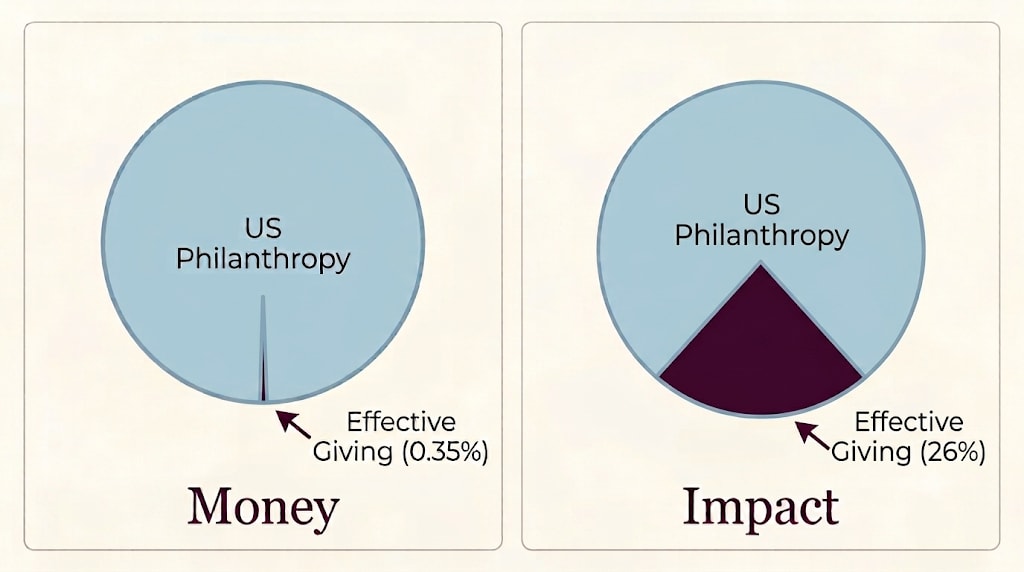
Now imagine what growing this ecosystem by even “just” $5 billion could make possible. For one, there are still $100s of millions in immediate funding gaps for some of the most cost-effective interventions, such as bednets, which could be immediately filled. As a consequence, tens of thousands of children would no longer need to die from preventable diseases such as malaria.
But the opportunity is even larger. To build on the malaria example: with billions of dollars in effectively allocated spending, eradication becomes a real possibility. In 2019, the Lancet Commission on Malaria Eradication estimated malaria could be eradicated within a generation, and at a cost of an additional $2 billion annually in the near to medium term. GiveWell, granting $270M in 2024, is already the third-largest funder in the fight against malaria, trailing only the Gates Foundation and the US government. The third wave, spent effectively, could do what the world should have done 70 years ago when we eradicated malaria in all the world’s wealthy countries.
And eradicating malaria is just one example of the type of opportunity this wave offers. If spent well, the $50 billion could succeed where governments and $600B of US philanthropy are currently failing in addressing global problems.
Impact investing: a cautionary tale
We can look at philanthropy’s sister sector, impact investing, to see what might happen when a lot of money arrives without the right incentives in place.
According to the Global Impact Investing Network (GIIN), the sector’s main coordinating body, by 2024 there was about $1.6 trillion USD in “impact investing assets under management”, up from $0.6 trillion in 2019. This would mean impact investing has grown much faster than philanthropy ever has, or than the third wave will bring.
This could have been amazing news for the world: imagine $1.6 trillion invested purposefully to solve world problems like extreme poverty, pandemics and climate change! But a read of GIIN’s 2025 “State of the Market” report doesn’t leave me optimistic, to say the least. Tellingly, the report doesn’t discuss the impact of the sector at all. It does have a chapter called “Financial and impact performance: perceptions and returns”. But this discusses whether impact investors are themselves satisfied with their impact performance and how they think they do compared to others. The results: 90% of investors are satisfied with their impact performance, 35% believe they are outperforming their peers on impact, and 0% believe they are performing worse than their peers.
To give GIIN some credit, they mention “impact washing” as a major issue of the sector. In their concluding chapter, they note that “While 71% of investors perceive impact-washing as a challenge to the market, only 10% felt it was an issue [...] within their own organizations.” and they admit “[impact] satisfaction may be driven more by the feeling of contribution to positive change [...] than by positive impact performance relative to targets”.
That said, I think the GIIN’s own way of measuring “performance” here is a key symptom, if not driver, of what has gone wrong. They’ve been measuring and optimizing for assets under management self-labelled as “impact investing” rather than for money that is invested impactfully. The incentives are all wrong, and it’s a case in point of Goodhart’s law at work at scale: “when a measure becomes a target, it ceases to be a good measure”.
I’m sure impact investing is doing quite a lot of good in the world: the lack of reporting by the GIIN doesn’t prove it doesn’t. And the same is true for most philanthropy: it’s doing good and I applaud anyone giving over not giving. But I think we can do better.
Building a new marketplace
To understand why the $600 billion of US donations isn’t already solving world problems at scale, and how we can do better, we need to examine the incentives at work.
In a traditional marketplace, a buyer buys a product of a seller and directly experiences the value of that product. If the product doesn’t live up to expectations, the buyer no longer buys it, and so the seller has an incentive to deliver.
In the charitable marketplace, the “buyer” is a donor, and rather than directly experiencing the value of the charity’s “product” (the impact) they experience the warm glow of making a donation, based on the communications and marketing of the charity they donate to. And so the charity is incentivized first and foremost to deliver that warm glow.
Obviously, the people working at charities aren’t only going to work every day motivated to “give donors a warm glow”, but in a sector plagued by scarcity, incentives are strong. Many small and some very large decisions (e.g. which problem does a charity work on?) are influenced by them every day, leading to a sector that as a whole predictably leaves a whole lot of impact on the table.
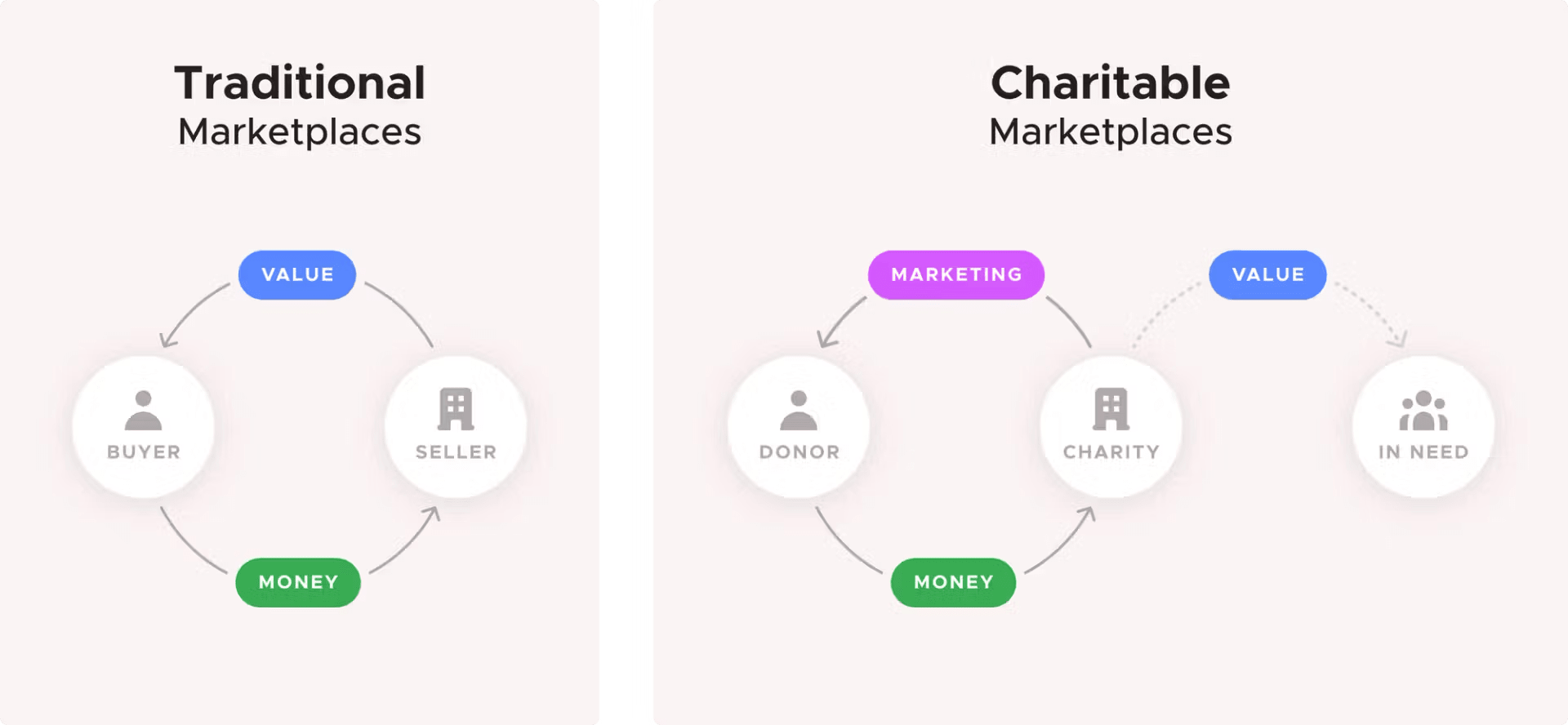
How do we fix this? Here’s one proposal to start: introduce independent evaluators who close the feedback loop and set incentives for impact. The effective giving ecosystem has been testing this, and I think successfully so, with GiveWell-directed funding alone already having saved 100s of thousands of lives even at its current, modest funding levels.
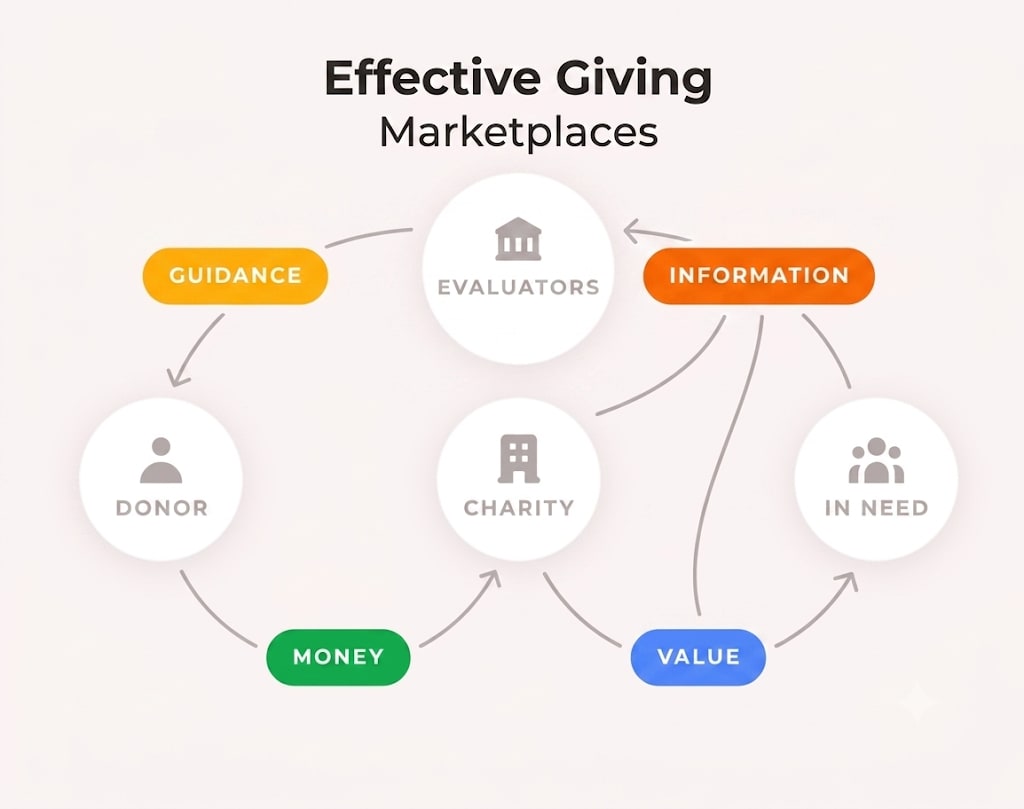
To be clear, the ecosystem is still in its infancy and has a lot of room for improvement itself: standards and governance need to be formalized, transparency should be further improved, gaps in the evaluation space should be filled, and evaluators themselves need better accountability mechanisms and coordination. But the foundation laid by organisations like GiveWell is there: independent and transparent research which measures what actually matters.
There are now 10+ impact-focused evaluators and grantmakers that try to allocate money where it does the most good. They don’t point to one “true” answer: all have their own worldview (ethical and empirical assumptions guiding their recommendations) and a methodology linked to that worldview. They use different metrics, have different standards of evidence, and different “risk tolerance”. Some include and some exclude more “high-risk high-reward” interventions like policy influence and research and development. And some depend mainly on randomized controlled trials, while for others the best available evidence consists of domain expert input.
The vision here is of a new marketplace where donors “buy” the most effective place to give based on their worldview, and evaluators are incentivized to “sell” this worldview and their evaluation expertise. Crucially, in this marketplace evaluators aren’t fundraising for themselves, but for an ever-changing portfolio of charities they have independently evaluated to be the best at solving world problems, according to their worldview. This system isn’t watertight, but it’s a huge upgrade from the current philanthropic marketplace.
The opportunity and challenge ahead is in further developing and scaling the effective giving marketplace to be able to absorb, as Nick Allardice argues, much larger amounts of money, while keeping a high standard and setting the right incentives. Standards and incentives are far easier to set before the money arrives than after, as is clear from the impact investing situation, so we have some urgent work to do.
Moreover, the Third Wave’s donors are busy people, and they won’t have the time or expertise to identify or evaluate charities themselves. If there are no well-incentivized organisations to inform them, they’ll be left to marketing, intuition or personal relationships like so many donors before them. Their interest in effective giving is a great starting point, but it’s not enough.
To me, the real question is not whether the $50 billion gets spent, but whether we can (1) help identify and create tens of billions worth of truly high-value initiatives, (2) build the marketplace and ecosystem that helps donors reliably deploy to these initiatives, and (3) withstand the inevitable pressures to lower our standards (too far) and adjust to donor preferences (too much) as we do so. I'd much rather see $10 billion spent well than $50 billion spent at the average effectiveness of the existing $600 billion.
I’m considering writing more about this and related topics on my new substack. Please comment or reach out if you have questions you’d like me to elaborate on in future pieces.

I agree, of course. But I like to use the term 'two sided market' (not in the technical economics sense).
The charitable work must (A) benefit the recipients and the world, but also (B) provide tangible and intangible benefits to the donor -- moral self satisfaction, sense of impact, connection with humanity, relief of injustice, prestige, catharsis, "kama muta", etc . (I always found the term 'warm glow' both vague and a bit dismissive, but it's widely used).
I think linking (A) and (B) is the key to sustaining and increasing effective giving (as well as support for foreign aid and global public goods). Finding ways to make the thing that benefits the world most align with the thing that makes donors feel good.
If a charity or intervention does B but not much of A, we have the old low-impact charity (e.g., people point to opera houses, make-a-wish, etc.).
If it does A but not B (perhaps stereotypically, for mainstream audiences, without good comms: shrimp welfare, AI interpretability, or support for nearly-invisible health-system infrastructure in Africa) we get great but underfunded EA charities.
I've argued (somewhere, to myself?) that, in deciding what charities to found or promote, we might sometimes choose interventions based on something like the product of their likely impact and their likely appeal.