Disclosure: I recently advised a client to fund a small grant to Dimagi, to do emergency cholera response in Nigeria.
Overall, this is a plausible way to activate a lot of small actors, while overcoming some of the difficulties of vetting very large numbers of small grants, or requiring overly burdensome due diligence from small actors.
I would also note that many of these interventions are externally validated, e.g. vitamin A, treating childhood malnutrition, kangaroo mother care. They are funded by organisations EAs have learnt to trust, like GiveWell (which specifically funds all three of these).
It is also often true that verification is a critical factor in delivering services or commodities, and that digital platforms like Connect can ensure more cost-effective delivery.
I would be interested to see actual cost-effectiveness figures for your table, rather than just rate per unit, if that is available? E.g. a cost per DALY averted estimate?
Thanks Jack-- appreciate that! Great idea on the CE figures. I'm going to add that to the article--I think cost per life saved estimates-- to the three health ones. I'll send you a message after I do that. Thanks for the suggestion!
Thanks for writing this, Neal. This is an interesting way of aggregating the existing capacity of locally led organizations to scale evidence-based interventions. I particularly like the emphasis on interventions that have been validated and proven to be cost-effective.
What I am curious about is how aggregation models like Connect might evolve for cause areas where achieving impact depends less on direct service delivery and more on strengthening systems and government capacity. For example, reducing lead exposure at its source has been noted to require stronger regulatory enforcement and government leadership alongside community-level interventions. My guess is that a meaningful share of this next wave of philanthropy may be directed toward these types of challenges.
Thanks much for the comments and questions! Agreed there are many things for which aggregating local capacity is not a good fit (and even when it is, Connect's approach won't always work for utilizing it). For some things like lead-exposure policy, perhaps you really want the 800 pound gorilla, i.e., a larger organization with clout, that we reference. And some health system strengthening projects may also be hard to decompose into a large number of discrete tasks. And we think there will still be a lot of important and cost effective things that can be done, and hopefully will be funded, through this next wave of philanthropy in addition to the types of interventions you mention. Thanks again for the comment.
The Overlooked Absorptive Capacity of Locally-Led Organizations
tl;dr: Discussion of the much anticipated third wave of philanthropy has focused on the absorptive capacity of large organizations. We argue there is substantial, overlooked capacity in the thousands of locally-led organizations that could each rapidly absorb ~$1M/year delivering cost-effective interventions. We draw on our experience scaling the Connect platform.
Epistemic status: We run the Connect platform and have a strong interest in these conclusions (this post could be viewed as part of our pitch to the third wave). We're confident in the operational data we report (verified service counts, LLO performance, engagement speed) and note our lack of confidence on some of the claims, in particular on the number of capable LLOs that exist.
The anticipation of a third wave of philanthropy, that may arrive as AI companies start going public, is raising concerns about whether there is enough absorptive capacity to spend it well. Most of the discussion we’ve seen is focused on what large non-profits can do. The goal of this post is to highlight the potential of utilizing the existing, well-placed capacity of thousands of locally-led organizations in sub-Saharan Africa to rapidly deploy third wave funding, if it materializes.
In essence, we’re saying there are substantial advantages to deploying 800 one-pound gorillas rather than creating another 800-pound gorilla. We have developed our perspective from over two decades of work on digitally enabling frontline service delivery in low- and middle-income countries (LMICs). We’ve long been mission aligned with EA, but only actively engaged with the community over the last 3-4 years as we started working on Connect as a means to efficiently scale high-impact interventions through high-performing local implementers. There are many examples of scaling through aggregation in industry, including franchises and two-sided marketplaces like AirBnB. Connect is one platform for aggregating local capacity in low-income countries for development. Others include GlobalGiving and PSI’s franchise model.
As of July 2026, Connect has aggregated the capacity of 58 locally-led organizations (LLOs) across 14 countries, who have delivered over 1.5 million verified services across a dozen intervention types. There are 200+ LLOs and 10,000+ frontline workers in our network, and we expect to fund many more of them as our funding grows. Only digitally verified services are paid for. Only high-performing implementers are given more work.
Aggregation side-steps many common pitfalls of scaling interventions
In the recent post on The Absorption Problem, Allardice articulates many of the reasons why things that work at small scale can fail to work nearly as well at large scale, or fail to scale at all.
Scaling through aggregation can avoid some of these problems because most of the work is done by organizations that never need to scale (the one-pound gorillas). For example, Allardice points out that as organizations grow, the number of human resource incidents that might require senior leadership attention grows, but, for example, in franchise models, very few HR issues percolate up to the central headquarters. Similarly, organizational growth challenges around decision rights and coordination are largely avoided through aggregation.
If interventions are designed and evaluated within an aggregation model, they substantially mitigate the "voltage drop" problem coined by economist John List (and referenced by Allardice) in which programs have much less effect at scale than initially measured. Often this is the result of the initial effect being artificially high due to special attention from the founder or people running a research study. Aggregation methods like Connect allow you to better study what you will scale. It’s not that Connect maintains a high voltage but rather that it introduces much less voltage to begin with, and quickly tests replication by running each intervention with several LLOs. IPA Nigeria is running a research study in Nigeria in which four LLOs will use the same Connect platform (albeit, with some extra attention from our staff) that we could deploy through hundreds of other LLOs.
Aggregation of course is not a panacea. It does not solve the problem of whether there is an inherent ceiling on how much an intervention can scale or unintended challenges introduced by successfully scaling it. We plan to write more about several community-based interventions that can be deployed by non-specialist workers and have high funding ceilings. And scaling through aggregation has its own problems. It may lack the clout (the 800-pound gorilla) important for stakeholder management, advocacy and policy work, and building long-term government relationships. The implementers may be less mission aligned or have less incentive to achieve high quality.
There are probably billions of dollars per year of absorption capacity in well-performing local implementers who can ramp up quickly
We can apply these abstract points towards our main claim: that aggregating local implementation capacity in sub-Saharan Africa is a strong match for the third wave of philanthropy that wants to spend a lot of money quickly and responsibly.
Siobhan M. recently made a similar case in "The new wave of global development philanthropy should go local". This post underscores the effectiveness of local implementers, and aligns with this recommendation that more of the funding flows into these organizations than current “far-off” funders typically allocate. Siobhan’s solution includes moving more funding to local grantmaking, even at the risk of proven cost-effectiveness. We differ with Siobhan in this respect. We are interested in the capacity of local implementers to deploy highly cost-effective interventions.
From our experience so far, we’d estimate more than half of the LLOs we have worked with could deliver $1m annually in cost-effective interventions (at least with the kind of support that Connect offers). The table below illustrates how we’d get there for several interventions. Most of these involve each LLO managing about 100 frontline workers (FLWs).
Intervention
Unit of service
Rate per unit
Annual volume
Frontline workforce
Annual spend
Child health campaign (Vit A, deworming, ORS/zinc)
Under-five child visited
$1.50
~676,000 children
100 FLWs @ 130 visits/wk
~$1.0M
Kangaroo Mother Care
Case supported (~5 home visits)
$60
~16,700 cases (~1,400/mo)
~92 FLWs @ ~3.5 new cases/wk
~$1.0M
Malnutrition treatment (RUTF/CMAM)
SAM case treated at home (~8 visits)
$75
~13,300 children
~85 FLWs @ ~3 new cases/wk
~$1.0M
Poverty graduation
HHs supported (~12 months)
$500
~2,000 households
~35 coaches @ ~60 HH each
~$1.0M
The three health programs have low cost per death averted under reasonable assumptions. For these crude calculations we'll use slightly higher costs than the table above: the rates in the table are set low to conservatively estimate absorptive capacity but are aggressive for estimating cost-effectiveness. GiveWell modeled CHAI's door-to-door distribution of ORS and zinc in Bauchi, Nigeria at a cost of $2.74 per child as achieving roughly $2,100 per death averted. For kangaroo care, at $80 per case supported, an absolute mortality reduction of 2 percentage points (say, a 20% reduction against a 10% baseline, which is consistent with GiveWell’s KC estimates) implies about $4,000 per death averted. For malnutrition treatment, at $100 per SAM case treated, a 2 percentage point reduction in one-year mortality implies about $5,000 per death averted, which is below GiveWell's parameters. At small scale we can deliver much more cost-effectively than these estimates, in part by targeting high-burden areas in Northern Nigeria and elsewhere. We haven’t thought through how cost-effectiveness would hold up at really large scale.
We don’t have particularly strong evidence that thousands of LLOs exist. Our network of 200+ LLOs that have responded to us in some way keeps growing and we see no signs of that slowing. There are national registries of non-profit organizations with very large counts, often over 10,000 and over 100,000 in Nigeria. Even if just 5% of these qualify, there would still be thousands available.
Existing absorptive local capacity can be rapidly deployed where it is most needed
One pushback we expect is on the feasibility of aggregating local capacity. The big gorilla approach is more common because it flows funding through organizations with proven track records and reduces the overhead of managing many different contracts.
We offer our Connect platform as an early proofpoint to address this (so discount accordingly). Connect is both a digital platform and an operational model: in the same way that Airbnb made every spare room bookable and Uber made every car hireable, our goal with Connect is to make every capable local organization cost-effectively fundable. Digital verification of service delivery is the underlying feature that our approach relies on. We set up pay-per-service-delivery contracts, pay only for verified services, and give more work only to organizations that perform well. Connect is designed to drive the overhead of adding and managing each additional LLO toward zero, which in turn allows us to efficiently find the LLOs that can perform well within Connect. Dimagi runs these contracts on roughly 20% of program funding, with 80% going to LLOs, FLWs, or commodities.
Connect is designed as a two-sided marketplace (like Airbnb) with some of the attributes Sjir Hoeijmakers describes in his case for a new philanthropic marketplace. We often talk about selling impact to donors. Reading Sjir's piece, we can envision supporting an independent evaluator layer on top of Connect data, for example, to determine which Connect programs are most cost-effective in a given geography.
Connect is able to rapidly engage LLOs. In most cases, delivery starts within a few months and when needed it can be weeks or even days. We recently launched six pilots in five weeks for malaria control (an intervention area new to the Connect team) across Nigeria, DRC, Sierra Leone, and Liberia. Quickly operating in these countries reinforces our claim that well-performing LLOs exist in some of the highest burden areas. We speculate that 800-pound gorillas often concentrate their work in easier-to-reach places than one-pound gorillas do (with a notable exception of humanitarian organizations).
Rapid engagement also lets us find the high performers by starting small and observing, rather than by vetting proposals. In 2025 we funded 40 LLOs for child health campaigns (funded by GiveWell and Founders Pledge). Each child health visit included delivering Vitamin A, deworming medicine, and/or ORS with zinc. In almost all cases, LLOs started with a small contract of under $5K. Five of these did not perform well enough on our metrics to proceed, and another five finished their initial pilots after we had allocated all of our funding.
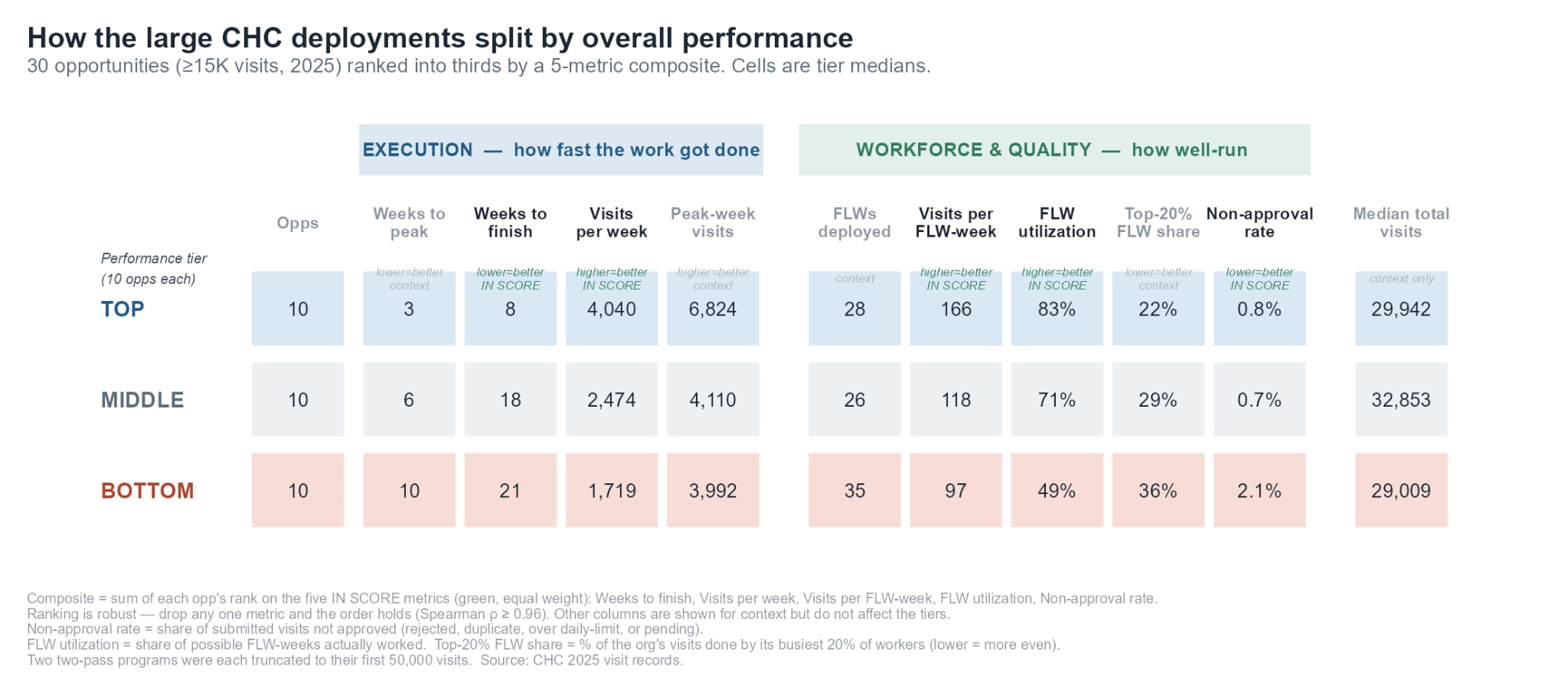
The (AI-generated) table below shows an analysis of the 30 LLOs we funded larger campaigns for, ranked into thirds by a composite of five delivery metrics. All three tiers ultimately delivered similar total volume (median ~30K visits), but at different levels of execution. The top third reached peak delivery in ~3 weeks and finished in ~8, while the bottom third took two to three times longer, with lower workforce utilization and higher rejection rates.
What could go wrong?
Our model carries risks as well. Connect's verification processes could be defeated. Digital checks (GPS, photos, timestamps, audio recordings) may be bypassed by coordinated fraud. We think this is more likely to happen at the individual delivery level than for a large number of services delivered, as we can detect anomalous patterns at an aggregate level, which requires a lot of sophistication to defeat.
Additionally, reach at low cost may not be sustainable. There may not be as many LLOs as we think, and early traction may reflect LLOs treating Connect as a loss leader or testing it out. Rewarding volume rather than outcomes could also push FLWs toward speed over rigor, and quality may fall short of what managed field teams under direct supervision achieve.
Some interventions require high quality execution to have good outcomes and many interventions need some adaptation to be deployed through Connect. Because Connect primarily verifies service delivery, it could fund work that turns out to be less cost effective. One mitigation is 3rd party assessments. We are also exploring embedding contiguous program monitoring (done by different LLOs than those implementing the program) into Connect.
There is more to this than just absorptive capacity
The focus of these points so far is to consider scaling through aggregation as a substantial element of absorptive capacity to deliver cost-effective interventions. We plan to write more about the many advantages of scaling through high-performing local implementers even if one is only thinking about how to spend limited dollars.
We welcome discussion or disagreement on any of the above. We’ve learned a great deal from this community that has helped us improve Connect, especially when challenged.
I was born at the end of the cold war, unaware of the danger we were emerging from. Duck and cover drills (as if those could protect schoolchildren from a nuclear blast) were a curiosity of the past.
The farmer-poet Wendell Berry, who wrote about the dread of nuclear war, died recently. From his 1968 “The peace of wild things”:
When despair for the world grows in me
and I wake in the night at the least...


Thanks for writing this - extremely interesting.
Disclosure: I recently advised a client to fund a small grant to Dimagi, to do emergency cholera response in Nigeria.
Overall, this is a plausible way to activate a lot of small actors, while overcoming some of the difficulties of vetting very large numbers of small grants, or requiring overly burdensome due diligence from small actors.
I would also note that many of these interventions are externally validated, e.g. vitamin A, treating childhood malnutrition, kangaroo mother care. They are funded by organisations EAs have learnt to trust, like GiveWell (which specifically funds all three of these).
It is also often true that verification is a critical factor in delivering services or commodities, and that digital platforms like Connect can ensure more cost-effective delivery.
I would be interested to see actual cost-effectiveness figures for your table, rather than just rate per unit, if that is available? E.g. a cost per DALY averted estimate?
Thanks Jack-- appreciate that! Great idea on the CE figures. I'm going to add that to the article--I think cost per life saved estimates-- to the three health ones. I'll send you a message after I do that. Thanks for the suggestion!