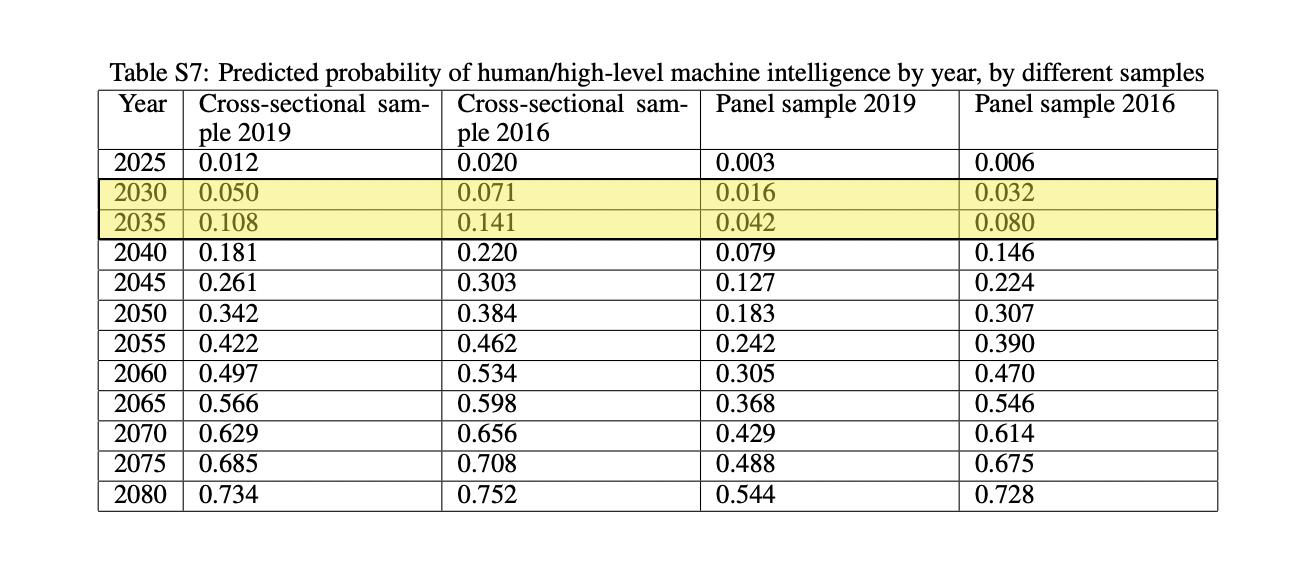
Artificial General Intelligence (AGI) poses an existential risk (x-risk) to all known sentient life. Given the stakes involved -- the whole world/future light cone -- we should, by default, be looking at 10% chance-of-AGI-by timelines as the deadline for adequate preparation (alignment), rather than 50% (median) chance-of-AGI-by timelines, which seem to be the current default.
We should regard timelines of ≥10% probability of AGI in ≤10 years as crunch time. Given that there is already an increasingly broad consensus around this, we should be treating AGI x-risk as an urgent immediate priority, not something to mull over leisurely as part of a longtermist agenda. Thinking that we have decades to prepare (median timelines) is gambling a huge amount of current human lives, let alone the cosmic endowment.
Of course it's not just time to AGI that is important. It's also the probability of doom given AGI happening at that time. A recent survey of people working on AI risk gives a median of 30% for "level of existential risk" from "AI systems not doing/optimizing what the people deploying them wanted/intended".
To borrow from Stuart Russell's analogy: if there was a 10% chance of aliens landing in the next 10-15 years, humanity would be doing a lot more than we are currently doing. AGI is akin to an alien species more intelligent than us that is unlikely to share our values.


It's wrong.
Thanks, have changed it to 30%, given the median answer to question 2 (level of existential risk from "AI systems not doing/optimizing what the people deploying them wanted/intended").
I'll note that I find this somewhat surprising. What are the main mechanisms whereby AGI ends up default aligned/safe? Or are most people surveyed thinking that alignment will be solved in time (/is already essentially solved)? Or are people putting significant weight on non-existential GCR-type scenarios?
Some relevant writing: