Note: This post was crossposted from the Coefficient Giving Farm Animal Welfare Research Newsletter by the Forum team, with the author's permission. The author may not see or respond to comments on this post.
Subtitle: On vegan advocacy, effective altruism, and FIFA
I turn 40 today. Here are some hot takes.
On factory farming
1. Our biggest challenge is salience. If factory farming led the evening news, it wouldn’t last lo...
On October 22nd starting at 10:00am Pacific Time, Every.org is matching donations to select animal welfare organizations at a 2:1 rate, up to $2,000 per donor per nonprofit (so if you give up to $2,000, they will contribute up to $4,000 and the nonprofit will get up to $6,000). The first donation a donor makes to each eligible nonprofit will be matched, and donors can get the match for multiple $2,000 donations. So, you can get more than $2,000 matched by donating $2,000 one time to multiple...
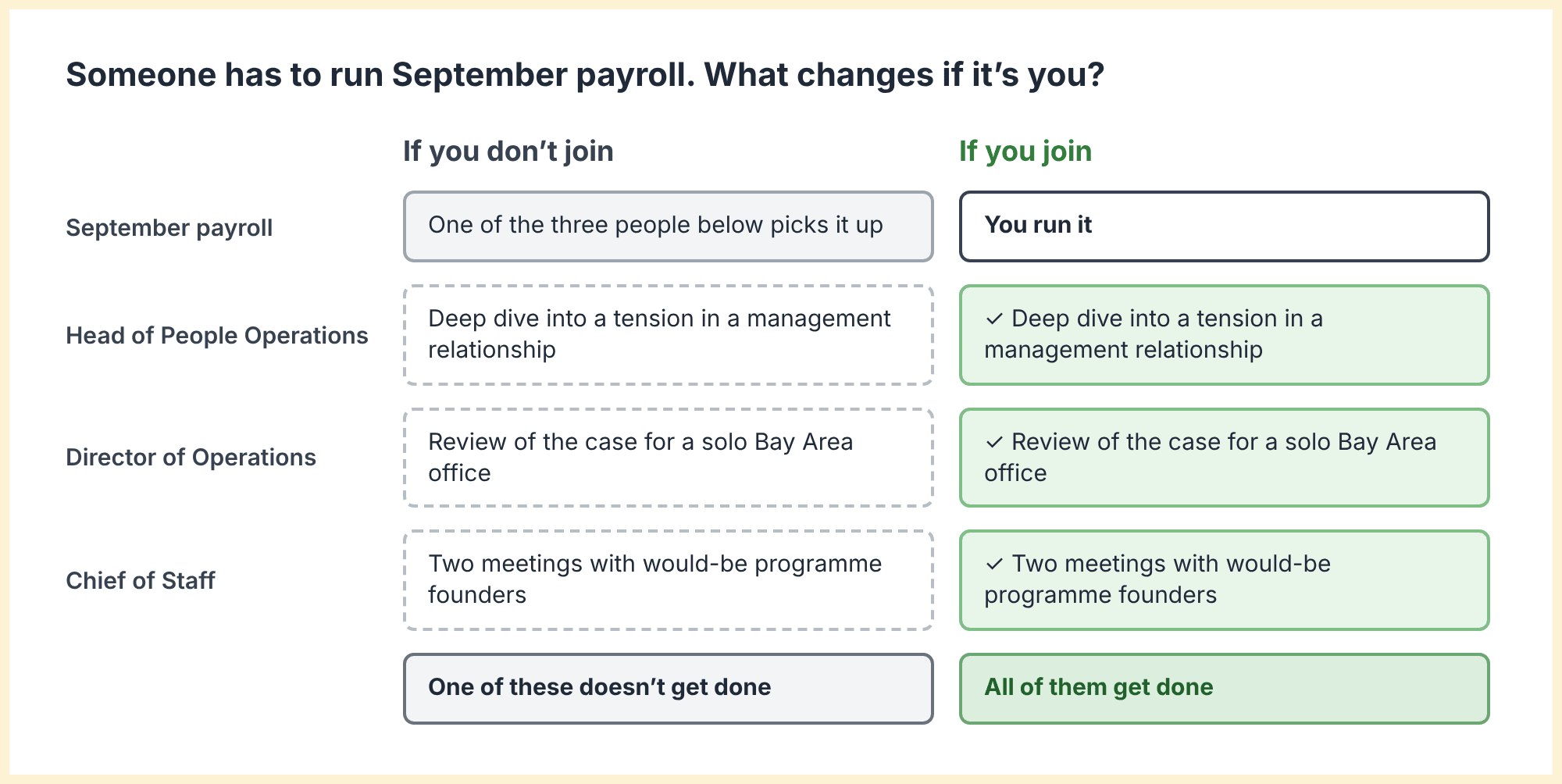
When speaking to candidates who are considering working with us at 80,000 Hours, I often hear people worry about replaceability.
The familiar version of the worry is about whether the organisation will hire someone else in your place. If it will, then the difference you make by taking the job is only the difference between you and them.
There are a couple of well-known answers to that. The person hired in your place probably cares about the world too, and would go on to do somethi...

I think we should not make compromises that decrease impact/dollar to benefit Americans. Americans are not more valuable than people from Poland or Pakistan or Kenya.
I agree that Americans are not more valuable than any other people, but EA orgs like GiveDirectly have made the choice to support impoverished Americans because they are based in the US and can reach them more easily.
I am skeptical that that's the reason for it. I haven't seen numbers on this but I would be shocked if the cost of delivery of any intervention to Americans is less than delivery in developing countries, because operating costs for any intervention are higher in the US - hiring people to identify recipients, for example, would be an order of magnitude more expensive than doing the same in Kenya.
I suspect the real reason, which is maybe worth centering in this post, is that the pool of money that people are potentially willing to donate to Americans is a) very large, b) not fungible with money they would otherwise donate to global poverty.
Point taken - I suppose my comment was a little oversimplified. I do think that identifying recipients is probably easier in the U.S., but that's irrelevant considering a poor American lives on $50/day versus $1-2 in Kenya.
Yes, this is the motivation behind my question. GiveDirectly states that "the additional attention from U.S. work generated $70 million in new donations for our Africa programs from donors who initially only gave to our U.S. COVID-19 response." In some cases, it may be wise for EA-aligned organizations to funnel some of their interventions "closer to home" for their donors. GiveDirectly was able to spur new funding opportunities by directing some of their revenue to U.S. recipients. Perhaps an org focused on health media campaigns in Africa could better fundraise in the U.S. by touting a the success of an U.S. program. Again, I don't think U.S.-based interventions are ever as effective as those in poorer nations, but they have the potential to expand the donor base of EA orgs.