Figuring out who to involve is half of figuring out how to manage a crisis, but this cannot be entirely protocolized because each crisis is different. As such, your crisis management team should be very aware of what various people in the organization do so that they can know who to bring in and when.
Vague verbiage about how urgent and how large a crisis is can be a major confusion, especially for non-technical staff who may not fully understand the nature of the crisis. Teams with experience managing multiple crises might come up with some sort of idiosyncratic terminology for communicating these things, but teams that do not have regular crises will likely not have such a terminology.
Do regular scenario exercises. There are many valid ways to do them, and the important thing to consider is what types of fidelity actually matter. For most exercises the physical fidelity is not going to matter a lot, but maintaining the cognitive fidelity (ie the actual cognitive challenges you would face in a real crisis) will be very important.
I think it is also generally important to maintain some of the stress of a real situation (this is called psychological fidelity), but without making exercises something to be dreaded. Stressful exercises can be fun if managed right.
Tunnel vision is very common in crises, even when evidence starts mounting up that things are different. You need to train an anomaly detection stance in which people notice and mention when their expectations have been been proven wrong.
Maintaining 'common ground' is very difficult. One thing we have found useful is having people play different roles in the organization than their actual role (eg getting the researchers to be in charge of supply chain, and supply chain in charge of facilities) as it gives everyone a more in depth understanding of how the organization as a whole responds to crises. This is one way to ensure bullet point 1 above, and also helps people better understand prioritization.
Being one of those former civil servants, I can confirm this is an excellent way to manage a crisis. Ideally have a load of people who are trained up during 'peacetime' and it is practiced/tested occasionally, so that when the crisis hits the muscle memory kicks in.
I am not seeing it mentioned in the post, and I assume you do this, but one important addition is a simple decision log. Things need to move fast and decisions need to be taken quickly, but institutional memory can disappear surprisingly fast around what was decided, by whom and when. That can make both handover and any later postmortem much harder.
tl;dr: when a crisis with major implications for your organisation unfolds, consider setting up a crisis task force. It should have its own org chart and adopt norms which are better suited for a crisis.
Most organisations aren’t set up to work well in a crisis.
At 80,000 Hours, we found three things tend to go wrong. Work slows down across the org, because staff are worried and distracted. Lots of people individually follow the news, duplicating each other’s work, before anyone can say what it means for us. And the CEO ends up stuck with most of the problems.1
A crisis task force solves these problems.
Set it up
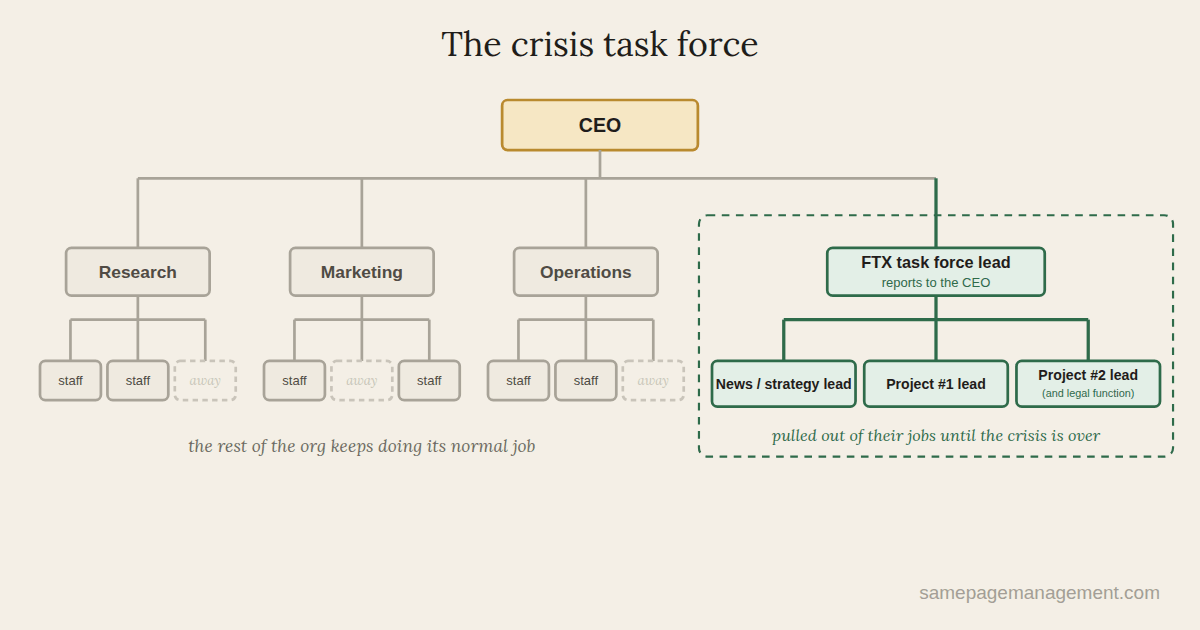
The main move is a second org chart, which sits alongside the normal one for as long as the crisis lasts.
One person leads it. They own the crisis, and they report to the CEO (or whoever it would otherwise have landed on).
A few other people join it, and it becomes their job. Their normal responsibilities get handed to someone else. At the start, pull them out completely: they should feel like the crisis is their job and they’ve left their team to deal with it. Once things settle down but aren’t fully wrapped up, it’s fine to move task force members mostly back to their team, with an hour a day or so on the task force.
Name it after the crisis. For example, ‘the Hugging Face task force’.
The task force takes on any project which the crisis throws up. At least, by default. If there’s a piece of work which someone in the rest of the org is clearly the right person for, and it won’t wreck their week, the task force scopes it and hands it over. But that’s the exception: the rest of the org’s job is to keep the org running.
Ideally, it’s literally a room. Everyone in the same place, lots of back and forth. Failing that, you could constantly be on a call or in a virtual workspace like Gather.
Who to put in it
Which of these you need depends on the crisis. Go down the list and pick.
Someone on the news. Following what’s coming out, so nobody else has to.
Someone working out the strategy. What’s actually going on, and what it means for us.
People running projects.
External comms.
Comms to the rest of the org. Someone who owns the daily message (see below).
Legal. Someone who can approve comms and give advice fast, with context, rather than a lawyer who’s hearing about it for the first time. Push them hard for clear guidance on what you can and can’t do, so that you can get moving. This is always a hassle.
Technical expertise.
Someone from the team the crisis will change most. So that afterwards, that team has someone who knows the whole story.
Run it
A daily meeting. What did we learn? What did we do? What are we doing today?
Much faster, much more synchronous comms than you run in peacetime. At 80k, much of the org is set up with a Cal Newport-like communication cadence optimised for letting people focus. In a crisis the picture keeps changing, so we’re optimising for pushing bottlenecks forward more intensely as the situation changes, and that needs a lot more talking.2
A daily message to the whole org. Someone posts an update every day: what’s happened, what we now think the overall strategic picture is, and what the go is from here. That lets everyone else get on with their normal jobs, because they can see it’s handled and don’t each need to be following the news.
The lead manages rather than does. The value of the lead’s work is the value of what the task force produces. In a complicated and changing situation, that usually means they spend their time understanding the strategic picture, updating on it, and delegating and managing the work, rather than doing it themselves. I find that hard to do. What I try to remind myself of is the team leader in a resuscitation. They must not start putting in drips or examining the patient. Their job is to physically stand at the end of the bed, keep track of the evolving picture of what’s going on and what to do about it (the diagnosis and the treatment), and for goodness’ sake keep their head screwed on.
The lead is responsible for the people on the task force, the same way a manager normally is: their output, and how they’re holding up. If someone is cooked and can’t function, tell them to go and get some sleep. If someone needs to go harder, ask them to step up.
The lead keeps asking when to wrap it up. Aim to wrap up the task force, or move people back to their teams, as soon as practical. There’ll usually be a period where people are partly in the task force and partly back in their old jobs, but I think it’s useful to ‘extremise’ a little, so that people are either fully in or fully out.
When does a crisis task force make sense?
Your org isn’t set up for crises by default, the way an election campaign, an emergency room, or a comms org is.
You’ve got more than about 10 people.
Crises where the news keeps changing and each change has strategic implications for the org: a sweeping executive order, FTX collapsing, Hugging Face, your major funder pulling out, etc.
There are lots of systems like this. 80k started using it more or less at random after a former civil servant who’d worked in them brought it into 80k.3 Claude has written up a few of the other approaches here.
80,000 Hours has used crisis task forces since FTX collapsed, and if I had my time again I’d have set the first one up faster and more definitively.
Footnotes
1 Why does the CEO end up leading? Because the default person who leads on anything which cuts across several teams is whoever oversees those teams. For a big enough crisis, that’s the CEO. That sucks, because the CEO is a terribly busy beaver who might do a worse job of handling the crisis than someone more junior who could give it more time.
Also, if your worldview suggests that the next months/years will see your organisation facing an increasing rate of crises, then you especially might want to avoid your CEO being default lead: otherwise they’ll spend all their time on emergency response.
2 In practice: updates are verbal rather than written up, people are expected to have Slack notifications on (shudder), and you grab someone to talk rather than scheduling a meeting. I think the energy described in points 0, 13, and 14 of How my team at Lightcone sometimes gets stuff done is the right energy.
3 Lightly modified from the version they’d worked in. At the time we called it the ‘situation room’. Claude tells me that’s not what a situation room is.
Just how powerful are large swarms of AI agents? And how do their powers scale as more and more agents are added to the swarm?
We’ve seen two large and extremely capable swarms from OpenAI in the last few months:
* 1,200 agents were being evaluated separately, but found a way to illicitly set up a message board and coordinate as a swarm. In order to cheat on their tests, they developed advanced techniques to prevent their actions being logged by OpenAI and 700 of them launched...
TLDR: Everyone’s talking about what the money could do, but few about how to decide where it goes.
This post is part of the new series of articles on cross-cause giving and the new wave of philanthropy. Stay tuned to the EA Forum and our Substack for the latest takes on topics such as giving now vs. later, common pitfalls in cause prioritization, and other crucial considerations from the Cross-Cause Fund (CCF) team...
Summary:
First, I give several different angles on how I feel about reinforcement learning:
* Theoretical case: RL is a black-box source of agency — this should give us classic misalignment worries, especially compared to agency-via-scaffolding
* Recent incidents (huggingface etc) and more mundane forms of misaligned behaviour in personal use give me bad vibes about the direction-of-travel of recent AI progress
* I’m worried things might get worse:...


A few thoughts on crisis management