We contacted our university about introducing the EA Introductory Fellowship as a one-credit elective in a program of our Economics bachelor’s degree.
They were happy to do it, and we ran it with 27 students. We were paid €1800 for it, and will continue offering it for the foreseeable future.
Past Economics students received the credit retroactively, and now all our fellowships offer one credit to eligible students.
We think this might be low-hanging fruit for other university groups as well, and would like to strongly encourage them to look for similar opportunities.
This spring, we at PISE (Positive Impact Society Erasmus) introduced the EA Introductory Fellowship as a one-credit elective at Erasmus University Rotterdam, a well-ranked Dutch university with a strong economics department. The ultimate goal in our theory of change is to get as many students as possible to do the most good they can, primarily through impactful careers and earning-to-give. The fellowship is how most of the students at our school become familiar with effective altruism and eventually become active in the community (and if you’re organizing a student group and not running a fellowship, you should seriously consider it. It’s a great way to communicate ideas in a high-fidelity manner that sticks).
The same is true for most other student groups, so if you’re already running a fellowship, it’s worth checking if you can get your fellowship accredited since most of the work is already done. An accredited course is a great way to significantly extend reach and improve the reputation of student groups. For us, the effort to get our fellowship accredited was surprisingly low (~4 meetings with the university, including the necessary preparation). We want to share how and why we did it in order to inspire and encourage other groups to find ways to do the same.
Why you should get your fellowship accredited if you can
The main advantages we found were:
The course gains a renewed sense of authority. We could now frame the fellowship more similarly to existing academic courses.
You can expect people to take the course more seriously (reflected in better preparation, engagement, and attendance). This reduces the need to bring people up to speed on the concepts (although a recap is still beneficial), and improves the quality of discussions and the overall experience.
You’re guaranteed people’s attention from the first to the last session, thanks to lower dropout rates. You have more time to build arguments, and can now build the course up in a more structured way. For example, you no longer have to front-load the fun stuff (games, interesting topics, speakers) just to get people to stick around.
You might be able to create a course page (such as a Canvas page) and a syllabus. You should make these appealing, as they are how students form their first impressions and expectations. You will be able to set deadlines and expectations around submissions, which you can communicate by invoking consequences (e.g., you are required to submit discussion notes every week in order to pass the course), and possibly introduce grading (more on this later).
It improves the standing of your group. Having an accredited course is a great conversation starter and reputation booster, which can be used to help organize talks, workshops, or collaborations with the university or other organizations.
You can get an academic supervisor to help review and improve the course. We were able to discuss our curriculum with a professor who was our academic supervisor, which exposed the professor to EA ideas and improved our curriculum at the same time.
It’s an upskilling opportunity for board members/organizers and facilitators. An accredited course is a chance to upskill in areas such as organization (setting up a university course), pitching (preparing and perfecting proposals to university staff), or content knowledge and communication (building the course and giving feedback). Being a university course coordinator is also a great CV booster and lets you build personal connections within the university.
You can obtain funding for your group. Your group might get paid by your university. We received €60 per student (€60 * 30 = €1800), which we used to help finance our group. I would guess that it postponed our CEA Group Support Grants application by 6–12 months.
It can extend to your regular fellowship. Once the course was accredited, all eligible Economics students who had completed our fellowship before received the credit retroactively, and all our fellowships now count for one credit for Economics students.
How to get started and make a good first impression
Here we talk about what we learned about the process of getting the fellowship accredited and how we made it happen, including advice for anyone looking to do the same.
Finding ways to get the fellowship accredited
Our Economics bachelor’s degree has a “Career Skills” program, a mandatory one-credit requirement that lets final-year Economics students choose from a number of pass/fail electives on a wide range of topics. We actually knew about this for a long time, but only thought to sign up much later. As far as we know, there is no official procedure for adding new courses, and we got in touch with someone at a different association who put us in contact with the program coordinator. So don’t be afraid to do some digging and just send an email stating your interest if you see a good fit for your fellowship somewhere.
We encourage you to look around for opportunities where the fellowship would be a good fit at your university. Some examples:
Career guidance programs (and career counseling programs)
Accredited professional courses (e.g., courses that teach specific skills such as Excel, programming, or foreign languages)
Faculty-specific courses (courses available only to economics/philosophy/history departments)
Electives
You can also just email the university and ask if they would be willing to accredit the fellowship as is (that is, validate the workload and acknowledge students’ effort) even if these credits do not count toward their degree.
First impressions
It is likely that a person (gatekeeper), or group of people, will be responsible for passing your request along before it’s officially considered by the university. That was our case. It is imperative that you make a good impression right away, which means preparing all relevant documents for your application before you begin presenting the course to anyone. These will depend on your situation, but you should be proactive and show that you’ve thought about the learning value of the course.
Here are the documents we prepared in advance for our initial pitch of the course:
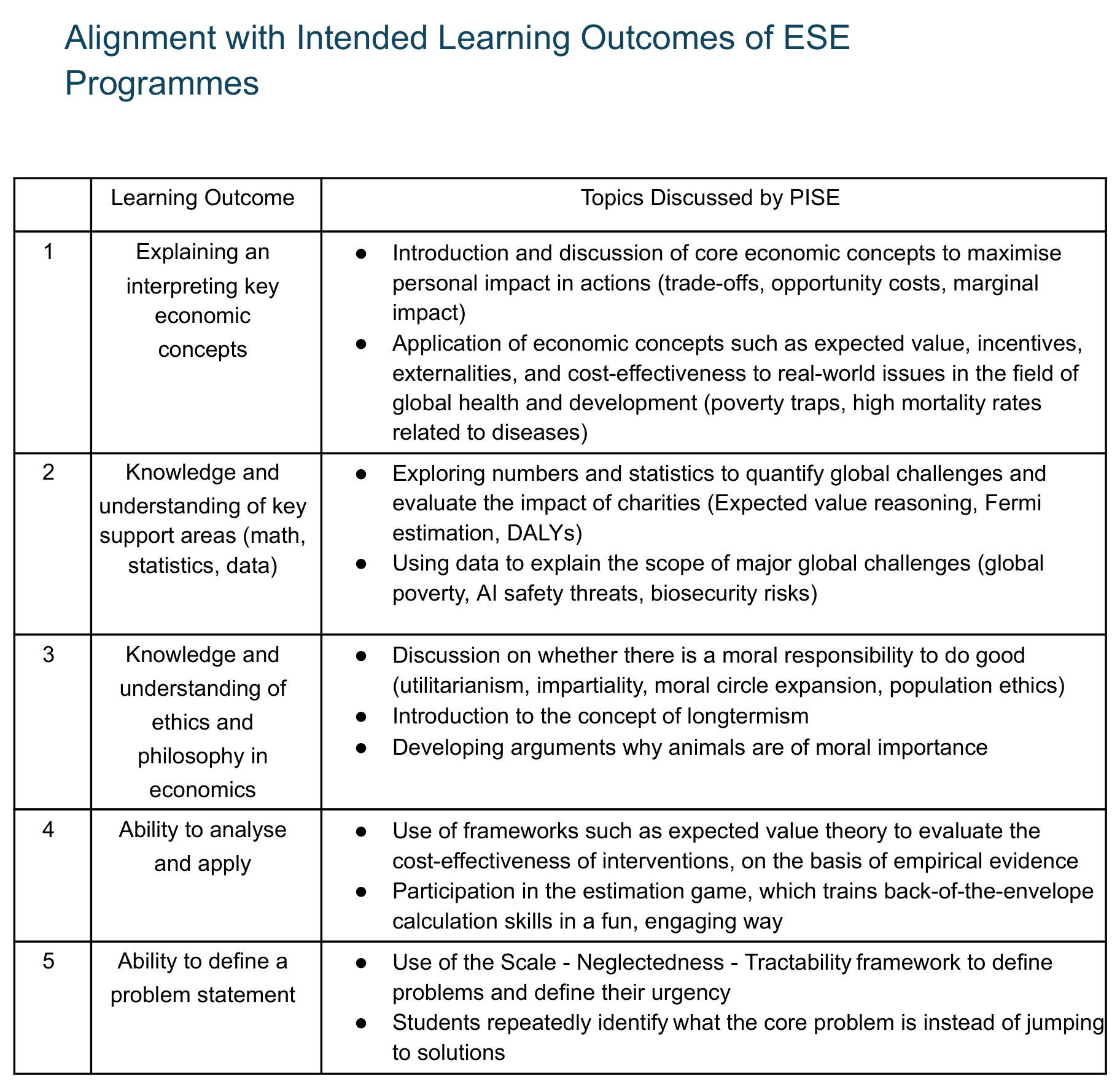
Alignment of the course with our faculty’s learning goals (we had no idea what these were before this; we just got them off the internet). If you can find the learning goals of your specific degree program, even better.
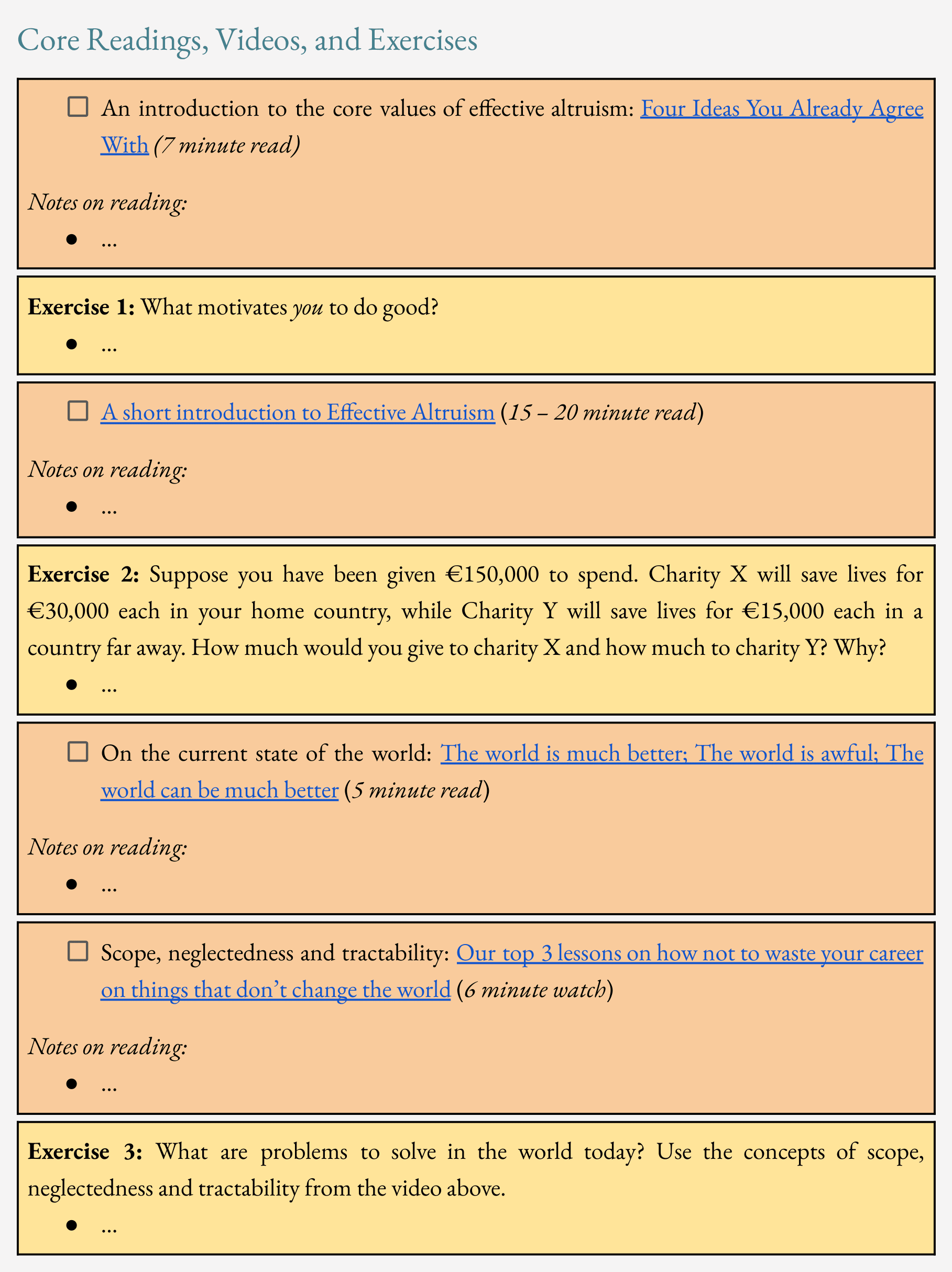
The course workbook (including all the readings and exercises). Making it look pretty is easy and can significantly improve first impressions.
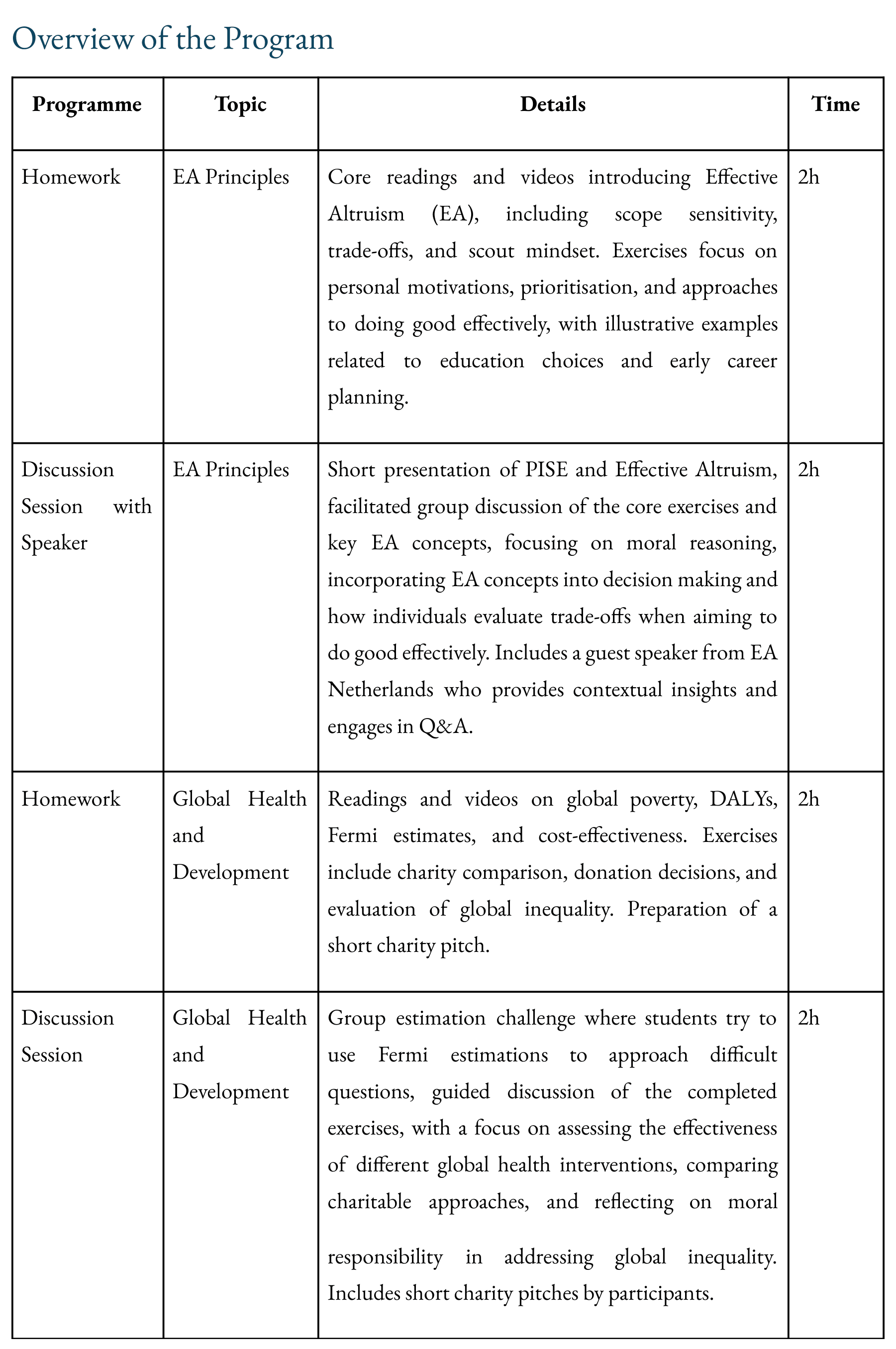
Breakdown of the workload. This was useful for us because the course had very specific workload requirements, but things might be different for you.
Optional: the assessment procedure. We did not have this at the beginning, but it probably helps. We would also include a statement of how your course fills a gap in the degree program. This can be either in the subjects it covers or in its methods (open-ended discussion rather than textbook learning).
Other things that can help you make a good impression:
Highlighting your previous experience running the fellowship. You can highlight your group’s experience with the fellowship. Successfully running the fellowship for multiple years with good participation and retention rates is a signal that the new course would just be business as usual and derisks the gatekeeper (e.g., the fellowship has been running twice a year for the past 3 years with an average of 15 students per cohort and a 75% retention rate).
Getting a faculty member (such as a professor) to vouch for you. We didn’t have this luxury, so don’t get discouraged if you don’t have one, but this would probably be especially useful for more ambitious, academically minded courses.
Emphasizing the course’s interest in positive impact. Many universities have mission statements that relate to creating positive social impact. Framing your course as helping students find impactful careers will help. In the reply to our initial request, we were explicitly told that the focus on positive impact was a plus.
Setting the course up
This is where things get fun! If you’ve run an introductory fellowship before, this shouldn’t be much different, with a few important exceptions. Here are the changes we made:
We introduced assignments. Weekly assignments ensured students actually completed the readings, which is essential for keeping discussion quality high, since everyone arrived with the same baseline knowledge. Students submitted notes on exercises tied to the reading, which we used both to shape the tutorial discussion and to get a direct read on each student’s thinking. We graded everyone’s submission on a 0 to 2 scale based on effort and engagement with ideas, which we think was a great motivator. This also allowed us to leave feedback and notes on some submissions, which was not previously possible. This took a long time, and we think it primarily resonated with the most interested students. We used these notes to challenge students’ reasoning, go deeper on specific ideas, and point students with particular interests toward relevant EA opportunities. It also gave us a clear sense of which topics appealed to them most.
Other options we considered were weekly quizzes and posting discussion points on a shared message board. We stuck with weekly submissions of their notes on the readings and exercises because it was the best way to make everyone engage with the material in a thoughtful manner and think critically.
We introduced a free book as a prize for the best scores. This was possible thanks to submissions and grading. At least one winner directly mentioned that the grade and book combo was a big motivator in their effort. By inviting the winners to the office, we were also able to talk to them about their career plans for 30+ minutes. Thus, we highly recommend handing out a book to the most enthusiastic students.
For the final assessment, students completed an adapted version of the 80,000 Hours career planning template, tailored to incorporate EA opportunities into their own career plans. We especially pointed them toward the EA Fellowship List.
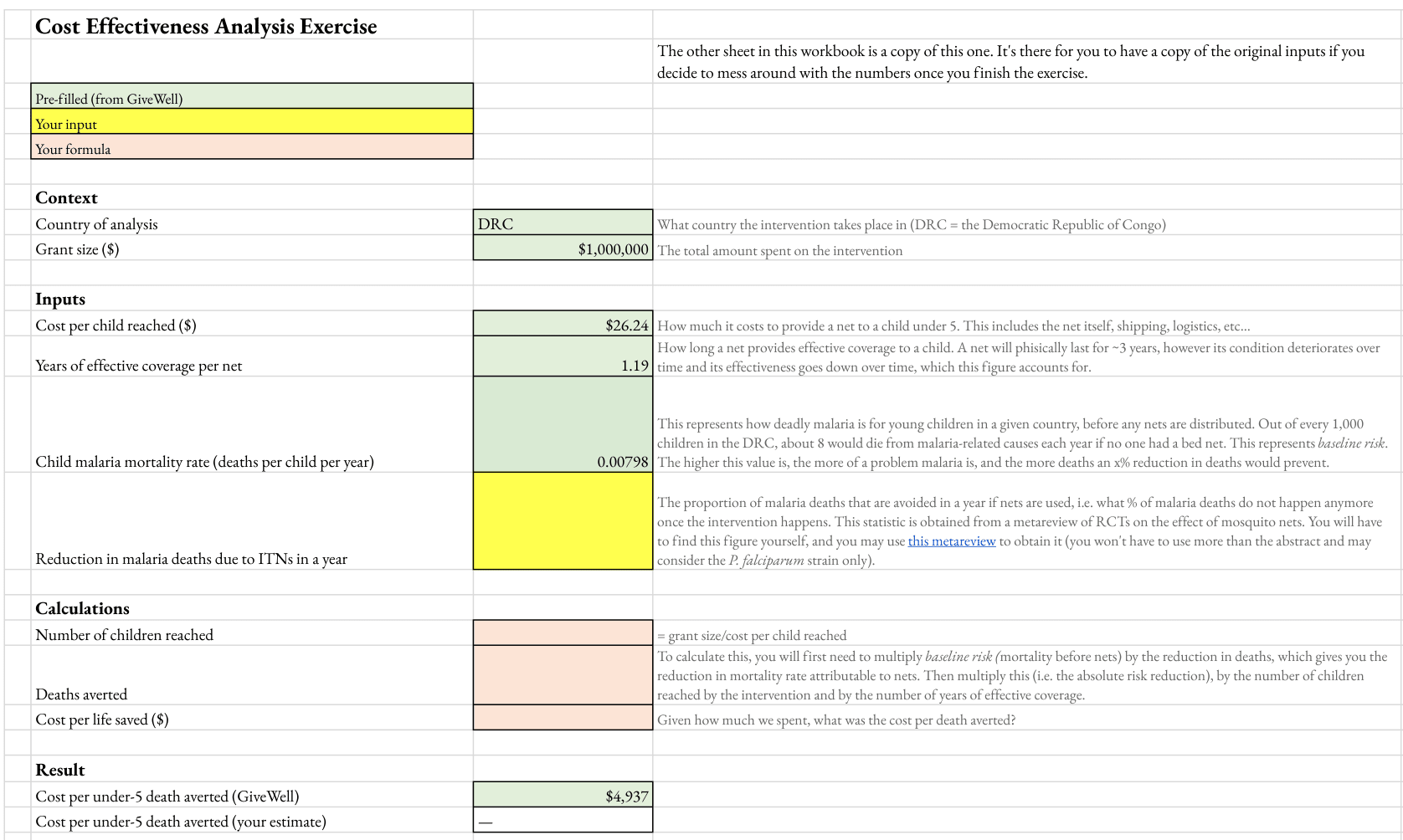
We tailored the curriculum to our audience. If you’re organizing the course for a specific faculty, you can adjust the curriculum to make it more engaging depending on their expertise. For our Economics cohort, we added one cost-effectiveness estimation and one Bayesian probabilities exercise.
The structure was almost unchanged. We ran two tutorial groups at different times in the week, which widened the pool of students who could attend. In hindsight, a single tutorial group would have made coordination and arranging guest speakers considerably easier. Our first session featured Henry Abbink, a Tobacco Free Future Fellow at the School for Moral Ambition, who used the tobacco industry as a compelling example of a neglected, tractable, and large-scale problem outside the usual EA cause areas.
In total, we had five discussion groups of six students across the two tutorial groups, each with one facilitator. Sessions opened with a short topic intro, followed by an interactive game (like the line game, where people position themselves along a line based on agreement with a statement, or the Fermi estimation game), then roughly an hour of discussion on the readings.
Things to keep in mind
There were some caveats for us as well, though not all of them might be generally applicable.
There was weaker selection on motivation and interests. There were only a handful out of 27 students who seemed intrinsically motivated by impact, showing interest beyond the assigned readings, and whom we expect to take further action after the fellowship. This is a lower rate than usual.
Still, we taught the scale, neglectedness, and tractability framework for evaluating global problems, which we think is valuable, since students can use it to increase their impact outside of EA cause areas. Since our course only had final-year Economics students, who were generally ambitious but were also more fixed in their career choices, we also put a greater focus on earning-to-give than usual. We would recommend being flexible and focusing on topics that are most likely to result in action in your particular student group.
It is plausible that people in an accredited course tend to be less intrinsically motivated than participants in a regular course. We would thus recommend to prioritize the regular course if you think that it is likely that the motivation in this group is higher.
Yet, if you’d be running the course on top of the regular fellowship (as was our case), then you'll already reach more people than you normally would. Having the accredited course allowed us to run the fellowship an additional time and reach people who would never have joined in the first place (that is, the counterfactual of running the accredited course was not running anything at all, or perhaps a different activity such as a committee). In this case, you would have to weigh this against the cost of your time and effort, which for us was worth it, even if the cohort was perhaps weaker. The specifics of this will vary based on the situation and student body at your university.
Our course name was “PISE – Pursuing a Positive Impact Career”, which may also have contributed to the weaker motivation we saw. Students told us that the name led them to expect a course on making their career in a certain fixed field more impactful, rather than choosing an impactful one. We are still looking for a better-fitting name and are open to suggestions.
There might be alternative ways to work EA into university teaching (including involving professors). We do think that weaving EA concepts into established, professor-led courses might be even more effective, since a broader audience is reached for less effort from the group, though this depends heavily on how the professor frames EA. Having an accredited course could be a first step in that direction. If you know of an EA-sympathetic professor at your university, we’d really recommend reaching out to them to discuss the possibility of setting up a course or elective. There are a lot of examples of EA courses, but most of them don’t seem to outlast their founders. Starting with courses that are evergreen and perhaps lower effort seems like a good start.
It goes without saying, but if you’re a professor at a university, establishing a course on effective altruism is a great way to share altruistic ideas with a large number of people at the same time (speaking as students ourselves, we would have killed to have such a course in our degree!).
We are unsure how the impact of an accredited course compares to the regular fellowship. In our situation, it’s likely that the accredited course is somewhat less impactful than usual. It’s plausible that offering credits means the students who join are less intrinsically motivated. We noticed that in the regular fellowship there was usually more consensus as people with opposing views self-selected out early. For us, the accredited course will be an addition to the regular fellowship, not a replacement for it.
What we plan to do differently
We will invite more guest speakers next time. They bring expert knowledge that we can’t provide, and give students a direct, often more inspiring connection to people actually working in EA cause areas. We received feedback that our participants would have liked more speakers as well.
We will update the AI session with more up-to-date resources to account for the rapid pace of progress. We’d also like to partner with BlueDot Impact next time to sharpen how we communicate AI risk to Economics students new to the topic.
We will add cause-area-specific job content to the workbook, so students can see concretely what impactful work in economics-adjacent fields actually looks like.
We will do more targeted advertisements to increase the fit of people for the course.
Are you a group organizer?
If your group has been running the introductory fellowship for some time already, you should check if there are opportunities to get it accredited. We also had no clear avenue for it at first, so don’t be afraid to send some cold emails. It’s very low-cost, high-reward in terms of reputation, reach, and skill-building. So if you're considering it, try giving it a shot and reach out to us if you have any questions!
You can email Andrei ([email protected]) or Lili ([email protected]) directly with questions, advice or to ask us to share resources and marketing materials. Feel free to use any of the materials below.
Note: This post was crossposted from Planned Obsolescence by the Forum team, with the author's permission. The author may not see or respond to comments on this post.
Subtitle: If acceleration compounds, the naive extrapolation implies superintelligence within a year
This post discusses a public METR report on AI R&D acceler...
TL;DR:
* When we started Rethink Priorities (RP) in 2018, our mission was, simply put, to close the knowledge gaps that stopped people from improving the world as much as they could. That hasn’t changed much, but the landscape we’re doing it in is shifting.
* In 2027, we plan to grow our core GHD, Animal Welfare, and Worldview Investigations teams to take on emerging priorities across causes, including those that the forthcoming transformative AI is creating.
...
This was cross-posted from the Animal Charity Evaluators blog.
We update our list of recommendations annually. This year, we announced our recommendations on November 10.
Most people who care about animals arrive at the same impas...