I feel like this should be on a log scale or something because even at a 1% probability of sentience, shrimp welfare interventions may still be highly cost-effective.
Hi Michael. I agree. On the other hand, I also think the Shrimp Welfare Project’s (SWP’s) Humane Slaughter Initiative (HSI), which leads to more farmed shrimps being electrically stunned, may have a very low cost-effectiveness even if their target shrimps are sentient with a probability of 100 %. Their subjective experiences can have a super low intensity. For individual welfare per fully-healthy-animal-year proportional to “individual number of neurons”^“exponent”, and “exponent” from 0 to 2, which covers my reasonable best guesses, the individual welfare per fully-healthy-shrimp-year is 10^-12 (= (10^-6)^2) to 1 times that per fully-healthy-human-year, as shrimps have 10^-6 times as many neurons as humans. In that case, I estimatethat HSI has increased the welfare of farmed shrimps 2.26*10^-4 (= 2.06*10^-8/(9.13*10^-5)) to 1.49 k (= 20.6*10^3/13.8) times as cost-effectively as cage-free corporate campaigns increase the welfare of chickens.
Because sentience is a binary question, and intensity of subjective experience is a scale, I feel like that should also be asked separately. People might being conflating the two by giving a low confidence probability in sentience, when they really mean they are sentience but just have experiences which aren't that intense.
Hello. I would take for granted that all animals are sentient, and focus on assessing the distribution of the intensity of subjective experiences. I think asking about the probability of sentience of an animal shares some of the issues of asking about the probability that an object is hot. People have different concepts about what "hot" means, and they do not depend just on temperature (for example, the minimum temperature for hot wood is higher than the minimum temperature for hot metal because this transfers heat more efficiently). I understand sentience as having subjective experiences whose intensity is not exactly 0. However, I suspect you are right that some people understand it as having subjective experiences which are sufficiently intense. Different bars for this will lead to different probabilities. Asking about the distribution of the intensity of subjective experiences mitigates this. For example, one could ask about the probability of the mean intensity of the pain shrimps experience during air asphyxiation exceeding the intensity of disabling pain in humans.
I'm pretty surprised by how high people are and that there are relatively few people in the middle (and I say this as a probably maximally invertebrate welfare friendly person who thinks we should spend lots of money on shrimp welfare but also only rated this question at 20%)! Interested in what's leading to these views being so different and polarized. I guess my view for insects and other invertebrates is that the evidence we do have is very promising, but we really don't have that much evidence.
Hey, have you written out your reasoning for why you believe shrimp have a 20% chance of sentience? I appreciate all the work you have done in this space, and am curious how you approach this.
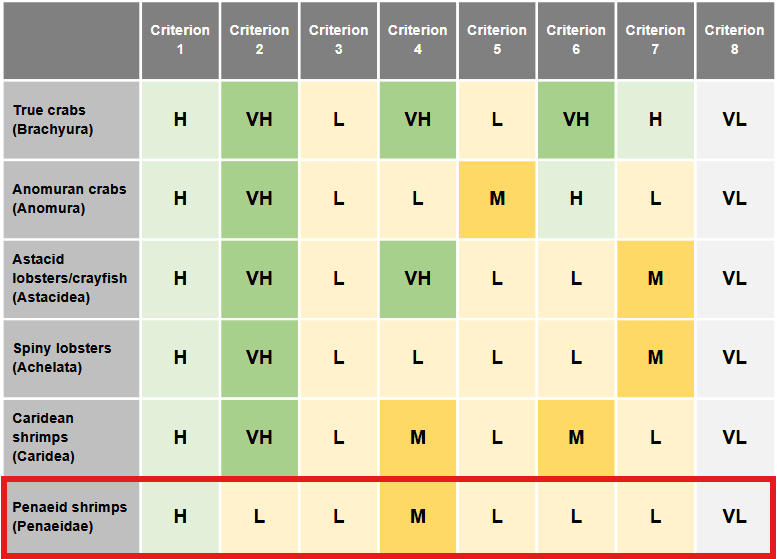
I am a little surprised that evidence for integrative brain regions is very high for all but the Penaeidae. Do we know to what extent this is the case because direct/proxy studies on Penaeidae sentience haven't been performed vs. studies were performed but results showed low evidence of sentience?
And answering some of your questions:
Which criterions do you think are the most convincing to update your confidence?
Criteria 2 ≈ 3 > 4 ≈ 5
Do you have other types of evidence that better influence your confidence?
Not evidence, but a heuristic I use when thinking about sentience is that any organism that performs reinforcement learning, i.e., making on-the-fly decisions informed by environmental stimuli is most likely sentient.
The report does not state explicitely why Penaeidae are given such a low rating compared to other taxons. From my understanding of their explanation, it would mainly be because brain regions highly involved with learning and memory (hemiellipsoid bodies) are especially reduced in Penaeidae. While Astacidea also display relatively small hemiellipsoid bodies, other brain regions (accessory lobes) have shown to compensate these integrative processes in this taxon, which has not yet been demonstrated for Penaeidae. It's thus still a low rating for lack of data, not for proof of failing this criterion. It would be reasonable to expect that Penaeidae validate this criteria as well, until showed otherwise
... other brain regions (accessory lobes) have shown to compensate these integrative processes in this taxon, which has not yet been demonstrated for Penaeidae. It's thus still a low rating for lack of data, not for proof of failing this criterion.
This reminds me of two things:
I am forgetting the precise terms here, but for a while in the 1800s through most of the 1900s, researchers thought that birds weren't intelligent because they were essentially comparing human and avian brains 1:1, but later, others found that while birds lacked that specific component (neocortex?), some other regions of their brain were functionally similar and that birds were indeed smart rather than instinct-driven biological machines.
I recall watching Dustin Crummett's presentation on insect sentience a while back, and when talking about lack of evidence of sentience in certain insects, he emphasized that the besides black soldier fly and honeybees, most insects aren't that well-studied.
I think hedonistic welfare per unit time should be represented as a practically continuous distribution. This implies a probability of practically 0 for the welfare per unit time being equal to any particular value, including 0, which results in a probability of sentience of practically 100 %. Here is a related article arguing for accepting that all animals are conscious, and focussing on how they are conscious.
I believe increasing the welfare of shrimps can still have negligible benefits despite the above.
If you trust there is as little variation in the probability of sentience as suggested by the values used by Ambitious Impact (AIM) and Animal Charity Evaluators (ACE), or presented in Bob Fischer’s book about comparing welfare across species, I believe there are other factors which may be more important for the probability of a small donation increasing animal welfare:
Donating to incremental instead of hits-based interventions.
Donating to smaller organisations.
Donating to organisations in lower income countries
I wonder to what extent people donate to interventions targeting animals which are more likely to be sentient to boost the probability of increasing welfare. People routinely take actions which are super unlikely to actually matter:
I calculate driving a car for 10 km in Great Britain without a seatbelt leads to 1 additional death with a probability of 1 in 73.0 M. AIM uses a probability of sentience of shrimps which is 34.2 M times as high.
Andrew Gelman found the probability of a voter in a small US state polling around 50/50 in a close election nationally changing the outcome of the national election could get as high as 1 in 3 million. AIM uses a probability of sentience of shrimps which is 1.40 M times as high.
How much confidence would you give to the statement: "Whiteleg shrimps are sentient"?
Justification for my vote: High credence given that I also believe many insects of similar size are sentient too. But my credence is highly volatile to further evidence, given that we lack a lot of empirical information and we don't know much the correct philosophy of mind either.
See the paper "Can insects feel pain? A review of the neural and behavioural evidence" by Gibbons et al. here for the Birch framework applied to insects. (Feel free to skip to the conclusion if you just want the quick takeaway).
How much confidence would you give to the statement: "Whiteleg shrimps are sentient"?
I think the best explanation for the behavior of shrimp and animals is sentience. Sure, it's not impossible that the behavior of a shrimp in response to negative stimuli is all a complex system of reflexes, and this has some additional weight due to the small number of neurons that white shrimp have, but even reflexes in humans are rarely as complex and contextual as would be needed to describe all of the behavior that being capable of suffering would provide shrimp and other similar creatures.
Furthermore, if you grant that non-mammalian species, such as octopus, have independently developed the capacity for pain, then that greatly increases the likelihood that shrimp feel pain, as shrimp have similar evolutionary incentives as other animals, such as avoiding predators, starvation, and other dangerous situations.
However, it's important to note that I think shrimp likely experience the world very differently from us.
I get your point - but which behaviors do you consider "complex enough" to be best explained by sentience? Which criterions do they fall into, or rather, where do you cross the line between a very complex system of reflexes and sentience?
On evolutionary incentives, it is true that nociception is particularly well conserved throughout the animal kingdom for this reason, but sentience might be "too expensive" for somes species to get or keep. Directors of Welfare Footprint Institute described this idea as the "sentience bargain" in this post if that's of interest for readers
As part of the Sentient Futures'Project Incubator, I am currently studying the state of the art of shrimp sentience. I would be highly interested to get some insights into your own views on the specific topic of whiteleg shrimps.
However, a recurring critique (such as fromthis post,this debate, or this conference paper) of this consideration is thatWhiteleg shrimps (L. vannamei), and the Penaeid shrimps more broadly -- the most farmed shrimps/prawns by far -- actually shows little evidence for sentience criterions, and that the extrapolation from studies on other species is farfetched. This information gap is especially important for organizations working on decapod welfare, such as Shrimp Welfare Project, Crustacean Compassion or Rethink Priorities.
Comprehension note: Penaeid shrimps (Dendrobranchiata order) should not be confused with “true shrimps” that are species from the Caridea infraorder (see also this explanation). Penaeid shrimps are often called “prawns” and include those commonly named:
The Pacific white shrimp (or White shrimp or King prawn)
The Atlantic white shrimp
The Giant tiger prawn (or Asian tiger shrimp or Black tiger shrimp)
The Indian prawn
Considering the current literature, “true shrimps” and other decapod crustaceans arguably show relatively satisfying evidence on multiple sentience markers. The information gap mostly relies specifically on Penaeid shrimps, including Whiteleg shrimps.
To argue that all decapod crustaceans should be considered sentient, Birch et al.’s report constructed sentience evidence by grading confidence for 4 neurobiological and 4 behavioral criterions, taking into account "both the amount of evidence for a claim and the reliability and quality of the scientific work".
Consider Birch et al. framework’s criterions, simply put and explained by Shrimp Welfare Project:
Possession of nociceptors - Let's say you accidentally touch a hot stove. Instantly, you will withdraw your hand from the stove. A simple circuit of neurons saved your hand from a noxious stimulus (the hot stove) and prevented you from a burn. This is referred to as nociception, named after nociceptors, the sensory receptors that detect the noxious stimuli.
Possession of integrative brain regions - Being able to integrate information from multiple different sensory sources.
Connections between nociceptors and integrative brain regions - Neural pathways connecting nociceptors to the brain (though it should be noted that the nervous system is organised very differently in elongated species such as shrimps, compared to compact species, such as crabs).
Responses affected by potential local anaesthetics or analgesics - If you have been to the dentist, you have probably been applied a substance to numb an area of your mouth so that the dentist can perform a procedure that otherwise would be uncomfortable or painful. That’s an anaesthetic, a substance that creates a lack of feeling. When used locally, anaesthetics reduce any sensation (not only pain) in a target area, while the individual remains conscious. If an animal responds differently to stimuli while under the influence of anaesthetics, this suggests the lack of feeling is mitigating an animal's experience of pain or distress.
Motivational trade-offs that show a balancing of threat against opportunity for reward - An animal can make a decision, like avoiding negative stimuli, such as an electric shock, rather than experience a positive stimuli (i.e. their actions cannot be explained by reflexes alone).
Flexible self-protective behaviours in response to injury and threat - Guarding, grooming or otherwise tending to an injured body part are protective behaviours. These are typically long term responses to injury, seen over periods of hours and days rather than seconds and minutes. In humans, protective behaviour is often controlled by the conscious feeling of pain, such as avoiding using an injured limb.
Associative learning that goes beyond habituation and sensitisation - If an animal can experience something, learn from it, and then make different decisions in the future, it provides good evidence of sentience.
Behaviour that shows the animal values local anaesthetics or analgesics when injured - For example, learning to self-administer anaesthetics or analgesics, or could learn to prefer a location where these can be accessed, or prioritise obtaining these over other needs (i.e. food) when injured.
Here is their summary for decapods:
Table 3. A summary of the evidence of sentience in decapods. The colours and letters represent our confidence level that the criterion in question (column) is satisfied by the order (or orders) of animals in question (row). VH (dark green) indicates very high confidence, H (light green) indicates high confidence, M (dark yellow) indicates medium confidence, and L (light yellow) represents low confidence. Since we have not found evidence to support criterion 8 in any decapod, we have used the category of very low confidence (VL, light grey) in this case. Importantly, low/very low confidence implies only that the scientific evidence one way or the other is weak, not that the animal fails or is likely to fail the criterion.
We can note that, as Birch et al.’s report insists: “low/very low confidence implies only that the scientific evidence one way or the other is weak, not that the animal fails or is likely to fail the criterion”. We can legitimately argue that evidence is lacking for Penaeid shrimps, as the report acknowledges, but we can also argue that these taxons are genetically close enough for evidence to translate well, even if more specific research would be greatly valuable.
Poll
Considering this specific context, please find attached to this poll a few questions I’d be grateful for you to answer in the comments:
How easily would you be able to change your confidence based on new evidence?
Which criterions do you think are the most convincing to update your confidence?
If you were to allocate money towards building more evidence for one or more criterions, which ones would you choose?
Do you have other types of evidence that better influence your confidence?
Thanks a lot! :)
Transparency note: As part of Sentient Futures’ Project Incubator, my work is supervised by Aaron Boddy. This post has been reviewed and validated by Aaron, but is part of an independent research project.
Edit: The match seems to now be over - the funds were expended in around 35 minutes. But many of these charities are great and should be supported regardless!
***
On October 22nd starting at 10:00am Pacific Time, Every.org is matching donations to select animal welfare organizations at a 2:1 rate, up to $2,000 per donor per nonprofit (so if you give up to $2,000, they will contribute up to $4,000 and the nonprofit will get up to $6,000). The first donation a donor makes to each el...
Crossposted to Less Wrong
‘Like most of life’s dangers, the dangers of artificial intelligence are not easily identified from the armchair.’
J Dmitri Gallow
Epistemic status
I’m not an expert in this field, and herein I make some sweeping generalisations educated guesses about the overall...



I feel like this should be on a log scale or something because even at a 1% probability of sentience, shrimp welfare interventions may still be highly cost-effective.
Hi Michael. I agree. On the other hand, I also think the Shrimp Welfare Project’s (SWP’s) Humane Slaughter Initiative (HSI), which leads to more farmed shrimps being electrically stunned, may have a very low cost-effectiveness even if their target shrimps are sentient with a probability of 100 %. Their subjective experiences can have a super low intensity. For individual welfare per fully-healthy-animal-year proportional to “individual number of neurons”^“exponent”, and “exponent” from 0 to 2, which covers my reasonable best guesses, the individual welfare per fully-healthy-shrimp-year is 10^-12 (= (10^-6)^2) to 1 times that per fully-healthy-human-year, as shrimps have 10^-6 times as many neurons as humans. In that case, I estimate that HSI has increased the welfare of farmed shrimps 2.26*10^-4 (= 2.06*10^-8/(9.13*10^-5)) to 1.49 k (= 20.6*10^3/13.8) times as cost-effectively as cage-free corporate campaigns increase the welfare of chickens.
Because sentience is a binary question, and intensity of subjective experience is a scale, I feel like that should also be asked separately. People might being conflating the two by giving a low confidence probability in sentience, when they really mean they are sentience but just have experiences which aren't that intense.
Hello. I would take for granted that all animals are sentient, and focus on assessing the distribution of the intensity of subjective experiences. I think asking about the probability of sentience of an animal shares some of the issues of asking about the probability that an object is hot. People have different concepts about what "hot" means, and they do not depend just on temperature (for example, the minimum temperature for hot wood is higher than the minimum temperature for hot metal because this transfers heat more efficiently). I understand sentience as having subjective experiences whose intensity is not exactly 0. However, I suspect you are right that some people understand it as having subjective experiences which are sufficiently intense. Different bars for this will lead to different probabilities. Asking about the distribution of the intensity of subjective experiences mitigates this. For example, one could ask about the probability of the mean intensity of the pain shrimps experience during air asphyxiation exceeding the intensity of disabling pain in humans.
This seems directionality correct. I would love some qualitative responses as well to try to gauge how people are understanding the question.