Since I actually did this work myself (in the US) I am going to go into too much information about my experience. Read the bolded bits if you want the summary of important points without the juicy mosquito-abatement details.
I was checking weekly anywhere we historically found mosquito larvae, including adding new locations any time another location was found - much the same as this program does: using a tablet, satellite map, and gps locations.
I witnessed the larvae populations reducing in response in many places and in other places maintaining a high number of larvae (but no further development stages). It did prevent there from being pupae except if returned to the site late. Pupae are the next stage ( 7-10 days) when the mosquito baby quits eating to morph (and BTI no longer works). As you can see this happens so rapidly that it is important to return to sites weekly and not a day late. Fortunately pupae can also be killed in an environmentally friendly fashion with mineral oil[1]although I rarely (twice per week over ~60? weekly sites in a 7mi2, 35hr a week with recordkeeping, car travel, etc)needed toresort to that.
As mentioned, the biggest obstacle is finding every transient water body, from large to small, and getting people to let you treat their puddles, ditches, water troughs, etc etc etc. I did not scout for new locations although I was encouraged by my employers to ask around for new problem locations. Having an updated map is really helpful but eradication seems unlikely. Another issue is that mosquitoes can fly up to 2 miles (iirc) so if they aren't breeding nearby they still might by flying in.
Regarding missed locations: I myself skipped some waterbodies when I was scared to trespass. Also water appears and disappears sometimes without much discernable cause, which made it annoyingly important to check empty sites repeatedly. Also obstacles like barb wire fences, and uh... when you are totally alone cattle are really big and I didn't want to find out if they would suddenly decide to charge me. Instead I kept hoping the next day they wouldn't be on that side of the pasture.
We loaded up on equipment once every couple of weeks when we ran out of supplies, but I would scan/travel/work closer to 80% of my time. I figured out the faster routes to locations and how I preferred to chain them together through the season. (Although the water does keep moving around as water appears or dries up.) Recording was a simple paper datasheet of larvae/pupae seen and how much treatment I used. I would take a picture at the end of the week to submit so I never had to go visit a central office. And the tablet would track my movements if I might be lying about actually visiting locations. No one ever checked, I'm pretty sure, but if there was a complaint they could. And when working alone it is reallllly tempting to eat 2 hour lunches and skip long, hot, slogs that end in a mostly-dried-up tiny puddle.
They mentioned having much better results when hiring undergrads. I suspect its because undergrads believe they have to be thorough much more than mid-career hires. Also the biology knowledge helps. Honestly I wish they had checked our work more, because I at the end of the season I found out I had been deploying double the treatment what everyone else was. By accident. It was still within permitted doses, but... uh... oops.
In summary: It was highly cheap and effective in the spots I was active. The main issue is coverage of transient water and returning weekly.
Pupae still need to breath. BVA Mineral oil (only a few drops) makes the surface tension at the top too strong for the pupae to break the surface to breath, for about 2-5 minutes. Long enough for them to suffocate. I assume other tiny air breathing species would die too, but not the critters that don't need air or the slightly-larger critters who can survive longer without air. These are mostly temporary standing-water areas with temporary populations so its likely to be easily repopulated after a suffocation event.
The oil naturally breaks down (from sunlight I think?) and disappears. There was no build up. It looked bad to see shiny oil across natural water but it dissipated in an hour or so, and left no residue. What really convinced me was encountering natural oils in the water from cattails that looked a lot worse than the mineral oil I was using. Oil is a natural thing too, sometimes.
Oil doesn't work for large bodies of water or flowing water, because the choppy water breaks the oil surface sheet. But mosquitoes don't live there because they need still water to breed for some reason. Oil is still used in water around the edges of ponds where vegetation keeps the surface still.
Thank you for sharing. I recommend to try "Aquatain AMF" instead of BVA Mineral oil. If you do try, please tell me which one was better in which context
Huh this is really interesting! On the funding side, I'd suggest having Aaron reach out to GiveWell ([email protected]) and Open Phil ([email protected]) to start a discussion. Both give incubation grants, but they may also be able to suggest other funding sources or provide other helpful information.
How many people in the relevant region have access to a mobile or computer that could run their app?
I'd guess that you can have cost-effectiveness improvements by only focusing on more urban areas, where the population density is higher.
Re: "Obviously the first times one runs a very big op - it won’t be the most effective it can be.", you sometimes have the opposite effect, where pilots are more effective because they have more motivated people.
How many people in the relevant region have access to a mobile or computer that could run their app? Hi its Arnon from Zzapp The people that do the operation are not random people - they are people that works for the Ministry of Health, and they get mobile device from the MoH (And this is part of the calculated operation cost).
Yes but we want to save more people (-:
Interesting comment. Let's hope we will see improvement.
Like this idea, as it's closer to a systemic approach to treating the problem at the source. Seems like less of a bandaid than bed nets. I wonder how effective this would be in conjunction with vaccines.
Most important question for me: how does the larvicide impact the environment? Does it kill anything other than mosquito larvae? How long does it linger around?
Edit: this has been answered. Next question: what are the effects on the ecosystem of mass killing of mosquitoes?
Hi! I worked with BTI distribution and mineral oil as a solution to reducing mosquito populations in some environmentally-sensitive parts of the USA. These areas were hit badly with West Nile and started this mosquito reduction program in response. This was my first question too! As a field tech I was given biased information, but my online research agreed with the lines my environmentally-friendly company fed me: BTI is a bacteria that only mosquitoes and 1 species of midges (in my part of the world) eat and are harmed by. The BTI ruptures their stomach and they die. Very targeted, used widely and safely for years. In my case, it was distributed in a pellet mostly made of corncob so it could be cast into water and dissolve. There are other containment media that exist, but my point is its easy and cheap to make reasonable distribution methods. It would disappear the next week when I returned to check mosquito populations. I did not see buildup over the course of several months, which is notable for the small puddles of standing water I was dealing with. I don't think the bacteria would survive or change the microbiome of the environment, but I also don't expect people to research into that. But, as I was working in populated areas, it seems safe to say this would be really far down on the list of impacts on the microbiome. There are organic versions of BTI as well. (although I don't ascribe to the benefits of organic)
Thanks for the detailed and interesting reply! (Turns out I missed the link in the OP explaining that it's safe, but your reply is much more informative)
Your next question seems like a crucial point to me. Bed nets are imperfect but since mosquitos can feed on on other animals, I suppose mosquito populations don't disappear when entire regions use bednets more often, they just slowly become less malaria-infected.
It's a link to a post in a closed FB group, so I guess it doesn't work for people outside the group. Yonatan, maybe add a link to the group itself so that they can add themselves?
I think this is clearly an interesting project and I’ll be watching your next steps.
My query has to do with environmental and cultural challenges the operationalization of this project might face. To be specific, certain water bodies have cultural importance to community members and some are sacred in most countries across Africa, hence considered “untouchable” or not to be tempted with. This problem may it be, would be aggravated by the low formal education level that might challenge “the destruction of their sacred waters”.
I want to inquire if your team have considered this and the possible way outs.
I am intrigued about the elimination of malaria probably due to my first hand experience of the disease, so kindly let me how I can help especially with the African pilots.
They claim to be 2x more cost effective than bed nets in reducing malaria in urban and semi-urban areas
You mention having a more detailed CEA coming soon; I'd be interested in seeing how it addresses the various usual complications around CEAs, and some uncertainty analysis as a low-hanging fruit way to prevent bad decision-making. (I admittedly start from a skeptical prior w.r.t CEAs, more so the higher the claimed CE.) That said, given everything else you mentioned I'd still bet on Zzapp if I were a hits-based donor and global health is in my portfolio.
Crossposted to Less Wrong
‘Like most of life’s dangers, the dangers of artificial intelligence are not easily identified from the armchair.’
J Dmitri Gallow
Epistemic status
I’m not an expert in this field, and herein I make some sweeping generalisations educated guesses about the overall...
TL;DR: EA has traditionally deprioritized climate change as a cause area. But a new report from Rethink Priorities, an EA research institute, suggests that specific Earth systems risks driven by climate change could have mortality impacts comparable to major global health burdens, on top of the known damages of climate change.
The report finds that research and governance work on ‘Earth Systems Stabilization’ to establish whether safe options to address th...
TL;DR: This post describes Zzapp’s approach and effectiveness from their own perspective, intended as an intro aimed at the Effective Altruism community, as an invitation to investigate further and maybe fund them. They claim to be 2x more cost effective than bed nets in reducing malaria in urban and semi-urban areas (over 70% of Africa’s population).
Epistemic status: Based on conversations with Arnon, the CEO of Zzapp Malaria, not cross checked with other info such as Givewell’s review of Against Malaria Foundation.
Zzapp’s approach and theoretical reason to think it would work
You can skip to their experiment and how it went, if you prefer.
TL;DR: Spray water bodies with larvicide to prevent mosquitoes from reproducing, and do it extra well by managing the considerable ops work of finding and spraying the water bodies using satellite imaging and an app for the people on the ground.
Spraying water bodies with larvicide - is tried and works, unrelated to Zzapp
In every place that malaria was eliminated (which happened many times), larvicide (the treatment of standing water bodies) was the main component.
Bed Nets only help people indoors during the night.
Many people don’t use their bed nets.
Mosquitos developed resistance to the bes nets’ insecticide in many countries
Note I think Givewell already took the problems into account in their analysis, and Arnon emphasizes he thinks bed nets are great, and this is a pitch for using larvicide in urban (and semi urban) areas, not for stopping distributing bed nets. Zzapp think the ideal solution would probably combine many interventions. We are writing this as a comparison with bed nets since EAs already think bed nets are great.
Problems in existing larvicide approaches
Existing solutions: Problems in theory
Coverage is important
It’s important [how many water bodies you find] and [how many of those you spray], and the difference between 95% and 50% is really big, similarly to the situation when vaccinating 95% or 50% of the population, because of the effect on R (reproduction number) - less infected people will infect less other people, it snowballs but in a good way (hopefully), and the same is true about reproduction of mosquitos.
Existing solutions have bad coverage
People miss water bodies in the areas they are assigned to search
People miss entire areas
Even when water bodies are found, the spray team sometimes may still skip them or forget to treat them according to schedule
Small RCT
Ref to a (tiny) randomized controlled trial run by Zzapp and AngloGold Ashanti Malaria Control (AGAMal), where two groups scanned the same square kilometer, one group used the app and one didn’t and the group with the app found 28% more water bodies.
Scanning an entire town
In a different operation, when scanning an entire town with AGAMal, they found 20x more water bodies when using Zzapp’s app. (publication in progress, we’ll add a link when it’s ready). From that they think that on a larger scale the app has an even greater impact.What happened behind the scenes is that without the app - the scanners skipped entire neighborhoods.
Not a problem: Poisoning water bodies
The larvicide in the relevant quantities (bti) isn’t poisonous to humans, animals, or other insects except for mosquitoes and black flies.
Zzapp’s advantages compared to “manual” larvicide
Zzapp has an app they give to the people “on the ground”:
The app follows “where do the people go go” and lets the people mark “I checked this house’s garden” and “I found a water source here” and “this house didn’t let me in”
The control room shows a map with
״Here are the places the worker was in, and here are the places that not״
״this water source was only sprayed 2 weeks ago, someone has to go there again”,
giving more order to the huge mess of going over all different water sources again and again.
Screen shots
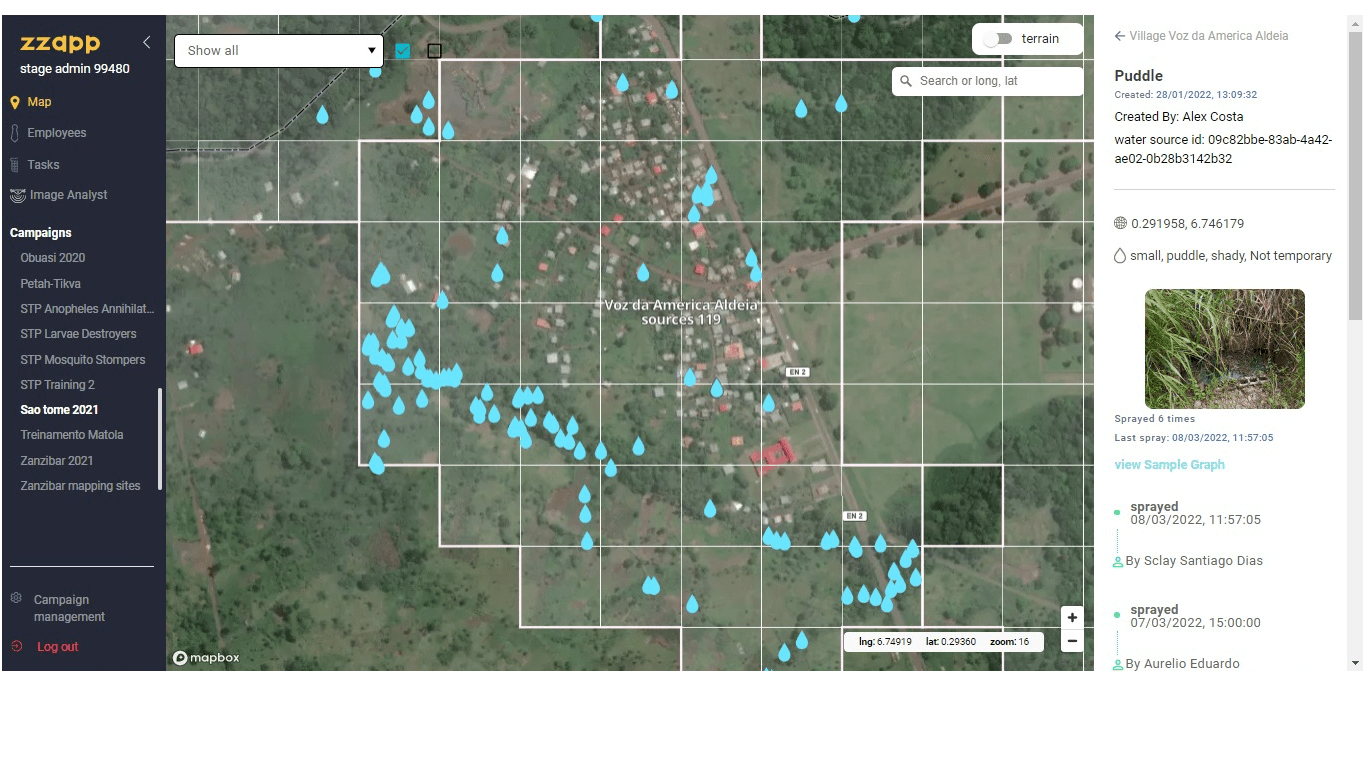
In this view, used by the control room, we see where all the water bodies are, including which ones were sprayed already and when.
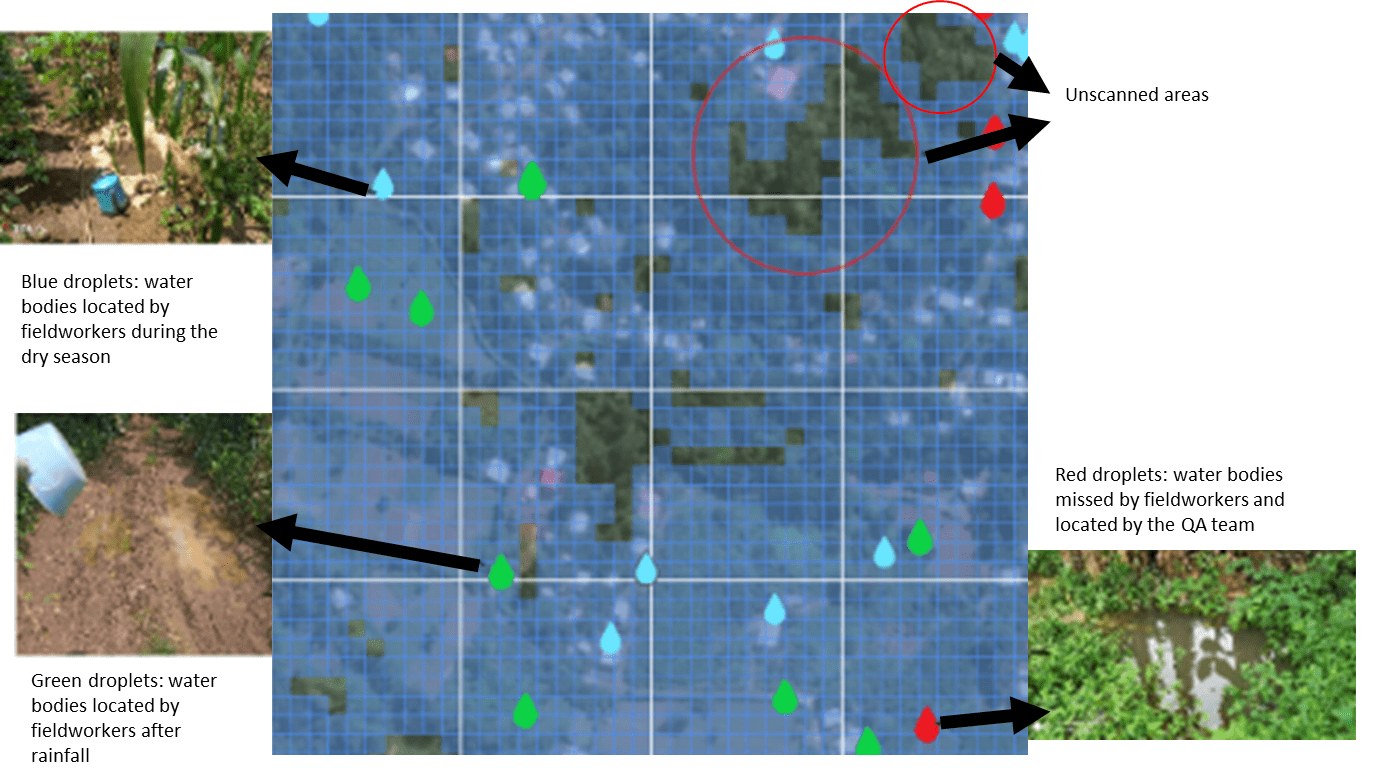
Another screenshot with captions by Zzapp
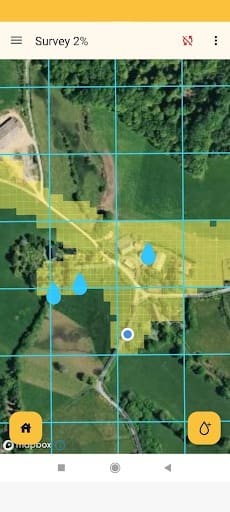
This is a screenshot from the app, where they see different colors for areas they have already scanned and areas that still need scanning, gradually changing as they walk around.
Author’s note: The last screenshot looks like one step away from Pokemon Go!
Arnon: Yeah, my colleague, also named Yonatan, always says that we should contact the Pokemon Go devs!
Me: You see, everyone? “Yonatan” is a totally common name here!
How effective is this?
Based on Zzapp’s run of their program
Effectiveness
As effective in reducing malaria as bednets (Zzapp reduces 53% of cases, bed nets reduce 45%. Zzapp say this is statistically the same)
There will be more about this comparison in a separate post, it’s more complicated than this.
Cost
In urban (and semi-urban) areas, the cost was 41 cent per person
In villages, it was 1.23 dollars per person, with high variance between villages.
In the first 2 months, they didn’t spray (this was done on purpose, to measure the amount of mosquitoes and establish a baseline. In a real world operation, they would have started spraying immediately)
So they protected for 6 months only, even though most (not all) of the cost components were for 8 months
After effects
The after effect of larvicide is expected to be more significant than the after effect of bed nets.
Cost Effectiveness
Zzapp estimates this is 2x cheaper than bednets (in urban and semi-urban areas).
Conventional larvicide costs $1.18 per person protected per year
Disclaimers
These results were not yet peer reviewed.
We’ll add a link here when they’re publicly available (expected within days/weeks).
Did we already tell you that Zzapp wants funding for running another RCT?
Potential to be way more effective (aka: Zzapp’s gaps)
TL;DR: Zzapp had things that can be significantly optimized during their first run which, if improved, could make them significantly more cost effective.
Meta: I appreciate Arnon’s openness about this.
My priors: Obviously the first times one runs a very big op - it won’t be the most effective it can be. But I’ll add some examples anyway.
Examples of why the cost could be lower:
Zzapp used taxies to drive the field workers between villages and towns. That’s an expensive solution.
Their software has big, eh, ”gaps” and they want to rewrite it. Did I mention they want to hire a CTO? We plan a post specifically about that.
They had trouble managing 70 people “on the ground”.
They got an effective 2.3 hours of scanning per person per day (but paid for 8).
Arnon explains that this makes sense - employees will obviously need time to, for example, wait to get their equipment at the start of the day, but he still thinks it’s realistic to raise this number to about 4 hours of scanning per day.
They think this is way better than doing larvicide without the Zzapp app, but it could be much better.
Did I mention they want to hire a COO who can manage a lot of people, experienced in running projects in Africa?
Examples of why the effectiveness could be higher (regardless of the cost) :
Zzapp could find more water bodies
Some people skip water bodies. These people could be identified early, Zzapp could.. do something about it.




Since I actually did this work myself (in the US) I am going to go into too much information about my experience. Read the bolded bits if you want the summary of important points without the juicy mosquito-abatement details.
I was checking weekly anywhere we historically found mosquito larvae, including adding new locations any time another location was found - much the same as this program does: using a tablet, satellite map, and gps locations.
I witnessed the larvae populations reducing in response in many places and in other places maintaining a high number of larvae (but no further development stages). It did prevent there from being pupae except if returned to the site late. Pupae are the next stage ( 7-10 days) when the mosquito baby quits eating to morph (and BTI no longer works). As you can see this happens so rapidly that it is important to return to sites weekly and not a day late. Fortunately pupae can also be killed in an environmentally friendly fashion with mineral oil[1] although I rarely (twice per week over ~60? weekly sites in a 7mi2, 35hr a week with recordkeeping, car travel, etc) needed to resort to that.
As mentioned, the biggest obstacle is finding every transient water body, from large to small, and getting people to let you treat their puddles, ditches, water troughs, etc etc etc. I did not scout for new locations although I was encouraged by my employers to ask around for new problem locations. Having an updated map is really helpful but eradication seems unlikely. Another issue is that mosquitoes can fly up to 2 miles (iirc) so if they aren't breeding nearby they still might by flying in.
Regarding missed locations: I myself skipped some waterbodies when I was scared to trespass. Also water appears and disappears sometimes without much discernable cause, which made it annoyingly important to check empty sites repeatedly. Also obstacles like barb wire fences, and uh... when you are totally alone cattle are really big and I didn't want to find out if they would suddenly decide to charge me. Instead I kept hoping the next day they wouldn't be on that side of the pasture.
We loaded up on equipment once every couple of weeks when we ran out of supplies, but I would scan/travel/work closer to 80% of my time. I figured out the faster routes to locations and how I preferred to chain them together through the season. (Although the water does keep moving around as water appears or dries up.) Recording was a simple paper datasheet of larvae/pupae seen and how much treatment I used. I would take a picture at the end of the week to submit so I never had to go visit a central office. And the tablet would track my movements if I might be lying about actually visiting locations. No one ever checked, I'm pretty sure, but if there was a complaint they could. And when working alone it is reallllly tempting to eat 2 hour lunches and skip long, hot, slogs that end in a mostly-dried-up tiny puddle.
They mentioned having much better results when hiring undergrads. I suspect its because undergrads believe they have to be thorough much more than mid-career hires. Also the biology knowledge helps. Honestly I wish they had checked our work more, because I at the end of the season I found out I had been deploying double the treatment what everyone else was. By accident. It was still within permitted doses, but... uh... oops.
In summary: It was highly cheap and effective in the spots I was active. The main issue is coverage of transient water and returning weekly.
Pupae still need to breath. BVA Mineral oil (only a few drops) makes the surface tension at the top too strong for the pupae to break the surface to breath, for about 2-5 minutes. Long enough for them to suffocate. I assume other tiny air breathing species would die too, but not the critters that don't need air or the slightly-larger critters who can survive longer without air. These are mostly temporary standing-water areas with temporary populations so its likely to be easily repopulated after a suffocation event.
The oil naturally breaks down (from sunlight I think?) and disappears. There was no build up. It looked bad to see shiny oil across natural water but it dissipated in an hour or so, and left no residue. What really convinced me was encountering natural oils in the water from cattails that looked a lot worse than the mineral oil I was using. Oil is a natural thing too, sometimes.
Oil doesn't work for large bodies of water or flowing water, because the choppy water breaks the oil surface sheet. But mosquitoes don't live there because they need still water to breed for some reason. Oil is still used in water around the edges of ponds where vegetation keeps the surface still.
Thank you for sharing. I recommend to try "Aquatain AMF" instead of BVA Mineral oil. If you do try, please tell me which one was better in which context