Executive summary: The author surveyed interest in an online neurodivergent community within EA, but based on the results and their experience decided not to pursue organizing it currently, though they may incorporate related ideas into a broader online community-building effort.
Key points:
Over 40 survey respondents expressed interest in an online neurodivergent EA community, but expected participation still seems low.
The author estimates at most 30 members would actively participate even in a highly successful neurodivergent EA community.
They learned people responded positively when messaged about the survey on Swapcard.
They still see value in creating neurodivergent-specific resources and contacts within the EA community.
The author has explored larger-scale EA online community building ideas to pursue instead.
This comment was auto-generated by the EA Forum Team. Feel free to point out issues with this summary by replying to the comment, andcontact us if you have feedback.
Neurodivergent EA community survey results [2023] — EA Forum
Last September I started wondering if people would be interested in being part of a neurodivergent online subcommunity within EA. I mentioned this idea at the Mental Health meetup at EAGxAustralia 2023, and after further contemplation I made an interest survey to try and get a less vague sense of what people actually wanted, how many people, and how those wants could potentially be met. Then I shared this survey widely among all neurodivergent-affiliated participants on Swapcard at EAGxVirtual 2023.
The main purposes of this post are:
To share the survey results, for general curiosity but also as a thank you to those who participated, most of whom also indicated an interest in seeing the results.
To present my assessment of potential and provide context as to why I've sidelined this idea.
Something I learned from this process.
To provide some background context for my upcoming post regarding a larger online community-building project I drafted and also decided not to pursue.
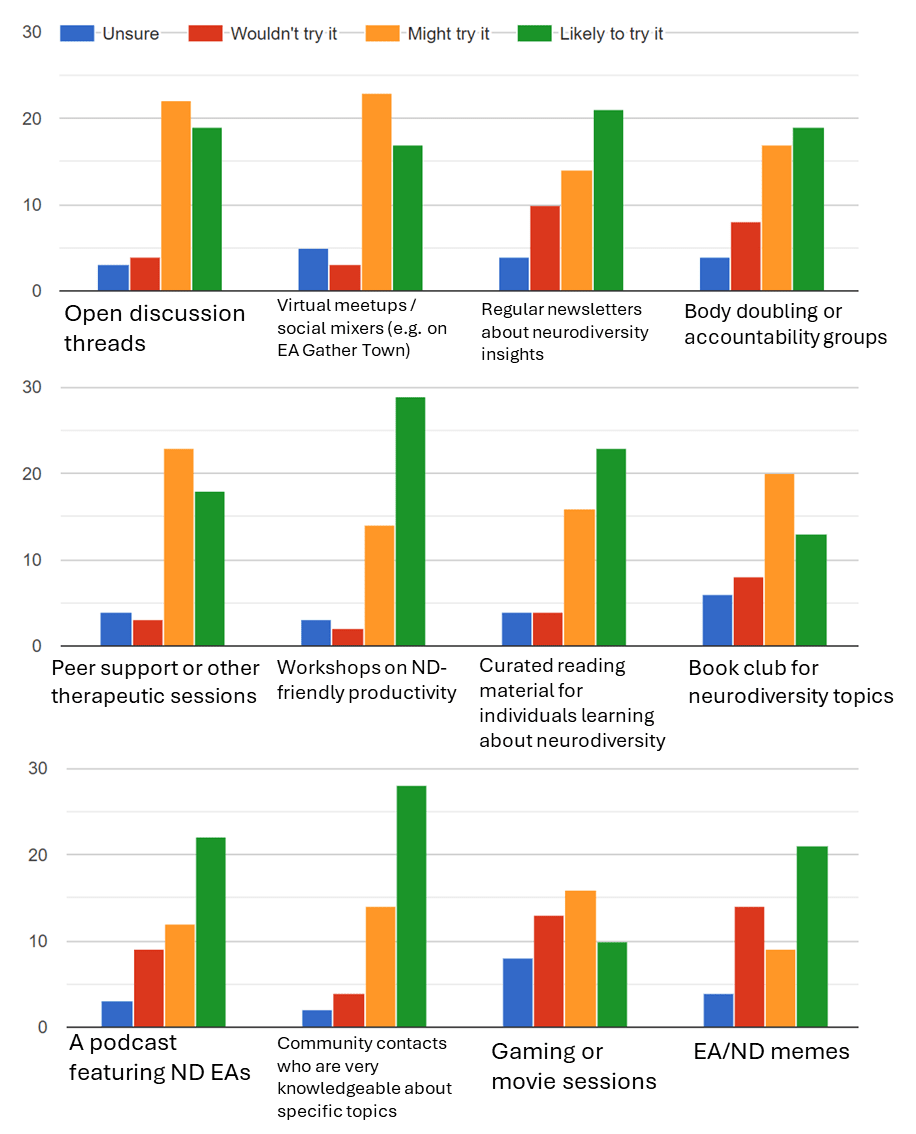
(Shameless teaser:) The results I found most interesting were from "What types of things would you want to see as part of the online community, and how personally relevant would those elements be for you?"
My subjective summary of responses to open-ended questions (not included for anonymity reasons):
Suggestions and ideas
A surprising number of participants were interested in helping out in specific ways
Lots of lovely, thoughtful, supportive, or appreciative comments
2. My estimate of potential as a community project
I have some experience with organizing online and offline social groups, and instead of presenting the exact 5-10 different heuristic calculations behind my vibe, I'm just going to state my intuitive estimation[1]:
If someone set up an online neurodivergent community in the very regular way of making it a public opt-in group, advertised in places like the EA Forums, other EA+ forums, and the dozen or so EA+ Slack/Discord/Facebook/WhatsApp groups, I would expect the "natural size" of the community to be such that the number of total lurkers (active and inactive members) reach the low hundreds within a few years, with fewer than 10% of members engaging on a monthly basis, and if monthly online social events were to be held, the expected turnout would be fewer than 10 members. This isn't a pessimistic estimate, it's simply what would be consistent with how online groups usually are, given how relatively few EAs there are globally, let alone EAs who participate in any online group, let alone EAs who participate in any online group at least once a month, etc etc.
If this online neurodivergent community were the most successful group in all of the history of EA online groups, relative to the actually addressable market of active online neurodivergent EAs, I would still expect the turnout at events to be lower than 30 members.[2]
I think fostering the group so that it reaches 10 active event-attending members is already a harder-than-one-might-think goal, especially for a timeline of 1-2 years. I can think of less typical approaches that could result in exceeding this goal (such as relying on word of mouth, peer influence, pitching to EA Virtual Program participants, and getting advertised on one of the EA+ newsletters with the biggest readerships), but this requires consistent effort and some luck, and I would be tempted to argue that this defeats the purpose of the online community in that it would no longer be about neurodivergent folks fitting in so much as trying to have a good turnout.[3]
Personally, the overall potential impactful was not high enough for me, but since I had been exploring how an active community might be fostered at all, I then considered a larger and encapsulating idea: what if the intention was to consolidate and boost both existing and future online EA groups? And if that project was worthwhile, then I could easily include the infrastructure for a neurodivergent subcommunity, whether or not I was invested as an organizer within that or someone else was. But that is a subject of another post.
3. Something I learned
I don't have any amazing insights to share, just this one anecdote.
I was feeling very conflicted before I sent out my survey to almost 80 ND-affiliated EAGxVirtual participants via Swapcard. But I'm glad I did though, because the results were pleasantly surprising. People didn't accuse me of being a spammer or call me out on unsolicited promotion of my survey, even though I was afraid of being perceived as wasting people's time. Instead, more than 40% of the people I messaged filled out the survey, with 80% of those that did responding positively to my message. Take what you will from that, but hopefully something in the direction of it being a good idea to overcome fear and reach out more on Swapcard!
4. What now with online community building?
One of the main draws I had to this neurodivergent group idea in the first place is that I see a lot of potential in creating ND-specific resources, such as:
Info directories of good books, YouTubers, podcasts, courses, etc.
Curated material, some of which may be improved encapsulations of important ideas that aren't so accessible or systematically captured by neurodivergent literature at present. For example, neurodivergent productivity seems not well represented.
Community contacts who can help others with their niche interests.
I still value this and am personally interested in contributing, but have opted to prioritize and pursue this in a much different way.
I have a lot more to share regarding my exploration of online community-building ideas within EA, and that will hopefully appear in a separate and much more in-depth post. Those ideas aren't really specific to this neurodivergent community idea, so I haven't included them here.
If anyone is inclined to make something happen with the ND community idea, I'm happy to share my background research or connect you with potential collaborators.[4]
I would be mildly curious to hear from organizers who have anecdotal experiences that deviate significantly from my projections. Besides that, I am uninterested in defending my heuristics/estimates, also knowing that shifting the estimates won't change my current direction anyway.
One can gauge a realistic upper bound on the turnout by looking at the turnout for a popular one-off online EA social event, e.g. one of the meetups at EAGxVirtual.
Edit: The match seems to now be over - the funds were expended in around 35 minutes. But many of these charities are great and should be supported regardless!
***
On October 22nd starting at 10:00am Pacific Time, Every.org is matching donations to select animal welfare organizations at a 2:1 rate, up to $2,000 per donor per nonprofit (so if you give up to $2,000, they will contribute up to $4,000 and the nonprofit will get up to $6,000). The first donation a donor makes to each el...
‘Like most of life’s dangers, the dangers of artificial intelligence are not easily identified from the armchair.’
J Dmitri Gallow
Epistemic status
I’m not an expert in this field, and herein I make some sweeping generalisations educated guesses about the overall nature of its contents based on my strong impression from the subset of work that I’ve read. I’ve recently spent maybe 2–300 hours lear...


https://www.facebook.com/groups/easwithadhd/