Comments
Does this apply to US only? If so, could be good to say at the very top.
(I haven't read the post, but I'm very excited that such a resource exists!)
Does this apply to US only? If so, could be good to say at the very top.
(I haven't read the post, but I'm very excited that such a resource exists!)
Also, if anyone is up for it, I think a resource for DAF providers in other countries would seem useful as well
Yeah this is for US only. I actually thought I had said that in the post, but looks like I forgot to! I'll edit it.
I just started researching DAFs and this article was so helpful! Thank you so much! Another option I came across in my research that you might want to add to your comparison is endaoment.org.
I'd also love a comparison of which DAFs support direct giving (e.g. gift a stock through the DAF provider to a charity rather than first to your DAF, then later to a charity) and whether that has an effect on the fees you pay.
I just had a brief look at Endaoment, later I will do a more careful look and update my post but here's what I noticed:
I was not aware of Endaoment, I will look into it!
I don't know if any DAF providers support direct giving. But any provider should let you give stock to your DAF and then donate it to charity a few days later.
In terms of fees, if you only use your DAF as a convenient way to donate stock and you mostly maintain a $0 balance, then you'll just have to pay the minimum fee. I listed the minimum fees here—I think your best bet is Schwab because it has no minimum fee. Charityvest has no minimum for cash-only accounts, and I think you can still contribute stock to a cash-only account (they'll just liquidate the stock once they get it), but I'm not sure about that so you might want to ask them.
Great post. One more resource that EAs should be aware of is Charitable Solutions LLC. They facilitate large (>$250k) DAF donations of exotic assets like restricted stock, LP interests, art, etc.
Charityvest just increased their fees for new investing accounts as of 2025-02-01. The annual minimum fee is now $100 (up from $48) and the % based fees seem to line up with what is listed here for Fidelity and Vanguard. 0-500k at 0.60%, next 500k at 0.30%, next 1.5m at 0.20%, with 0.15% -> 0.10% -> <? onwards.
They're still quite competitive and I remain quite happy with them (even if I weren't on their prior fee structure). Same sentiment as Lisa: This state of the world comparison post helped a lot in understanding our choices.
Daffy was interesting, but ultimately off-putting to me for both their app based vibe (we invented the open web for a reason!) and their apparent insistence on cryptocurrency being an investment.
Updated to include the new fee schedule. I decided not to update the flowchart because, although Charityvest is no longer cheaper than Schwab, I still like it better because it has lower fees on the default investment funds.
Aw man this means I'm gonna have to remake my flowchart
This looks really useful, many thanks for the writeup. I'd note that I've been using Vanguard for regular investments and found website annoying and the customer support quite bad; there would be long periods where they wouldn't offer any because things were "too crowded". I think most people underestimate the value of customer support, in part because it is most valuable in the tail end situations.
Some quick questions:
- Are there any simple ways of making investments in these accounts that offer 2x leverage or more? Are there things here that you'd recommend?
- Do you have an intuition around when one should make a Donor-Advised Fund? If there are no minimums, should you set one up once you hit, say, $5K in donations that won't be spent a given tax year?
- How easy is it for others to invest in one's Donor-Advised Fund? Like, would it be really easy to set up your own version of EA Funds?
"Do you have an intuition around when one should make a Donor-Advised Fund?"
The reason I, personally, opened a DAF was to make it dead simple to donate appreciated stock.
If you're not familiar: you can give a lot more to charity, at the same cost to you, if you gift stock that's gone up in price instead of cash. For example, say you bought stock for $1k and has appreciated to $10k. (Lucky you!) If you sold it to donate it to charity, you first have to pay capital gains tax on the $9k, which is 35% or about $3k. So the charity only gets $7k. If instead, you gift the stock directly: you don't pay taxes, and neither does the charity. Basically, the US Govt matches your donation. Great deal, right?
The catch is: actually gifting stock is really annoying! When I was donating TSLA shares to GiveWell I had to literally fax a piece of paper telling them which shares to take out of my account. A DAF is much simpler; I just click some buttons from my Schwab investment account and the stock lands and gets sold in my Schwab Charitable DAF. There are other great reasons to open a DAF too -- but making this tax optimization really easy is why I went for it.
DAFs do make it much easier to donate appreciated stock, and this is good advice. However, if you want to make a donation of appreciated assests and you aren't able to set up a DAF, EA Funds accepts donations of stock (in the US) and cryptocurrency (US, UK, and NL) for donations of more than $1000 (no promises that you won't have to send a fax to your broker if you want to donate stock, but in general that hasn't been the case for most of our donors who are donating from Vanguard etc).
Thanks for sharing your experience with Vanguard! That aligns with anecdotes I've heard about Vanguard's brokerage service.
- Are there any simple ways of making investments in these accounts that offer 2x leverage or more? Are there things here that you'd recommend?
I just published something about DAF investing strategies: https://mdickens.me/2021/04/06/investing_strategies_DAF/ In this section, I talk about leveraged ETFs. I believe the only way to invest with leverage in a DAF is through a leveraged ETF or mutual fund, although I've heard conflicting things about what the actual legal requirements are. In general, I don't think leveraged ETFs are good investments.
- Do you have an intuition around when one should make a Donor-Advised Fund?
If you want to use leverage, probably never. (Or just use it to convert stock into cash for donations, as akrolsmir described.) Otherwise, you want to have at least $10,000 or so, otherwise the minimum fee will eat too large a % of your assets each year. (Schwab and Fidelity both have a $100 minimum fee.)
- How easy is it for others to invest in one's Donor-Advised Fund?
It's definitely possible. I personally don't have my own DAF, I use my parents' DAF. I'm a full authorized user on the account, which means I had to connect my Fidelity account to the DAF. If you don't care about managing anything and just want to donate to the DAF, I would think that should be pretty easy, but I haven't tried it. I think it should be as simple as writing a check to Fidelity Charitable with a note that the money is for that particular DAF.
Michael -- Thanks so much for doing this. So many people find the whole concept of DAFs to be mysterious and overwhelming, and your chart(s) help to make it easy.
You may want to correct your Vanguard fee schedule; they charge a $250 “maintenance fee” on account balances under $25,000. This appears to be on top of the 0.60% fee, meaning that accounts that ultimately decline in value suffer total annual fees bordering on ~2% . This seems to make Schwab a much better option for accounts that may ultimately decline below $25k, right?
See “Maintenance Fee” at https://www.vanguardcharitable.org/company-policies/policies-and-guidelines
Thanks for pointing this out! I updated the post.
Thanks so much for this great post! I've had Schwab Charitable for about a year now, and has been very smooth. Also potentially worth noting, one can transfer between DAFs across various providers, so if the size of a DAF were to change, I think it should be feasible to move to one with better options/fees as needed.
Grateful to you Michael for analysis and summary/guide, very useful to me as the landscape has changed significantly since I last had a DAF 30 years. A couple of things:
1) Under Fees section, you state: "If you make $75,000 and you donate 10% of your income, you'll hit the basic plan's limit in 4 years and the family plan's limit in 7 years." BUT since the prior sentence indicates the lifetime limit applies only to NON-cash, it seems to me that for many/most people this condition would not be a concern. I was reading/skimming fast, and initially that sentence threw me as a Daffy deal breaker. And, in your example of $75K income and 10% annual donation, presumably the donations would be "cash" and not have a lifetime cap. It might just be me, but perhaps this aspect of the fee section might be worded a bit differently! {Personally, I'm leaning toward Daffy but have no affiliation with them.}
2) I particularly appreciated your comments on the basis of "risk" for those DAF vendors that are startups. The structure does seem to mitigate substantial aspects of risk. Perhaps if you occasionally updated info on their indebtedness, which for one was only accounts payable (for outstanding bills that were not overdue), that'd be a great service to all.
3) Perhaps one area you might wish to address in the future: Charitable bequests written in one's Will with the named charity being the DAF. On the surface of things, I don't believe this would differentiate or be a problem with any of the vendors, but I don't know. Somewhat similarly to the tax advantages during one's lifetime of donating appreciated stock vs donating cash, to reduce Federal and I believe for many/all state level estate taxes as well that naming in one's Will a DAF might be worthwhile. One would want to name a contingent alternative DAF or charity(s) in case the named DAF goes belly up. And, have those who have rights to submit requests to your DAF know your wishes in case you die unexpectedly.
Again, thank you very much. I find it hopeful and encouraging to read comments here and see so much interest.
Vanguard's website does not state that they can accept cryptocurrency, but I confirmed with a representative that they take donations of cryptocurrency if the value of the contribution is at least $50,000.
Schwab also told me (in Nov 2020) that they only accept cryptocurrency if the contribution is >$50,000, and their vendors charge a 1% fee on Bitcoin and a $3,500 flat fee for Ethereum. I spoke to Fidelity Charitable who told me they had no minimum contribution for cryptocurrency, but I didn't inquire about fees.
FYI @MichaelDickens I just heard from Vanguard Charitable:
> At this time, Vanguard Charitable only accepts contributions of Bitcoin and Bitcoin Cash that are valued over $100,000.00.
Might be worth mentioning in the post.
One important factor when looking for a DAF is whether it restricts your donations to only public charities as defined by the IRS and will not let you direct donations to private foundations. Both of these can be approved as 501(c)3) non-profits. I believe the vast majority of non-profits are classified as private foundations. My son started a non-profit that was initially classified by the IRS as a private foundation. He can file in a future year after having actual experience and try to get classified as a public charity. In his initial fund raising several of our friends with DAF's could not use their funds to make donations while other friends using other providers were allowed to make donations to his private foundations. I have my own 501(c)(3) private foundation and I can donate to any approved non-profit, public or private. Investment options, fees and customer service are all important but the real value is in making donations to the charities you want to support.
another relevant minimum is minimum account activity—have you or others incorporated this into your comparisons? for example, it looks like fidelity requires disbursement of 5% of net assets per year (averaged over 5 year periods), whereas vanguard requires at least one $500 grant every 30 months.
Where are you getting that info? I thought Fidelity Charitable had no distribution requirement. Distribution requirement is definitely relevant if there is one.
fidelity: their "open an account" page (https://www.fidelitycharitable.org/open-account.html) directs to their program guidelines (https://www.fidelitycharitable.org/content/dam/fc-public/docs/programs/fidelity-charitable-program-guidelines.pdf), with the relevant info on page 17. on closer inspection, it looks like disbursement of 5% of net assets per year could be a policy for fidelity charitable as a whole, not necessarily for each individual account. even so, they claim to require active grantmaking and say they will start making grants from any account that hasn't disbursed anything for two years (top of page 18). i don't know if this policy is commonly applied, but at the very least it's a risk.
vanguard: their "open an account" page (https://www.vanguardcharitable.org/open-an-account/consent/) has a link to their policies and guidelines, with the relevant information under heading "minimums, timing, and amounts", subheading "minimum account activity".
i didn't see any minimum activity info on the schwab website and haven't had a chance to check others.
even so, they claim to require active grantmaking and say they will start making grants from any account that hasn't disbursed anything for two years (top of page 18). i don't know if this policy is commonly applied, but at the very least it's a risk.
After a number of years Fidelity required me to make a $50 disbursement, so I think this requirement might be de minimis.
I used T. Rowe Price Charitable for the last several years. Seems to me it has the lowest fees of any DAF administrator other than startups like Daffy. Its annual fee was 0.5% and the investment funds had annual fees as low as 0.07%. I have no complaints about it.
Fantastic analysis, wish I had this prior to making my decision. Back in the day both Fidelity and Schwab had a $5K minimum and Fidelity had a $50 minimum contribution whereas Schwab had a $500 minimum, which is why I went with Fidelity. Glad to see they made these improvements.
Going off of Dan's comment, if a Fidelity (or Schwab) account is at $25K or more, would you recommend switching over to Vanguard given the better fees and investment options?
Unless you're putting a lot of work into optimizing your DAF investments (like I describe here), Fidelity is pretty much just as good as Vanguard.
Love that you’re writing a comprehensive write up about navigating DAFs, Michael.
Another one I’ll put on your radar is Groundswell (www.groundswell.io).
Full disclosure, I work for them and I would consider it comparable to Charityvest in regards to price and the ability to accept stock.
We are focused on offering DAFs as an employee benefit, although anyone can download and use Groundswell as they would with Charityvest.
This was really helpful, thank you!
Can you clarify why you'd create a DAF instead of just donating directly to a high-impact charity? Using EA Funds as a baseline, I'd be interested in what value a DAF provides over just donating there.
That's a complicated question, but in short, if you believe that there will be better donation opportunities in the future, you might use a DAF.
Excellent, helpful and concise, thanks so much Michael! Perhaps include a minimum balance line to your Appendix just under "minimum fees" section. As you noted, Vanguard has a $25k minimum balance, effectively making their minimum annual fee $150. Fidelity has no initial minimum deposit and no minimum balance, which may be helpful when opening an account and managing large grants that bring the account balance below the minimum between contributions.



Last updated 2026-07-11.
A donor-advised fund (DAF) is an investment account that lets you take a tax deduction now and give the money to charity later. When you give money to a DAF, you can deduct that money just as you would deduct a charitable donation. The DAF invests the money tax-free. At any time, you can write a grant from your DAF to a charity of your choice.
You can open a DAF through a donor-advised fund provider. A provider charges an administrative fee to invest your DAF and make donations when you recommend them.
For donors in the United States,[1] which DAF provider is best?
The short answer
All the big DAF providers offer similar features. For most people, it doesn't matter much which one you choose.
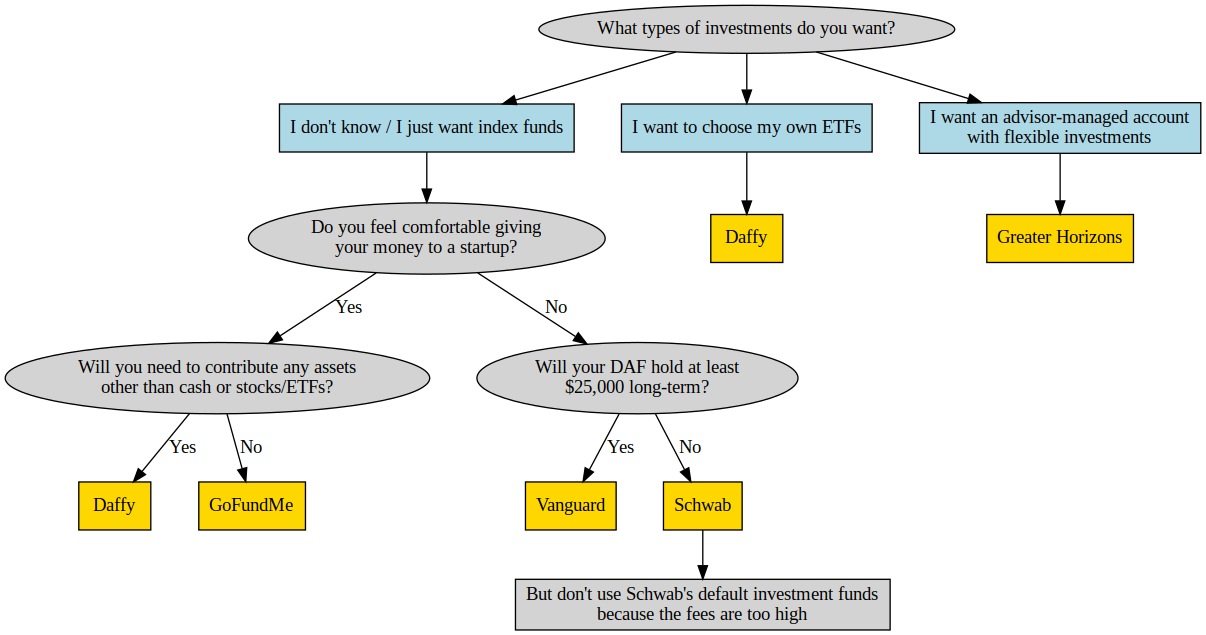
Otherwise, this handy flowchart can help you choose a DAF provider that fits your preferences.
The long answer
That flowchart should cover most use cases, but it might give you the wrong answer if you have unusual circumstances. In the rest of this post, let's look in detail at how DAF providers compare.
Cross-posted from my website.
I made a list of every United States nationwide DAF provider I could find. I excluded regional DAF providers (example: Silicon Valley Community Foundation), providers that only support certain causes (example: National Christian Foundation), and providers that don't work with individual donors (example: American Online Giving Foundation). Your local community foundation might offer a better DAF than any of the national providers of my list, but there are too many community foundations for me to look at them all.
I ended up with eleven DAF providers (in alphabetical order):
This list is probably not comprehensive, but it's all the DAF providers I could find that meet my criteria.
I spoke to representatives at these providers to fill in some gaps in my knowledge. I also spoke to a few DAF users and financial advisors who manage DAFs at different providers.
I then eliminated five DAF providers:
Six DAF providers remain: Charityvest, Daffy, GoFundMe, Greater Horizons, Schwab, and Vanguard.
Caveat 1: I don't have good firsthand knowledge of any of these DAF providers except for Fidelity Charitable (which I used to use) and Greater Horizons (which I currently use). I created accounts at the other providers to get a sense of how they work, but I haven't tried to do anything fancy like set up an advisor-managed account. I had to make subjective judgments on things like UI, so don't take my claims as definitive.
Caveat 2: This article is not about whether you should open a DAF in the first place. You might want to keep your money in a taxable account, or maybe donate it all right away. But if you've already decided you want a DAF, then I hope this article will help you choose a provider.
Let's compare Vanguard, Schwab, Greater Horizons, GoFundMe, Daffy, and Charityvest on these questions:
Minimum fees:
Charityvest, Greater Horizons[3], Schwab, and Vanguard offer tiered fee structures based on the account value. Daffy charges a monthly fee but no percentage-based fee. See Appendix for full details on the administrative fees for each provider.
GoFundMe has no administrative fees whatsoever.[4] Users can optionally provide tips.
Daffy has a unique pricing structure. It offers four plans at different tiers: $3/month, $5/month, $20/month, and $40/month. The cheap tiers have contribution limits and restrictions on what features can be used.
Daffy is the cheapest DAF provider if you have a basic account with at least $6,000 or a $20/month account with at least $40,000. The $20/month tier has almost all the features of the $40/month tier, the main difference being that at $20/month, your contributions are limited to a maximum of $100,000 per year.
If you're on Daffy's $3/month plan, contributions are capped at $25,000 per year.
Daffy's $40/month plan has no limit. You can put $10 million in your DAF and still only pay $40/month. But be aware that Daffy has changed its fees more than once already[5], and may change them again.
If you only use a DAF as a convenient way to donate appreciated stock (or other assets), and you don't plan on keeping money in the DAF long-term, then you want a DAF with no minimum fee—your best options are Schwab and GoFundMe.
Daffy, Charityvest, and GoFundMe are startups, which makes them riskier. If we exclude the two startup-y DAF providers:
Donor-advised funds have three types of minimums:
| Charityvest | Daffy | GoFundMe | Greater Horizons | Schwab | Vanguard | |
|---|---|---|---|---|---|---|
| Account Min | $0 | $0 | $1* | $0 | $0 | $25,000[6] |
| Contribution Min | $15 | $0 | $5 | $0 | $0 | $5,000 |
| Grant Min | $15 | $18 | $5 | $0 | $50 | $500 |
| Advisor Min | $1 million | N/A | N/A | $0 | $0 | N/A |
*GoFundMe has no account minimum, but it only allows you to donate up to 97% of your account balance at a time, to allow for market fluctuations. You can only donate a whole number of dollars, so effectively you are required to keep $1 in your account. I'm told they plan to change this requirement to make it more flexible.
If you don't know much about investing or you want to invest in whatever default your DAF provider uses, skip to the next section.
Let's compare the investment options for Charityvest, Greater Horizons, Schwab, and Vanguard.
Two providers are excluded from the table:
The DAF providers offer index funds covering the following asset classes.
| Charityvest | Greater Horizons | Schwab | Vanguard | |
|---|---|---|---|---|
| US stocks |  |
|
|
|
| US small-cap | |
|||
| international stocks | |
|
|
|
| emerging market stocks | |
|
||
| US bonds | |
|
|
|
| international bonds | |
|
||
| TIPS | |
|
||
| money market | |
|
|
|
Vanguard offers funds covering many other market segments, including US growth/value, US REITs, European stocks, Pacific stocks, corporate bonds, dividend growth stocks, and commodities. Other than Daffy, Vanguard has the best variety in terms of index fund offerings.
The expense ratios on the funds themselves are low enough not to matter as long as you stick with the passively-managed funds. (Vanguard and Schwab offer a few actively-managed funds with higher fees, which you should avoid.) You can use any of these DAF providers to construct a globally diversified portfolio for an average expense ratio of about 0.05%.
Vanguard and Charityvest investors can approximately replicate the global market portfolio with 30% US stocks, 30% international stocks, 20% US bonds, and 20% international bonds. Investors with Schwab or Greater Horizons don't have access to international bonds, so the closest they can get is something like 30% US stocks, 30% international stocks, 40% US bonds.
All six providers offer ESG funds. All but Schwab's have low expense ratios; Schwab's ESG funds are unreasonably expensive.
If you want to invest in cryptocurrency, you can either do that through an advisor-managed account[7], or you can invest in a cryptocurrency fund through Daffy. Daffy is the only provider that offers crypto funds.
In summary:
Each of the five DAF providers offers a few default investment allocations. The defaults cater to investors with different levels of risk tolerance (conservative/balanced/aggressive).
Schwab's default investments are not good because they charge unconscionably high fees.[8] Schwab does offer some low-fee options (listed in the previous section), so if you use Schwab, make sure you choose their low-fee funds instead of the defaults.
The other five providers—Charityvest, Daffy, GoFundMe, Vanguard, and Greater Horizons—charge low fees on their default investments. So if you use one of those providers, you don't need to worry about fees.
All six providers offer ESG portfolios. Again, though, Schwab's ESG funds are unreasonably expensive.
All the providers' default funds allocate too much to US stocks relative to the global market portfolio. I personally wouldn't use a default allocation because I'd want to invest more into international stocks. Every provider other than GoFundMe lets you choose your own allocation if you want to.
Daffy is the only DAF provider that lets you build a custom portfolio from a long list of eligible ETFs. Not every ETF is eligible, but there are around 500 choices.
Custom portfolios are only available for the $20/month tier, so this is not a cost-effective offering for smaller DAFs.
The full list of ETFs includes the following categories, among others:
Unfortunately, Daffy does not include some of my favorite ETF providers: AlphaArchitect, Avantis, Cambria, and Return Stacked. It also doesn't include any managed futures ETFs.
Schwab, Charityvest, and Greater Horizons allow donors to appoint an investment advisor who can invest in things other than the pre-selected funds. Their program guidelines (links: Greater Horizons, Schwab (p. 11–14)) dictate what investments are allowed. Charityvest's advisor-managed accounts must hold a minimum of $1 million.
Vanguard and Daffy allow advisor-managed accounts, but advisors don't get to invest in anything beyond what individuals get.
Some examples of restrictions that apply to advisor-managed accounts at Schwab/Charityvest/Greater Horizons:
Schwab has some additional restrictions that Greater Horizons does not:
(Charityvest allegedly also has some restrictions, but they're not publicly listed.)
Greater Horizons provides the most flexibility to investment advisors. If I wanted to do anything unconventional, I would use Greater Horizons. (In fact, I do use Greater Horizons for exactly that reason.)
Four of the six providers—Greater Horizons, Schwab, Charityvest, and Vanguard—can accept donations of complex assets, including cryptocurrency, private equity, real estate, and more.[9] Daffy can accept cash, stocks/ETFs/mutual funds, private stock, and cryptocurrency, but not other types of exotic assets. GoFundMe can only accept cash, stocks/ETFs, and transfers from other DAFs.
Those four providers claim to accept more or less any type of asset that can legally be donated. But if you want to donate a large position in a complex asset, you should contact your DAF provider of choice to confirm they can receive it.
These providers all manage donations of complex assets through the same third party (Charitable Solutions LLC).[10]
(Amusingly, AEF, NPTrust, and Schwab each claim to be "uniquely flexible" when handling complex assets. If they're all uniquely flexible, I guess that means none of them is?)
Most donors only care about the basic features of a DAF—they don't need fancy investment options or the ability to donate complex assets. So the main deciding factors for most people are (1) fees and (2) user experience.
Of the providers I'm focusing on, Greater Horizons easily has the worst sign-up process. You have to request that a customer service representative reach out to you. Then they send you a PDF form to fill out and the representative manually creates the account for you. In contrast, the other providers all let you sign up online and you can fill out your personal information on the website.
In the process of writing this article, I created accounts at Vanguard, Schwab, GoFundMe, Daffy, and Charityvest and went through a few common use cases. I found them all easy to use. Vanguard was slightly more complicated than the others. GoFundMe's "main flow" (sign up -> contribute funds -> donate to charity) was easy to use, but some things outside of the main flow were unintuitive.
Another important aspect of user experience is the quality of customer service. Good customer service matters, but it's difficult to assess—if you have a good/bad customer service experience, that might have more to do with the specific person you talked to than the quality of service in general. That said, I communicated through email and over the phone with all of the providers to get answers to my questions, and had decent experiences with all of them. My customer service experience might not generalize because reps from Charityvest, Daffy, and GoFundMe reached out to me after I published this article, which means they were on their best behavior (see disclaimer). That said, the Daffy rep didn't do a great job of answering my questions, and the GoFundMe rep did an excellent job.[11] I have heard anecdotes from a personal friend[12] and from an independent financial advisor who report that Daffy customer service was helpful and responsive when dealing with issues.
I've heard that Schwab has particularly good customer service. I've heard Vanguard the brokerage has worse customer service, but that Vanguard Charitable has a separate customer service department and it's better than Vanguard the brokerage.
A side note: You might think it's a good idea to evaluate user experience by looking at reviews on a site like Trustpilot or Better Business Bureau. I would avoid looking at those sites because they are protection rackets[13]—they offer to remove bad reviews in exchange for money. So the companies with good reviews are just the ones who pay to get the bad ones deleted.
I can't give objective metrics for user experience, but my ranking based on my personal experience is Charityvest > Schwab > Daffy > GoFundMe > Vanguard > Greater Horizons.
Daffy, Charityvest, and GoFundMe's DAF offerings only started a few years ago. If they can't earn enough money to sustain themselves, they might have to dissolve customers' accounts and use their money to pay their bills (which they have a legal right to do, as established by National Heritage Foundation v. Highbourne Foundation[14]). You might not want to use those DAF providers if you're concerned about the risk.
I believe that:
Here's why you are unlikely to lose your money:
Charityvest and Daffy both use a financial structure that is novel for DAF providers. They were founded concurrently with sister corporations (Vennfi, Inc. for Charityvest and Aside, Inc. for Daffy). Vennfi/Aside receive funding from VC firms and Charityvest/Daffy pay the corporations to develop their technology. This lets the corporations run at a loss using VC funding until the DAF providers grow large enough to make the corporations profitable.
This structure works in donors' favor. If the for-profit corporation declares bankruptcy, VC funders can only make bankruptcy claims against the corporation, not against the DAF provider, so donors' money is safe. And according to their 2022 public filings (viewable through the Florida Check-A-Charity website), Charityvest/Daffy have very little debt (or at least they did as of 2022).[15]
(GoFundMe Giving Fund has a similar structure, except that its partner for-profit (GoFundMe) is a well-established company in its own right.)
Even if you don't lose your money, there's a risk that DAF providers raise their fees. Since the first version of this article in 2021, Schwab/Vanguard/Fidelity have not changed their fees at all; but Charityvest and Daffy have both changed their fees at least once. If you open an account with Charityvest/Daffy on the premise that it's cheaper, that premise might stop being true at some point. (Charityvest used to have lower fees than the big DAF providers, but in early 2025 they raised their fees and now they're tied with Fidelity and Schwab.)
It's possible to transfer money from one DAF to another, so if your provider starts charging exorbitant fees, you can move away from it.
This flowchart shows the best DAF provider depending on your circumstances.
A text description of this flowchart:
Some other factors you might care about, that I didn't put on the flowchart because it would be too big:
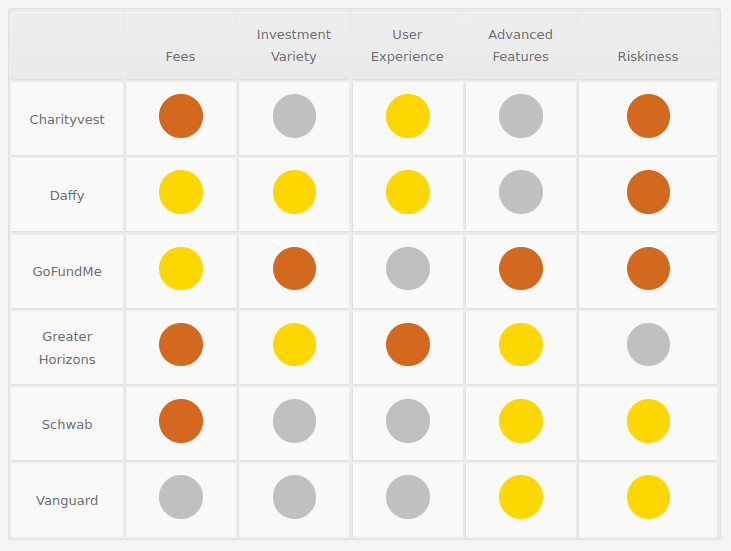
This table illustrates my evaluation of the providers along five dimensions, ranked as bronze, silver, or gold.
This article only covered Charityvest, Daffy, GoFundMe, Greater Horizons, Schwab, and Vanguard. That's not because I believe these are better across the board than the other providers. For example, I think Fidelity has a better UI than Vanguard; and NPTrust offers more flexibility than Schwab for advisor-managed accounts. Rather, I chose these DAF providers because each one is the best at something, while the other providers are not the best at anything (even though they are good at some things).
Even though I didn't compare them in detail, here are my impressions of five other DAF providers, ranked from most to least favorable.
Fees can be found at these links: AEF[18], Charityvest, Endaoment, GoFundMe, Fidelity, NPTrust, Schwab, T. Rowe Price, Vanguard.
Greater Horizons does not publish its fees online. I learned what it charges by speaking to a representative. I don't like it when companies don't publish their fees, but I will respect Greater Horizons' preferences by not disclosing them. If you want to know the specifics, contact them directly.
Minimum fees:
| AEF | Charityvest | Daffy | Fidelity | NPTrust | Schwab | T. Rowe Price | Vanguard | |
|---|---|---|---|---|---|---|---|---|
| Minimum Fee | $500 | $48 | $36 | $100 | None | None | None | $250 |
Percentage-based fees:
| Account Value | AEF | Charityvest | Fidelity | NPTrust | Schwab | T. Rowe Price | Vanguard |
|---|---|---|---|---|---|---|---|
| First $250K | 0.70% | 0.60% | 0.60% | 0.85% | 0.60% | 0.50% | 0.60% |
| Next $250K | 0.70% | 0.60% | 0.60% | 0.70% | 0.60% | 0.50% | 0.60% |
| Next $500K | 0.35% | 0.30% | 0.30% | 0.60% | 0.30% | 0.39% | 0.30% |
| Next $1.5M | 0.25% | 0.20% | 0.20% | 0.45% | 0.20% | 0.18% | 0.13% |
| Next $2.5M | 0.15% | 0.15% | 0.15% | 0.25% | 0.15% | 0.12% | 0.13% |
| Next $5M | 0.15% | 0.10% | 0.15% | 0.13% | 0.10% | 0.13% | |
| Next $5M | 0.15% | 0.10% | 0.12% | 0.10% | 0.13% | ||
| Next $15M | 0.10% | 0.10% | 0.09% | 0.10% | |||
| Over $30M | 0.05% |
Caveats:
Some observations:
The original version of this article did not include Charityvest, Daffy, or GoFundMe. I updated the article when representatives from those DAF providers reached out to ask me to include them. Everything I wrote about them is my own opinion.
(The original version of this article did not include Endaoment, but I discovered it on my own, and I have nothing to disclaim with respect to it.)
I learned about Charityvest in May 2021, when the CEO, Stephen Kump, emailed me to ask me to review it prior to its public launch. He gave me access to the beta (which I used to check out Charityvest) and added $20 to my account (which I did not use, to avoid any conflict of interest). I did not receive any other compensation for writing about Charityvest.
In early 2022, a representative from Daffy reached out to me, and I proceeded to forget about their message for a year. I rediscovered it in late 2023, when a couple of other people asked me for my opinion on Daffy and I decided to update this article to include it. I did not receive any incentive from Daffy.
A representative from GoFundMe reached out in March 2026 to tell me that they had just launched a DAF offering. I did not receive any incentive from GoFundMe.
I don't know how DAFs work outside the United States. If you do have DAFs in your country, you could use this post as a guide for what sorts of things to look for when choosing a DAF provider. ↩︎
Notes from my brief investigation:
Endaoment has an unusual fee structure: a one-time fee of 0.50% on deposits of up to $250,000 (with lower fees on large deposits), plus a one-time fee on 1% on all donations.
I found the UI confusing.
I can't provide a link for Greater Horizons because its fees are not publicly available. But I will say that they're broadly similar to Vanguard and Schwab. ↩︎
GoFundMe Giving Funds operates as a sister nonprofit to GoFundMe, which is a for-profit; hypothetically they can afford to run DAFs for free as a loss leader. I'm skeptical that a for-profit would want to continue running a free DAF service indefinitiely, so I would not be surprised if they introduce administrative fees at some point. ↩︎
Making it difficult for me to keep this article up to date. ↩︎
Vanguard requires an initial contribution of $25,000, but you do not need to maintain a balance of $25,000. ↩︎
An advisor-managed account will probably still have limits on how much cryptocurrency you can hold, something like 50% of your portfolio. Daffy lets you invest up to 100% of your portfolio in crypto. ↩︎
Schwab actually got sued for its high fees (see Philip Pinkert v. Schwab Charitable Fund), but the court ruled in Schwab's favor on the basis that Schwab legally owns donated funds so they have no fiduciary duty toward donors. Isn't that fun? ↩︎
Vanguard's website does not state that they can accept cryptocurrency, but I confirmed with a representative that they take donations of cryptocurrency if the value of the contribution is at least $50,000. ↩︎
AEF, Fidelity, and NPTrust also use Charitable Solutions LLC. It seems that Charitable Solutions LLC has something of a monopoly on managing donations of complex assets. ↩︎
The GoFundMe rep pre-emptively wrote out most the information that I'd need to fill in each section of this article, categorized by section. ↩︎
h/t Barak Gila for talking to me about his experiences with Daffy. ↩︎
I have strong private evidence for this claim. The public evidence for this claim is weak because review site protection rackets, much like the mafia, know how to avoid leaving any incriminating evidence. But you can find many anecdotes, such as here, here, and here (see also the comment section on LinkedIn) from business-owners who claim Trustpilot extorted them, and here from an alleged former employee of Trustpilot. I didn't look for evidence on Better Business Bureau, but in my experience it's more widely known that BBB is a protection racket, so evidence shouldn't be hard to find. ↩︎
I am not a lawyer. ↩︎
They both had less than $20,000 of debt against tens of millions of dollars of assets. The debt was entirely accounts payable, with no other sources of debt. I had to look up what "accounts payable" means but if I understand correctly, that means they were charged a fee (presumably by the partner corporation) and they haven't paid the fee yet. ↩︎
Fidelity's and Schwab's UIs are similar. The only big difference I noticed is that Schwab does a better job of conglomerating your accounts. If you have both a brokerage account and a DAF at Schwab, you can easily switch between them from the landing page. If you have both types of accounts at Fidelity, you can navigate to your DAF from the landing page, but it sends you to a separate URL and sometimes requires you to log in again. ↩︎
My incredible customer service experience with NPTrust:
I'm tempted to send them one of those "this meeting could have been an email" coffee mugs. Or, better yet, don't make me email you, just list your offerings on your website. ↩︎
AEF does not provide a fee schedule, only a fee calculator. I used the calculator to reverse-engineer the fee schedule. ↩︎
For the mathematically inclined, this function converts Fidelity's flat fee into an equivalent tiered fee on amounts over $5 million, given two variables AUM and flat_fee:
tiered_fee = ((AUM * flat_fee) - $11,250)
             / (AUM - $5,000,000)
Thanks for writing this! I opened and donated to a Charityvest DAF mostly based on this post.