Comments
Thank you for this list! These kind of overviews are extremely helpful.
Thank you for this list! These kind of overviews are extremely helpful.
Awesome list, thank you for sharing!
Is there any further research on those project ideas, eg comparing the ideas in terms of size, tractability and neglectedness?
There is definitely a lot of further research on some of these specific ideas (I tried to link out to a few projects), but I don't know of a ton of comparative research on them. It's possible there are internal ITN estimates at some grantmaking orgs? And this graph from Technologies to Address Global Catastrophic Risk is in the right direction (but doesn't focus on neglectedness):
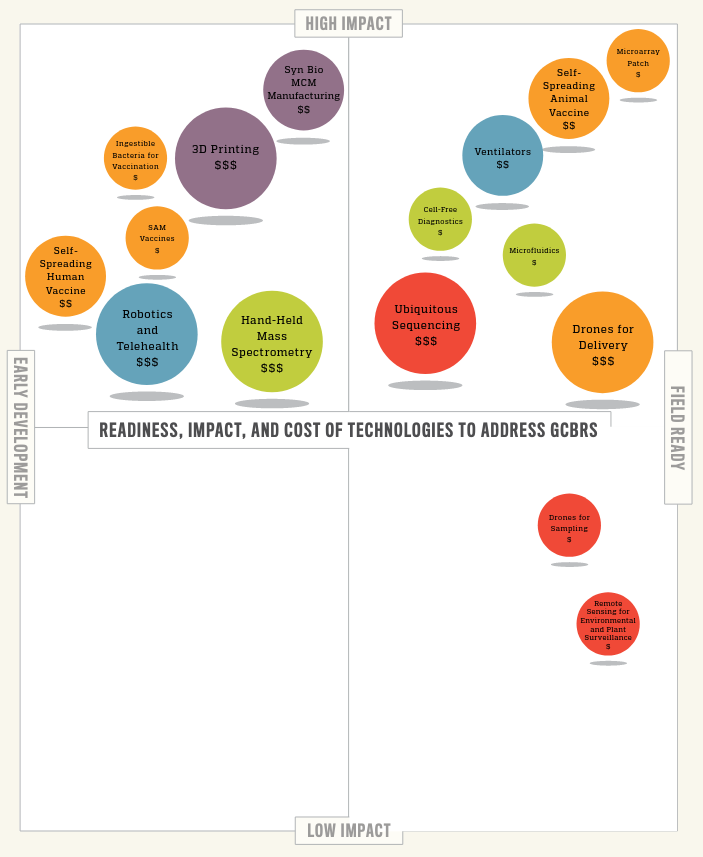
Additionally, I believe some organizations in the EA community (e.g. Open Philanthropy and Convergent Research) working on deeper strategic / comparative investigations of possible biorisk mitigation efforts.
This is useful, but shouldn't there be projects to breakdown the pipeline that could enable engineered pandemics? This seems the highest risk among all possibilities.
Last Updated: January 2024
I was working on my own list of biorisk reduction project ideas, and ended up creating this list of lists, which seemed silly not to share.
I have quoted a few words describing each project, but it’s well worth clicking through to the original lists. None of them describe projects for longer than two pages, and most for a paragraph or so. Several of the EA Forum posts also contain links for getting in touch with teams working on these projects. If you’re interested in that, you might also want to fill in the longtermist census.
In general, I am so tired of people dying in pandemics. It does not necessarily make me optimistic to see all these project ideas― the world should already be much better at this, and there is so much work to be done. However, it does make me feel hopeful: the world can be much better, and there are projects that you could work on to help it become so.
November 2023 Vitalik Buterin Blog Post
Projects that can make the world more hardened against airborne pathogens by default quoting a list from the blog post
June 2023 EA Forum Post
Finding market opportunities for biodefence-relevant technologies
Often no current market segment has been identified or developed. A project could help identify market segments (e.g. immuno-suppressed people) and create a market for technologies such as far-UVC systems or personal protective equipment
Crisis planning and response unit
We think a ‘crisis planning and response unit’ specifically focused on global catastrophic biorisk or extreme risks from AI could increase civilisational resilience and reduce existential risk.
Monitoring GCBR-relevant capabilities
A team or organization could be responsible for developing and compiling estimates of GCBR-relevant capabilities to inform funders and other organizations working to reduce GCBRs, as well as to make a more compelling case about the risk from engineered pathogens and biotechnology.
Public advocacy for indoor air quality to reduce pandemic spread
There are known effective interventions to improve air quality (ventilation, filtration, and germicidal ultraviolet light), but they need additional support to become deployed en masse globally... there could be more public advocacy aimed at broadly increasing its profile as a public health issue of concern – similar to other issues like cancer, HIV/AIDs, or, historically, water sanitation.
Biolab safety watchdog group
There could be a watchdog group or network that uses open-source intelligence and/or investigative journalism practices to uncover labs involved in significant biorisk-relevant activities. This group could bring increased attention to lab-related risks, deter future risky activities, and help authorities to manage irresponsible actors better.
Advocacy to stop viral discovery projects
Viral discovery projects (or ‘virus hunting’) are research programs that involve collecting unknown viruses from the wild and producing vast amounts of genetic data about them... Advocacy or lobbying to shut down or prevent viral discovery projects from getting started (or ensuring that their results can’t be disseminated widely) could reduce catastrophic biorisk.
January 2022 EA Forum Post
Early Detection Center
Early detection of a biothreat increases the amount of time we have to respond (e.g. designing tailored countermeasures, using protective equipment, heading to bunkers, etc)
See also: Nucleic Acid Observatory announcement from Will Bradshaw, Anjali Gopal, Mike McLaren, related post from Jeff Kaufman
Super PPE
it seems plausible that with good materials science and product design we could come up with next-generation PPE that is simultaneously highly effective in extreme cases, easy to use, reliable over long periods of time, and cheap/abundant.
Medical countermeasures
“radically improved medical countermeasures against GCBR-class threats, either by 1) producing targeted countermeasures against particularly concerning threats (or broad-spectrum countermeasures against a class of threats), or by 2) creating rapid response platforms that are reliable even against deliberate adversaries
See also: Alvea Vax announcement from Kyle Fish
BWC Strengthening
there is more scope for creative ways of strengthening the treaty (e.g. whistleblowing prizes), or creating new bilateral agreements and avoiding bureaucratic gridlock
Sterilization technology
Sterilization techniques that rely on physical principles … have the advantage of being broadly applicable, difficult to engineer around, and having little dual-use downside potential
See also: post on UV-C air purifiers
Refuges
specially designed refuges that safeguard against catastrophic pandemics
See also: Fønix: Bioweapons shelter project launch, Help Us Make Civilizational Refuges Happen from Linch Zhang and Ajay Karpur
As of July 2022
(I have not repeated ideas that pull directly from the above post, though the FTX write-ups are not word-for-word identical)
Crisis-aware regulation for global catastrophic biological risks
public health measures that would have a poor risk-benefit balance in normal times may be warranted or even critical in a crisis in which the benefits to eradicating or delaying a public health threat are unusually large” (link)
See also: original Project Ideas Competition submission by Mackenzie Arnold, with contributions by Kyle Fish
Rapid development and approval of emergency vaccination and therapeutics
imagine a team of high-powered vaccine developers, large-scale manufacturing capability on standby, and ready-to-go infrastructure for rapid human challenge trials in a regulatorily compliant manner” (link)
July 2022 EA Forum Post
Record-keeping for strong attribution
a record-based system for strong attribution of biological agents may be a powerful mechanism to deter biological weapons development and use”
Responsible access to genetic sequences
similar to how patient data is anonymized unless absolutely required, a responsible access system could ensure that [pathogen] genetic sequence fractions are shared with developers of vaccines and other countermeasures that are actually needed”
Consensus-finding on risks and benefits of research
one of the reasons for the debate around… the enhancement of potential pandemic pathogens having stalled is the fact that researchers disagree over the benefits and risks of research… we should try to pool the opinions of different experts to come up with a consolidated estimate”
Information loops to steer funding to less risky projects
“public disclosure of laboratory accidents would likely incentivize better laboratory practices… public disclosure of funding risky research like the enhancement of potential pandemic pathogens might encourage more thorough review and oversight”
December 2021
The below is a direct quote from the post:
- Improving personal protective equipment (PPE): The design of face masks and other PPE has barely changed for many decades, and still receives relatively little attention. PPE that was highly effective, easy to use, and cheap to distribute would be perhaps the single most transformative technological intervention to overcome biological risks, but is currently laughably neglected.
- Suppressing pathogen spread in the built environment: Indoor spaces are far more dangerous than outdoor spaces for transmitting respiratory infections. While not as general or powerful as improved PPE, interventions to reduce transmission in building could significantly slow the spread of severe biological threats. Proposed interventions in this area include improvements in ventilation, far-UVC irradiation, and upper-room UVGI. However, many of these have significant difficulties to overcome before widespread adoption, and relatively little time and money have gone into either implementing these technologies or identifying promising alternatives.
- Improving biosafety in high-containment labs and clinics: As with PPE for general use, the technologies and systems used to maintain biosafety in high-containment labs and isolation wards are decades old and slow to change. While less important than PPE, improving the other technologies and processes used to contain high-consequence pathogens would help prevent accidental release.
- Suppressing pathogen spread in vehicles: Many of the same principles applied to buildings could also reduce transmission in large vehicles, such as planes and cruise ships. This seems much less important than fortifying buildings against pandemics, but still valuable.
September 2021 report from the Bipartisan Commission on Biodefense
Vaccine Candidates for Prototype Pathogens
by investing in vaccines for at least one prototype pathogen in each of the 25 viral families known to infect humans, we could reduce the global burden of infectious disease while simultaneously preparing for the next unknown biological threat
Multi-Pathogen Therapeutic Drugs in Advance of Outbreaks
previous efforts to develop multi-pathogen therapeutics have largely targeted direct-acting small molecule antivirals. However, new modalities are emerging that may result in increased breadth and potency and which warrant extra investment, including host-directed antivirals and monoclonal antibodies targeting regions conserved across multiple viral species
Flexible and Scalable Manufacturing of Pharmaceuticals
government should broadly invest in the advancement of platform technologies to ensure that therapeutic and vaccine candidates against the next pandemic pathogen can be rapidly manufactured at scale
Needle-Free Methods of Drug and Vaccine Administration
technologies exist that could facilitate the self-administration of drugs and vaccines… microneedle patches have been extensively investigated for influenza vaccine delivery… intranasal or inhalable drugs or vaccines may also enable self-administration… delivery is common for small molecule drugs [but] has seen limited use with biologic drugs and vaccines”
Ubiquitous Sequencing
sequencing could become routine in the clinical setting, as well as in high-risk low-resource areas of the world… sequencing could serve as the diagnostic for diseases generally and permit novel pathogen detection early and beyond our borders. All this, while also being robust against genetic changes in pathogens and offering the details needed to track, and ultimately reduce pathogen transmission
Minimally- and Non-Invasive Infection Detection
new sensing capabilities such as non-invasive volatolomics (the detection of volatile compounds emitted by an individual) and wearables could permit constant passive monitoring of markers of infection without interfering with or inconveniencing our daily lives Massively Multiplexed Detection Capabilities bring new benefits by simultaneously testing for multiple pathogens, resistance genes, biomarkers, and analytes in a single simple assay. Massively multiplexed detection capabilities in the form of pan-viral and pan-microbial assays have also been demonstrated, ushering in a new paradigm for diagnostics
Rapid Point-of-Person Diagnostics
Point-of-person diagnostics stand in contrast to clinically administered diagnostics, which often require transportation to centralized laboratories, and days or weeks before rendering results
Digital Pathogen Surveillance
digital pathogen surveillance systems, which use internet-based and other electronically available data (e.g., medical bulletins, search queries, social media)... have the potential for near real-time warning ability, international detection, and automated operation
A National Public Health Data System
Although it is an enormous undertaking, a National Public Health Data System [for the USA] would provide the capabilities needed to effectively address the spectrum of biological threats
An Integrated National Pathogen Surveillance and Forecasting Center
An integrated real-time national pathogen surveillance and forecasting center with advanced capabilities to detect and model naturally occurring, accidentally released, and intentionally introduced biological threats does not currently exist
Next-Generation Personal Protective Equipment
innovations in the following areas: 1) reusable, sterilizable, and self-disinfecting equipment; 2) modular designs responsive to a wide range of threats; 3) personalization to ensure adequate protection, comfort, and attractiveness; 4) rapid production from widely available materials without supply vulnerabilities; 5) the ability to neutralize pathogens; 6) sensing capabilities to detect potential exposures; and 7) protection beyond traditional masks, respirators, gloves, gowns
Pathogen Transmission Suppression in the Built Environment
Suppressing pathogen transmission, especially in high-risk and high-traffic spaces, would reduce the spread of infectious diseases, extinguish some outbreaks, and buy critical time to combat more aggressive pathogens
Comprehensive Laboratory Biosafety
Our risk tolerance in laboratories worldwide working with biological threats should be comparable to that of air travel, where safety is engineered into the airlines and airports, and monitoring occurs constantly to detect and prevent human-generated and technology-based accidents
Technologies to Deter and Prevent Bad Actors
The ability to investigate, analyze evidence, and attribute deliberate biological events is essential for both deterrence and response… Unfortunately, biological attribution, genetic engineering detection, and microbial forensic techniques have only made small strides since the anthrax attacks of 2001”
Johns Hopkins Center for Health Security, October 2018 report
(this is an older list; I've included 11 out of 15 ideas)
The aim of this post is to provide lists of project ideas, not to provide a complete view of the entire space of projects relevant to mitigating global catastrophic biorisks. There are a lot of people doing and funding concrete biosecurity projects! That said, here are a few more places you might look for inspiration as you think about what to prioritise.
Lists of EA biosecurity grants
Lists of research questions more than projects
Concrete projects prioritized by specific organizations
NTI’s Biosecurity Innovation and Risk Reduction Initiative has the following working groups:
CEPI’s End Pandemics Investment Case outlines the following priorities:
Kevin Esvelt's lab works on relevant concrete projects, including some (such as the Nucleic Acid Observatory) mentioned above.
I believe that Convergent Research and Charity Entrepreneurship also maintain lists of health security / biorisk-related projects, but I don’t know of public versions of their lists.
If you know of other lists of project ideas, please share them in the comments and I will try to incorporate them into the post!

This is a really great list! Thanks for taking the time to write this post.