Comments
TsviBT
13h
-2

By Alexander Berger, Chris Smith and Aaron Roesch
Earlier this year, Nan Ransohoff, head of Public Goods at Stripe, published a viral[1] blog post about the coming third wave of American philanthropy. She estimated that wealth associated with frontier AI companies could lead to more than $37 billion in new philanthropy each year. At current valuations, that figure would be even higher.
The expected surge of funding has led to concern in some quarters that there is nowhere for this money to go — and that donors who care about effective giving will have trouble finding good places to donate.[2] There are a couple aspects to this worry: that institutions don’t yet exist at sufficient scale to spend this money; and that, even if they did, there just aren’t enough cost-effective ways to do so.
We agree that a diverse set of funders and implementers will need to scale to enable the best use of new resources. But we think it’s important to remember that these potential flows remain small compared to the scale of tractable problems in the world.
In fact, we think this wave could be spent well many times over. While scale-up will take time in some areas, others — like global health — can deploy resources quickly. Even where institutions must grow or new ones will need to be created, early funding commitments can give them the runway to do so rapidly and efficiently. Below we’ve pulled together examples of how additional funding could be spent well at a far larger scale than we or others are expecting. While far from “tapping out” the good philanthropic opportunities in the world, these new flows could make a real dent in the world’s most pressing problems.
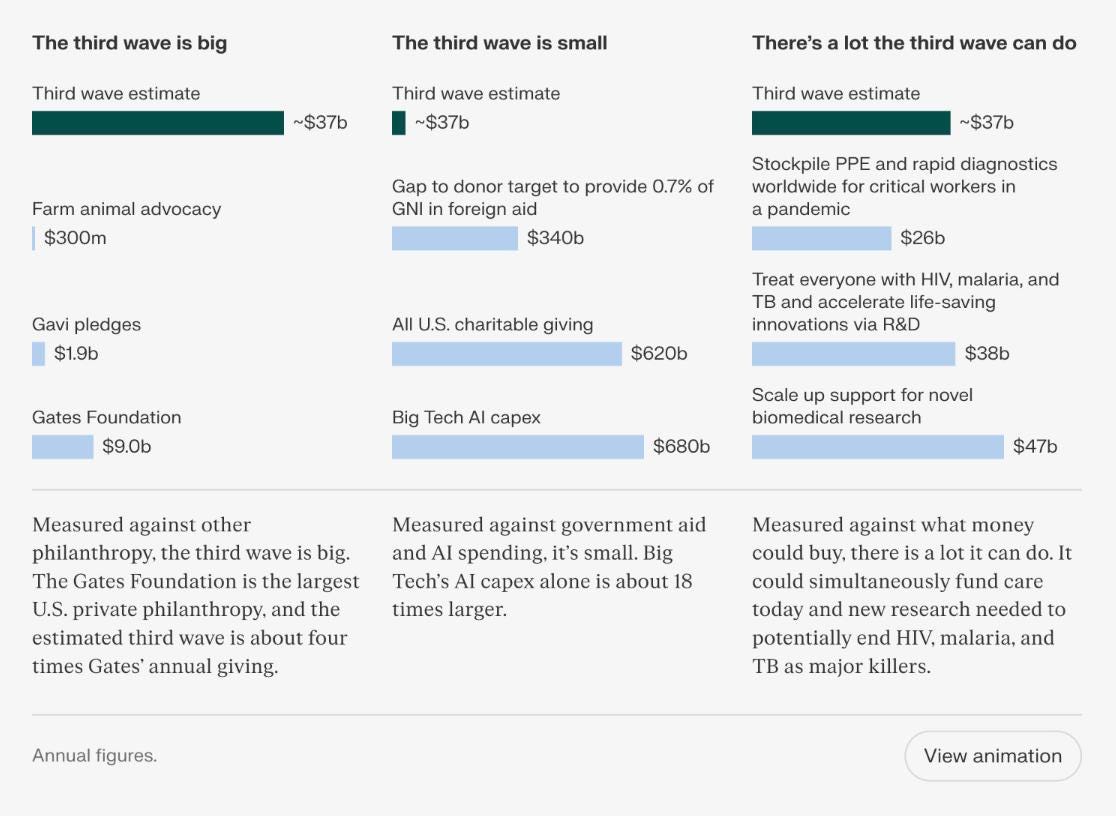
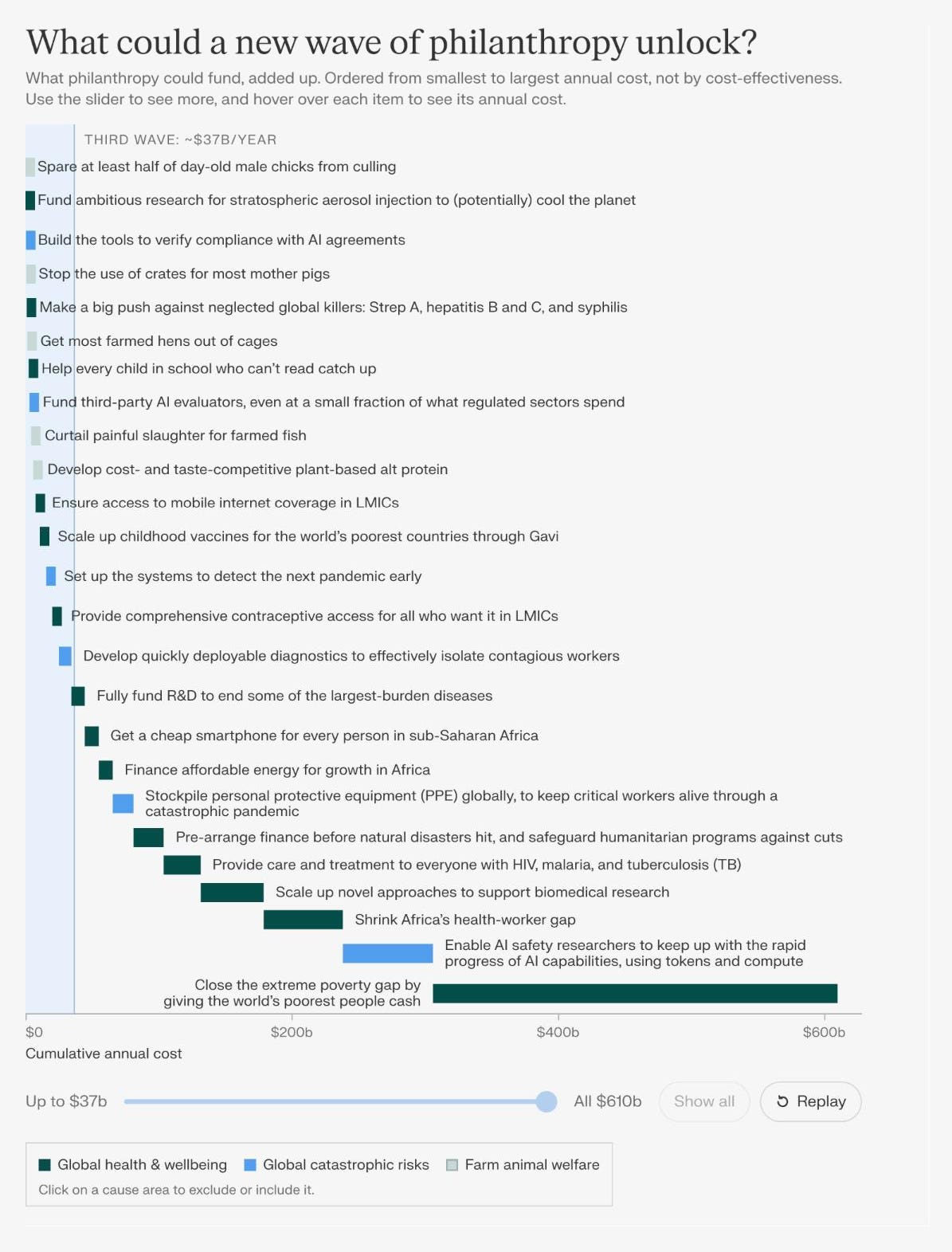
This list, of course, is far from exhaustive and is just a rough sample of good things philanthropy could do that happened to already be on our (limited) radar. We think of it as illustrative and wouldn’t want to confidently stand behind every cell here being correct.[3] In the aggregate, we think these would cost nearly $610 billion per year — more than 15x what Nan’s blog post anticipates, nearly equivalent to all U.S. philanthropy today, but still only half a percent of nominal world output.
Max Roser of Our World in Data wrote a post in 2018 that we all love, titled “The world is awful. The world is much better. The world can be much better.” We think about the prospect of increased giving in a similar way: the third wave is big; the third wave is small; there’s a lot the third wave can do.
Here are some ideas for problems philanthropy could help meaningfully address, with coarse estimates of the resources needed:[4]
Listed in order of largest to smallest estimated annual cost. The small number next to each cost is a footnote explaining how we estimated it. Cause areas: GHW is global health and wellbeing, GCR is global catastrophic risks, FAW is farm animal welfare.
| Area | What philanthropy could fund | Why it’s good | ~Cost/year |
|---|---|---|---|
| GHW | Close the extreme poverty gap by giving the world’s poorest people cash | There are approximately 847 million people living below the World Bank’s extreme poverty line. Despite rapid progress over the past 25 years, global poverty reduction has effectively stalled. Providing cash directly to people living below this basic level of consumption would move virtually all of them out of extreme poverty (although just to what’s still a very low consumption level), providing them resources for whatever they wanted to use them for. | $300b/yr[5] |
| GCR | Enable AI safety researchers to keep up with the rapid progress of AI capabilities, using tokens and compute | The increasing automation of frontier AI research creates both a challenge and an opportunity for third-party safety researchers. Those doing incident detection, auditing, and neglected alignment research will need to move much faster to keep pace with progress in AI capabilities. At the same time, similar to frontier labs, third parties could massively speed up their research with access to compute and tokens. Giving them enough resources to conduct experiments and evaluations at a comparable scale to frontier labs would require billions of dollars annually. | $68b/yr[6] |
| GHW | Shrink Africa’s health-worker gap | The WHO and African Union project Africa will need more than 6 million more health workers in the coming years to deliver essential care to everyone who needs it. While there are other constraints to providing care (e.g. cheap drugs) and to scaling up the workforce itself (e.g. training skilled personnel), paying salaries is one of the most direct ways to turn money into care quickly, and to incentivize people to become medical professionals. | $60b/yr[7] |
| GHW | Scale up novel approaches to support biomedical research | The National Institutes of Health (NIH) is the world’s largest public funder of biomedical research, at ~$47.5b/year. It’s an essential institution, but its core model — peer-reviewed project grants to academic labs — has barely changed in decades. Philanthropy could establish a parallel and complementary scientific grantmaking architecture at NIH scale to spearhead novel approaches: expected value peer review, angel investing, focused research organizations, institutional regrantors, fast grants. This less centralized system would test which processes produce more discovery and diversify the funding base for biomedicine. | $47b/yr[8] |
| GHW | Provide care and treatment to everyone with HIV, malaria, and tuberculosis (TB) | TB, malaria, and HIV kill ~2.5 million people a year and cause ~140 million disability-adjusted life years (DALYs), more than any other infections. Despite proven, cost-effective technologies (like insecticide-treated nets) and new treatments coming online (like lenacapavir, a twice-yearly HIV pre-exposure prophylaxis), health systems often are constrained by the resources to deploy and deliver them — which philanthropy could help deliver through existing institutions, like the Global Fund. | $28b/yr[9] |
| GHW | Pre-arrange finance before natural disasters hit, and safeguard humanitarian programs against cuts | Humanitarian aid has dropped by almost one-third since 2023; only 35% of the UN humanitarian appeal was funded in 2025. But even before the cuts, most aid arrived late and was committed a year at a time. Donor governments should reverse cuts to humanitarian aid and scale up responses to meet needs. But philanthropy is well placed to help: it can move quickly, and it isn’t tied to annual budgets or political cycles. Around one-fifth of humanitarian needs come from shocks, like droughts and floods, whose exact nature and timing is uncertain, but that they’ll happen is relatively predictable — yet less than 1% of aid is set aside to act before they hit. And acting early saves lives: in Bangladesh, families who got cash before a flood peaked were far less likely to go a day without eating. Most other needs come from crises that go on for years, where funding swings from year to year, making programs less cost-effective. Guaranteeing funding for essential multi-year programs, by topping up what donors give and holding a reserve for sudden cuts, would let responders plan ahead and avoid inefficient and life-threatening stop-start costs. | $23b/yr[10] |
| GCR | Stockpile personal protective equipment (PPE) globally, to keep critical workers alive through a catastrophic pandemic | While most people can effectively eliminate their exposure during a severe pandemic through isolation, some workers need to be in shared indoor spaces with potentially infectious colleagues to keep society running. If a pandemic kills or incapacitates much of the workforce that keeps power, food, transport, and communications running, it could become severe enough to threaten civilization writ large. If all of them consistently used high-performing PPE and other equipment, ongoing workplace transmission could be completely blocked for any possible airborne pathogen. While high levels of adoption require public buy-in and worker training, the most serious gap is simple physical availability; there are not enough respirators, for instance, to cover the critical working population in the U.S. or most other countries. But reusable respirators can be bought ahead of time, stored for 5-10 years or longer, and can be used for more than a year, meaning pandemic supplies won’t rely on ongoing production and fragile supply chains. Critical workers could also be protected with portable air cleaners, pathogen-agnostic tests, and kits that turn ordinary rooms into pressurized bioshelters. | $16b/yr[11] |
| GHW | Finance affordable energy for growth in Africa | Africa has a fifth of the world’s people but gets less than 3% of energy investment, and capital costs 2-3x what it does in rich countries. Unreliable power is a major constraint to growth, and therefore to reducing poverty and improving wellbeing: 41% of firms say insufficient electricity is a major impediment, and outages average more than 50 hours/month. Ensuring more reliable power for businesses has large economic returns. The International Energy Agency assesses Africa’s electricity system needs as ~$120b a year by 2030. Even if much of that eventually comes from private investment, cheap, patient capital is necessary, especially in low-income settings, to fund grid upgrades, new generation, and storage. That money goes furthest alongside reforms that put utilities on a sound financial footing. | $11b/yr[12] |
| GHW | Get a cheap smartphone for every person in sub-Saharan Africa | ~820 million people in sub-Saharan Africa live within broadband coverage but don’t have a device to benefit from it (i.e. the “usage gap”). Previous randomized controlled trials (RCTs) have found meaningful consumption increases from increased handset access in low-income settings. Plausibly, access to the internet (and, through it, AI tools and services) will be increasingly important to economic opportunity in the near future, as AI capabilities continue to develop and shape the global economy. | $10b/yr[13] |
| GHW | Fully fund R&D to end some of the largest-burden diseases | At current trends, HIV, TB, and malaria are projected to still cause 82.7 million DALYs in 2050. New tools — vaccines, long-acting prevention, shorter treatments, better diagnostics — are the main route to ending these epidemics more quickly. | $10b/yr[14] |
| GCR | Develop quickly deployable diagnostics to effectively isolate contagious workers | Keeping contagious workers out of critical workplaces can effectively cut transmission among the people who keep society running; in a fast-moving outbreak, this capability could be needed within weeks. The U.S. didn’t approve its first rapid antigen test until four months after the SARS-CoV-2 genome was published, and mass home testing wasn’t available for more than a year. This problem can potentially be resolved through a combination of R&D to identify faster-to-scale binders for rapid tests, stockpiling pathogen-agnostic consumables like swabs, and expanding PCR and sequence capability and sample collection and distribution infrastructure to enable overnight testing, while self-administered rapid tests are developed. | $9.3b/yr[15] |
| GHW | Provide comprehensive contraceptive access for all who want it in LMICs | Contraception lets women decide whether and when to have children. Fewer unintended pregnancies also mean fewer maternal deaths and unsafe abortions. | $5.1b/yr[16] |
| GCR | Set up the systems to detect the next pandemic early | During the exponential growth phase of a novel pathogen outbreak, even a few days or weeks of earlier warning can make the difference between containing transmission through interventions like PPE and diagnostics and allowing an outbreak to spread uncontrollably. Detection isn’t enough to trigger effective mitigations on its own, as we need pathogen sequences and accurate forecasts. To accomplish this, we think the highest-leverage bet is to perform routine metagenomic sequencing of diverse samples from wastewater, community nasal swabs, emergency department visits, and blood banks, capturing pathogens that shed in different amounts and have different transmission characteristics. | $4.7b/yr[17] |
| GHW | Scale up childhood vaccines for the world’s poorest countries through Gavi | Gavi buys vaccines for the world’s poorest countries and, depending on the vaccine, the Center for Global Development (CGD) estimates it is up to 10x more cost-effective than giving cash to people in extreme poverty. Yet Gavi faces a funding shortfall — and could in fact scale up further beyond current plans to address malaria, HPV, and other burdensome diseases, given the resources. | $4.5b/yr[18] |
| GHW | Ensure access to mobile internet coverage in LMICs | More than a quarter of the world’s population doesn’t use the internet. Yet broadband coverage, in particular, has been shown to boost consumption and reduce poverty — e.g. quasi-experimental studies in Nigeria, Senegal, and Tanzania found income gains of 6-14% from gaining network access. Network expansion doesn’t solve the entire connectivity challenge, which also includes device affordability and digital literacy, but would go a long way. | $3.3b/yr[19] |
| FAW | Develop cost- and taste-competitive plant-based alt protein | Alternative protein products that are just as tasty and cheap as conventional meat could displace a meaningful share of factory farming, reducing animal suffering and climate change impacts. A sector-scale program to get alt protein projects like a plant-based chicken breast (a very popular product in high-income countries) to taste and retail-price parity could help propel this shift. | $2b/yr[20] |
| FAW | Curtail painful slaughter for farmed fish | Of the ~130 billion farmed fish killed each year, nearly all of them die by suffocation in air or ice slurry, or are gutted alive. Stunning could reduce this suffering significantly, with further work needed to validate methods for many species. Current aquaculture certification commitments to use stunning cover ~1.2 billion fish a year, with full implementation expected over the coming years. | $1.5b/yr[21] |
| GCR | Fund third-party AI evaluators, even at a small fraction of what regulated sectors spend | Independent evaluators who test if AI systems may pose chemical, biological, radiological, or nuclear (CBRN) risks or slip out of human control collectively spend in the tens of millions of dollars a year. The companies they assess earn more than $100b annually and are worth trillions. Aviation, pharmaceuticals, and nuclear power fund their safety regulators at between roughly 0.5% and 2.5% of industry revenue. A pooled fund at the low end of that level could support thousands of evaluators focused on risk assessments and provide ample compute budgets for experiments. | $1b/yr[22] |
| GHW | Help every child in school who can’t read catch up | About 70% of 10-year-olds in LMICs can’t read and understand a simple text, yet most of them attend school. “Teaching at the Right Level” groups children by ability rather than age for part of the school day, works through existing teachers, and has produced some of the largest learning gains of any rigorously evaluated education program, at <$10/child/year. | $800m/yr[23] |
| FAW | Get most farmed hens out of cages | There are about as many laying hens alive at any time as people on earth (~8.2 billion); the vast majority of them (~85%) are in wire cages with less floor space each than a sheet of A4 paper. They’re unable to walk, spread their wings, nest, or perch. Advocates have so far helped get ~300 million hens out of cages. This has helped the U.S. reach ~47% cage-free and Europe 64%. | $750m/yr[24] |
| GHW | Make a big push against neglected global killers: Strep A, hepatitis B and C, and syphilis | Strep A, hepatitis B and C, and syphilis kill ~1.8 million people a year, plus syphilis causes ~150,000 stillbirths — together, more than TB, HIV, or malaria causes on its own. But there’s still no vaccine for Strep A, hepatitis C, or syphilis, and the best hepatitis B drug, just approved in the U.S. in October 2026, cures only about 1-in-5 patients. Even where cheap tools exist, few people get them: fewer than 5% of people with hepatitis B are on treatment, and ~700,000 babies a year are born with syphilis, even though a test costs ~$0.35 more than the HIV test already given in antenatal care, and penicillin costs under $0.50 a dose. A serious push on vaccines and cures could help end these diseases, and since late-stage trials take years of enrolling and following up patients, funding them now speeds up approval even if AI rapidly accelerates research. | $550m/yr[25] |
| FAW | Stop the use of crates for most mother pigs | Most of the world’s 90 million breeding sows spend much of their lives (a 115-day pregnancy, twice a year) in a crate too narrow to even turn around in. Advocacy helped win EU rules in 2013 that limit how long pregnant sows can be crated, and more recent campaigns have moved ~1 million sows into group housing during pregnancy in Brazil, China, and the U.S. | $500m/yr[26] |
| GCR | Build the tools to verify compliance with AI agreements | When competing AI developers agree that costly safety protocols are good for everyone, verification technology can allow them all to follow those protocols without sacrificing their competitive positions. Without verification technology, it’s hard to prevent a race to the bottom, or to slow down if critical safety problems remain unsolved. Another benefit of this technology is greater confidence and security over how compute is being used, making it much more difficult for an internal AI or a human threat to run secret workloads. | $300m/yr[27] |
| GHW | Fund ambitious research for stratospheric aerosol injection to (potentially) cool the planet | Stratospheric aerosol injection could cool the planet quickly and cheaply, but nobody knows enough to decide whether to do it — including how the particles behave, how they spread around the globe, and what side effects they may have. | $140m/yr[28] |
| FAW | Spare at least half of day-old male chicks from culling | Most male layer chicks are killed (~7.5 billion/year) within hours of hatching because they serve no commercial purpose. Most are macerated or gassed. Technology now exists to identify males inside the egg before they hatch via in-ovo sexing. Thanks to in-ovo sexing and bans on chick culling in Germany and France, more than 100 million male chicks a year are spared from slaughter. The technology is now being used in countries in the Americas and Asia. | $50m/yr[29] |
The list may seem daunting, but it’s long because the world is a big place with lots of challenges. This year, some 4.5 million kids will die before they turn five; roughly 23 billion land animals will live in factory farms at any time; and AI capital expenditures will outstrip safety spending by over a hundred times.
Progress is possible, however, and philanthropy can be part of the story. In 2010, around 827,000 people died of malaria; by 2023 that number had fallen almost 20% despite rapid population growth in exposed areas, as insecticide-treated bednets and other solutions were scaled up, in part through philanthropic funding. In 2014, only 6% of U.S. layer hens were cage-free; in 2024 it was more than 40%, after a sustained pressure campaign. And as the risks of AI become more evident, they’re now openly discussed by the U.S. and Chinese governments, the UN, and even the pope — marking a big shift from being seen as a niche and esoteric concern when we first started getting involved in 2015.
There are some practical near-term barriers to scaling up quickly, of course. It takes time to hire staff, develop more ambitious plans, and execute new programs. But we don’t think donors should worry that the social returns on new funding will fall off a cliff.
To illustrate this, consider a basket of global health spending focused on tackling the largest disease burdens in low- and middle-income countries: essential nutrition, childhood vaccines, and proven prevention and treatment tools for malaria, TB, and HIV. Major funders in these areas spend about $18 billion annually today, and based on their own estimates are saving nearly 3 million lives each year.[30] They also think there’s much more to do, and have developed detailed plans for deploying more resources, like the Global Plan to End TB and the Immunization Agenda 2030. Nan’s estimate of new philanthropy — $37 billion a year — if all directed to global health could come close to fully funding these five plans, which total about $42 billion annually. A crude estimate based on the modeling in these plans, with some adjustment for likely over-optimism, is that funding them could save more than 2 million additional lives each year.[31]
This scale of impact is broadly consistent with our expectation for declining marginal returns: as health funding scales, we expect the cost of saving a life to get higher, but not dramatically so. In 2021, we wrote a post about how we thought GiveWell’s opportunity set would change with scale. At the time, we very roughly modeled a doubling of expected funding as reducing marginal cost-effectiveness by about one-quarter.[32] When we try to extrapolate to bigger changes in funding levels on today’s margin, our rough best guess would be that each doubling of spending reduces marginal cost-effectiveness by a bit more than one-third, and a conservative estimate would be that doubling spending halves marginal cost-effectiveness.[33]
“There are some practical near-term barriers to scaling up quickly, of course. It takes time to hire staff, develop more ambitious plans, and execute new programs. But we don’t think donors should worry that the social returns on new funding will fall off a cliff.”
So, we expect that even if the third wave was as big as Nan’s base estimate and it all went to global health, additional funding could still save a life for perhaps 2-3x today’s cost. At our 2021 estimate of diminishing returns, the whole third wave going to global health could save ~2.6 million lives a year; at our current estimate, ~2.2 million lives; and with a more conservative bound we project saving ~1.8 million lives annually.[34]
So if the third wave were all directed to global health, it could save many tens of millions of lives over the coming decades. And as philanthropy scales, yes, marginal cost-effectiveness will decline, but steadily rather than sharply, and it will remain outstanding in objective terms.
The size of these problems — and the cost of addressing them — can make anyone feel insignificant. Even for the world’s wealthiest people, fully addressing even one of the highest-priority or most fixable problems often requires more than their entire net worth, which is a major motivator for our model of charitable funds with multiple major donors.
But looking at these challenges in a large table also underplays the value of incremental progress. All of us are donors to GiveWell, who identify highly cost-effective opportunities for individual donors — and estimate that they can, very roughly, save a life for $3,500-5,500 through supporting one of their top charities.
Beyond GiveWell, there are several items on our list for which giving can scale incrementally today, including through organizations like GiveDirectly, Gavi, the Global Fund, the Animal Welfare Fund, Longview, and others. Whether someone is giving $100, $1,000, $1 million, or $1 billion, there are good ways to spend that money right now.
Yet there are other challenges for which we need dramatically scaled-up or even entirely new institutions to absorb an influx of new philanthropy. Scaling programs to eventually spend $100 billion per year or more, if the third wave gets that big — equivalent to more than 10 Gates Foundations — would take time and demand careful attention to cost-effectiveness. And this problem may be particularly acute for AI safety, where a lot of third-wave donors may focus and the existing infrastructure is smaller and newer. But part of the promise of the third wave is the opportunity to build infrastructure that can solve problems that aren’t easy for donors to address — similar to the creation of Gavi and the Global Fund a generation ago. (And both could still use more resources today; Gavi came $2.5 billion short of its 2025 replenishment target, with opportunities to scale well above that.)
“Part of the promise of the third wave is the opportunity to build infrastructure that can solve problems that aren’t easy for donors to address — similar to the creation of Gavi and the Global Fund a generation ago.”
We’re already trying to address a small piece of this. Our closest funding partner, Good Ventures, has dramatically expanded their giving this year — with one explicit goal being to help scale up cost-effective organizations and initiatives, so that good projects are shovel-ready when a third wave lands. In 2025 we deployed more than $1 billion for the first time in our history, and in 2026 we expect to at least triple that. This includes some big new efforts: We’re seeking proposals for new or scalable funds tackling important, underfunded problems in global health and wellbeing and we put out a call for ambitious AI safety initiatives.
But this is a massive project. Donors, funders, and implementers can and should all think in new ways about, not just what the next dollar can most effectively achieve, but what the next $100 billion (or more) can unlock that didn’t seem possible before.
With thanks to Abbey Chaver, Matt Clancy, Amanda Glassman, Ben Goldhaber, Martin Gould, Darius Meissner, Tanae Rao, Adin Richards, Christian Ruhl, Jason Schukraft, James Snowden, Elbert Ventura, Hannah Yang, and other CG colleagues for input, plus anonymous external reviewers.
In the circles we tend to be in, that is. Viral enough, at least, to prompt a couple New York Times op-eds in response, including a Gilded Age-inspired call to spend the money on “monuments, statues, museums, universities, cathedrals, public gardens.” We think there are some better options!
This wasn’t the message of the original post itself, and in other quarters this may seem strange — that in a time of rising prices and reduced public investment and international aid, that there aren’t many worthy causes an influx of philanthropy could readily support. We tend to agree! But we think it’s helpful to be concrete about where money could go, why, through which channels, and what the challenges to rapid scale-up may be.
In addition to not differentiating by cost-effectiveness, the table also mixes costs in several ways: It spans our worldviews (global health and wellbeing, farm animal welfare, and global catastrophic risks). It includes some ongoing flows (e.g. closing Gavi’s annual funding gap) and some items that are one-off stocks (e.g. stockpiling PPE for critical workers). By default, we amortize the latter over 10 years, with a few exceptions (e.g. for certain big farm animal welfare campaigns, we think getting to scale will take longer, so we amortize over 30 years). A number of these costs also potentially overlap (e.g. cash transfers could be used by recipients on smartphones or healthcare), but many are also complementary. In some cases, organizations exist that could scale up relatively quickly; in others, new institutions would probably be needed. This list includes efforts we fund, are currently investigating, and things we haven’t looked into closely but may in the future. We don’t intend this to be a statement on the cost-effectiveness of these particular interventions, compared to one another or to items not on the list — just an illustration that there are lots of big problems worth solving and tangible ways philanthropy could help do so at scale. All costs are converted to 2026 $US. We round to two significant figures throughout.
Throughout this post we rely mostly on third-party estimates of costs and benefits. In a few cases, we use our own internal estimates. All of these should be treated as very rough. They’re not as thoughtful or careful as the type of research we use in our own grantmaking.
We use the ~$300b per year estimate from the recent Sahoo et al. (2026) paper, which estimates that a real-world effort to provide cash transfers to the poorest would cost approximately 4x as much as if there were perfect information on exactly the people living in extreme poverty. Sahoo et al. produce their estimates on the basis of 34 countries with representative household consumption surveys accounting for 76% of people living in extreme poverty; $304b is a global extrapolation. Rather than strictly ending extreme poverty, they model a reduction to 1% (from approximately 10% today). It is also based primarily on the prior $2.15/day poverty line, so closing the full gap to the current $3/day line would be substantially more expensive.
Compute budgets are fuzzy, but OpenAI projects ~$50b of compute spend in 2026, perhaps half of it R&D (based on last year’s split); Anthropic’s compute is growing so fast it’s hard to track, but Q1 2026 spend implies ~$31b for the year, with ~60% R&D. Overall, Big Tech — Microsoft, Alphabet, Amazon, Meta, and Oracle — AI capex is ~$660-690b. As a benchmark, we simply take 10% of this number.
The WHO projects a shortage of ~5.3m doctors, nurses, midwives, and dentists by 2030. At the report’s median salaries (~$9k on average, weighted by occupation), that’s ~$55b/year. We add ~1m community health workers (CHWs), the gap between the African Union’s 2m CHW target and current staffing levels, at ~$4,300/CHW — for another ~$4b/year. This counts salaries only and excludes training, as well as facility costs, equipment, commodities, etc.
We simply estimate this based on the size of the NIH itself. Total fiscal 2026 enacted program funding was ~$47b. The idea draws on Nielsen & Qiu (2022), who argue the way science gets done is sclerotic, dominated by a few large organizations that struggle to change themselves, and propose a $10b endowed “printing press for funders” to spin out new funders and increase the structural diversity of scientific research.
The WHO and UNAIDS put the annual costs of fully scaled responses across the three diseases at ~$57b, against ~$29b currently available (TB, malaria, HIV). This need could grow, though, as baseline funding doesn’t fully capture the impact of recent aid cuts; the Global Fund’s 2026-2028 replenishment, alone, fell ~$1.8b/year short.
We take the average of UN humanitarian appeal requirements over the last 10 years (2017-2026): ~$47b/year. About 20% of that (~$9b/year) comes from highly predictable shocks; we count it as the cost of pre-arranging early action, less the ~$300m/year already set aside for that. For the rest, we focus on essential programs: in its last two appeals, the UN prioritized about two-thirds of requirements as most life-threatening, or ~$25b/year of the remaining need. Donors gave ~$14b toward that in 2025, so topping it up costs ~$12b/year. We add a reserve that could protect those programs against a major cut, like 2025’s (34%), for one year: ~$9b upfront, plus ~$1.4b/year on average to refill it, since funding to appeals fell by ~5%/year on average over the past decade. Together that’s ~$23b/year.
These are rough estimates from our Biosecurity & Pandemic Preparedness team. This would include $100b for powered air-purifying respirators, ~$35b for pathogen-agnostic components for a month of rapid diagnostics, and ~$20b for elastomeric respirators (assuming, e.g. ~$20-30/unit, ~$1/year for storage, $4/unit workplace training, and ~375m critical workers around the world). Production capacity would need to be expanded quickly to produce these at scale, and so could be a near-term constraint.
The IEA estimates that Africa needs ~$30b/year of concessional finance through 2030 (grants, cheap loans, guarantees) for clean energy, out of the $120b/year total need. We subtract the ~$2.4b/year that advanced economies have given Africa’s energy sector on average over the past decade, leaving a gap of ~$27.6b/year. Since most of that money is lent or guaranteed rather than given away, we only count the subsidy part as the cost: ~35%, between the 25-30% reserve the IEA says guarantees require and the 45% minimum grant element for aid loans to low-income countries. That comes to ~$11b/year.
We assume $50/phone for the roughly 820m people living in areas with broadband access but without a connected device. We assume each phone is replaced every four years.
The Stop TB Partnership’s Global Plan is a fully costed R&D agenda for TB; while there are technical plans for malaria and HIV, there isn’t a similar model for scaling up R&D. Taking the TB plan as a guide, though — which envisions R&D funding of $220/projected 2050 DALY, against ~$35/2050 DALY today — we can estimate the cost of a full-scale research agenda for these three major health risks in LMICs, using current spending from G-FINDER and NIH. To close the gap would require roughly tripling spending, from ~$5b to ~$15.4b/year, or an extra ~$10b.
According to rough estimates from our Biosecurity & Pandemic Preparedness team, R&D could absorb $50-100m (~5-10 efforts of ~$10m); stockpiling a month’s worth of rapid diagnostic consumables for the U.S. could cost ~$2-4b (30m critical workers x 30 days ≈ 1b tests, where the pathogen-agnostic consumables cost ~$2-4) and $20-80b for the world (~10-20x more critical workers than the U.S.). Expanding U.S. PCR and sequencing capacity might take ~$2b upfront and possibly ~$3-7b/year.
We use estimates from Guttmacher Institute’s “Adding It Up” (2025). They estimate 928m women in LMICs who wish to avoid pregnancy, of which 78m are not using modern contraception, with the result of 96m unintended pregnancies each year, nearly half of all pregnancies in these countries. The Guttmacher Institute estimates meeting everyone’s needs would cost ~$5.1b/year, or ~$60 a year for each newly served woman.
A major U.S. surveillance system could sample wastewater from ~400 major metropolitan catchments 3x/week (~60k samples/year). Collection, processing, and deep metagenomic sequencing might cost ~$1.5-3k/sample, or ~$100-200m/year. Sequencing another ~1-2m clinical and community samples annually (including respiratory swabs and blood), using pooling where appropriate, may cost ~$50-100/sample, adding ~$50-200m/year. Additional spending on laboratories, rapid sample transport, bioinformatics, confirmatory sequencing, and reporting could bring the U.S. total to ~$200-500m/year. Expanding surveillance to international sites might bring the total to ~$1-5b, with room to grow. This relies on rough estimates from our Biosecurity & Pandemic Preparedness team.
Gavi’s 2026-2030 budget of $11.9b came up $2.5b short at the 2025 replenishment (~$500m/year). Beyond Gavi’s current plans, CGD has also proposed a set of scaled-up interventions: a malaria vaccine catch-up for 45m under-3s plus every new birth cohort at $28/child; an HPV vaccine for 112.5m unvaccinated girls plus new cohorts at $10/child; and a rotavirus, pneumococcal, and typhoid package for 100m children at $24/child. Net of Gavi’s existing malaria and HPV plans, that comes to ~$3.4b/year. In addition, paying parents $2 per visit would help keep ~30m children born each year on the vaccine schedule, totaling ~$600m/year, focused on India, Indonesia, and Tanzania (where electronic vaccine registries allow quick scaling, reaching ~one-quarter of births in LMICs). The scale-up estimates take into account malaria (~10m) and HPV (~24m) vaccine coverage already planned in Gavi’s full replenishment ask.
Some 270m people (~3% of the world) live outside mobile broadband coverage: ~180m have no mobile network at all, and ~90m have 2G only. Building ~82.5k new rural cell sites (assuming ~2k people served/site) at ~$145k each and upgrading ~40k 2G sites at ~$45k each, would cost ~$13.8b in capex, plus ~$1.6b/year to operate.
There are no published estimates of the resources needed to bring to market a plant-based chicken breast product that has taste and price parity. Based on rough estimates from our Farm Animal Welfare team, $2b/year over 10 years could significantly increase the chances of this type of breakthrough. Funding would go toward R&D to take all major structuring routes to reduce costs, bring down ingredient costs, and test and iterate with consumers on products. Then, funding could be used for demonstration plants to test production at scale and providing commercialization support.
We estimate that ~$1.5b a year in advocacy, over 30 years, would achieve stunning for ~50% of farmed fish. These are rough estimates from our Farm Animal Welfare team, extrapolating from the cost of fish welfare campaigns to date and assuming advocacy costs per fish helped rise as campaigns move to species where validated stunning methods don’t yet exist and which are not currently covered by aquaculture certification schemes.
The Federal Aviation Administration’s aviation safety arm is ~0.7% of U.S. airline revenue, the Food and Drug Administration ~1.5% of U.S. prescription drug spending, and the Nuclear Regulatory Commission ~2.4% of U.S. nuclear generation revenue. Applying just the low end of that range (~0.7%) to the $130b combined annualized revenue of OpenAI and Anthropic gives $1b. The tens of millions for the spend of independent AI evaluators is a rough estimate using public funding announcements. It covers organizations focused on catastrophic risks, not the larger commercial market for general AI testing or companies’ in-house safety teams. This is based on rough estimates from our Navigating Transformative AI team.
UNESCO estimates 262m in-school primary-age children fall below minimum reading proficiency. A catch-up for every non-reader would cost ~$2.6b one-off at $10/child, plus ~$600m/year to reach each new cohort, or only ~$800m/year over a decade.
We estimate it would take further sustained advocacy, costing ~$750m/year for 30 years (~$23b), for 80% of hens worldwide to be permanently removed from cages. These are rough estimates from our Farm Animal Welfare team, extrapolating from the cost of cage-free campaigns to date and assuming advocacy costs per hen helped rise as a greater share of campaigning takes place in economies where retail and food service industries are more fragmented.
For vaccines and cures, we use the WHO/Duke P2I model’s average costs and chances of success by product type and current stage, which gives the expected cost of getting one product approved: ~$2.2b each for a Strep A and a hepatitis C vaccine (nothing like them has been approved before, and both are in Phase 1), and ~$250m for a better hepatitis B cure (combinations are in Phase 2). A syphilis vaccine is further off, so we cost taking one candidate through early trials (~$90m), which comes to ~$4.8b. Alongside that, for syphilis testing and treatment today, which on its own can avert many deaths, we estimate technical assistance to procure tests, improve policies, and train health workers costs ~$0.60/birth, or ~$683m to cover the 120m+ births in all LMICs over 10 years. Together, that’s $550m/year.
We estimate it would take ~$500m a year for 30 years (~$16b total) to ensure 80% of sows are no longer crated. These are rough estimates from our Farm Animal Welfare team, extrapolating from the cost of crate-free campaigns to date and assuming advocacy costs per sow helped rise as campaigns expand into countries where this advocacy is in its infancy.
Our Navigating Transformative AI team estimated the cost of engineering necessary to research, develop, and produce solutions that can work at frontier scale, based on a “portfolio bets” approach that seeds many efforts in parallel. We expect to need teams with expertise in cryptography, frontier machine learning, formal verification, nation-state security, and AI accelerators and networking. There are a few problems to solve: allowing AI developers to declare their tasks so they can be privately checked for compliance; verifying with high security that the tasks were performed as declared, without revealing anything sensitive; and verifying that no undeclared tasks were covertly performed.
The non-profit org Reflective has laid out a stage-gated research roadmap: existing evidence, small outdoor experiments, global distribution tests, monitored cooling. Their estimated cost is $370m-$1.36b, and they expect to take 10-22 years in total. We take the high end because running research in parallel to hit the fast timeline is the more expensive path.
We estimate that, at a cost of ~$50m a year, 80% of male chicks worldwide can be spared. These are rough estimates from our Farm Animal Welfare team, extrapolating from the cost of technology refinement, industry outreach, and campaigns to date. This assumes advocacy costs per chick rise as adoption moves into less technologically developed markets.
The total spend estimate (~$17.5b) reflects the sum of 2024 spending by Gavi, the Global Fund, the Gates Foundation, UNICEF (for child nutrition), major U.S. bilateral initiatives, and GiveWell in five areas — HIV (~$8.5b), vaccines (~$3.3b), malaria (~$2.6b), TB (~$1.9b), and nutrition (~$1.3b) — as recorded in IHME’s Development Assistance for Health database, plus for GiveWell its 2024 metrics, all converted to 2026 dollars, as described in this sheet. For lives saved, we divide the area total by the geometric mean of high and low estimates of cost-per-life-saved, as on this sheet, getting a total of 2.9m lives saved per year. The figures predate the 2025 aid cuts and exclude domestic and out-of-pocket spending. This is of course a very rough, illustrative model.
This is based on each area’s global plan: WHO’s Global Technical Strategy for malaria, the Global Plan to End TB (as costed by Pretorius et al. 2023), UNAIDS’s Global AIDS Strategy (Stover et al. 2025), the Immunization Agenda 2030 (Sriudomporn et al. 2023; Carter et al. 2024), and the World Bank’s Investment Framework for Nutrition, and the math is in this spreadsheet.
That is, we modeled the GiveWell opportunity set as isoelastic with eta = .375, implying that a doubling of expected funding should reduce marginal cost-effectiveness by 23% (1 – 2-.375 ≈ 23%). That was based on fitting isoelastic curves to projections GiveWell had performed, though they were very uncertain about those projections and wouldn’t want to independently defend them. Here, the estimates are in terms of cost per life saved for comparability with non-GiveWell-produced estimates.
Our rough best guess of eta ≈ 0.65 comes from very roughly fitting a curve across health spending in the five areas above (HIV, malaria, TB, vaccines, nutrition), in three segments (current, the plans mentioned above, last-mile spending to 95% burden reduction). Under eta ≈ 0.65, each doubling cuts marginal cost-effectiveness by ~36% (1 – 2-.65). Eta ≈ 0.65 also roughly splits the difference with eta = 1, which we use as a conservative bound here and implies that doubling spending halves marginal cost-effectiveness. One caveat is that the 2021 fit was to GiveWell’s whole opportunity set, which values income gains plus lives saved; the marginal cost-effectiveness of that mix of outcomes should diminish more slowly than a curve that only looks at a narrower set of life-saving interventions.
These are based on eta (from here using the actual letter η) = 0.375, 0.65, and 1, respectively. We model diminishing returns with an isoelastic curve: the cost, c, of saving an additional life rises with total spending, S, such that c(S) = c₀ · (S / S₀)η. If we raise spending from today’s ~$17.5b (S₀) to ~$54.5b (S₁) a year (adding the third wave’s ~$37b), and take ~$11,300 (c₀) as the approximate marginal cost now (roughly the cost per life of HIV spending, the most expensive area, in the underlying dataset), then lives saved = (S₀ / c₀) · [(S₁ / S₀)1-η – 1] / (1-η), or (S₀ / c₀) · ln(S₁ / S₀) when η = 1. That gives ~2.6m, ~2.2m, or ~1.8m additional lives a year, at each eta value.