Comments
I have cross-posted this article from RP Strategic Animal Insights, based on our presentation for the Rethink Priorities Strategic Animal Webinar Series, which happened in May 2025.
Subtitle: State of farmed animal welfare and the organizational landscape in the region
Guest authors: Aurelia Adhiambo, Moritz Stumpe
On May 12, 2025, Rethink Priorities hosted “Factory Farming in Africa,” the seventh webinar in the RP Strategic Animal Webinar series. The session featured Moritz Stumpe, Executive Director of Animal Advocacy Africa, and Aurelia Adhiambo, Senior Open Wing Alliance Africa Lead at The Humane League.
This guest post by Aurelia Adhiambo and Moritz Stumpe contextualizes and summarizes the contents of their webinar presentation. It covers the growing scale of animal farming in African countries, the state of the organizations working on the problem, and what the field would need to catch up.
The big picture
Ask anyone from the Global North to imagine animals in Africa, and they’ll probably describe a savannah of elephants, lions, and giraffes. It’s a telling reflex illustrating a similar blind spot that leads the global animal welfare funding community to direct only 1–2% of its resources toward a continent on track to become home to more farmed land animals than almost anywhere else on earth.
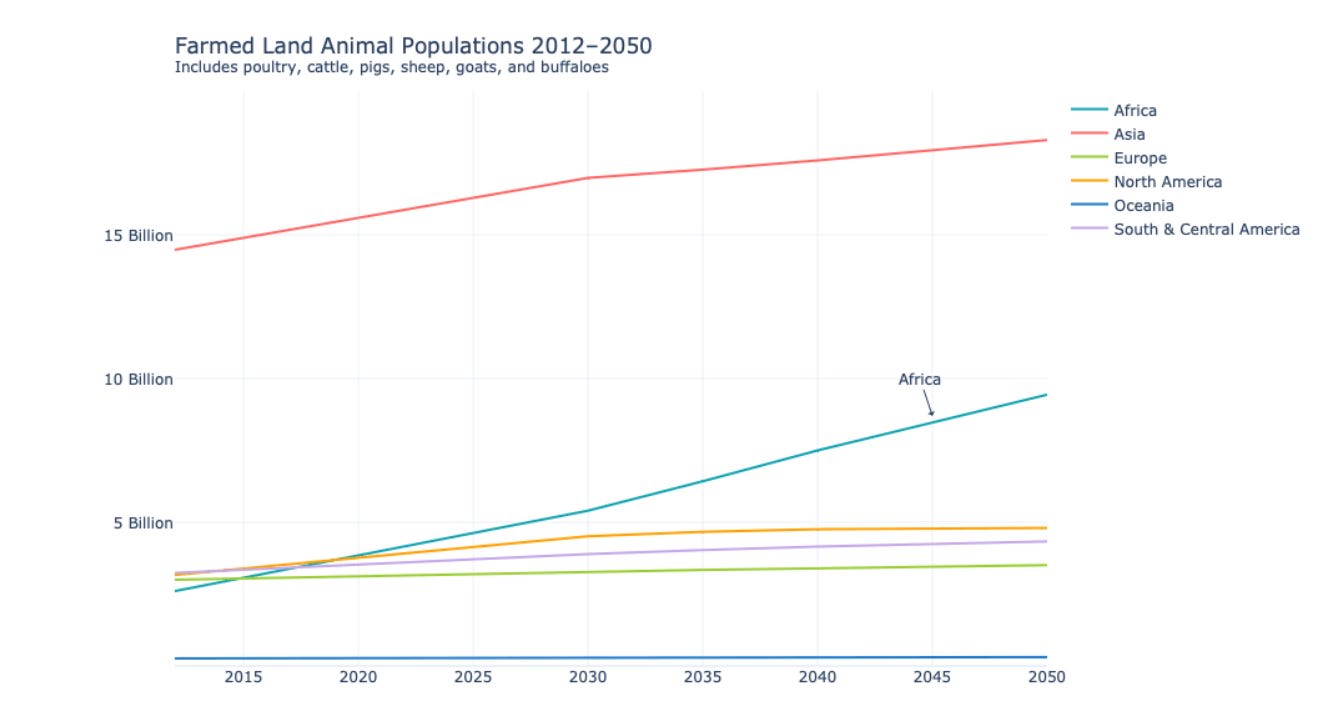
Close to 5 billion land-based animals are already farmed at any point in time in Africa, a number projected to surpass that of every other world region except Asia by 2050, and potentially sooner. The absolute increase is expected to be larger than Asia’s, meaning Africa is not just becoming one of the world’s largest sites of farmed animal production but also the fastest-growing. Two forces drive this phenomenon: population growth (Africa’s human population is expected to nearly triple by 2100) and economic growth, which translates into greater demand for animal products.
Unfortunately, the funding picture sits in stark contrast to this growth. According to a Stray Dog Institute analysis, Africa and the Middle East received approximately $7 million in funding for farmed-animal advocacy. This is in stark contrast to the more than $125 million being deployed in North America.
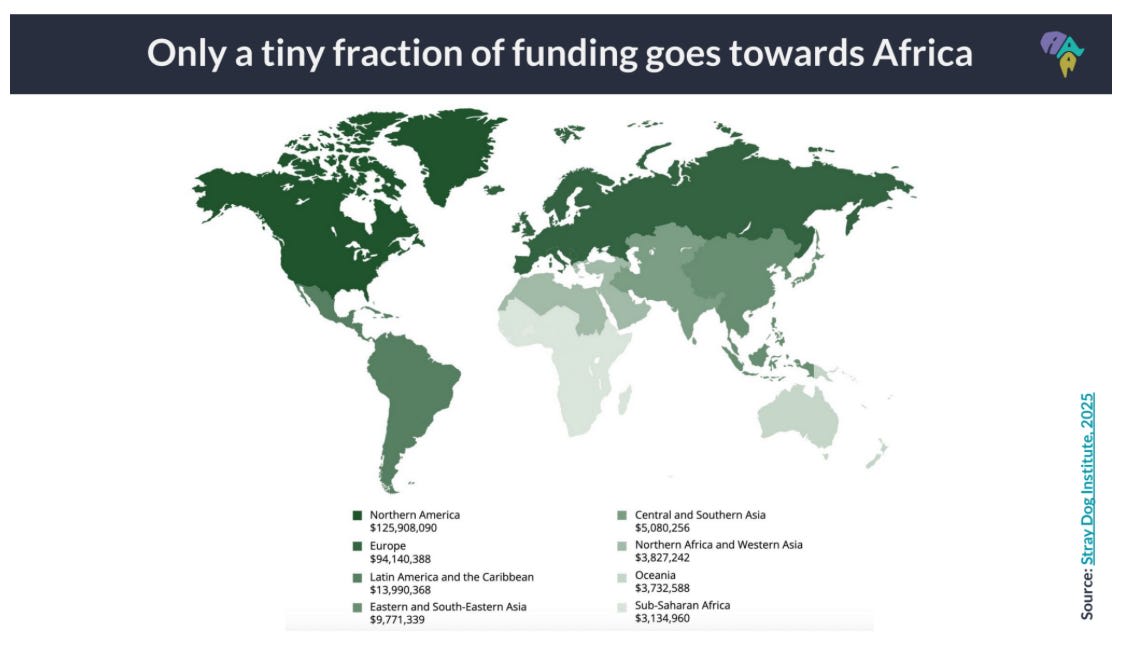
However, the trend in philanthropic funding for farmed animals in Africa is towards growth. Major funders have significantly increased their grantmaking to African organizations and projects over the last few years.
A mixed landscape with different farming systems
The monolith view causes people to miss how different the farmed animal situation is across 54 countries with their own production patterns, economic context, and advocacy landscape. Three case studies illustrate the range:
- South Africa sits at one end. It is already heavily industrialized, with around 90% of laying hens confined in battery cages (small, barren wire enclosures standard to industrial egg production) under conditions similar to those found in Europe or North America. A cage-free movement exists, some commitments have been secured, and the advocacy infrastructure is more established than elsewhere on the continent. The movement there is already playing catch-up, working to reverse an industry that has already dug in deeply.
- Ethiopia is at the other end. The country is mostly smallholder and backyard farming, with almost no industrial base yet, and even the percentage of hens currently held in cages is unknown. Barely any advocacy organizations are operating there. That absence is a problem, but it also presents a rare opportunity to intervene and shape the norms and economic incentives before industrialization takes hold.
- Nigeria sits in the middle, which makes the case for urgently growing the movement there stronger. Around 60% of laying hens, for example, are estimated to be in cages[1], and that number is climbing. The pattern documented in research is consistent: essentially every farmer who can afford cages buys them, meaning affordability is the binding constraint rather than preference, and as incomes rise across the country, more farmers cross that threshold. Nigeria is the most populous country in Africa, one of its largest economies, and the country where the question of what African factory farming will look like is perhaps most actively being decided right now. The stakes sharpened in November 2024, when JBS, the world’s largest meat processing company, signed a $2.5 billion, five-year memorandum of understanding with the Nigerian government to build six new factory farms.
These three examples show just how different regions in Africa require tailored attention, approaches, and interventions.
Which animals are most farmed in Africa?
Chickens and fish, as smaller animals, dominate production almost everywhere in Africa, but the farmed species mix varies considerably by region in ways that matter for where efforts are directed. For example, in the three example countries above, the species mix looks like this:
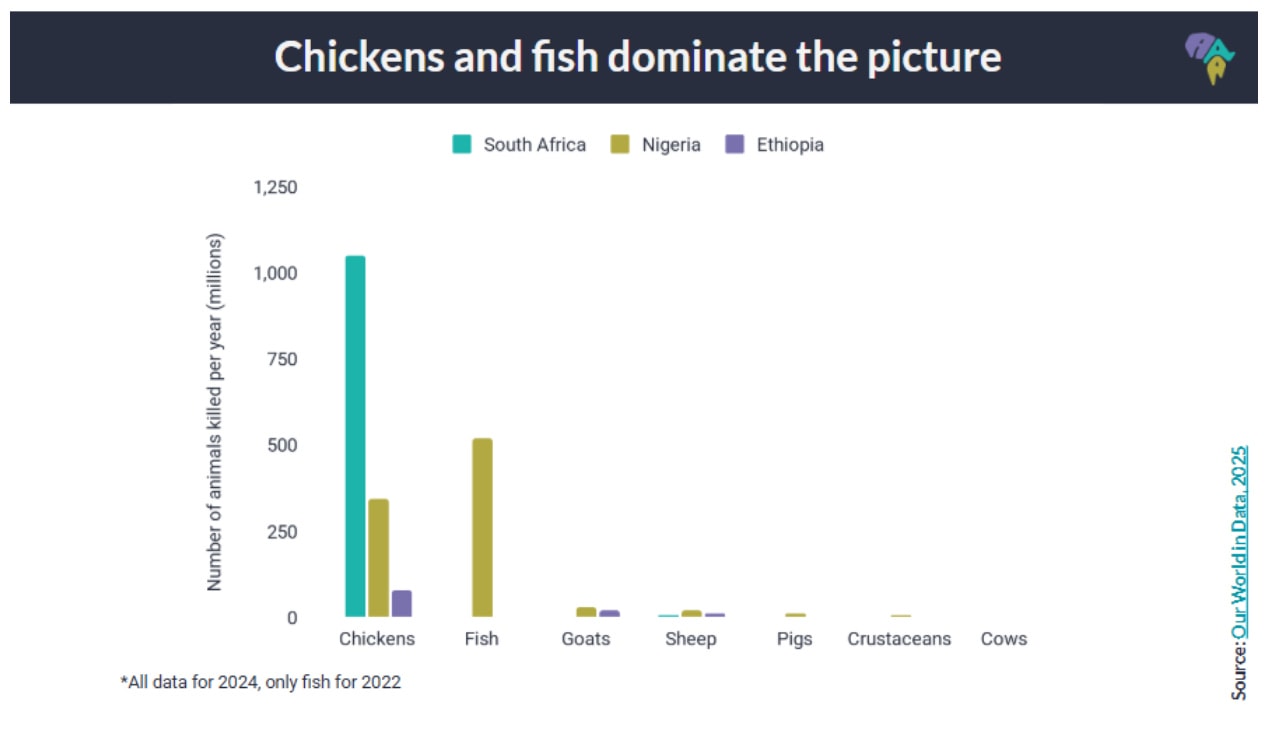
Fish and aquaculture production are particularly large in Nigeria, Ghana, and Egypt, making aquatic animal welfare a significant concern across West and North Africa. Ethiopia stands out differently: goats and sheep are farmed there in numbers relatively close to chickens, and because those animals have longer lifespans, the population alive at any given time is proportionally larger than slaughter figures alone would suggest. Crustacean production appears relatively low across most of Africa, with that sector still concentrated in Asia.
Insect farming is a newer and still-unsettled part of the picture. It has attracted substantial investment globally under a food security and sustainability narrative, but most insect farming businesses in the Global North are currently struggling economically, and investors are increasingly looking to lower- and middle-income countries, including in Africa, as potentially more viable markets.
The upshot is that advocacy strategies designed around Nigerian conditions, where chickens and fish dominate at industrial scale, will look quite different from what is needed in countries like Ethiopia, for example, where small ruminants are a significant part of the picture and almost nothing is yet industrialized. This is why a country-specific approach matters.
Building the movement
In a region with so many farmed animals but a sparse advocacy landscape, the farmed animal advocacy movement currently follows a two-pronged approach.
- Capacity building. Animal Advocacy Africa focuses on talent pipelines, research, and organizational capacity, with an approach built around country-specific investment rather than spreading efforts thinly across the continent. Its current Nigeria fellowship puts significant resources into a single country with the aim of building a local ecosystem from the ground up. And the interest is there, with roughly 1,700 applicants this year for this one country alone. A community-maintained directory of farmed animal advocacy organizations across the continent maps the growing landscape, with the highest concentrations currently in English-speaking hubs: Nigeria, Ghana, Kenya, Uganda, and South Africa.
- Targeted welfare-issue-level work. For example, the Open Wing Alliance (OWA) focuses specifically on ending the use of battery cages in the egg industry through corporate engagement. In Africa, the OWA has built a coalition of 17 member groups across ten countries: South Africa, Kenya, Uganda, Tanzania, Rwanda, Malawi, Zimbabwe, Ghana, Nigeria, and Cameroon. The coalition pools resources for members’ organizations and pressure on companies through joint actions. It funds member organizations directly through regranting, enabling groups to dedicate staff time to on-the-ground work. The results are measurable: as of 2025, the coalition had secured 64 regional cage-free commitments, up from approximately 12 in 2024.
What makes this work hard
Cage-free advocacy work and animal welfare work generally in Africa face several bottlenecks:
- Access to farmed animal industry data is difficult. Across most of Africa, the farmed animal industry remains highly informal. In the egg industry, for example, this means it is often hard to trace supply chains, estimate how many hens a company’s purchasing decisions actually affect, or verify whether a commitment has been honored. Accountability work, i.e., following up with businesses after commitments are made, is an identified gap as a result.
- Advocacy tactics proven in North America and Western Europe cannot be replicated. Running corporate campaigns, for example, requires legal and political adaptation. Protests that would be routine in Western Europe can create real legal risk for advocates in some African countries, and the movement has had to develop creative alternatives, including coordinating online actions, engaging companies through industry associations, reaching hotel chains and food service buyers rather than taking to the streets.
- There is low public awareness around the suffering of farmed animals. Animal welfare is not yet widely recognized as a priority in most African countries, and research in Nigeria has found that many people believe battery cages are actually better for hens. Campaigns need to work around this misconception. Many advocates have found more traction by leading with non-welfare framings: food safety, antimicrobial resistance, and smallholder farmer protection resonate more readily in many contexts. Building explicit public awareness of animal welfare is a longer-term goal that runs in parallel with policy and corporate work.
- The farmed animal advocacy movement is unevenly distributed throughout the region. Existing advocacy organizations are concentrated almost entirely in English-speaking countries, leaving French-speaking and Arabic-speaking Africa ( including Egypt, Algeria, and Morocco, which already have industrialized farming sectors and large farmed animal populations) with almost no coverage. This means that even the people paying close attention to advocacy organizations in Africa are, in many cases, still paying attention to only parts of the region.
The window of opportunity to prevent more animal suffering
The difference between South Africa today, where the nature of farmed animal advocacy work is largely remedial, and Ethiopia in the near future, where farming industrialization has not yet arrived at scale, speaks to how much may still be preventable. Countries that receive sustained advocacy attention before their industries calcify have a meaningfully different set of possibilities than those that don’t, but also present environments with an extremely weak evidence base on effective advocacy tactics.
The window of opportunity is still open across much of Africa, though it is narrowing faster in some countries than others. Making use of it will require:
- More funding reaching advocacy groups
- Movement infrastructure capable of absorbing talent already showing up in significant numbers
- Coordinated regional collaboration instead of one-size-fits-all campaigns
- Expansion into French-speaking and Arabic-speaking countries, where the gap between industrial scale and advocacy presence is largest
- More rigorous research and intervention pilots to understand which approaches are most cost-effective in African contexts (where the evidence base remains thin)
In conclusion, Africa finds itself in a uniquely interesting position in the industrialization of animal agriculture. Unlike regions where factory farming is deeply entrenched, there is still an opportunity to prevent and transform food systems in many parts of the continent. This is a time-sensitive opportunity for the movement and an investment that can prevent a lot of suffering for farmed animals in Africa, now and in the future.
Learn more
- Visit animaladvocacyafrica.org for more information on the landscape of animal advocacy organizations in Africa, fellowship opportunities, and more on Animal Advocacy Africa’s work.
- For more information about The Humane League’s Open Wing Alliance, visit thehumaneleague.org/open-wing-alliance, or reach out to Aurelia Adhiambo at [email protected].
Acknowledgments
Many thanks to Moritz Stumpe and Aurelia Adhiambo for their presentations. This webinar was organized by Elisa Autric and Urszula Zarosa.
- ^
Please note that these estimates have a high level of uncertainty.