Comments
Amazing work Tom! Particularly impressed by the strength of of the giving pledges
Amazing work Tom! Particularly impressed by the strength of of the giving pledges
It is written by Tom Hutton - Director of Community at EANZ, and lead organiser for the Summit.
While I use “we”/”our” to refer to the Summit as an event/the people who made it happen, all opinions are mine alone/not explicitly endorsed by anyone else.
I’ve tried to note currency throughout. If currency is not noted assume figures are in NZD unless stated otherwise.
Our core target audience was proto-EAs or early stage EAs who had not yet engaged with EA as a community. Our programme was designed with newcomers in mind. Experienced EAs were in attendance mostly to act as mentors/experts, though them being able to network was a positive externality.
The inaugural EA Summit was run in Christchurch at a similar time last year, and had different organisers. You can read their retrospective here.
Numbers are averages except where obviously not averages
| 2026 | 2025[1] | ||
| Attendance | # of Attendees | 69 | 70 |
| Feedback Survey | # of Respondents | 47 | 27 |
| Likelihood To Recommend - x/10 | 8.85 | 8.33 | |
| NPS | 59.6 | 33.3 | |
| New Connections | |||
| Average per attendee | 4.04 | 5.18 | |
Total (New Connections x # of Attendees)[2] | 279 | 362 | |
| Impactful Connections | |||
| Average per attendee | 1.89 | 2.11 | |
Total (Impactful Connections x | 130
| 148
| |
| Felt Welcome - x/5 | 4.72 | 4.74 | |
| Felt Respected - x/10 | 9.40 | 9.33 | |
| Women and Gender Minorities Respected - x/10 | 9.49 | 9.42 | |
| Unwanted sexual/romantic - x/10 | 0.00 | 0.73 | |
| Food - x/10 | 9.33 | 9.00 | |
| Use of time (vs counterfactual) | |||
| Better | 91.49% | 96% | |
| “Notably” or “Much” better | 76.6% | 54% | |
| Worse | 0% | 0% | |
Understanding of EA (self rated 0-10)[4] | |||
| Mean before | 6.3 | 7.0 | |
| Mean after | 7.9 | 8.3 | |
| Difference - all attendees | 1.6 | 1.3 | |
| Difference - attendees with initial understanding 0-5 (n=15) | 4.1 | ||
| 2026 | 2025 | ||
| Budget | Event costs only - NZD | $24,560 | |
| All expenses - NZD | $48,110 | ||
| Expenses | Event costs only - NZD | $15,742 | |
| All expenses - NZD | $35,310
| $30,547
|
| Cost per attendee - NZD | $511.74 | $436.40 | |
Cost per attendee - USD[7] | $288 | $245 | |
Ticket Sales- NZD[8] | Benefactor - $300 | 2 | |
| Supporter $150 | 6 | ||
| Standard - $80 | 30 | ||
| Student - $40 | 8 | ||
| Free (volunteer / on request) | 32 |
These “big three” make up $30,921 or 88% of the total expenditure. Including the fourth biggest expense of travel support accounts for 98% of total expenses.
On the advice of CEA we opted for a professional and better located venue over a free but difficult to access student space.
The event was ticketed with free and volunteer tickets were available on request. We also offered a student discount.
We decided to have tickets by default primarily as a commitment device, and ended up with 8/77 registrations no-showing[9].
Total registrations were 85, with 8 cancellations ahead of time.
We had 69 attendees on the day, with 8 no-shows, and 8 cancellations.
12 (27%) had attended 1-2 of these events, 9 (20%) had attended 3+
We ran boosted posts and a series of ads on Instagram and Facebook. We found the boosted posts had better engagement and click through, though that could be due to timing and the rushed nature of getting the ads over the line[11].
LinkedIn marketing had too high of a base cost, and we’d heard from others that they’d had more success with Meta.
In total we spent ~$200 on boosted posts, and ~$130 on ads. We believe this resulted in at least 10 counterfactual registrations, all from the boosted posts. The counterfactual registrations were approximately evenly spread across Facebook and Instagram as their source.
In addition to actually leading to more (10 vs 0) registrations, our boosted posts did a better job than ads of driving traffic to Luma.
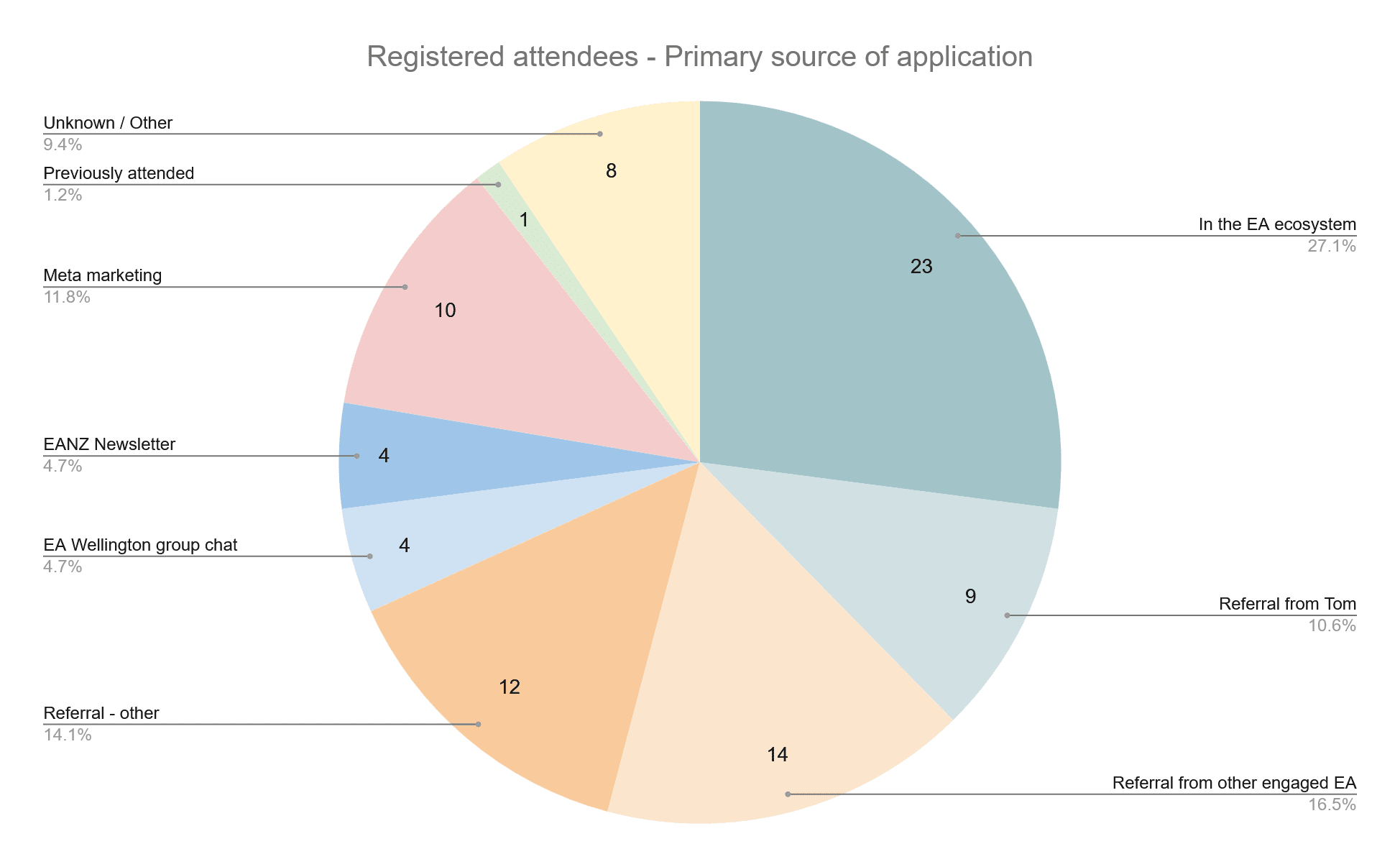
This chart shows all 85 people who registered for the summit. Data is primarily self reporting during registration, supplemented by utm_source, and my insider knowledge/judgment[12].
“In the EA ecosystem” includes group organisers, speakers, local highly-engaged EAs, and other people who were almost certain to attend regardless of how they self-reported finding out about the Summit.
“Unknown / Other” includes answers too vague to categorise e.g. “online”.
Referral is split to distinguish between referrals from already engaged community members, and referrals from people who themselves are new to EA. Several in the “referral-other” group were referred by one student attendee who told their classmates about the Summit after finding us through a boosted post.
Each edition of the monthly newsletter is opened by ~450 people, and we mentioned the summit in 4 editions, with a heavy emphasis in the latter two.
This low turnout is somewhat surprising, even when we were targeting the event to less experienced people, it seems very likely that many more subscribers would have been a good fit to attend.
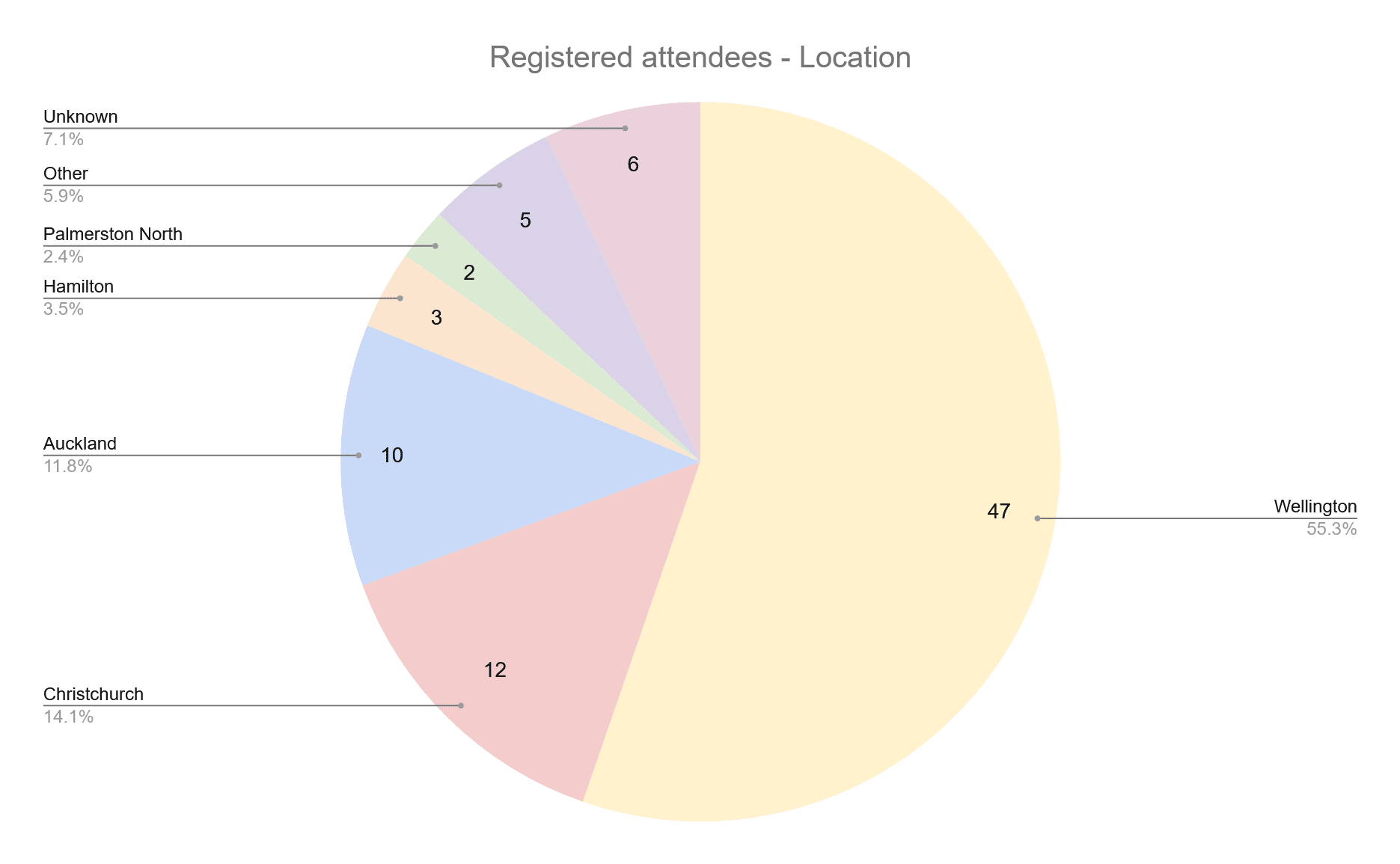
Auckland has a population of ~1.55 million, Christchurch and Wellington[14] both have populations around 410,000.
Both Auckland and Christchurch are a 1 hour flight from Wellington, typically costing ~$180 return if booked well in advance[15].
Christchurch having more attendees than Auckland seems almost certainly to be because there’s an active EA group in Christchurch, where there hasn’t been one in Auckland for several years.
Obviously some of Wellington being over-represented is convenience, though there’s also an argument that Wellington, has more people naturally interested in EA topics per capita[16].
NZ does not have functional intercity public transport. So getting between cities involves flying (and no city in NZ has rail or light rail to the airport, just bus services), or driving for a long time[17]
All of our advertising covered NZ in general, and travel support was offered and promoted, despite this 7/7 registered attendees who found out about the Summit through marketing and actually attended[18] were Wellington based.
We’ve demonstrated an ability to get cold attendees through marketing with me[19] fumbling around in meta business suite. Ideally we would have someone with experience in marketing, and context on the event (i.e. not a last minute volunteer with limited capacity) take this on for future events.
A positive externality of promoting the Summit is that we grew EANZ’s social media presence.
Our accounts had been mostly unused for a number of years, and all of them were given a branding overhaul and regular posts in the lead-up to the Summit. My plan is to now keep these active year-round.
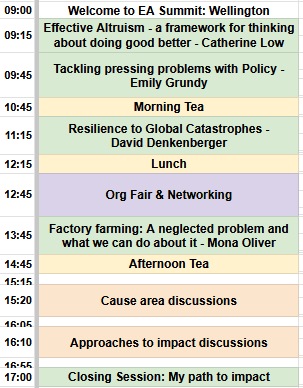
We were relatively constrained by the availability of local speakers. As an introductory event with only a handful of talks we wanted speakers who were deeply engaged in EA (contrast EAGx where we can platform a wider range of speakers), and we only had a limited budget to bring in speakers from out of the country.
Ideally we would have had some form of global health talk as well, unfortunately Kiwis working on Global Health tend to no longer live in NZ.
Speakers were briefed to talk about their Why and How, as well as what they were doing, and we ran an EA 101 session at the start of the day to establish core ideas like the ITN framework and common cause areas.
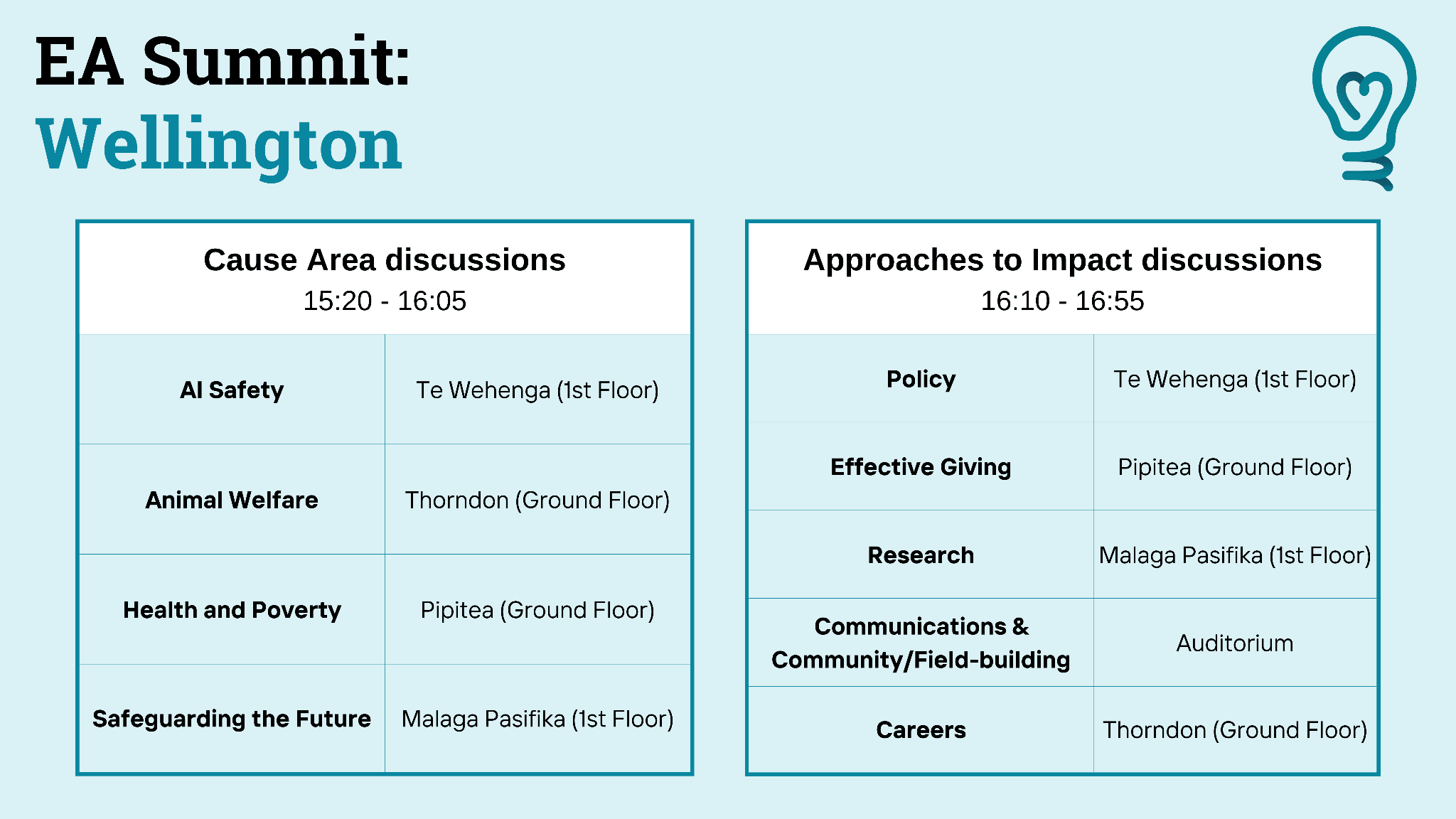
These were somewhere at the intersection of office hours, meetups, and a workshop. As our target audience was newer-to-EA we were worried about standard meetups having not enough knowledgeable people. We wanted a structure that explicitly highlighted who some of the “experts” in the room were, without putting too much burden on our experts to plan a whole workshop[21].
The (abbreviated) pitch to hosts was:
Structured gathering of people interested in or engaged in a specific area.
By default this will consist of a brief intro then breaking out into discussion tables on different topics (often sourced from the participants), with an invitation to switch tables/topics ~every 10 minutes.
For EA Summit: Wellington we’ll have 1 or 2 designated mentors (if you’re reading this, that’s probably you!) supporting each discussion group
If you want to do something different with your 45 minutes please let me know! - I’m broadly in favour of this if you have a clear vision. The format provided above is to make this easier to run, not because I necessarily think it’s the best way to use the time.
The description for attendees was:
These discussions are a chance to connect with others interested in particular [cause areas/approaches to impact]. Each discussion will have 1 or 2 people with experience in the area helping guide the discussion.
Some of the sessions got strong positive feedback, and some had more mixed feedback (i.e. both negative and positive mentions in the feedback survey). The best received sessions were the ones the hosts put the most time into planning (slide decks and prepared discussion questions).
The booth saw 7 trial/student pledges, and 1 10% pledge. Several of these were from people who hadn’t engaged with EA ideas before hearing about the Summit!
This was thrown together at the very last minute, and announced at the closing talk.
The $4000NZD came from 5 donors and was matched by an anonymous donor, and went towards EANZ’s Maximum Impact Fund.
A major benefit of Luma was the ability to collect payment information at application, but only charge the card after approval (i.e. only a single form/process for attendees).
Downsides included inability to export or see detailed tracking data, or to customise reminder and follow up emails, which we ended up sending through Swapcard instead. The confirmation emails were also very limited in terms of what could be customised, which forced us to use Luma instead of Swapcard for tickets/registration on the day (arguably Luma was better for this anyway).
We used a paid Luma plan in order to have a custom URL, and to avoid attendee transaction fees.
A couple of people registered with only their first name, or with multiple names where it was unclear which parts were first, middle, and last names[22].
I had some logistical support and advice from CEA (shoutout Dion, Ander, & George), from Rowan and Catherine at EANZ, and from Gavin - who organised the 2025 Summit, but at the end of the day it was just me making decisions and making sure everything happened. In terms of hours worked this was manageable with ~250 hours over ~6 months[23], but at times there was a fairly high mental load.
Keeping track of and communicating with speakers, volunteers, DG hosts, attendees, etc, and trying to be across all aspects of production, content, admissions, marketing, and attendee experience without fully being able to delegate responsibility was challenging and I would not recommend organising an event of this size without at least one other person on the core team.[24]
There are also other ways to split this depending on the lead organisers areas of expertise; directionally my advice is to have a 2-3 person team for events of this scale.
The challenge is finding good-fit people who are willing to engage with organising the Summit over the long term, while only working a small number of total hours.
Throughout the planning process I had some wonderful volunteers helping out. They took on tasks like: set up luma, design t-shirts, design and run ads, and the very broad “make catering happen” (thanks Olivia!).
These volunteers were all low/unknown context, and I had to be mindful of what work could be delegated[25]. I was still the bottleneck on major decisions and it also took a non-negligible amount of time to brief volunteers, to manage their work, and to check their output.
While some aspects of the organising were hard to delegate, I was able to brief a small team on on-the-day tasks. A big part of this was being able to hand over attendee registration and volunteer management to Maria (thanks Maria!) and to have Rowan and Gavin on standby with specific duties if I was unable to make it. While we didn’t have to rely on this plan, it was comforting to know I wasn’t a single point of failure.
I anticipated, and experienced, issues with the printing[26], and was very glad I went in person, and brought a laptop with me to update files as needed.
We printed double side, and on A3 (6x3 template), which meant the names also had to be flipped (top left = top right) in the print files. Canva AI made this fairly easy once I figured out a good way to prompt it.[27]
Guillotining and hole punching was a time consuming process.[28] I estimate doing this DIY included about 4 hours more work than getting a professional print (assuming no issues with the professional print). One major benefit was the ability to print the week of the Summit, given how many registrations came in late this was very useful. Most professional card printing services either wanted 10 business days lead time, or charged a significant extra fee for shorter turnaround.
These were explained in the attendee guide and opening talk
Some attendees will have an orange lanyard. This indicates that they have prior experience with effective altruism or work in a related cause area. Feel free to approach them if you have questions or would like to hear about what they work on.
Note that these attendees are participating in a personal capacity. They are not representatives of Effective Altruism NZ or the Centre for Effective Altruism, and may have different levels of context or expertise. They are also here to attend the event, so please be mindful if they are unavailable at a given moment.
This was partially cost driven. Due to the scale of the event and nature of the venue, volunteers on shift were stationed at the information desk, so there was less need for them to be identifiable from afar.
We had a box by the main entrance with a sign saying “Return your unwanted lanyards here”.
NZ currently only has one active EA group (Christchurch uni) but has a good number of experienced EAs, people who are working in EA fields and involved in the community, but are less interested in a regularly meeting group.
In terms of impact I’m inspired by the number of pledges as a measurable outcome, though I think the more important impact is in connections made on the day, new collaborations, and people feeling energised/inspired to take future action.
Unfortunately vibes are hard to measure and report on.
My current default stance is one of wait-and-see. I have plans to more deeply look into EANZ CB strategy in the coming months.
With questions, advice, how your experience was different from or the same as mine.
You can reach me here, or [email protected], or on the EAGx Organiser Slack.
Shared during dinner rather than at the closing session, likely leading to fewer responses from more-engaged people.
As far as I can tell this is how other CEA events count this. It counts both ends of a connection, but this makes sense where some impactful connections might be one-directional.
As far as I can tell this is how other CEA events count this. It counts both ends of a connection, but this makes sense where some impactful connections might be one-directional.
One attendee reported decreasing in understanding (10->9). This was assumed to be an error and the values flipped.
Covered by a separate funding source in 2026 .
Covered by a separate funding source in 2025.
Exchange rates as of 14/10/2026.
Minus cancellations (refunded)
Only 2/8 no-shows were on free tickets.
To this question.
We had a marketing professional volunteer to help out and set up some ads, but this was very late in the process.
In reality there’s overlap between categories, but this seems like the most useful way to portray the broad strokes.
Several other attendees are newsletter subscribers, but are either “in the EA ecosystem” or were directly referred.
Including Porirua, Lower Hutt, and Upper Hutt
Though TIL flights from Christchurch go up in price earlier?
I’m not sure how to explain this to non-Kiwis, something about being the capital city, reasonably liberal, and having Vic uni?
Wellington to Auckland is ~8 hours, Wellington to Christchurch starts with an expensive 4 hour ferry crossing before the ~5 hour drive
Plus 2 of 3 who did not attend
Someone who prior to this had basically no experience with marketing and very limited experience in canva.
I have good reason to believe EA Wellington will restart regular events in the next 4 months
Reach out if you’re organising an event and want more info/to see our explanation doc!
Relevant for name badge formatting and Swapcard.
Unevenly distributed, and leaning heavily on my experience and resources from EAGxAustralasia.
I found organising the Summit to be much more of a mental load than organising EAGxAustralasia, despite being a smaller event and smaller personal workload, and coming in with 2 EAGxAustralasia’s already under my belt.
E.g. I had lots of random queries over email from speakers and attendees, but couldn’t hand these over to someone else.
Margin errors, and templates not lining up properly when flipped for double sided printing.
Reach out if you’re doing this. It was fiddly in unexpected ways.
(I learnt that drilling through a stack of card causes too much damage to be a useful hole-punching method)
I have good reason to believe EA Wellington will restart regular events in the next 4 months


Great post.
Sad to hear NZ has only one active EA group, and notably the largest city has none. What happened to EA Auckland Uni? The leadership was excellent when I was a student there.