Comments
Insecticides kill more animals directly than any other human activity. What should we do about it?
Insecticide use on agricultural land kills more animals directly than any other human activity, plausibly in the quadrillions of animals (not including springtails, mites, and other very small invertebrates, which might push these figures much higher). Despite this, there is practically no research or work on the animal welfare impacts of these practices. And insecticides aren't the only highly neglected animal welfare issue on agricultural land — other agricultural practices use or kill billions or trillions of animals annually, such as the use of parasitoid wasps for biological control, managed honey bees used for pollination services, and wild residents of cropland killed by harvesting practices or stubble burning.
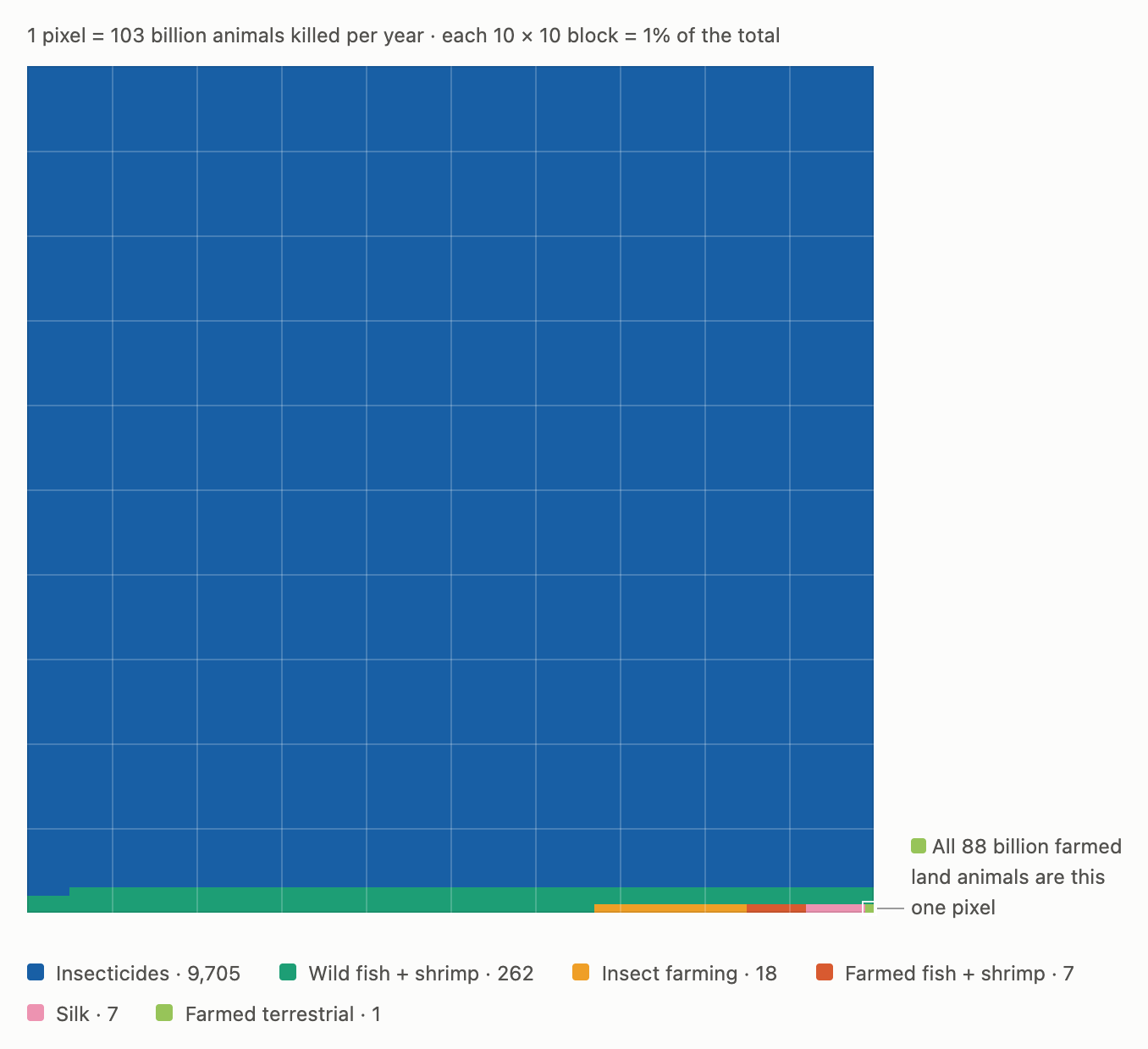
I've started a new organization that works to reduce the harms of these practices on animals. Our initial planned intervention is a large-scale program to induce farmers to use less painful insecticides. Our work is complicated to talk about publicly so we aren’t making a top-level post, but we think that helping animals on agricultural land is plausibly among the most cost-effective things that can be done to help animals, and that very promising interventions are on the near horizon.
We’d love to share more about our work with donors interested in learning more. Our core budget funding gap is around $350k for 2027, our ambitious budget gap is much larger, and we’re aiming to deploy initial interventions in the near future. Complete this brief form, and we’ll share a document with more information. You can also support us directly here.




The Arthropoda Foundation exists to produce the science we need to improve the lives of farmed invertebrates. We identify the research questions that we need to answer to make credible asks of industry; then, we coordinate and fund the labs that can answer them. Our current focus is validating humane slaughter and depopulation methods for both farmed insects and shrimps, though we support many other kinds of projects via our semi-annual calls for proposals, which helps us to identify talent and build the field of aligned researchers.
Invertebrates are the most numerous farmed animals: many trillions are slaughtered each year, including over 900 billion farmed shrimp, black soldier flies, and mealworms. (Rethink Priorities projects that shrimps, BSF, and mealworms alone could exceed 5 trillion by 2033.) To a first approximation, then, all farmed animals are invertebrates. Moreover, they face all the problems we should expect from other forms of intensive farming: selective breeding for productivity at the expense of welfare; high stocking densities, leading to aggression and disease outbreaks; slaughter largely without stunning. And the solutions aren’t obvious: many changes to producers’ practices that sound reasonable could make welfare worse; many changes that look feasible, aren’t. Finally, industry funds research that serves production goals; traditional science funders spend almost nothing on invertebrate welfare. So, if we’re going to figure out how to help these animals, we have to pay for the science.
I’m not worried about covering our core programming in 2027; we have several months of runway and I expect to be able to raise the rest. However, we can absorb far more than our core programming, as we’re discovering far more opportunities than we can afford. For instance, we’re currently building out a research program on substrate enrichments for shrimps, which can reduce the aggression that compromises the welfare of younger shrimp in particular. We’d like to run a program on honey bee depopulation, which is currently a slow and painful affair (the killing, not the program). We’d like to support work on species that have hardly been studied at all, such as cochineals and lac bugs. Even the pilot versions of each program would cost between $150K and $300K; the full versions would be more like $500K to $1M per year for three years.
Questions? You can contact me at [email protected]. You can also give here.