Comments
"Soft lockout" feels pretty loosely defined and in practice less a "lockout" than any other type of property claim. Your article largely covers this, but it's akin to the theoretical ablity for a sufficiently well resourced individual to "lock out" a country by renting every single available property in it. Emphasis on renting, valuable orbits don't have price appreciation benefits but are expensive to maintain unless you're actually obtaining value from satellites in them. Terrestrial property is much more concerning: there's considerably less of it, more demand for it, you can claim much more of it than you can occupy and claim absolute rights to it delegate enforcement of your claim to a state at low cost, permanently. That's more than you get from a launch permit and spectrum license!
Occupation of something like SSO is less "lockout" and more congestion, but that's a tragedy of the commons problem rather than a territorial claims problem. Having a lot of satellites[1] in a particular orbit doesn't mean nobody else can enter it, it just means that they (and you) have to make a lot more avoidance manoeuvres.[2] Also those satellites need renewing/refuelling with fresh launches [3] or they deorbit, so the number of satellites in a given orbit lasts only as long as your local regulatory environment wants you to sustain it.
"Hard lockout" doesn't feel like a real world scenario in a world which has more than one superpower (at peace). ASAT technology exists with or without Golden Dome, but (i) using it is an act of war, and not an act of property rights enforcement (ii) it would probably be a horrendous waste of resources anyway and the advantage obtained would be temporary. It's a more violent and less useful form of conflict escalation than blockading seaports, especially since the adversary would probably be in a position to continue to buy EO and satcomms from neutral states, and if you stop that then as you've said they still have the option of denying space access to you and everyone else with an ICBM. Slightly nicer form of MUAD than the other one, but the same basic "the only way to win is not to play" dynamic applies...
Also think you're underestimating costs, both because those Golden Dome estimates are massive underestimates and because as @Arepo says it's really less a point estimate to build a system with a particular capacity, and more an arms race dynamic to see who has the most capacity. And if peers chose to get into a race I don't see why the dynamics would favour the force that has to build and maintain lots of capable interceptors over the force launching the minimum viable decoy, and even less reason to believe this advantage would be sustainable
- ^
current tech level satellites anyway. if we're talking Dyson Spheres or giant SBSP arrays, all bets are off
- ^
I am here making the assumption that not every space actor worries about FCC licensing. If they did the article is a lot less interesting, because the answer becomes "yes, the FCC can lock out any orbit they want at any time irrespective of actual use". The collision probability rule is a much softer, more movable limit than, say, an airport slot anyway because there's always the theoretical capacity to demonstrate that you can safely operate in that zone by demonstrating increased SSA/manoeuvre capability relative to the last applicant to get their application denied..
- ^
technically refuelling with space sourced material is possible, but that's very much "future tech" and most other satellite life-extension is even further from being independent from earth based launches...





Fascinating analysis! In what follows I'll focus on criticisms/queries, because
it's in my natureit seems most productive, but in general I thought it was a great essay, anticipating most of my criticisms.A couple of general thoughts
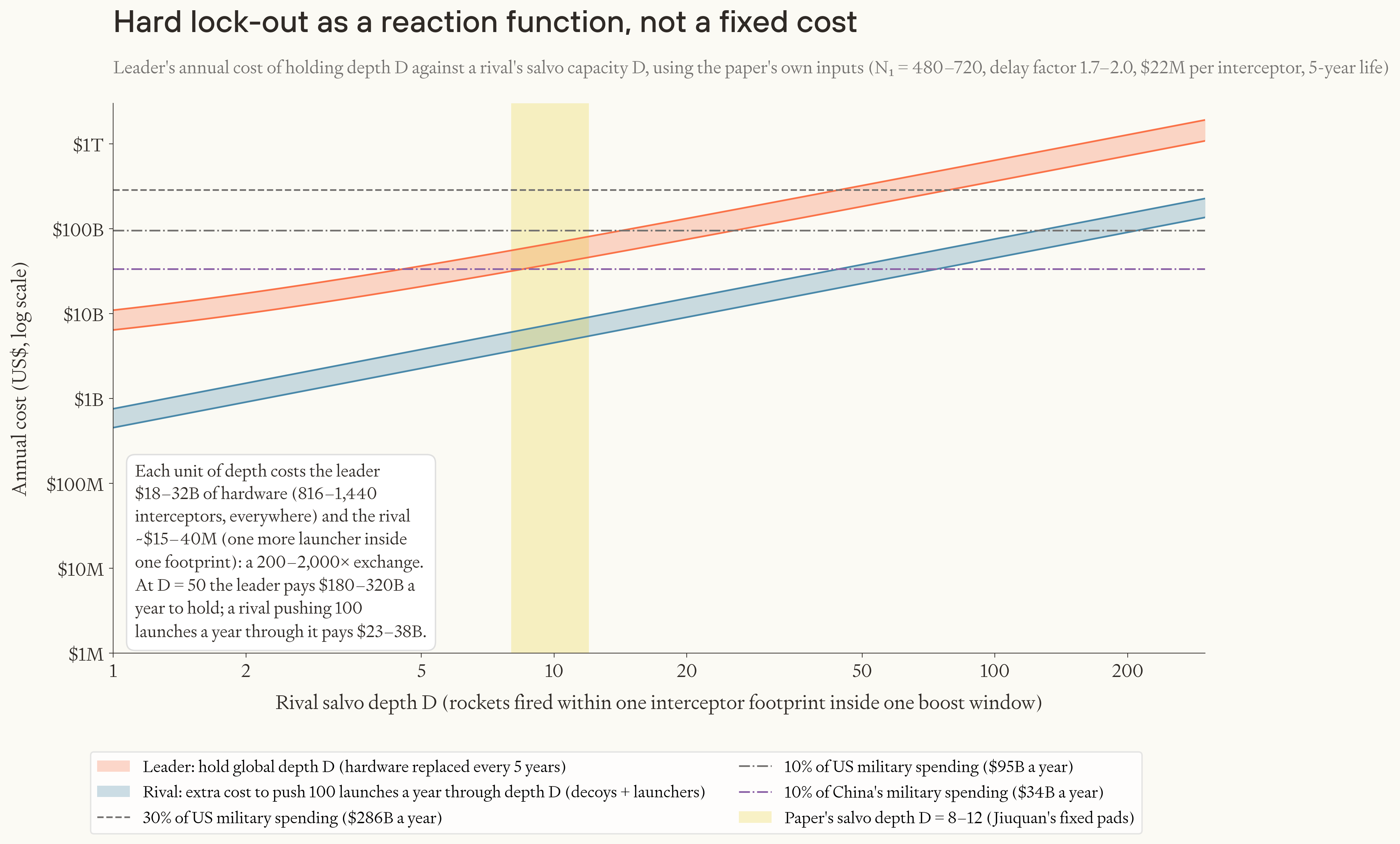
1. My biggest overall criticism is in the choice to model the cost for hard lockout as a fixed cost rather than an arms race dynamic. It can't be the case that both the US and China already have enough money in their military budgets to achieve a decisive single-actor victory - the cost to any actor has to depend on the costs other actors are willing to pay to get it themselves or at least deny their opponent, so you surely need a recursive function or at least a ratio. From a very quick bit of research it seems like the costs of arms races are substantively explored in game theory - it looks like the classic concepts are Tullock contests and Richardson arms races (annoyingly it doesn't look like there's a good simple intro or surprisingly even a Wikipedia page for either).
2. I'd much prefer to see this as a Monte Carlo analysis rather than point estimates. We literally have an in-movement tool for this - and at this point I think it would be relatively easy to vibecode it to accept arbitrarily complex functions, which was a sticking point in the past. (I have this criticism of pretty much all quantitative EA analyses, but that's a topic for another day :)
3. On the economic scales you're looking at, prices seem like they'd often be more useful given as ratios or percentages than $ values (or rather as both). For eg
This comparison feels kind of apples to oranges. NASA spending over that period seems at best very loosely correlated to mature Starship launch prices. The latter presumably assume Starship development costs have been amortised, so could be many years out, in a substantially larger economy. The former includes a lot of R&D that other actors won't need to repeat.
I think absolute estimated costs are useful, since they give some sense of which actors might be able to afford them, but it would also be useful to estimate how much of a proportionate cost-increase such a change would be. Also for such grandiose questions, it would be helpful to supplement $ value with something like an estimate of cost as a percentage of anticipated US or global GDP. That has the downside/upside that it makes the estimate quite sensitive to the interval in which the moon colonisation (or in general imagined event) happens, which is harder work with more room for error, but meaningfully matters if we take seriously the possibility of a century of growth in a decade - depending on what you consider a century of growth, this seems like it could reduce the 'real' cost of a fixed $-value by anywhere from 20-1000-fold per decade.
For the really big picture stuff, like Dyson swarm building, maybe you want to just measure things in terms of something like 'energy cost as a fraction of the sun's output'.
Thoughts on specific passages
This sounds like it wouldn't end up being much of a factor - 1200 tonnes of water ice split 3 ways sounds like virtually nothing. Taking just the max amount, which looks like ~636 tonnes in the PNS03 site, ChatGPT reckons a lunar Starship would consume that within single-digit launches to high lunar orbit.
If instead it was used for human consumption, based on ISS astronaut use of approx a gallon (3.7 litres) a day it could support a population of somewhere around 100-150 people with perfect recyling (depending on how much redundancy you built in). But at, say the ISS recycling efficiency of 98% per cycle, you'd lose about half of the water in around a month. Maybe on the Moon/in future you could get dramatically higher efficiency? But it still seems like even with radical efficiency improvements, absent a lot more water ice being found near the surface this could at best be a small windfall for a new settlement, not much of a DSA.
This sounds basically like loss-leading. I wonder if there's some straightforward models of loss-leading dynamics you could apply here (although maybe they're so straghtforward as to come down to 'expected return on investment').
AIUI most or all ways of reducing cost to space rely on substantial static or orbital infrastrcture, which would prob be much easier to target than rockets (though maybe that would work to later movers' advantage, if it wasn't realistic to move significant mass outside the cislunar system without using such tech).
This seems like a form of 'free' market trade. But it also seems very hard to enforce the initial deal, and somewhat at odds with your idea that launching from Earth is the key chokepoint. Unless the first mover has already physically taken most of the solar system (in which case they prob don't have much incentive to bargain), a rival that had access to a decent amount of the solar system could surely expand to capture more than they'd been offered (or if they coudn't, that suggests Earth wasn't that key a chokepoint).
Variance seems extremely high here especially at the upper end. If we don't see an industrial explosion (and it seems too early to treat it as inevitable) it could take a century+, especially if along the way there are substantial backslides of the kind I sort-of modelled here ('The perils-focused model' section) - obviously longer still if civilisation actually collapsed, but that's prob outside scope for this analysis.
I'm not sure this would necessarily be permanent, at least in the sense that it might splinter into factions, or at least lose a sense of original national identity over time (though it would prob still have a strong counterfactual effect on future values)
I'm a bit confused that you're putting soft lock and kinetic interceptors together, having spent most of the essay conceptually distinguishing them. Also using them as you've described seems at odds with 'not attempting hard lock out' (unless you mean they're trying to hard-lock a proper subset of rivals, while allowing multiple players first-n-mover advantage)?
This actually seems very conservative to me, as a commercial comparison. SpaceX launched 18 rockets in 2018 years ago, and have been ~growing exponentially since, so that would naively put them about 8 years ahead of their closest competitor. But also Rocket Lab's Electron rocket has a payload to orbit of 300kg vs Falcon 9's 23000, so by total mass to orbit Rocket Lab are still behind where SpaceX were in the early 2010s!
That said, it seems like by far the biggest competitor is China's space program, which is nontrivial to calculate since it includes several rocket classes, but which launched 51 times in 2025, and looks like it has a payload capacity maybe half Falcon 9's (but their launch cadence growth rate is much lower).
Is there anything preventing non-American companies, from just putting their data centres into the same orbit? That could be a halfway measure between a scorched Earth policy of denying it to the US, with plausible deniability ('their satellite collided with mine, your honour'). Also, the US might prevent SpaceX dominance internally, on antitrust laws, if it looked like they were really crowding everyone out of this orbit (that outcome seems like it might be quite sensitive to which party was in power in the crucial interval).
Thanks. I think your points about models, tools, and cost framings are on point. The hard lock-out costing started out as a BOTEC, but as new dynamics kept being added at some point it crossed a threshold where it was no longer a BOTEC! And then sunk cost fallacy and all. I'll try out the models/tools you suggest.
I think it's worth fleshing out the arms race dynamic in more detail (and most of the numbers are in there already to do that). I think a big question with the lock-out story is how long one could sustain lock-out at a loss for it to then pay for itself (i.e. when does "loss leading" pay off?). I think I framed "outgrowing the world" based on a space industrial explosion as the threshold, but it could be much sooner, e.g. developing directed energy weapons that can destroy adversary space assets at a much lower cost than interceptors (plausible near-term tech), building a mass driver on the Moon with an extremely high fire rate, or even just grabbing enough metal from near-Earth asteroids and placing them in Earth orbit to use as weapons against space or ground targets.
On your specific points:
I agree. There is little economic value in claiming the best sites on the Moon, and I doubt there is very much strategic value either in claiming the best spots (vs just being there first). Almost all the soft lock-out premium comes from grabbing the sun-synchronous orbits for data centres (even then, the possible DSA comes from hard lock-out).
Sure, I guess nothing is really permanent. I think there is a possible argument for their control being extremely long lasting, e.g. through some of the mechanisms Will describes in Persistent Path Dependence (like AGI-based institutions). But yeah I have no expectation that the USA will control the universe in the Iron Star Era.
I think this is essentially a game of chicken with assets worth millions of dollars. It's possible that other countries could put their assets in the same orbits against the allocations of the ITU, but it would be a bit like driving into oncoming traffic to try and change which side of the road everyone should drive on. It's definitely possible SpaceX could chicken out though. They did previously move Starlink satellites into lower orbits to be further away from Chinese satellites.