Comments
The full report is definitely one of the better treatments I've seen of the subject (and I've read quite a few recently as they're loosely related to my work). A few comments though...
- Feels like an unduly favourable assumption to ODCs to amortise hardware over exactly the same schedule as terrestrial ones. Any situation in which inference compute hardware doesn't become obsolete at exactly the point the ODC reaches end of design life favours terrestrial datacentres.[1] Also feels generous to assume bleed rates in space are no worse than terrestrial bleed[2]
- I'm not sure what model you've determined your satellite hardware costs on and I know you've itemised solar and radiator panels else where, but taking the most feasible approach of thousands of smallsats for your 1GW datacentre, the $4b is buying a lot of propulsion systems, GNC subsystems, intersatellite links, space rated batteries and MAIT work as well as aluminium frames[3]. The article doesn't really discuss how much more complex satellite buses are than modular buildings...
- I think the regulatory arguments actually mostly stack in favour of terrestrial datacentres, because you get to jurisdiction shop. Whilst space isn't effectively regulated, spectrum and launch licensing is and you basically only have one choice.[4] There's growing concern over orbital congestion and even the effects of deorbiting on the mesosphere to deal with, and plenty of parts of the world where NIMBYs either don't live or are less relevant to local regulators than your money.
- The cooling estimate for earth may or may not be representative of what people are paying for climate control for racks of servers in a building, but feels a lot easier to improve that than max out the specific power of satellite radiators, especially since for ODCs we've already relaxed design principles like "chips should be less than 1km away from each other!".
So I agree with the overall point it's going to depend a lot on launch costs but I think there's still some way to go. And even if the unit economics do work, your "fast takeoff" approach with Starship launches scaling to 10k by 2028 feels very fast assuming no obstacles at all to development, scaling capacity or even launches scrubbed by weather. c.f. industry expectations that Blue Origin losing their only launchpad recently will set them back a full year. SpaceX's launch cadence being exceptional feels like reason to doubt they'll 50x it in the next 2 years with an experimental platform...
A couple of further points slightly more favourable to ODCs in the longer run
- costs look different if one assumes a architecture where much of the mass doesn't get deorbited every five years (especially stuff which suffers minimal degradation like radiators) [5] which probably looks a bit more like Starcloud plus orbital refuelling and servicer vehicles to upgrade chips. That sort of modular architecture is still a work in progress and obviously has its own tradeoffs with more expensive components.
- the other use case for orbital datacentres is edge compute for military uses, which isn't fully defined yet and isn't nearly as price sensitive
- ^
Your terrestrial datacentre can keep on running if its 5 year old chips are still useful, or conversely be replaced much earlier if the economics favours keeping the building/microgrid but replacing the chips with much better ones. Obsolete chips potentially have some resale market too. Your ODC needs deorbiting after 5 years regardless; propellant refuelling and in space chip replacement are theoretically possible but orders of magnitude more expensive than keeping a building powered on.
- ^
we have some evidence of COTS inference chips surviving 5yr LEO radiation doses without issue, but might be a different matter for the marginal chip whilst running hot over a 5 year duration in that environment. If needed, radiation hardened variants could be delivered... for a price
- ^
if I understand correctly that's supposed to be just $4 per watt bus/subsystem/MAIT costs excluding solar panels, radiators and inference chips which would be two orders of magnitude cheaper than competitive providers in today's market. Even with the benefits of vertical integration and automation that seems ambitious for the near term...
- ^
I suppose you could pin your hopes on Europe or India improving launch cadence and offering less restrictive licensing regimes but that sounds unlikely...
- ^
one reason why some people manage to be both sceptical of ODCs and bullish on SBSP (which has similar pros and cons) is that the latter is supposed to amortise its build costs over decades rather than be replaced every 5 years, which offsets transmission efficiency loss. Though yeah, that does mean more expensive solar panels etc...
- ^
I don't know how much very slight latency between different nodes or sporadic disruption affects inference compute, but feels like something that could be more of a problem than precision pointing and tracking (these are solved problems, albeit problems solved with more expensive hardware and mission ops and regulators might not like dense formations)


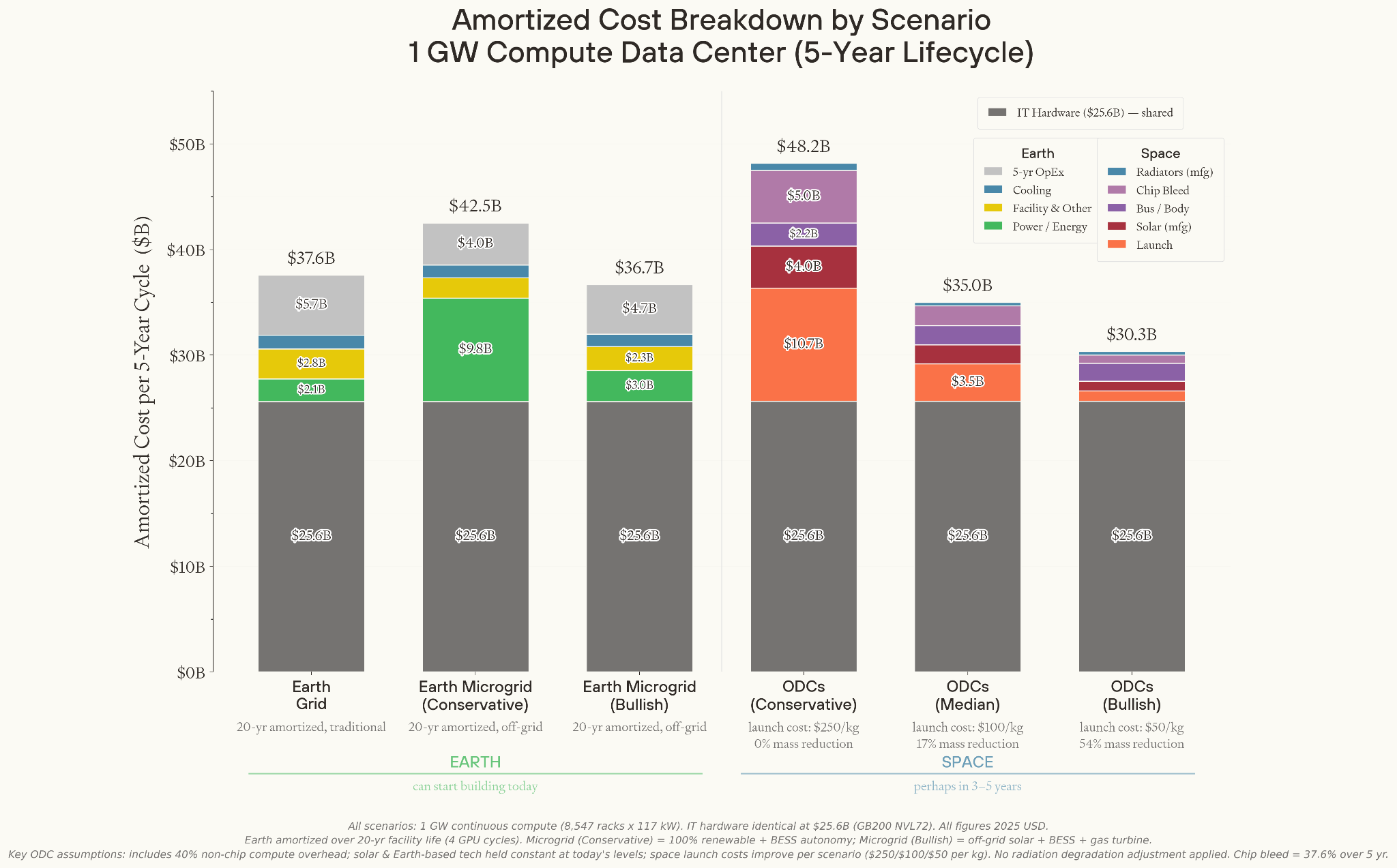


I'm glad to see this rigorous analysis!
I was skeptical of the cooling being cheaper in space. It is true that you can radiate to a much colder temperature in space, about -60°C equivalent. It does look like space cooling would be cheaper with your future launch costs for your constellation model. However, for your modular station model, you would need around 1 m diameter pipes to start, which would weigh a lot and pose a large single source of failure. Also, you would have to pump long distances, increasing the pump mass and energy use.
I think inference would be challenging because the satellite is in view for only a few minutes. I guess most queries take less time than this, but would you keep handing off the session memory?
This is much more reasonable than people claiming that going off grid is cheaper than grid electricity with the same reliability. Still, you note that this capacity factor is reasonable for the desert, but typically there is around a two times seasonal variation. Since 80 hours of storage can't handle that, you would need to oversize your PV more. But it wouldn't change the results that much (~10%). And the gas turbine in your Baseline B solves this seasonal problem.
If you want 80 hours of storage for 100 GW, that is 8 TWh, which is years worth of current production, so I think you'd have to pay a premium.
For the longwave radiation coming from the earth, you would get ε absorption, not α absorption. So the equation should be:
P_net = 2εσT⁴ − αS − αF(Al × S) − εF(σT_earth⁴)
Also, the view factor to the Earth is 0.25 for one side of the radiator, but you are counting both sides for the emission, so I think the view factor should be 0.5.
So then at 20°C: emitted 770 W/m², absorbed 248 W/m², net rejected 522 W/m² (not 633 W/m²).
Also note that if your fluid temp is 20°C, the radiator will be lower average temp because of conductive thermal gradient. But with 1 mm of high-modulus pitch-based carbon fibre reinforced polymer, it doesn't look like too much of a loss.
Footnote 17 seems to end abruptly: "The scenarios in a bit more detail are as follows:"
Hey David, thanks for this excellent comment.
Re: cooling skepticism, actually this has been helpful. On review I think the net rejection will be greater than 633 W/m2. You’re right, we get absorption = ε for longwave radiation from Earth (Kirchhoff would not be pleased).
On view factor, hmm I think this will just vary over the orbital band. Computing the analytic per-face as F = (1/π)[θE − ½sin(2θE)] with sin(θE) = R⊕/(R⊕+h) I get:
Altitude
F per face
F total
550 km
0.258
0.515
1000 km
0.194
0.388
2000 km
0.118
0.236
Maybe we should go worst case and also initial ODCs would prefer to be on the low end of altitude for as long as slots are available (lower cost to orbit, less radiation) You do I think want to go high enough to avoid occasional shading in dawn-dusk-SSO so perhaps ~675km and up. If we correct the absorptivity for Earth IR and take the low end view factor, I get your 522 W/m2. That looks like a ~1% increase in total cost for ODCs if you’re right.
While checking this though it occurs to me you should be able to be have the radiators edge on to the sun while still radiating from both sides, something like this:
Basically a Starlink v3 with panels at 90 degree pivots. Then with shading from direct sunlight I think I get 650 W/m2 for 675 km altitude, F = 0.473, so an improvement on radiator performance overall. I’ll have to think about this a bit more and potentially update the appendix. Certainly we can fix the erroneous use of α in the 3rd term.
Re: inference, not my area of expertise and I don’t think the computer architecture totally decided but from looking into it I think it looks like you’d only be handing off the query and response. The routing should be the same as for traditional satellites so this problem is already ~solved (though you may need to scale the satellite mesh as demand/traffic increase). The orbital compute is in a polar orbit so typically not overhead. The trip in a kind of worst case scenario might look something like this:
For example I think for a 100 GB workload through a 100 Gbps optical ground station, total time is ~8 seconds serialization/transfer, essentially the same ~8 seconds as terrestrial on 100 Gbps direct connect, plus something like 175 ms of constellation overhead.
Re: terrestrial solar and battery. Good points: these make terrestrial microgrids look a good bit worse. For solar on Earth in addition to the seasonality we’re also assuming some of the best solar sites in the world so this should be fairly bullish for terrestrial data centers. We didn’t spot any fundamental blockers to scaling microgrids through some combo of solar overbuy + battery and gas but prices may be at a premium either for turbines or for batteries as you say. In some sense it seems like the data center buildout may have hyperscalers acting like water flowing down hill, pivoting into whichever buildout channel offers least resistance at the moment. Similarly if ODCs start going up en masse there could be lower lying supply chain issues that emerge. The most biting constraint of all is probably chips and memory.
I dug in a little more, and I think your Earth cooling estimate is high at $2.5–3.0B/GW with water chillers. An NREL study was more like $0.7B/GW with water chillers. Also, we may be able to dispense with the water chiller (as you have assumed in space), and then it could be even cheaper. So I doubt it's actually going to be cheaper to cool in space. However, your point that cooling in space doesn't wreck the economics still stands.
I'm glad it was helpful!
I was using 550 km, so I agree that higher up, you would have more net radiation leaving the radiator.
As for your bent configuration, that is creative to avoid the sun incidence. However, then you would have radiation from the solar panels to the radiator, and since the solar panels will be warmer than the Earth, I think it will work out worse overall.
Incomplete?
Your other points make sense.
Seems to be a formatting error and it's supposed to be in the main text, referencing the table.