Comments
133
What Helped the Voiceless? Historical Case Studies
By request, here's the shorter version of "What Helped the Voiceless? Historical Case Studies" as its own post. I've edited for coherence as a stand-alone post and for conciseness. My hope is that people feel free to share their thoughts on this, even if they haven't read the full report.
I read about the histories of various policy shifts that benefited groups whose conditions limited their capacities for self-advocacy, especially abolition and economic expansions of voting rights. My main takeaways were:
Other takeaways:
All my takeaways should be scrutinized before use.
Various voiceless groups are harmfully neglected in today’s policy making. What strategies for changing this can advocates of neglected groups learn from times when excluded groups gained political protections?
People in this community have called for investigating moral and political progress. Still, before this report, there were (as far as I'm aware) no accounts familiar to this community of why countries other than the UK abolished the slave trade and slavery, of why countries around the globe became democracies, or of why these international shifts happened around the industrial revolution. This report aims to provide a summary of such an account, and to argue that it has certain implications for how we can best help neglected groups.
I examined historical case studies of global policy shifts that greatly benefited excluded groups. Of these, I focused on the abolition of the slave trade and slavery, and on extensions of the voting franchise over economic lines. Drawing on these case studies, I propose and argue for a qualitative, rational-choice model that makes predictions about political inclusion. In the full report, I discuss implications in more detail.
This comes from the research I did over the summer, through a university program.
I'm not a professional historian, so, to an even larger degree than usual, all important implications should be heavily scrutinized and considered together with other analyses.
For more caveats and acknowledgements, as well as sections on the case studies, please see the full version of this report.
The cases studied back the following model of political inclusion/exclusion. After introducing the model, I offer supporting historical examples, some elaboration on implications for moral circle expansion, and responses to two potential objections.
More details about the case studies and how the model connects to my takeaways, as well as citations, can be found in the full report.
A policy shift that’s particularly valuable for any group is political inclusion—a relatively durable increase in a group’s political power, e.g. legal protections or political representation. While a group is excluded, its interests aren't reliably considered in policy making, making political inclusion particularly valuable for any group.
Given the importance of political inclusion—the wide range of benefits it lastingly brings—it would be useful to know what makes shifts to political inclusion happen and last.
This model aims to make predictions about when transitions to political inclusion are more likely to occur and persist. It’s inspired by Acemoglu and Robinson’s (2005) model of democratization, and it focuses on particularly durable forms of political inclusion: legal protections and political representation. The model’s main assumptions are the following:
Generally, factors that make transitions to one state (inclusion or exclusion) more likely also make transitions away from that state less likely, so we can usefully group together factors that favor the occurrence and persistence of inclusion/exclusion.
The above framework suggests that the following factors, when high, make it more likely that transitions to greater political exclusion will occur and persist:
The framework also suggests that the following factors, when high, make it more likely that transitions to greater political inclusion will occur and persist:
We can represent this with a picture:
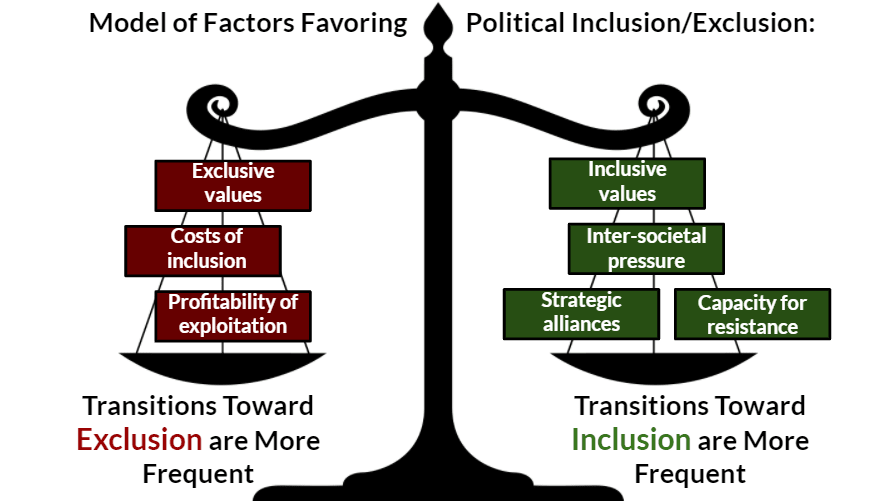
Some factors create incentives that weigh the balance toward exclusion being more frequent, while other factors weigh the balance toward inclusion being more frequent.
This model has important limitations.
The above model has significant support from the case studies that informed it. In the cases studied, each of the factors identified above (or their absence) seem to have repeatedly had the predicted effect on transitions to inclusion or exclusion. The model was informed by the case studies, making this accuracy less surprising, but the framework's simplicity suggests that its accuracy is not a mere case of overfitting.
Examples of opportunities for profitable exploitation favoring political exclusion:
Examples of high costs of inclusion favoring political exclusion:
Examples of exclusive values contributing to political exclusion:
Examples of effective resistance contributing to political inclusion:
Examples of strategic alliances contributing to inclusion:
Examples of inclusive values contributing to inclusion:
Examples of inter-societal pressure contributing to inclusion:
Idealistic theories of moral circle expansion (e.g. Singer's) are prominent within this community. Some take them to mean that it’s highly plausible—perhaps inevitable—that inclusion will continue expanding, until the interests of currently neglected groups have entered into decision makers’ consideration. For example, applying this idea to concerns over animal welfare, 80,000 Hours writes:
Will the future be better? [...] moral concern for other beings seems to have increased over time — the ‘expanding moral circle’ — so we expect that people in the future will have more concern for animal welfare
Historical case studies of inclusion cast doubt on these arguments. As argued above, the existing or potential influence of the excluded was usually a major force driving inclusion, at least for the abolition of slavery and economic extensions of voting rights. Inclusion so frequently required powerful actors to be coerced, violently replaced, or otherwise incentivized that theories which focus on benevolence completely miss most of the historical motivators of inclusion, at least in the cases studied.
The historical evidence here more strongly suggests a new theory of moral circle expansion:
The first part of this hypothesis—on the causes of inclusion—is supported by the historical case studies and model reviewed earlier. The second part of this hypothesis remains speculative. Still, it involves highly plausible mechanisms, fits actual historical cases of inclusion much better than hypotheses which (wrongly) claim that inclusive values generally preceded political inclusion, and is plausible in light of findings in moral psychology.
If this view is correct, prospects for the inclusion of future generations and other totally powerless groups are not very bright. After all, both domestically and internationally, groups with no capacity to exert influence can’t effectively resist exclusion, and they are not appealing allies. In these cases, then, political actors have fewer potential motivators for inclusion, but no fewer potential motivators for exclusion. The following picture illustrate this:
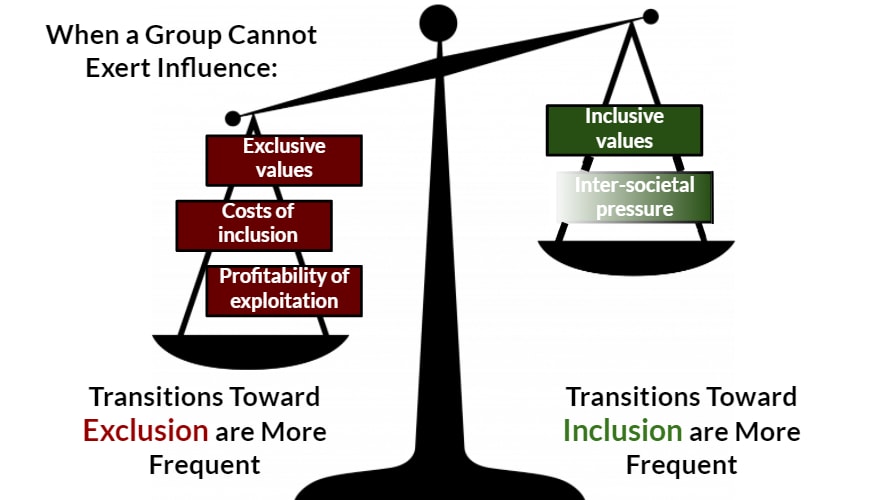
Extrapolating from the past inclusion of influential groups to the future inclusion of voiceless groups would be pretending that these differences are of little importance.
One might object to the above arguments: if progress toward greater inclusion has been caused mainly by the influence of the excluded, why has most inclusive progress happened over the last few centuries? This, very plausibly, has been mostly because economic growth—especially industrialization—has greatly increased the ability of excluded humans to gain and hold on to political inclusion.
One way that industrialization probably favors inclusion is by strengthening excluded groups. Industrialization improves communication technologies, and it drives increases in population density. These make it easier for excluded groups to organize resistance. Economic growth also seems to empower some newly wealthy actors to demand civil liberties, and these also make it easier for other excluded groups to organize resistance.
Industrialization may have also favored inclusion by causing elites to be more vulnerable to resistance, making exclusion less appealing. Slaves can more easily mess up industrial tasks than agricultural ones. Similarly, riots of the disenfranchised do not threaten landowners’ wealth as much as they threaten the machinery and human capital that makes up the wealth of industrial elites. In brief, we can explain the timing of these modern era increases in inclusion through the impacts of industrialization: making excluded groups more able to resist exclusion, and making makes elites more vulnerable to conflict. Together, these effects make it much costlier for elites to continue violently repressing excluded groups, incentivizing elites to accept the alternative: accepting others' demands for political inclusion.
One might also object: if inclusive values are not very strong contributors to inclusion, then why have there been many policy shifts that greatly benefited powerless groups, including future generations? Actually, other historical events may appear to have been successes for the inclusion of voiceless groups, but they were mainly successes for groups that were already powerful. As argued earlier, environmental conservation and the early governance of genetic engineering (as well as children’s protection, to a lesser extent) seem to have been largely done for the benefit of existing, powerful actors.
Other policies that may seem to have helped future generations probably did not do so for their sake. Action on climate change has been highly limited, and the limited action that has been taken may have resulted from the great importance of climate change for present (empowered) generations. Other major successes of environmentalism have also offered (and emphasized) significant benefits for already powerful actors: the regulation of directly harmful pollutants, and ecological modernization. In these cases, future generations mainly got lucky, so these events are not strong evidence for a reliable trend of ever-broadening benevolence favoring the inclusion of future generations.


Thanks for posting this!
Full disclosure to readers: I was the one who repeatedly requested that this shorter version be its own toplevel post on the EA Forum (hope I wasn't too annoying!) ; I think forum readers + Mauricio can benefit a lot from engagement.
Some specific comments:
Are you counting cases where there are intra-elite battles for power, and a certain move that franchises the voiceless also directly helps elite group A's interests at the expense of group B(eg, presumably some workers will benefit from not having to compete against slave/prison labor)?
Not sure how broad "strategic alliances" are referring to.
Thanks for your comment!
Nah :)
What I have in mind is: cases when elite group A included group B, because group A thought that group B would use its new influence in ways beneficial for group A. I wouldn't count the example you mention, because then the benefit seems to come from the exploiters being weakened (not being able to charge such low prices), rather than from the new influence of the formerly excluded.
(I'm trying to distinguish between inclusion that comes from the influence of the excluded, and inclusion that doesn't, because only the latter could help groups like future generations.)
The dynamic you bring up does seem important. I'd currently put it in the miscellaneous bucket of "costs of inclusion" (as a negative cost--a benefit for elites). I wonder if there's some better way to think about it?