Nice! Your theory of change makes a lot of sense to me, and I really like how you laid out why this project makes sense as well as some of the challenges. Quick question about ZISWAF: why does your impact turn on shifting non-zakat funds and not also promoting, for example, GiveWell's Zakat Fund?
Thanks for the thoughtful feedback! Great question regarding GiveWell’s Zakat Fund.
From my understanding, while we’d certainly be open to promoting GiveWell’s Zakat options (and likely will in the next campaign!) our focus on the more non-zakat (the "-ISWAF") funds comes from a mix of constraints we face on the ground such as:
Regulatory & Legal Barriers: We currently don't have the regulatory status that allows us to collect zakat, which means we are technically limited to just promoting the funds rather than facilitating collection.
Psychological Preference for Local Giving: There is a strong cultural expectation for local distribution for zakat. Ultimately, we’d love to have highly cost-effective local zakat options, but that requires a level of rigorous charity evaluation involving the existing ZISWAF orgs.
Flexibility: Focusing our efforts on the non-zakat funds enables us to prioritize cost-effectiveness without needing to navigate the complex theological and operational criteria required for zakat.
So, while GiveWell's Zakat Fund is a fantastic tool that we'll definitely mention to our future audience in the right contexts, focusing on the broader and more flexible non-zakat pool gives us a clearer path to execution (at least in these early stages!)
I don't know if you're connected into the global EG ecosystem, if not, talk to Luke Moore, he knows everyone and everything.
Some of your challenges have been solved or are being worked on in different countries, in different ways. E.g. many European EGI's had to translate material and adapt for local consumption. Several (including us in Ireland) have struggled with tax-policies which discourage foreign donations.
For funding, have you talked to Meta-Charity Funders?
- We’ve only been in touch with Luke Moore a couple days ago & thanks to him, now connected with the global EG ecosystem!
- Really interesting indeed how European EGIs have translated their material across different websites. We looked into Effectiv Spenden’s website (https://effektiv-spenden.org/en/methodology/) and linked EGIs in the EU; this reference will be really helpful for us to emulate going forward. We are thinking of further adapting them to local (e.g. religious) values, considering the existing BAZNAS context in Indonesia. We’ve also talked to Manal Zehouani from Doneer Effectief about Muslim donor outreach.
- On funding, Effective Altruism Indonesia community was previously funded by MCF and EAIF (recently lapsed), so we’ve had previous experiences with them. We’re still exploring those funds for new requests, and other funds.
Super glad to have you share these amazing references and rooting for us!
Congratulations for the launching, Fawwaz et al. I understand the need for content targetting broad audience. But on the ToC/intervention/advisory to the High Net Worth Individuals (HNWI) or family offices, can you elaborate more?
Broadly, we think that reaching HNWIs will depend heavily on establishing trust, legibility, and credibility to get our foot in the door. As highlighted in CEARCH's report on EG in Asia, Asian philanthropists tend to be predominantly relationship-based, domestic/inward-looking, and reactive to their peers. Our current thinking about the ToC on HNWI giving can be divided into three parts:
Rather than reaching HNWIs in a vacuum, we use our broad-based leg to provide us with the necessary credibility, surface area, and public standing to facilitate warm introductions
We'd like to translate EA ideas into framings that are more resonant to their current predispositions. For example, we can frame cost-effectiveness around high impact domestic and regional causes and work within their existing philanthropic focus (such as anti-stunting, maternal health, or religious giving), that over time we can expand towards more cause-neutral/wider-moral-circle interventions.
We want to engage with HNWIs in a high-touch manner, to offer them research adapted to their giving preferences, that they may not find elsewhere.
We are still refining the precise pipeline and welcome any thoughts or connections in the space!
Launching Efektif Berbagi, an Effective Giving Organization in Indonesia — EA Forum
Launching Efektif Berbagi, an Effective Giving Organization in Indonesia
We’re launching Efektif Berbagi, an organization dedicated to introducing and advancing effective giving in Indonesia.
Despite ranking several years in a row as the “most generous country in the world”, Indonesia currently has virtually no public advocacy or infrastructure directed towards cost-effective & high-impact giving. We’re working to be the bridge between Indonesia’s vast philanthropic energy and the world’s most pressing problems.
Why Indonesia?
For several years, Indonesia has placed #1 on the Charities Aid Foundation (CAF) World Giving Index, having an estimated ~90% donation rate and a ~65% volunteering rate. While the World Giving Index measures participation, rather than absolute funds moved, the underlying pool for philanthropy is quite large:
Religious giving - Domestic religious giving, particularly Islamic (ZISWAF, which stands for zakat, infaq, sadaqah, and wakaf), is estimated by national bodies (like BAZNAS) to exceed $2 billion annually. The theoretical TAM (total addressable market) for Islamic religious giving has been estimated to reach $20 billion annually.
Expanding UHNWI base - Knight Frank estimates ~8,000 HNWIs ($10M+) and ~4,000 UHNWIs ($30M+) in Indonesia, with UHNWI growth projected among the fastest globally.
Retail crowdfunding - Platforms like Kitabisa have popularized micro-donations across millions of users across Indonesia, moving $280 million+ in the past 10 years, showing that there’s a willingness to donate if friction is sufficiently low.
Mandatory CSR budgets - Indonesian law mandates companies operating in or related to natural resources and state assets to budget for CSR activities. In practice, this represents hundreds of millions of dollars in annual spending, with a government-estimate of up to ~$5 billion.
Growing urban middle class - Indonesia is the 4th largest country in the world, with a rapidly urbanizing population. The Jakarta metro area has recently overtaken Tokyo as the biggest metro area in the world. Jakarta and other tier-1 Indonesian cities have a rapidly growing density of white-collar professionals, with high discretionary income, that are plausibly looking to give effectively.
Plus, … we are Indonesians and are based in Indonesia!
The ‘effectiveness premium’
Despite this high baseline level for generosity, effective giving remains virtually nonexistent in Indonesia. Giving has predominantly been directed towards causes that are relatively parochial and domestically-oriented. Donors who are attempting to give to high-impact causes face frictions, or an ‘effectiveness premium’, i.e. the hidden cost that a donor has to ‘pay’ to give effectively. We see several hurdles:
Payment frictions - Recommending an Indonesian donor to give to a GiveWell top charity implies a cross border transaction, with its corresponding FX costs. As most Indonesians don’t have or use international cards, donations would require local rails.
Tax treatment - Under Indonesian law, cross-border donations to overseas charities don’t have a special tax treatment, like tax deductions.
Norms & social legibility - Giving is traditionally viewed through the frames of religious duty (ibadah), or local community solidarity (gotong royong), or immediate disaster response.
Trust - There’s a significant trust deficit in organizations that don’t currently have a presence in Indonesia, particularly with evaluations conducted by foreign organizations about beneficiaries far away. There’s also a gap in ground-level work to translate cause prioritization and cost-effectiveness framings into a more culturally-resonant framing.
What we're building
We’re tackling these hurdles through several approach:
Local broad-based acquisition and a domestic pledge - We plan to produce Indonesian-language content, run targeted paid broad-based acquisition on key social medias (like Instagram and TikTok), host monthly events in Jakarta, and manage a domestic pledge starting at 1% (mirroring One for the World, and CharityBox). We particularly are targeting a segment where the aforementioned ‘premium’ is lowest, i.e. urban, educated, online, young professionals who are more comfortable with digital giving and persuadable to consequentialist framings.
Early traction - At Indonesia’s recent EA summit (146 attendees, ~130 new to EA), roughly 45% of signups came via Instagram, compared to <20% at comparable EA events globally, at $0.03 per click and $1.40 per application. We’re filling a local social media niche that is not being filled in by other EG orgs.
Why 1%? - We think 1% represents a significant commitment for our segment, not only from a utility-sacrifice standpoint, but also because we’re working with a lower level of background trust to begin with. While GWWC's trial pledge is flexible, it expires after six months. We’d like to offer a permanent low-threshold entry point, with GWWC as the natural next step as one’s income grows.
Large donor conversations - We plan to conduct targeted advisory conversions with HNWIs, executives, and family offices. We expect the majority of counterfactual funds moved to originate here. Although the majority of our counterfactual impact is here, we think that this is quite linked to the first broad-based acquisition, as we become a more visible and locally legible organization with pledgers, events, and public standing required to get our foot in the door.
Reducing the effectiveness premium - More generally, we’d like to reduce the effectiveness premium through several ways
Local payment rails - Explore local payment rails that allow e.g. domestic bank transfers and QRIS/e-wallets to donate to top charities with less friction.
Content - Produce high-quality content that frames cost-effectiveness in more locally-salient forms.
Research - Build our own research capacity over time to understand the domestic philanthropic landscape and to identify cost-effective local programs & opportunities. As is the case in other LMICs, global evidence (e.g. GiveWell benchmarks) mostly come from trials in Africa/South Asia, which don’t always transfer cleanly to Indonesia. We also think there is a large underfunded space for iteration studies for local implementers to have high-value evidence that things work here.
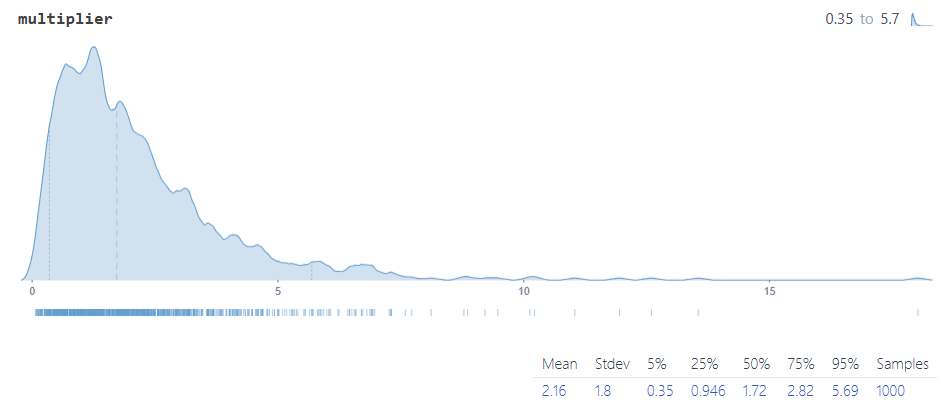
In more detail, we have a rough Monte-Carlo model of our impact in Squiggle here. Based on this preliminary model, our 80% CI [10th, 50th, 90th percentile] over a 2-year period, for various metrics are
Funds raised: [$52k, $167k, $419k]
Share from large donors: [63%, 92%, 98%] by dollar amount
After adjustments (for counterfactuality and intervention quality): [$26k, $86k, $215k]
Against a $50k budget: Multiplier of [0.5x, 1.7x, 4.3x], with a mean of 2.2x. P(>1x GiveWell)≈73%; P(>2x GiveWell)≈42%.
Our distribution for the multiplier (against a $50k budget), from this model
Key uncertainties
Our key uncertainties include
Large-donor is a huge chunk of our counterfactual impact. In particular, our preliminary model assumes ~18 serious conversations over two years at a ~10% conversion rate. Our expected value for impact is sensitive to the parameters regarding this large-donor leg of donation.
Broad-to-HNW diffusion hypothesis is untested in Indonesia. We assume that broad-based pledgers, grassroots events, and local brand awareness will create credibility for HNWI outreach. We draw this from peer EG orgs globally (e.g. Charity Box) and other experiences by similar social advocacy orgs in Indonesia, but this remains untested for effective giving in Indonesia’s context.
Summit sign-up conversion vs pledge acquisition. Our early CAC (Customer Acquisition Cost) reflects acquisition for a relatively low-friction activity (i.e. event registration), and not something that is high-commitment (i.e. pledge commitments) - though we did see high takeup of new (mostly trial) pledgers from the GWWC booth during EA Summit Jakarta in Indonesia.
Pledger retention rate is still unknown. We assume a ~0.67 12-month rate from other peer EG orgs, but local retention could differ significantly. If broad, small-dollar pledges churn quickly whilst not stepping up to larger commitments, the long term counterfactual impact of the broad leg decreases.
Tractability within Islamic giving (ISWAF vs Zakat). While the scale of religious giving in Indonesia is huge ($2B+), zakat faces strict religious constraints that exclude many global charities. Our impact in this front relies on whether we can nudge non-zakat islamic discretionary funds towards cost-effective programs/charities.
How you can support us
We’re at an early stage and would love your help with
Feedback - We welcome feedback and critique on our theory of change, on our assumptions (e.g. donor retention, conversion), particularly from teams in other national effective giving orgs.
Introductions - We’d love to be introduced to Indonesian diaspora professionals, regional founders, or Southeast Asian family offices.
Funding - We’re exploring funding (e.g. cG’s recent RFP) to secure funds for our first 12-24 months of operation. In particular, we’re seeking $50k to cover our 24-month pilot ($20k in Y1, and $30k in Y2).
Get in touch
If you are interested in collaborating, advising, or supporting us, please leave a comment below or reach out directly through
Website: efektifberbagi.id (still in construction)
Headline finding: I audited 17 AI Safety Talent programmes. Zero of 17 have published any comparison group, rejected-applicant follow-up, matched control or randomisation. Not one. Every programme that mentions a counterfactual does it by asking participants to self-report.
Background
At least $70 million...
I want to start by noting that I am amazed and somewhat in awe of what's been accomplished by the EA animal welfare movement. I am enthusiastically supportive of all campaigns that make living and dying conditions less bad for farmed animals.
I worked on such campaigns for almost 20 years, and I'm proud of that work.
That said, I do think it's a strategic error that the EA animal movement has so thoroughly moved on from advocacy for animal liberation and diet change.&n...
Author: Grace Ryba (she/her), Executive Director
TL;DR:
* BluePerch is a new animal welfare grantmaker.
* Grant applications aren't open yet - we're aiming to open applications in roughly mid-2027.
* We welcome early expressions of interest from potential grantseekers so we can notify you when applications open - express your interest here or see further details below.
* We're also seeking boa...



Nice! Your theory of change makes a lot of sense to me, and I really like how you laid out why this project makes sense as well as some of the challenges. Quick question about ZISWAF: why does your impact turn on shifting non-zakat funds and not also promoting, for example, GiveWell's Zakat Fund?
Hi Ben!
Thanks for the thoughtful feedback! Great question regarding GiveWell’s Zakat Fund.
From my understanding, while we’d certainly be open to promoting GiveWell’s Zakat options (and likely will in the next campaign!) our focus on the more non-zakat (the "-ISWAF") funds comes from a mix of constraints we face on the ground such as:
So, while GiveWell's Zakat Fund is a fantastic tool that we'll definitely mention to our future audience in the right contexts, focusing on the broader and more flexible non-zakat pool gives us a clearer path to execution (at least in these early stages!)