Comments
176
Epistemic status: decision rules I have actually used for years, not a theory of anything. I posted the first one on Twitter once and it did numbers (which surprised me, because it took about ten minutes to write)
TL;DR: For requests that arrive one at a time, I use a threshold, where any new project must meet at least 4 of 6 criteria including the compulsory last one. For choosing between projects that are all viable, a threshold is the wrong shape and I use a weighted scoring sheet instead.
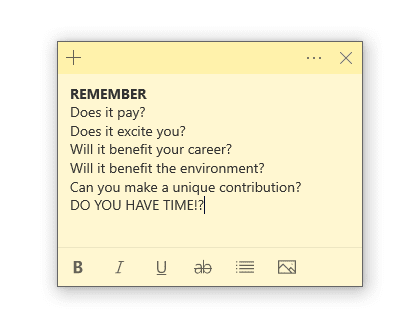
Here it is:
Four out of six, and number six is compulsory. It lives on a sticky note.
I shared this on Twitter a few years ago and it got about ~2000 likes (which is probably more attention than anything I have published in a journal). I think that may tell us something about how many people in this community are quietly drowning in things they said yes to…
The obvious objection is that this throws away information, and a weighted score really is more defensible. I'll come to the one I use.
But most requests do not arrive as a comparison. They arrive one at a time, from someone you like, at a moment when you are already busy, and they need an answer this week. The failure mode is not choosing badly between two good options, it is saying yes to something you deeply regret 2 months later when you have 15 things on the go and you’re beginning to develop a twitch in your left eye.
Four out of six is deliberately generous. It lets through work that pays badly but matters, and work that is fun but strategically useless, while still catching the project that is only appealing because someone flattering asked you.
Does it pay? Unpaid work is not free work, because it's paid for out of the time you would otherwise have spent on the paid work, or on not working at all. Asking the question at least forces the trade to become visible. Plus, you know, most of us have rent or a mortgage to pay.
Does it excite you? Interest is not a luxury criterion. Anything you are not interested in will take longer, come out worse, and sit on your desk generating guilt.
Will it benefit your career? Uncomfortable to write down, and worth writing down anyway. If you never ask this you end up as the most useful person in the room with the least ability to change anything about it.
Will it benefit the environment? (Substitute your own cause here.) This is where we think about the actual benefits that may arise from the project, rather than just something theoretically interesting.
Can you make a unique contribution? The counterfactual question, in the form that is actually usable when someone is waiting for a reply. If three other people could do this as well as you, your yes is worth much less than it feels.
DO YOU HAVE TIME? In capitals because it is the only compulsory one, and because it is the one I most want to argue my way around. A project can hit all five of the others and still be a mistake, and the mistake is always the same mistake. You are not deciding whether the project is worth doing, you are deciding whether it is worth more than what it displaces. And if there is no room, what it displaces is either your existing commitments or your evenings.
The main thing it has done for me is get me off taskforces. I have turned down several invitations to sit on them, and every single one would have hit four criteria comfortably: interesting, good for the cause, good for the career, arguably a unique contribution. All of them failed six. Without the sticky note I would have said yes to most of them, and then quietly resented every meeting. (Disclaimer, I did join one taskforce…)
When I was at Yale I built a standard template for comparing research projects. The sticky note is useless once you have five proposals that all clear the bar but only capacity for two.
It scores each project against weighted criteria on deliberately unequal scales. Some examples: 0 to 3 for whether the results would land in a high impact journal, and 0 to 5 for how useful the findings would be to practitioners. The ranges carry the weighting, so practitioner usefulness can outrank journal prestige by design rather than by argument each time. (Note, our ability to rank practitioner value above journal prestige was a bit of a privilege due to being at a well-funded Ivy League institution, and not everyone may have that luxury.) We also had criteria on networking, learning new skills, feasibility, risk, and so on.
It's really useful to do this as a team exercise. Scoring surfaces disagreement early, because when two people score the same project differently, the argument you then have is much more useful than the one you'd otherwise have had six months in. And it makes the trade-offs legible.
(The same principle applies wherever capacity is fixed and demand isn't. Funders face it constantly: a pile of applications that all clear the bar, and money for a fraction of them)
Of course neither handles obligations, favours, or the things you do because you owe someone, and neither has much to say about internal work your manager has assigned you.
Mostly the sticky note works because it converts a social question ("do I want to let this person down?") into an administrative one ("does this hit enough criteria?"). The scoring sheet works because it converts a taste question into a documented one.
What's on your sticky note? I'd like to steal some criteria.