Comments
Sorry for the long and disorganized comment.
I agree with your central claim that we need more implementation, but I either disagree or am confused by a number of other parts of this post. I think the heart of my confusion is that it focuses on only one piece of end to end impact stories: Is there a plausible story for how the proposed actions actually make the world better?
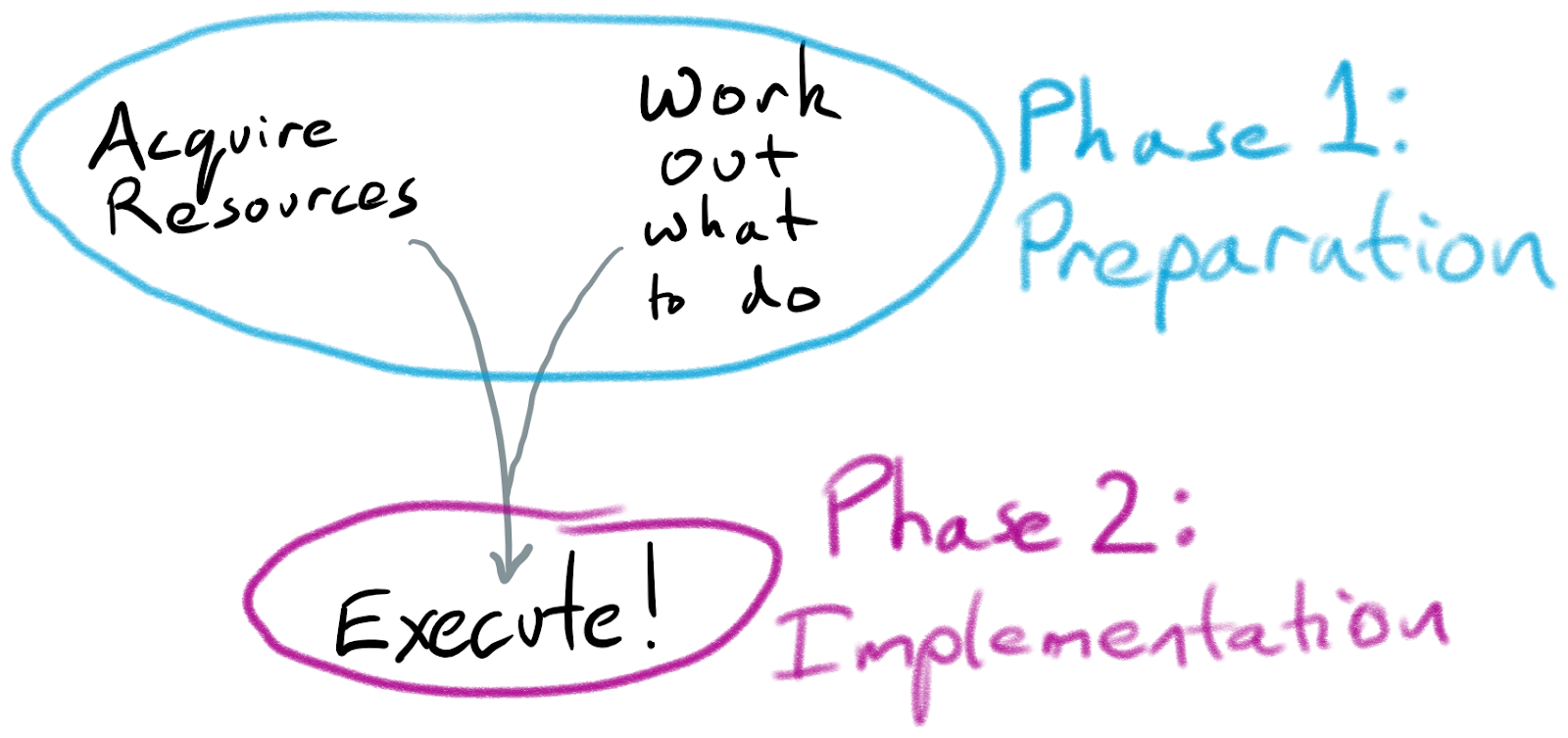
You frame this post as “A general strategy for doing good things”. This is not what I care about. I do not care about doing things, I care about things being done. This is semantic but it also matters? I do not care about implementation for it’s own sake, I care about impact. The model you use assumes preparation, implementation and the unspoken impact. If the action leading to the best impact is to wait, this is the action we should take, but it’s easy to overlook this if the focus is on implementation. So my Gripe #1 is that we care about impact, not implementation, and we should say this explicitly. We don’t want to fall into a logistic trap either [1].
The question you pose is confusing to me:
“if the entire community disappeared, would the effects still be good for the world?”.
I’m confused by the timeline of the answer to this question (the effects in this instant or in the future?). I’m also confused by what the community disappearing means – does this mean all the individual people in the community disappear? As an example, MLAB skills up participants in machine learning; it is unclear to me if this is Phase 1 or Phase 2 because I’m not sure the participants disappear; if they disappear then no value has been created, but if they don’t disappear (and we include future impact) they will probably go make the world better in the future. If the EA community disappeared but I didn’t, I would still go work on alignment. It seems like this is the case for many EAs I know. Such a world is better than if the EA community never existed, and the future effects on the world would be positive by my lights, but no phase 2 activities happened up until that point. It seems like MLAB is probably Phase 1, as is university, as is the first half of many people’s careers where they are failing to have much impact and are skill/career capital building. If you do mean disappearing all community members, is this defined by participation in the community or level of agreement with key ideas (or something else)? I would consider it a huge win if OpenAI’s voting board of directions were all members of the EA community, or if they had EA-aligned beliefs; this would actually make us less likely to die. Therefore, I think doing outreach to these folks, or more generally “educating people in key positions about the risks from advanced AI” is a pretty great activity to be doing – even though we don’t yet know most the steps to AGI going well. It seems like this kind of outreach is considered Phase 1 in your view because it’s just building the potential influence of EA ideas. So Gripe #2: The question is ambiguous so I can’t distinguish between Phase 1 and 2 activities on your criteria.
You give the example of
writing an AI alignment textbook would be useful to the world even absent our communities, so would be Phase 2
I disagree with this. I don’t think writing a textbook actually makes the world much better. (An AI alignment textbook exists) is not the thing I care about; (aligned AI making the future of humanity go well) is the thing I care about. There’s like 50 steps from the textbook existing to the world being saved, unless your textbook has a solution for alignment, and then it’s only like 10 steps[2]. But you still need somebody to go do those things.
In such a scenario, if we ask “if the entire community disappeared [including all its members], would the effects still be good for the world?”, then I would say that the textbook existing is counterfactually better than the textbook not existing, but not by much. I don’t think the requisite steps needed to prevent the world from ending would be taken. To me, assuming (the current AL alignment community all disappears) cuts our chances of survival in half, at least[3]. I think this framing is not the right one because it is unlikely that the EA or alignment communities will disappear, and I think the world is unfortunately dependent on whether or not these communities stick around. To this end, I think investing in the career and human capital of EA-aligned folks who want to work on alignment is a class of activities relatively likely to improve the future. Convincing top AI researchers and math people etc. is also likely high EV, but you’re saying it’s Phase 2. Again, I don’t care about implementation, I care about impact. I would love to hear AI alignment specific Phase 2 activities that seem more promising than “building the resource bucket (# of people, quality of ideas, $ to a lesser extent, skills of people) of people dedicated to solving alignment”. By more promising I mean have a higher expected value or increase our chances of survival more. Writing a textbook doesn’t pass the test I don’t think. There’s some very intractable ideas I can think of like the UN creates a compute monitoring division. Of the FTX Future Fund ideas, AI Alignment Prizes are maybe Phase 2 depending on the prize, but depends on how we define the limit of the community; probably a lot of good work deserving of a prize would result in an Alignment Forum or LessWrong post without directly impacting people outside these communities much. Writing about AI Ethics suffers from the alignment textbook because it just relies on other people (who probably won’t) taking it seriously. Gripe 3: In terms of AI Alignment, the cause area I focus on most, we don’t seem to have promising Phase 2 ideas but some Phase 1 ideas seem robustly good.
I guess I think AI alignment is a problem where not many things actually help. Creating an aligned AGI helps (so research contributing to that goal has high EV, even if it’s Phase 1), but it’s only something we get one shot at. Getting good governance helps; much of the way to do this is Phase 1 of aligned people getting into positions of power; the other part is creating strategy and policy etc; CSET could create an awesome plan to govern AGI, but, assuming policy makers don’t read reports from disappeared people, this is Phase 1. Policy work is Phase 1 up until there is enough inertia for a policy to get implemented well without the EA community. We’re currently embarrassingly far from having robustly good policy ideas (with a couple exceptions). Gripe 3.5: There’s so much risk of accidental harm from acting soon, and we have no idea what we’re doing.
I agree that we need implementation, but not for its own sake. We need it because it leads to impact or because it’s instrumentally good for getting future impact (as you mention, better feedback, drawing in more people, time diversification based on uncertainty). The irony and cognitive dissonance of being a community dedicated to doing lots of good who then spends most its time thinking does not allude me; as a group organizer at a liberal arts college I think about this quite a bit.
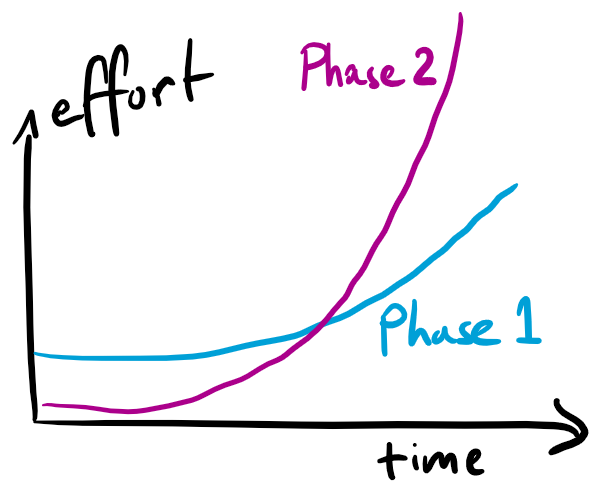
I think the current allocation between Phase 1 and Phase 2 could be incorrect, and you identify some decent reasons why it might be. What would change my mind is a specific plan where having more Phase 2 activities actually increases the EV of the future. In terms of AI Alignment, Phase 1 activities just seem better in almost all cases. I understand that this was a high-level post, so maybe I'm asking for too much.
- ^
the concept of a logistics magnet is discussed in Chapter 11 of “Did That Just Happen?!: Beyond “Diversity”―Creating Sustainable and Inclusive Organizations” (Wadsworth, 2021). “This is when the group shifts its focus from the challenging and often distressing underlying issue to, you guessed it, logistics.” (p. 129)
- ^
Paths to impact like this are very fuzzy. I’m providing some details purely to show there’s lots of steps and not because I think they’re very realistic. Some steps might be: a person reads the book, they work at an AI lab, they get promoted into a position of influence, they use insights from the book to make some model slightly more aligned and publish a paper about it; 30 other people do similar things in academia and industry, eventually these pieces start to come together and somebody reads all the other papers and creates an AGI that is aligned, this AGI takes a pivotal act to ensure others don’t develop misaligned AGI, we get extremely lucky and this AGI isn’t deceptive, we have a future!
- ^
I think it sounds self-important to make a claim like this, so I’ll briefly defend it. Most the world doesn’t recognize the importance or difficulty of the alignment problem. The people who do and are working on it make up the alignment community by my definition; probably a majority consider themselves longtermist or EAs, but I don’t know. If they disappeared, almost nobody would be working on this problem (from a direction that seems even slightly promising to me). There are no good analogies, but... If all the epidemiologists disappeared, our chances of handling the next pandemic well would plunge. This is a bad example partially because others would realize we have a problem and many people have a background close enough that they could fill in the gaps

Thanks for writing this. I had had similar thoughts. I have some scattered observations:
One worry I have is the possibility that the longtermist community (especially the funders) is actively repelling and pushing away the driver types – people who want to dive in and start doing (Phase 2 type) things.
This is my experience. I have been pushing forward Phase 2 type work (here) but have been told various things like: not to scale up, phase 1.5 work is not helpful, that we need more research first to know what we are doing, that any interactions with the real world is too risky. Such responses have helped push me away. And I know I am not the only one (e.g. the staff at the Longtermist Entrepreneurship Project team seemed to worry about this feature of longtermist culture too).
Not quite sure how to fix this. Maybe FTX will help. Maybe we should tell entrepreneurial/policy folk not to apply to the LTFF or other Phase 2 sceptical funders. Maybe just more discussion of the topic.
PS. Owen I am glad you are part of this community and thinking about these things. I thought this post was amazing. So Thank you for it. And great reply John.
I agree with you, and with John and the OP. I have had exactly the same experience of the Longtermist community pushing away Phase 2 work as you have - particularly in AI Alignment. If it's not purely technical or theoretical lab work then the funding bodies have zero interest in funding it, and the community has barely much more interest than that in discussion. This creates a feedback loop of focus.
For example, there is a potentially very high impact opportunity in the legal sector right now to make a positive impact in AI Alignment. There are currently a string of ongoing court cases over AI transparency in the UK, particularly relating to government use, which could either result in the law saying that AI must be transparent to academia and public for audit (if the human rights side wins) OR the law saying that AI can be totally secret even when its use affects the public without them knowing (if the government wins). No prizes for guessing which side would better impact s-risk and AI Alignment research on misalignment as it evolves.
That's a big oversimplification obviously, boiled down for forum use, but every AI Alignment person I speak to is absolutely horrified at the idea of getting involved in actual, adversarial AI Policy work. Saying "Hey, maybe EA should fund some AI and Law experts to advise the transparency lobby/lawyers on these cases for free" or "maybe we should start informing the wider public about AI Alignment risks so we can get AI Alignment on political agendas" at an AI Alignment workshop has a similar reaction to suggesting we all go skydiving without parachutes and see who reaches the ground first.
This lack of desire for Phase 2 work, or non-academic direct impact, harms us all in the long run. Most of the issues in AI alignment for example, or climate policy, or nuclear policy, require public and political will to become reality. By sticking to theoretical and Phase 1 work which is out of reach or out of interest to most of the public, we squander opportunity to show our ideas to the public at large and generate support - support we need to make many positive changes a reality.
It's not that Phase 1 work isn't useful, it's critical, it's just that Phase 2 work is what makes Phase 1 work a reality instead of just a thought experiment. Just look at any AI Governance or AI Policy group right now. There are a few good ones but most AI Policy work is research papers or thought experiments because they judge their own impact by this metric. If you say "The research is great, but what have you actually changed?" a lot of them flounder. They all state they want to make changes in AI Policy, but simultaneously have no concrete plan to do it and refuse all help to try.
In Longtermism, unfortunately, the emphasis tends to be much more on theory than action which makes sense. This is in some cases a very good thing because we don't want to rush in with rash actions and make things worse - but if we don't make any actions then what was the point of it all? All we did is sit around all day blowing other people's money.
Maybe the Phase 2 work won't work. Maybe that court case I mentioned will go wrong despite best efforts, or result in unintended consequences, or whatever. But the thing is without any Phase 2 work we won't know. The only way to make action effective is to try it and get better at it and learn from it.
Because guess what? Those people who want AI misalignment, who dont care about climate change, who profit from pandemics, or who want nuclear weapons - they've got zero hesitation about Phase 2 at all.
I agree with quite a bit of this. I particularly want to highlight the point about combo teams of drivers and analytical people — I think EA doesn't just want more executors, but more executor/analyst teams that work really well together. I think that because of the lack of feedback loops on whether work is really helpful for longterm outcomes we'll often really need excellent analysts embedded at the heart of execute-y teams. So this means that as well as cultivating executors we want to cultivate analyst types who can work well with executors.