Comments
Could space debris block access to outer space?


Nearly 15,000 tons of artificial objects are orbiting Earth. By count, the vast majority of those objects are tiny pieces of debris. This raises some worries about what happens when even more space debris accumulates — worries which get even bigger if we see an industrial explosion and rapid tech progress quite soon.
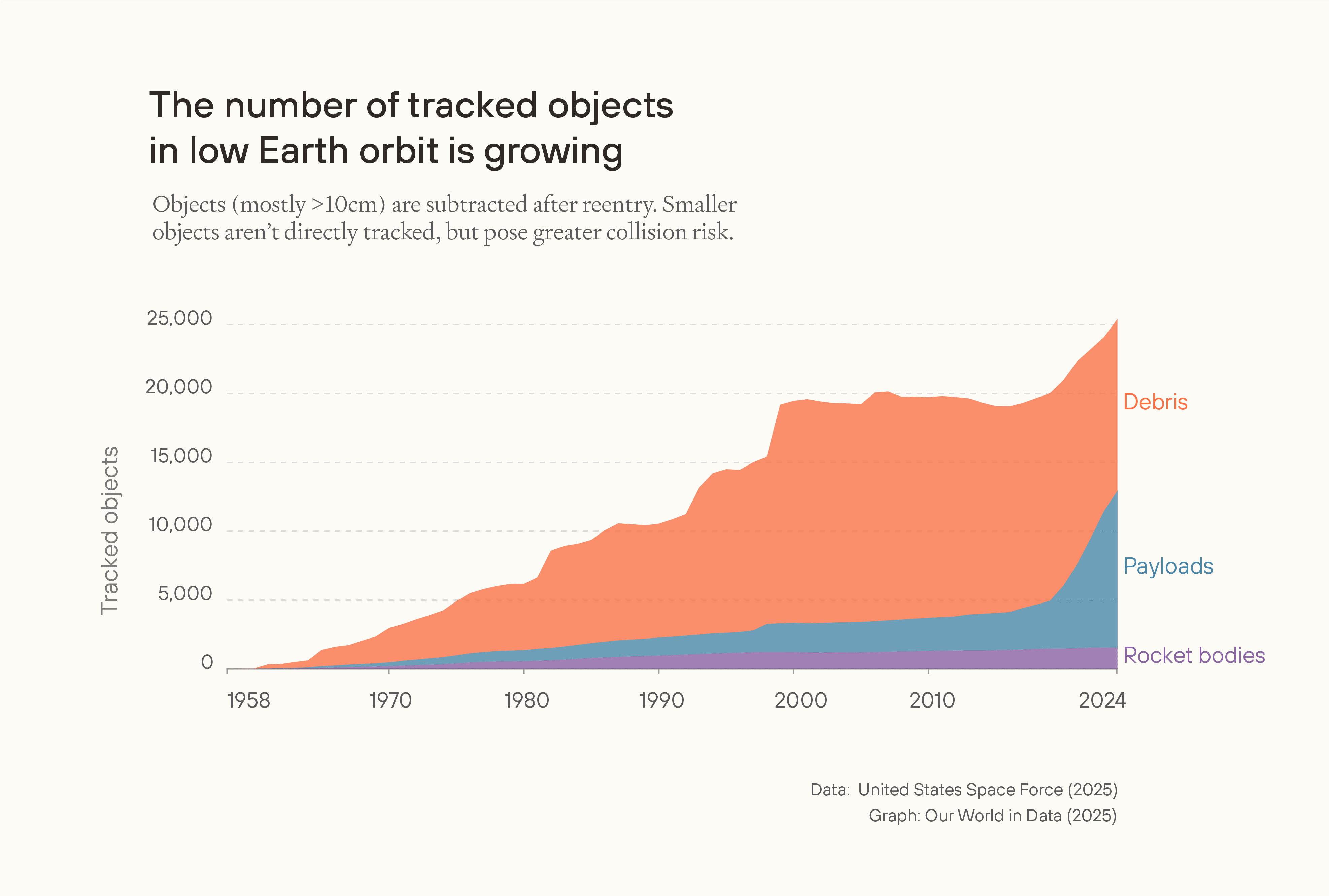
One question is just how bad things could get as the amount of space debris ‘naturally’ grows. Another question, which hasn’t been discussed nearly as much, is what happens if people deliberately try to create huge amounts of space debris. I investigated both questions.
More debris means more collisions with satellites, launch vehicles, and (crucially) other bits of debris. More collisions generates even more debris, by fragmenting larger objects into smaller ones. If that process blows up, it’s called ‘Kessler syndrome’. It’s a hot topic, especially because launch activity has increased so much recently.
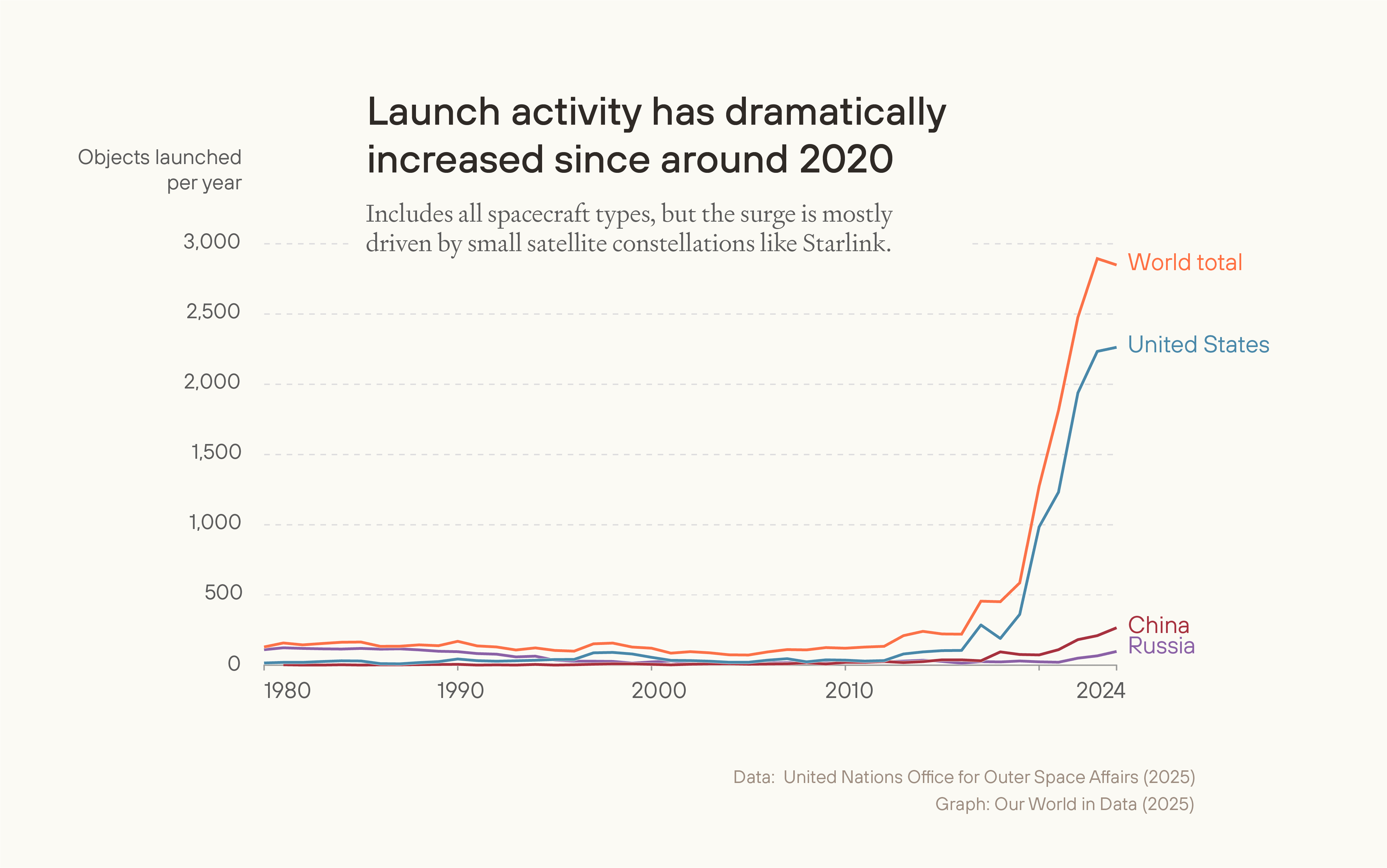
Kessler syndrome isn’t guaranteed to happen, since debris eventually falls back to Earth through drag. But some very crude models of debris suggest that a runaway increase is surprisingly hard to rule out, if we don’t get much better at cleaning it up.
This would be very costly, because it would make it less practical to operate satellites in preferential (the most useful) orbits. But it wouldn’t be the end of the world. First, it would happen over months to years — enough time to adapt. Second, models of debris are already fairly sophisticated, so we’d likely spot an “inflection” point on the horizon before it shocks anybody. Third, we haven’t tried very hard to get effective cleanup and avoidance tech. Scenarios where orbits get really crowded are also probably scenarios where that tech is much improved.
We can also look at how bad the aftermath of Kessler syndrome would be, once we hit peak debris. As I said, it would make it much more expensive to operate satellites, because they’d keep getting destroyed. An even more extreme possibility is that launches themselves could become practically impossible, including launches beyond Earth — maybe passing through the cloud of orbital debris is like running across a street in the rain and hoping to stay dry. That would be a big deal. Fortunately, I don’t think Kessler syndrome would naturally create nearly enough debris to block launches, even with worst-case assumptions.
Space debris and space traffic management are classic public goods and commons problems, so they’re predictably underinvested in, and that’s bad. But I don’t expect ‘natural’ kinds of Kessler syndrome could get so bad that they could dampen humanity’s long-run prospects.
But what about the second question? What if someone wanted to cause there to be more debris in key orbits? If they could somehow generate so much debris that launches through orbit are practically impossible, they could then secure a ‘first-mover advantage’ for themselves: leave Earth first, then seal off the possibility of catching up for many years, effectively grabbing space for themselves in the meantime. That would be big if true.
One strategy to generate more debris is by launching kinetic anti-satellite weapons at active or defunct satellites already in orbit. On collision, they generate huge amounts of debris (spikes in the first graph are caused by single ASAT tests). But a more effective strategy could be to literally lift debris into orbit, perhaps sand or ball bearings, and release it. I think this could get a lot worse than accidental kinds of Kessler syndrome, especially because the size distribution of the debris could be optimised for destruction.
Fortunately, outside of very worst-case assumptions, I don't think this would be enough to make launches through orbit impractical, although I do think it could make preferential orbits totally inhospitable. And a bad actor would need to carry out the plan covertly before they’re stopped, so they’re limited by what they can launch in a short time window.
Moreover, launch vehicles don’t currently have tough shielding, because debris collisions are so unlikely. Better shielding could make it much harder to knock them out, at a big but manageable weight cost.
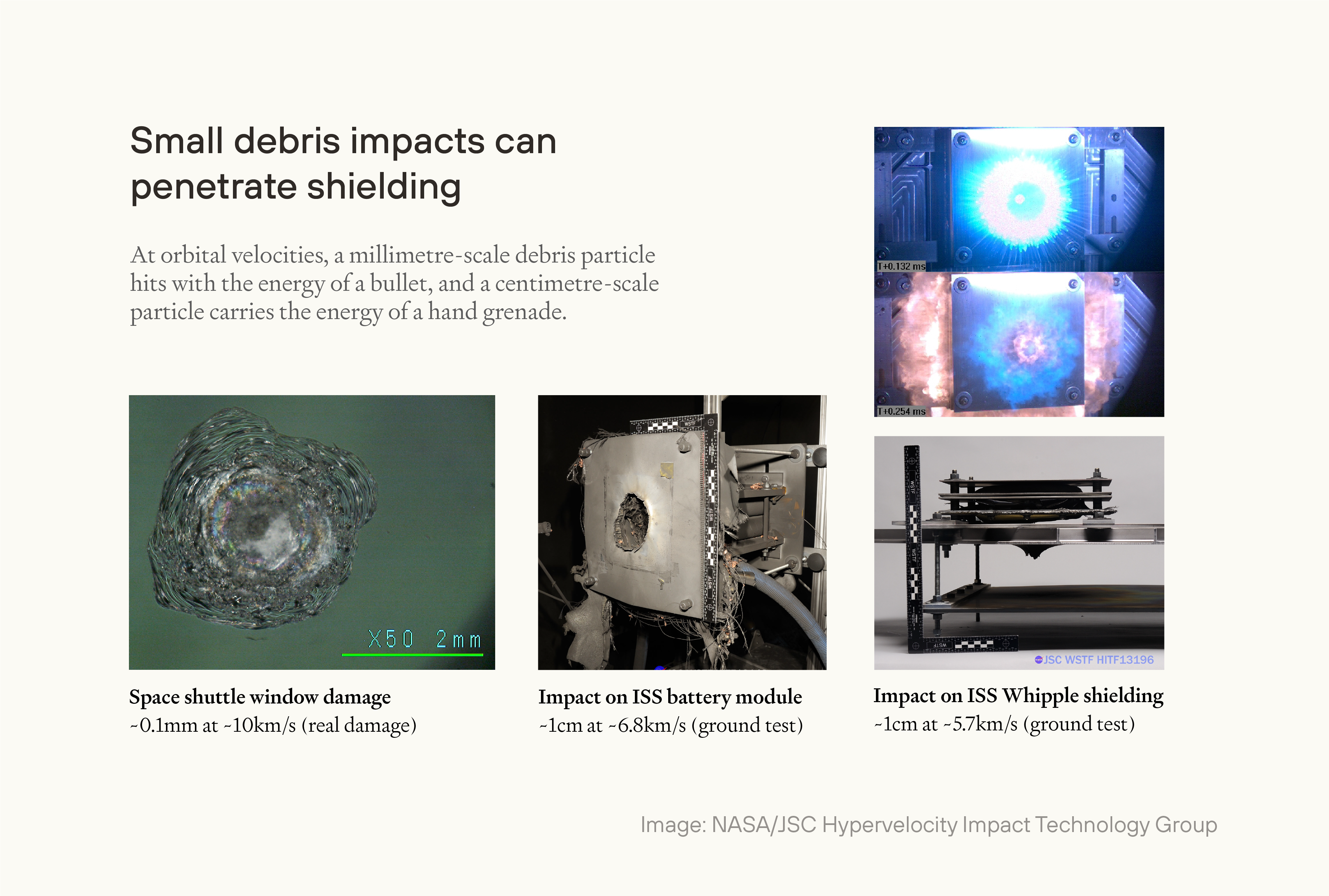
I still worry that a rogue actor could inject space debris into orbit for other reasons. But I do think there are some straightforward options for mitigating that strategy, like more thorough payload inspection.
All this is not to say that much better ‘launch denial’ techniques don’t exist, that is some way a powerful first mover could themselves leave Earth, but block others from doing the same. Militaries already think about this question in the context of blocking ICBM launches, especially in their boost phase.
You can read the full article here.
