Comments
Disclaimer: I am a consultant for Tarrina Health.
Thanks to @Corrina Vali and @Prasanna Senthil🔹 from the Tarrina Health team for sharing internal data and providing feedback on multiple iterations of this analysis. Thanks to the AIM/Founding to Give team for framing work that directly informed this post. I'm also grateful to @Benh713, @ChetanKharbanda, @Jacintha Baas, Nikita and @Tony Senanayake for giving me feedback on an earlier draft of the post and CEA.
Imagine a rural pharmacist in Uttar Pradesh, India, who wants to stock oral rehydration salts. She knows the demand is there. Diarrheal disease is a leading post-neonatal cause of death in children under five in India (second only to pneumonia) [5, 6, 37], and ORS is one of the most cost-effective treatments known to medicine [7]. But she can't reliably get the product because her distributor is inconsistent, and stockouts are routine. Products often arrive damaged, delayed, or in the wrong quantities. A reason this problem persists is that reliable distribution infrastructure requires scale and working capital that most nonprofits structurally may not be able to sustain. [16, 17, 18, 34, 35]
Effective altruism has a rigorous and well-developed framework for evaluating health nonprofits and direct-transfer programs. GiveWell's methodology, the DALY-based cost-effectiveness analyses used by organisations like Malaria Consortium and the Against Malaria Foundation, and the broader randomista development tradition have generated enormous value. These tools were built to evaluate interventions with clear, testable impact pathways. But these frameworks may not suit structures like B2B logistics companies [23], mobile payments platforms [21], or drone delivery networks [19], which have been among the most impactful development-adjacent interventions of the past two decades.
This post argues that for-profit companies, in the specific contexts where revenue and impact are structurally aligned, represent an underexplored lever in EA's toolkit. The case rests on three observations:
Two recent EA Forum posts have opened this conversation: AIM's "Can For-profits Create Significant, Direct Impact?" and the earlier "Growth and the Case Against Randomista Development." This post tries to build on both with a concrete case study, a back-of-the-envelope calculation (BOTEC) and a CEA that readers can stress-test.
One common concern about for-profit impact models is that the pursuit of profit can conflict with the pursuit of impact. While a legitimate concern, it is also an oversimplification that can rule out some of the most impactful interventions in global development. A more useful question is: under what conditions are impact and revenue structurally aligned?
Capital leverage: Seed capital can buy a proof of concept, but the for-profit can scale using its own revenue. A grant to a nonprofit doing direct delivery must be renewed each year. An investment in a distribution company that reaches profitability after three years creates a permanent, self-sustaining distribution network.
Infrastructure is the intervention: Many health problems require reliable ongoing access. Supply chains, logistics networks, data systems, and quality assurance are public goods with network effects. A for-profit has aligned incentives to build and maintain these because they are also revenue assets.
Revenue-aligned feedback loops: Paying customers create real-time operational signals like order volume, repeat rates, stockouts, and complaints that are often more sensitive and faster than formal M&E. Although not a substitute for rigorous impact evaluation, it is a meaningful complement.
Access to non-philanthropic capital: A for-profit with demonstrated traction can raise venture capital, debt, and commercial investment, unlocking capital on a scale the philanthropic market cannot approach. Total development assistance for global health runs to roughly $40–50 billion a year [10], and private philanthropy for global health is far smaller, on the order of $8–12 billion [11]. Private capital is already an order of magnitude larger: global private equity and venture capital deployments into healthcare have exceeded $100 billion annually in recent years, reaching a record of roughly $190 billion in 2025 [12]. And once a company approaches IPO or investment-grade scale, the ceiling rises again by about two further orders of magnitude. The world's listed healthcare companies are worth on the order of $12 trillion in combined market capitalisation [38], and healthcare is among the largest sectors in a global corporate-bond market with tens of trillions of dollars outstanding and several trillion issued each year [39]. The contrast is starkest at the level of a single transaction: an investment-grade healthcare issuer such as AbbVie or Johnson & Johnson can raise $10–15 billion in one bond offering [40], a sum comparable to a fifth to a third of the world's entire annual development assistance for health. A for-profit that reaches scale can therefore tap capital orders of magnitude beyond the philanthropic pool. This may beg the question “Why philanthropic capital?” I address this below in the section on philanthropic leverage.
Lack of paying customers: A distribution business needs a paying customer somewhere in the chain, so it structurally cannot reach populations that do not participate in the market, such as people in acute crisis. For those groups, direct transfers, food aid, and subsidised delivery remain important. [13] The boundary is not as hard as it first looks because the paying customer need not be the patient. In many health-distribution contexts, the payer could be an institution, such as a clinic, pharmacy, or hospital, that procures on the patient's behalf. In India specifically, schemes such as Pradhan Mantri Jan Arogya Yojana (PM-JAY) and Ayushman Bharat provide health insurance coverage to roughly 500 million lower-income Indians [13], so a significant share of patients at private facilities are not themselves bearing the cost of treatment. This lets a for-profit distributor serve low-income populations without requiring those populations to have direct purchasing power. But someone in the chain still has to pay, and where no one can, this model does not reach.
High risks of incentive drift: The history of for-profit healthcare contains many a cautionary tale. Babylon Health, once valued at $4.2 billion and backed by leading investors, collapsed in 2023 after its capitation-based model created a perverse incentive: the company lost money each time a patient requested more than a handful of consultations per year, structurally discouraging the access it claimed to improve [28]. SmileDirectClub, valued at $8.9 billion at its peak, bypassed in-person dental evaluations to cut costs and was found by independent orthodontists to have approved treatment plans for patients who should not have been treated at all, before filing for bankruptcy and abandoning patients mid-treatment [29]. These examples illustrate that commercial model design is everything: the structure of incentives must align with patient outcomes.
Weak counterfactual additionality: Sometimes the public sector already does the job well. Routine childhood vaccination through the UK's NHS historically achieved about 90% coverage in children under five [14]. This is a public-health success that private markets would likely have neither the incentive nor the infrastructure to replicate at that scale and with equity. Singapore's Housing Development Board has housed around 80% of the country's population in government-built flats, with over 90% of those residents owning their homes [15], a record few private housing markets can match. Where delivery requires guaranteed equity of access and long-term subsidy, well-governed public institutions can excel, and a for-profit's additionality could be weak.
In India, Tarrina Health addresses the reliable last-mile availability of health products in rural private markets. The evidence that the public sector is not filling the gap is consistent. A 2023 study in PLOS ONE on the Anemia Mukt Bharat iron and folic acid supplementation programme, one of India's most ambitious nutrient initiatives, found systematic stock-outs attributable to the absence of standardised forecasting, no fixed distribution schedules, inadequate transport, and a fragmented information system [16]. PATH's analysis of supply chains across nine Indian states found that patients at remote facilities are often unable to receive vital medicines because of stockouts or because drugs expire in district warehouses run on outdated processes [17]. A systematic review in Human Resources for Health reached the same conclusion across low- and middle-income countries, with the barriers concentrated at the last mile [18]. In situations where delivery requires speed, commercial accountability, last-mile flexibility, and data-driven responsiveness, private actors with the right incentive structures tend to outperform, and this is the zone Tarrina operates in.
It is worth establishing that for-profit models can generate significant, measurable health and development impact. Here I highlight three cases across a spectrum of scale and directness.
Zipline is a for-profit drone delivery company that delivers medical supplies in Rwanda, Ghana, and Nigeria, demonstrating that logistics infrastructure can be a health intervention. Before its entry, stockouts of blood and essential medicines were common in rural facilities. Zipline cut delivery times from days to 30 minutes, eliminated blood-product stockouts in served areas, and reports saving over 10,000 lives per year at full scale, funded through government contracts and commercial clients. Because the public supply chain was not solving this, its impact appears to have a high counterfactual value. The commercial model gave Zipline the resources and incentives to build and maintain infrastructure that a government health system may not have been able to. [19, 20]
M-Pesa is a mobile money service launched by Safaricom and Vodafone in Kenya in 2007. A 2016 study in Science by Tavneet Suri (MIT) and William Jack (Georgetown) found that access to it lifted an estimated 194,000 Kenyan households, about 2% of the country, out of extreme poverty, with especially large effects for female-headed households: a 9.2-percentage-point reduction in extreme poverty and a 22% rise in savings. The authors attribute the effect chiefly to improved financial resilience and savings rather than higher consumption alone. [21]
M-Pesa was funded through commercial capital and became self-sustaining, so its poverty impact was a byproduct of a commercially viable business. GiveDirectly, one of the most impactful cash-transfer charities, later built on that infrastructure to deliver cash directly, showing how for-profit infrastructure can also extend the reach of nonprofits and governments. [22]
Wasoko (formerly Sokowatch) is a B2B distribution platform serving informal retailers across Kenya, Tanzania, Rwanda, Uganda, Senegal, and Côte d’Ivoire, delivering consumer goods including health and hygiene products such as ORS, antiseptics and zinc, to small retailers’ doorsteps via mobile ordering, with same-day delivery and embedded credit. Serving hundreds of thousands of retailers, it cuts out inefficient middlemen and reduces stockouts, and it is the closest operating analogue to what Tarrina Health is building in India. This illustrates that last-mile B2B distribution in low-income markets is commercially viable at scale. [23]
The risks of poorly designed commercial incentives in healthcare are well documented. The most catastrophic version is Purdue Pharma's promotion of OxyContin. A sales force was explicitly incentivised to push opioid prescriptions to high-volume prescribers regardless of clinical appropriateness, with marketing that misrepresented addiction risk. The resulting crisis caused hundreds of thousands of deaths before Purdue pleaded guilty to federal charges. [24, 25]. The same dynamic shows up in fee-for-service medicine: a survey of over 2,000 practising US physicians found that 70.8% believed doctors are more likely to perform unnecessary procedures when they profit from them and estimated that around 20% of medical care is unnecessary [26]. In India, a study by IIM-Ahmedabad estimated that private hospitals performed roughly 900,000 preventable C-sections in a single year, driven primarily by financial incentives rather than clinical need. During 2019–21, 47% of deliveries in private Indian hospitals were by Caesarean section, versus 14% in public hospitals [27].
The problem in each case was that incentive structures rewarded revenue over patient outcomes. The lesson for high-impact for-profit healthcare is that an incentive structure aligned with health access and outcomes is ethically preferable and makes the case for impact more credible. A distributor like Tarrina Health faces a milder version of this risk. There can be a pull toward higher-margin SKUs, and the highest-health-impact products (ORS/zinc, for example) often carry thin margins. I return to this issue in the Limitations section below.
Tarrina Health is a B2B healthcare distribution company serving rural India, founded in May 2022 by Corrina Vali and Tanvi Dalwadi. Before founding Tarrina Health, the two co-founded and led Saheli, a nonprofit that delivered menstrual health programs in rural Gujarat. Corrina also worked at Fortify Health and was an incubatee at Charity Entrepreneurship in 2020.
In India, the private market accounts for approximately 65% of medicine and health product consumption, yet rural private-market distribution infrastructure is fragmented and unreliable, and the quality of products is inconsistent. Nonprofits doing direct delivery are not self-sustaining at the scale needed to reach hundreds of millions of rural Indians. [33] Tarrina Health's model is to supply quality health and hygiene products through a reliable, technology-enabled B2B distribution network across rural districts. [30, 31]
Scale: 4,000+ retailers, pharmacies, and hospitals across six districts of rural Gujarat, India
Partnerships: P&G, Dabur, HUL (Hindustan Unilever), Himalaya, Reckitt Benckiser - providing both product access and distribution credibility
Operations: ~40 employees, field sales mobile app, 10,000 sq ft distribution centre
Financials: Crossed $1M ARR in April 2026 and reached distribution-centre-level profitability in December 2025. The distribution centre covers its direct costs on medicine margin, though corporate overheads (technology, salaries, admin) leave the company net loss-making for now. Projections show company-level profitability in FY2026-27.
Current product portfolio: FMCG health and hygiene products, skin-disease treatments, and antiseptics. The seed round funds expansion into prescription drugs, injectables, surgical consumables, and diagnostics, which are categories where the rural quality and supply-chain gap is most acute, and Tarrina's cold chain gives it an edge.
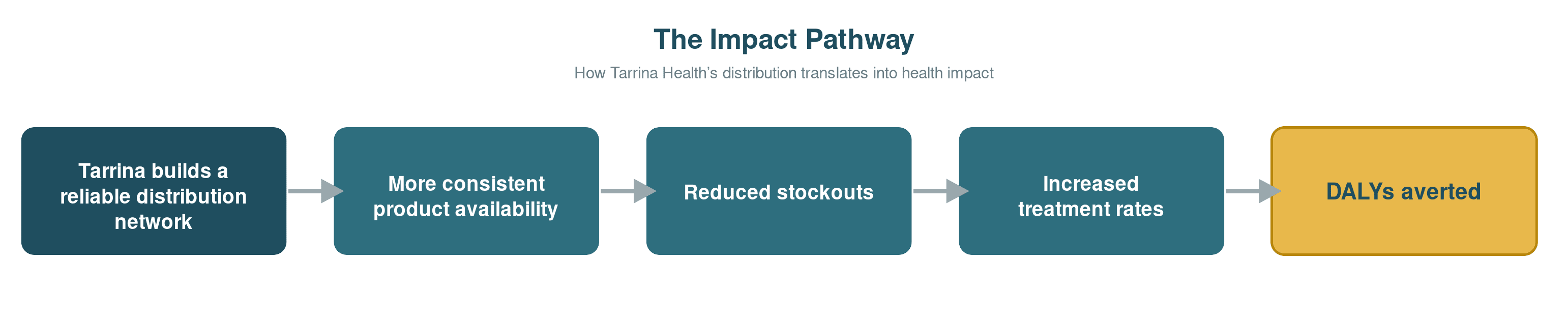
An underappreciated risk in rural pharmaceutical distribution is quality degradation. Many medicines, particularly injectables, vaccines, and temperature-sensitive formulations, require strict adherence to Good Distribution Practices (GDP) around storage temperature, humidity, and handling. When these standards are not met, drug potency can drop significantly even before the medicine reaches the patient, rendering treatments ineffective or unsafe. Informal supply chains and many government distribution systems in India lack consistent GDP compliance. Tarrina Health maintains GDP-compliant storage and distribution practices across its network, ensuring that medicines reaching rural health providers retain their specified potency and efficacy. [34, 35, 36] This quality-improvement claim rests on adherence to Good Distribution Practices rather than on a completed study: Tarrina Health has not yet directly measured the resulting difference in drug potency or health outcomes, so I treat it as a moderate-to-low-confidence claim pending a future impact evaluation. The evidence that these practices are widely not followed in rural supply chains is, however, well established. The strongest causal evidence that the distribution channel itself drives quality comes from Bennett and Yin’s study of retail-pharmacy chain entry in India, which rules out the manufacturer and the store and pins quality on the supply chain. Samples fell below standards about 6% of the time overall, but 22% of the time for local brands moving through the fragmented regional channel, and quality improved measurably once retailers grew more selective about their distributors. [41]
Seed philanthropic capital of approximately $1M would fund the next phase of expansion, which includes new distribution centres, portfolio growth, and technology. After reaching profitability, Tarrina Health would finance expansion through revenue and commercial capital.
Why philanthropic capital, if the commercial model is viable? Early-stage rural distribution is unfamiliar territory for conventional venture investors and lenders. Purchasing power is low, supply chains are hard, and few have funded this segment before. Investors consistently say they want to see company-level profitability at a larger scale before they commit. A catalytic philanthropic grant could bear that pre-commercial risk and carry Tarrina Health to the scale at which commercial capital will follow, so its role is to de-risk the model and mobilise the far larger commercial pool. At scale, the distribution network continues generating impact without additional philanthropic input.
This is a back-of-the-envelope (BOTEC) DALY projection and not a realised result.
For each year and each product category live that year,
DALYs averted = avertible DALYs × market share × underserved multiplier (2.5) × (1 − counterfactual discount, 40%) × Gujarat share (5.6%),
Summed across live categories, then divided into the one-time $967k seed over 5- and 10-year horizons. The seed is what's needed in 2026 to build the next distribution centre and the supporting technology. Once that's in place, the business finances its own growth through operating profit and access to private capital, so no further philanthropic input is assumed in the model. I don't count revenue as a cost: customers pay for products they value at least as much as the price, so the commercial side is self-funding, and the seed buys a permanent distribution network that keeps averting DALYs after it's spent.
Because only ~4.2% of the modelled impact comes from products live today, the future roadmap is weighted by a 70% execution probability rather than assumed certain. The 10-year figure discounts future health at 4%/year, matching GiveWell, so the comparison is like-for-like. I also do not credit all of the venture's impact to the philanthropic seed. Tarrina Health is funded by philanthropy, equity, debt, and reinvested profit, so I allocate impact across those sources using a Shapley value. In the base case, the seed is credited with about half of the venture's impact. The one contestable input is how much of the impact the commercial round would have produced without the seed, the seed's counterfactual weight (funging). I have set it to 0.30, consistent with the company-level counterfactual I concede below: another founder or impact investor would probably build a similar venture eventually, but later, more urban, and higher-margin. All cost-per-DALY figures below are attributed to the philanthropic seed on this basis.
| Scenario | $/DALY | x GiveDirectly |
| GiveDirectly (cash transfers) | $200.00 | 1.0x |
| Tarrina Health (10-yr) | $23.11 | 8.6x |
| Tarrina Health (5-yr) | $64.52 | 3.1x |
| GiveWell ORS/zinc (low) | $56.00 | 3.6x |
| GiveWell ORS/zinc (high) | $87.00 | 2.3x |
In expected terms, Tarrina Health averts roughly 30,000 DALYs over five years and 84,000 over ten. Crediting the philanthropic seed with its Shapley share puts the cost at about $65 per DALY over five years and $23 over ten, about 8.6x GiveDirectly, and in the same range as GiveWell's $56–87/DALY ORS/zinc benchmark. Across the plausible range for the seed's counterfactual weight, the ten-year figure stays between about $18 and $29 per DALY.
One caveat dominates all the others: this is a projection of a staged portfolio. Only oral care and skin products are live today, about 4.2% of the modelled impact pool. The remaining ~96% depends on the roadmap (ORS/zinc and core pharma, then injectables, surgical consumables, diagnostics, and devices) launching across FY2026-27 and FY2027-28. This is the single largest swing factor, which is why the base case weights the roadmap by a 70% execution probability rather than treating it as certain. Holding the portfolio at current products only would deteriorate the ten-year figure by more than an order of magnitude, from roughly $23 to several hundred dollars per DALY. Whether the roadmap launches on schedule matters far more than any individual parameter.
Setting that aside, the result also depends on the counterfactual discount and underserved multiplier as shown below:
| Conservative | Base | Optimistic | |
| Counterfactual discount | 55% | 40% | 30% |
| Underserved multiplier | 2.0 | 2.5 | 3.0 |
| Cost per DALY (10-yr) | $51.96 | $23.11 | $8.16 |
| x vs GiveDirectly | 3.8x | 8.6x | 24.5x |
If the roadmap launches, this could be an exceptionally cost-effective health intervention but if it stalls at current products, it could be roughly on par with existing benchmarks rather than dramatically ahead. My base case bets on the former scenario.
There are many gaps and uncertainties in this analysis. As I noted earlier, the paying-customer requirement sets a boundary on who this model can serve. It is worth being concrete about where that leaves Tarrina Health in practice: its beneficiaries are the rural poor who participate in private markets, which is a large population, but not the poorest of the poor, and not those cut off from markets entirely. My cost-per-DALY figures describe the impact within that population.
Incentive drift is also a risk. As Tarrina Health scales and potentially raises commercial capital, investor pressure may push toward higher-margin products and away from the products with the highest health impact (like ORS/zinc, which carry thinner margins). Tarrina Health does not yet have a formal safeguard in place, but is exploring ways to bake impact into its core governance, for example, giving a mission-aligned trust a significant ownership stake, and amending the company's constitutional documents so that impact metrics, alongside financial ones, formally govern board review and the evaluation of the CEO. This is an open problem they are actively working to close.
Counterfactual uncertainty is high. Rural healthcare distribution in Gujarat represents a commercial opportunity, and it is plausible that a similar company would emerge within the next 10–20 years without Tarrina's existence. It's worth separating two different counterfactual questions here. The product-level counterfactual asks if these products would have reached the patient anyway. This is what the 40% discount in the model addresses.
The company-level counterfactual (Would some distributor eventually build this network?) is a different question. It is worth considering why a commercial player has not already closed this gap, since a sceptic would reasonably ask why the market has left it open. It seems to be likely that the risk-adjusted returns to serving the rural poor at the last mile are too thin and too slow for conventional capital. Purchasing power is low, and the highest-impact products can carry thin margins. The model is also capital-intensive, requiring distribution centres, working capital and technology that only pay back at scale and over years. Additionally, rural distribution is unfamiliar territory that venture investors and banks have historically avoided, so the capital needed to reach proof-of-concept is scarce until proof-of-concept already exists. The supply chain compounds the problem: India’s pharmaceutical distribution market is served by an estimated 65,000 mostly small, family-owned distributors [42], a fragmentation that no individual small player can resolve [41]. The evidence that this is a hard market rather than an unexploited one is that even well-capitalised players have barely penetrated it. Entero Healthcare, among the largest organised pharmaceutical distributors in India, reached only about 1.3% of the market by FY24 despite heavy capital and some fifty acquisitions, and organised players collectively still hold under a tenth of a roughly ₹2.7-trillion market [42]. Public distribution, meanwhile, continues to fail on the physical last mile, with persistent stock-outs, absent forecasting and fragmented information systems documented across Indian states [16, 17]. A commercial entrant will likely serve rural India eventually, but would possibly be more urban and higher-margin than a mission-locked company.
Attribution is imperfect. Tarrina's distribution network reaches many products, and attributing DALYs to any single philanthropic investment requires assumptions about which products drive which outcomes. I have added supporting citations for the largest disease categories (cardiovascular, diarrhoeal, nutritional, tuberculosis, respiratory), but flag that exhaustive, disease-by-disease attribution across thirty-plus categories is not feasible in a back-of-the-envelope model. For the large non-communicable categories in particular, the binding constraint is as much diagnosis and care-seeking as product availability.
Tarrina is four years old. The cost-effectiveness numbers are projections based on a company that has reached $1M ARR and distribution-centre-level profitability. They are not realised outcomes. The model depends on continued growth and market penetration that have not been fully achieved. There is substantial early-stage uncertainty.
The EA evaluation toolkit for for-profits is underdeveloped. In this post, I offer a BOTEC which would greatly benefit from an external review of the model and its assumptions and from the development of a standard methodology for evaluating for-profit health ventures.
To solve a problem, one must ask which institutional form best fits the problem's structure. Some global health problems are bottlenecked by infrastructure and incentives that are difficult to sustain through philanthropic funding alone. For those problems, a well-structured for-profit that aligns revenue with impact may offer exceptional cost-effectiveness.
Funders and researchers should develop better tools for evaluating for-profit companies, including:
Tarrina Health may or may not be the best example of this model. I only present it as a case study. The numbers are promising, but they are projections. What I am more confident about is the structural argument that the field should include for-profit companies as a category deserving of rigorous evaluation.
Tarrina Health is currently raising a $1M seed round, with $300K already committed by equity investors. These funds will go toward expanding Tarrina's evidence-based pharma, injectable, and surgical portfolio; building tech infrastructure for transparent rural healthcare delivery; conducting market research and evidence generation; and opening a second distribution centre in a new rural district cluster. Over the next 12–18 months, this is projected to let Tarrina reach roughly 4 million rural people and capture about 0.5% of rural Gujarat's healthcare distribution market, averting an estimated 2,300 DALYs annually by March 2028. For more information, reach out to the Tarrina Health team at [email protected].
If you'd like to learn more or discuss the analysis, please get in touch with me at shrilaxmi[dot]patil[at]gmail.com.
[1] GiveWell. “Cost-Effectiveness Analyses.” https://www.givewell.org/how-we-work/our-criteria/cost-effectiveness/cost-effectiveness-models
[2] GiveWell. “Oral Rehydration Solution (ORS) and Zinc.” https://www.givewell.org/international/technical/programs/oral-rehydration-solution-zinc
[3] GiveWell. “GiveDirectly’s Cash for Poverty Relief Program.” https://www.givewell.org/international/technical/programs/givedirectly-cash-for-poverty-relief-program
[4] GiveWell. “Approaches to Moral Weights: How GiveWell Compares Different Outcomes.” https://www.givewell.org/how-we-work/our-criteria/cost-effectiveness/comparing-moral-weights
[5] World Health Organization. “Diarrhoeal disease.” 7 March 2024. https://www.who.int/news-room/fact-sheets/detail/diarrhoeal-disease
[6] UNICEF Data. “Diarrhoea.” https://data.unicef.org/topic/child-health/diarrhoeal-disease/
[7] UNICEF Supply Division. “Oral rehydration salts (ORS) and zinc.” https://www.unicef.org/supply/oral-rehydration-salts-ors-and-zinc
[8] T.K., Ambitious Impact, and Jacintha Baas. “Can for-profit companies create significant, direct impact?” Effective Altruism Forum, 2024. https://forum.effectivealtruism.org/posts/Se7gdAbjHPLLnRgbf/can-for-profit-companies-create-significant-direct-impact
[9] Hillebrandt, Hauke, and John Halstead. “Growth and the case against randomista development.” Effective Altruism Forum, 16 January 2020. https://forum.effectivealtruism.org/posts/bsE5t6qhGC65fEpzN/growth-and-the-case-against-randomista-development
[10] Institute for Health Metrics and Evaluation. “Tracking development assistance for health, 1990-2030.” 2025. https://www.healthdata.org/research-analysis/library/tracking-development-assistance-health-1990-2030-historical-trends-recent
[11] OECD. Private Philanthropy for Development, Third Edition. 2026. https://www.oecd.org/en/publications/private-philanthropy-for-development-third-edition_98e676c0-en.html
[12] Bain & Company. “Global Healthcare Private Equity Report 2025.” 9 January 2025. https://www.bain.com/insights/year-in-review-and-outlook-global-healthcare-private-equity-report-2025/
[13] Government of India / MyScheme. “Ayushman Bharat - Pradhan Mantri Jan Arogya Yojana.” Updated 1 July 2026. https://www.myscheme.gov.in/schemes/ab-pmjay; BMZ, “Health insurance for 500 million Indians,” 24 October 2019. https://health.bmz.de/events/health-insurance-for-500-million-indians/
[14] NHS Digital. “Childhood Vaccination Coverage Statistics, England, 2023-24.” 17 September 2024; UKHSA COVER annual report 2024-25. https://digital.nhs.uk/data-and-information/publications/statistical/nhs-immunisation-statistics/england-2023-24/6in-1-vaccine
[15] Housing & Development Board, Singapore. “About Us”; HDB Sustainability Report FY2023. https://www.hdb.gov.sg/about-us
[16] Ahmad, K. et al. “Public health supply chain for iron and folic acid supplementation in India: Status, bottlenecks and an agenda for corrective action under Anemia Mukt Bharat strategy.” PLOS ONE 18(2): e0279827, 2023. https://doi.org/10.1371/journal.pone.0279827
[17] PATH. “Transforming supply chains for equitable health access in India.” 18 September 2025. https://www.path.org/our-impact/articles/transforming-supply-chains-for-equitable-health-access-in-india/
[18] Olaniran, A. et al. “Stock-outs of essential medicines among community health workers in low- and middle-income countries: a systematic literature review of the extent, reasons and consequences.” Human Resources for Health 20, 58, 2022. https://doi.org/10.1186/s12960-022-00755-8
[19] Nisingizwe, M. P. et al. “Effect of unmanned aerial vehicle (drone) delivery on blood product delivery times and wastage in Rwanda.” The Lancet Global Health, 2022. https://www.sciencedirect.com/science/article/pii/S2214109X22000481
[20] Zipline. “Zipline Fact Sheet.” https://www.zipline.com/about/zipline-fact-sheet
[21] Suri, T., and W. Jack. “The long-run poverty and gender impacts of mobile money.” Science 354(6317):1288-1292, 2016. https://www.science.org/doi/10.1126/science.aah5309
[22] J-PAL / Innovations for Poverty Action. “Unconditional Cash Transfers to Increase General Welfare and Local Public Finance in Kenya”; GiveDirectly mobile money materials. https://www.povertyactionlab.org/evaluation/unconditional-cash-transfers-increase-general-welfare-and-local-public-finance-kenya
[23] Wasoko. Company site and credit / last-mile delivery materials. https://wasoko.com/; Unreasonable Group. “Wasoko (formerly Sokowatch).” https://unreasonablegroup.com/ventures/wasoko
[24] U.S. Department of Justice. “Justice Department Announces Global Resolution of Criminal and Civil Investigations with Opioid Manufacturer Purdue Pharma and Civil Settlement with Members of the Sackler Family.” 21 October 2020. https://www.justice.gov/archives/opa/pr/justice-department-announces-global-resolution-criminal-and-civil-investigations-opioid
[25] Van Zee, A. “The Promotion and Marketing of OxyContin: Commercial Triumph, Public Health Tragedy.” American Journal of Public Health 99(2), 2009. https://pmc.ncbi.nlm.nih.gov/articles/PMC2622774/
[26] Lyu, H. et al. “Overtreatment in the United States.” PLOS ONE 12(9): e0181970, 2017. https://doi.org/10.1371/journal.pone.0181970
[27] Surana, M., and A. Dongre. “Too much care? Private health care sector and surgical interventions during childbirth in India.” IIM Ahmedabad Working Paper, 2018. https://www.iima.ac.in/sites/default/files/rnpfiles/916097432018-11-01.pdf
[28] Axios. “Behind the fall of a telehealth ‘unicorn’.” 4 September 2023; Mansfield Advisors. “Three key lessons for digital health investors from the demise of Babylon Health.” 2025. https://www.axios.com/2023/09/04/babylon-health-emed-bankruptcy
[29] Associated Press. “SmileDirectClub shuts down months after filing for Chapter 11 bankruptcy protection.” 13 December 2023; American Dental Association News, “ADA dentists can help patients abandoned by SmileDirectClub.” 21 December 2023. https://apnews.com/article/f978e23a33b6eedfaacec5fcd6ee4d4f
[30] Tarrina Health. “Our Team.” https://www.tarrinahealth.com/our-team/
[31] Tarrina Health. “About Company” https://tarrinahealth.com/about-company
[32] IndiaFilings / MCA-derived company profile. “Tarrina Health Private Limited.” https://www.indiafilings.com/search/tarrina-health-private-limited-cin-U52599GJ2022PTC132240
[33] Lavtepatil, S. et al. “A study of India’s ‘People’s Medicine’ scheme in two districts of Maharashtra.” Journal / PMC version, 2022. https://pmc.ncbi.nlm.nih.gov/articles/PMC9107149/
[34] World Health Organization. “Good storage and distribution practices for medical products.” WHO Technical Report Series, Annex 7, 2020. https://iris.who.int/bitstreams/3bfa1a91-528f-4894-a2df-ce6b7fbe2e55/download
[35] Central Drugs Standard Control Organization (India). “Guidelines on Good Distribution Practices for Pharmaceutical Products.” 2024. https://cdsco.gov.in/opencms/resources/UploadCDSCOWeb/2022/Guidance_doc/GDP.pdf
[36] World Health Organization. “Substandard and falsified medical products.” 3 December 2024. https://www.who.int/news-room/fact-sheets/detail/substandard-and-falsified-medical-products
[37] Million Death Study Collaborators. “Causes of neonatal and child mortality in India: nationally representative mortality survey.” The Lancet, 2010; Farrar, D. S. et al. “Seasonal variation and etiologic inferences of childhood pneumonia and diarrhoea mortality in India.” eLife, 2019. https://elifesciences.org/articles/46202
[38] HolonIQ. "$12.6T of Value in 6,167 Global Health Stocks." https://www.holoniq.com/notes/12-6t-of-value-in-6-1k-global-health-stocks
[39] OECD. Global Debt Report 2026: Corporate Debt Market Outlook in a Transforming World. 2026. https://www.oecd.org/en/publications/global-debt-report-2026_e9d80efd-en/full-report/corporate-debt-market-outlook-in-a-transforming-world_cf86a220.html; SIFMA. "US Corporate Bonds Statistics." https://www.sifma.org/research/statistics/us-corporate-bonds-statistics
[40] White & Case. "Investors Flock to Investment Grade Debt Markets." Debt Explorer, 2024. https://debtexplorer.whitecase.com/leveraged-finance-commentary/investors-flock-to-investment-grade-debt-markets
[41] Bennett, D., and W. Yin. “The Market for High-Quality Medicine: Retail Chain Entry and Drug Quality in India.” Review of Economics and Statistics 101(1): 76–90, 2019. https://www.nber.org/system/files/working_papers/w20091/w20091.pdf
[42] Finance Pulse. “Entero Healthcare: Consolidating India’s fragmented pharma distribution.” 2025. https://financepulse.ai/deep-dives/Entero-Healthcare/