Comments
The Saturation View holds that a world of varied joys is better than a world of equal but identical joys. Elliott Thornley objected that no one benefits from this variety, and Will MacAskill answered that it is a claim about the pattern of value in the world, rather than about individuals' experiences. This post elaborates on Thornley's point and argues that a pattern that possibly no one ever experiences is not a valid moral category. Treating it as intrinsically valuable smuggles a fictional experiencer into the moral conversation.
I call this the reified referent: the mirror image of Carol J. Adams's absent referent. Where the absent referent hides a real being, the reified referent invents an unreal one.
There may be good instrumental arguments for variety, but we should reject the claim that a world can be made better by a change that no individual gains from. And if, like me, you care more about reducing suffering than increasing happiness, there may be a danger in valuing variety, since it can push toward widening the spectrum of valence, away from stability and perhaps tranquility.
Thanks to @KonradKozaczek and @Alistair Stewart for helpful comments on this post.
In The Saturation View, Will MacAskill, in work with Christian Tarsney, proposes that the value of an experience depends not only on its welfare but on how many relevantly similar experiences already exist. Near duplicates have diminishing marginal value. A world's value is a function of total welfare and of how widely that welfare is spread across the landscape of possible experience types. So Variety, a world of diverse excellent lives, beats Homogeneity, a world of equal welfare concentrated in identical copies of the single best life.
I think variety could have instrumental value: exploration, robustness, error correction, and hedging under moral uncertainty. Felt variety is valuable too: novelty, contrast, and surprise are good experiences. But that is already counted inside the welfare, so at the experience level variety should not be double counted. If two beings have the same valence, one from a very familiar experience and one from a novel one, then whatever the novelty adds is already inside the number, and something else in the familiar experience is making up the difference.
But the crux of Saturationism is not at the individual level but the pattern level. Elliott Thornley pressed this in his comment: "no one benefits from this variety. No one cares about this increased variety, at least in some sense of the word 'care.' You yourself, the person choosing Variety over Homogeneity, wouldn't care if you were incarnated into this universe." MacAskill answered: "The claim that Variety is better than Homogeneity is not a claim that each person in Variety is better off. It is a claim about the pattern of value in the world." I argue that the main mistake of this view sits exactly there. "The pattern of value in the world" invites us to count a fictional character's experience of variety, even though it could be that no individual experiences this variety at any moment in time.
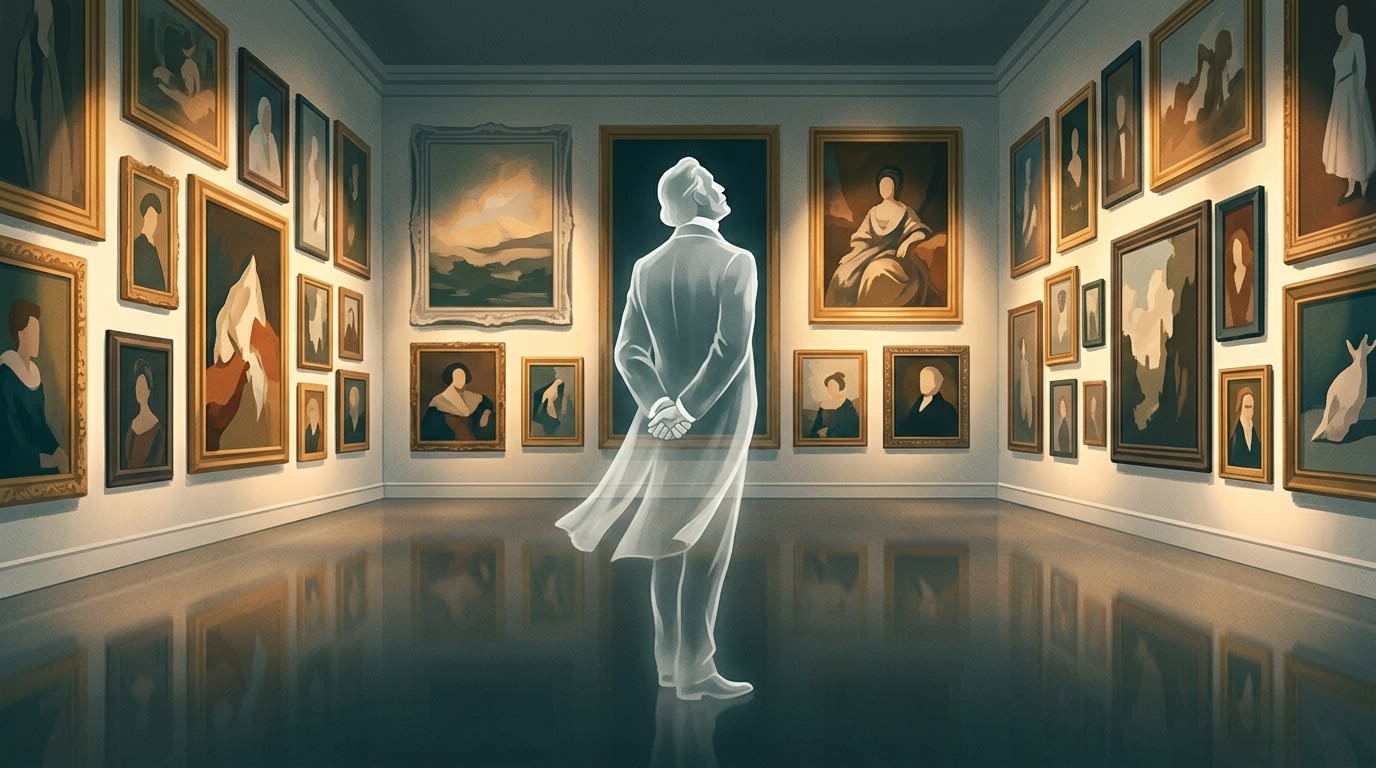
In The Sexual Politics of Meat (1990), Carol J. Adams coined the absent referent: the animal is made to vanish from the meat, so that a living individual disappears behind a word. I propose the inverse operation, which I call the reified referent: language makes a nonentity appear inside the moral conversation and treats it as a stakeholder. The absent referent hides someone who is really there. The reified referent invents someone who is not there, at the expense, to a certain extent, of the individuals who are.
God is taken by some to be a case of this kind. If no god exists, then "we must do this because it pleases God" brings the preferences of a fictional character into ethics. The subtler cases are much harder to detect. A group made of you and your friend is real in the sense that its parts are real; the group as a collection is a useful thought experiment, but it has no patienthood of its own. A specific case of the reified referent happens when the group itself, or the "total picture", is quietly promoted from a collection of experiences to an experiencing subject who gets a vote.
There is a simple test: restate every value claim in terms of what some being feels or will feel. Whatever cannot be restated this way relies on a reified referent.
This is quite counterintuitive to me, but truth that is viewed as an intrinsic value is also a reified referent. I value truth enormously, but there is no God looking at the world and feeling happy when truth is revealed or reflected in it. Hence it should be viewed as of instrumental value.
Environmental ethics runs on this error, in my view. Intrinsic biodiversity value treats the diversity itself as mattering; the last rare lizard is said to matter intrinsically more than an individual of an abundant species. But no lizard knows he is endemic. The rarity is not in the lizard's life; it is in a catalog. The environmental language consistently hides the sentient and highlights the insentient, reified referents: "the ecosystem", "the species", "the balance of nature". But a forest full of color, valued apart from any mind watching it, is actually colorless. Color is not the wavelengths themselves. It appears when light meets a mind, which transforms signals from "outside", through the visual system from the retina to the brain, into something completely different in quality and essence. Without a mind, the beautiful picture is just waves and particles, and the forest is silent.
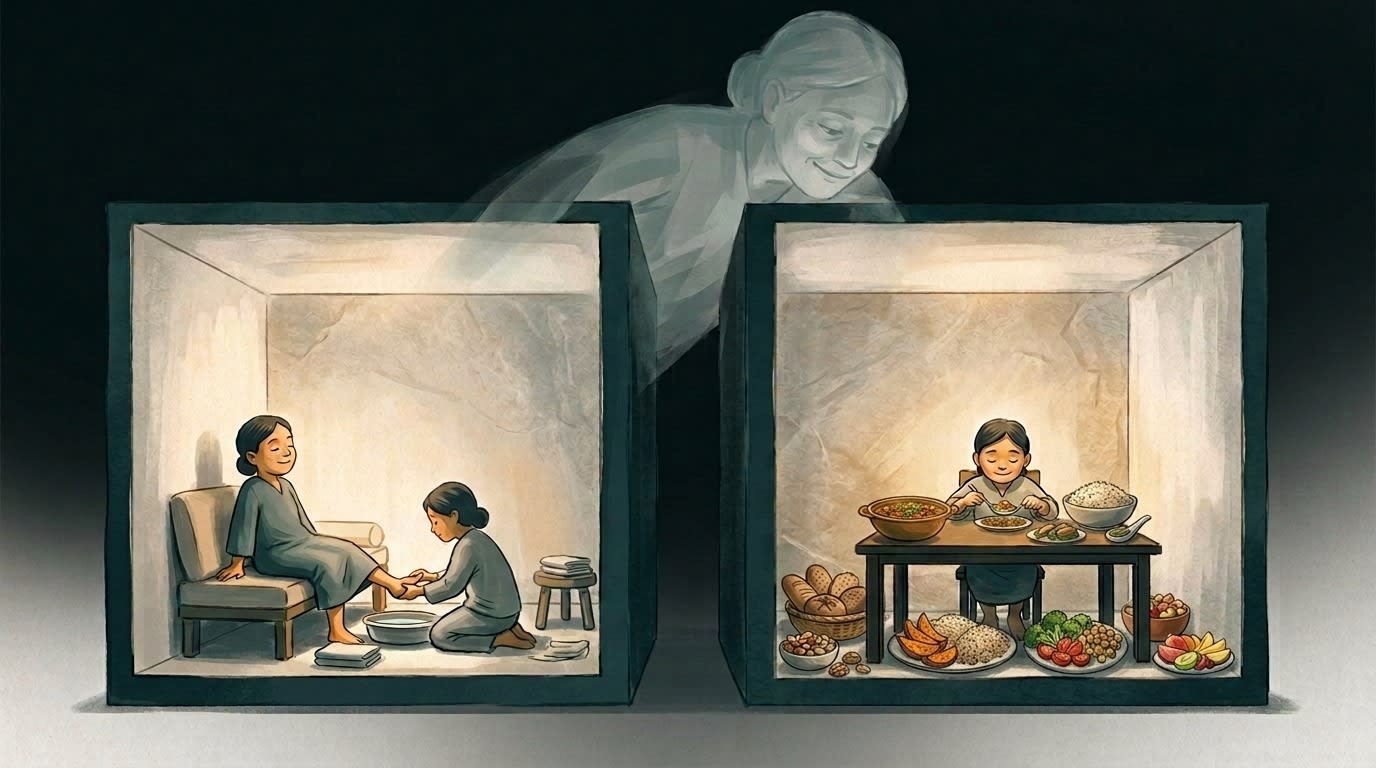
Two beings live in sealed rooms. They will never meet, never learn of each other. In World V, being A spends an hour receiving a foot massage and being B eats a wonderful meal. In World H, both eat the wonderful meal. Every experience involved has exactly the same valence, the same quality level of goodness. Ask A whether she wants to switch worlds: she is indifferent, and she must be, because if she preferred one, the welfare would not be equal. Ask B, same answer, because nothing changes for him. No being, at any moment, in either world, is one drop better or worse off than in the other, yet the Saturation View holds that World V is better. "Better", though better for no one, is a sentence in search of a subject. The only way to make sense of it is to imagine a viewpoint hovering over both rooms, comparing the kinds of experiences, and preferring the spread. That viewpoint is the reified referent.
To count that look as a cost is to charge real beings for the boredom of a ghost. To view a being's joy as less worthy because of his species, or his location, or the fact that there are other beings with similar joys, seems equally mistaken to me.
Variety is not the only pattern one could value. Think about spikes: a life where valence swings between very low and very high, against one with the same total welfare but a narrow, calm range.
Let's assume your total life's valence is just a bit above neutral. Within your life, you may prefer the spikes, which are more attuned to excitement, or the opposite, stable valence (tranquilism pushes further in that direction). I am more sympathetic to the latter.
Spikes could be one parameter inside variety. If I get this right, stable valence does not leave much room for valence diversity, whereas spikes could give us, even under the same total valence and the same total equal valence for each individual, more variety of valence, hence of experience. This can lead us to a dangerous place where we push for a wider and wider spectrum of valence. I am especially worried about this since I value reducing suffering, especially the worst kinds, more than increasing happiness. A wider spectrum of valence is a bigger risk of severe suffering.
I argue that using a reified referent is a mistake, but it is a tempting one, and I have a few thoughts about why:
When I claim a world with five suffering beings is worse than a world with three flourishing beings and two suffering ones, am I adopting a viewpoint nobody occupies? No individual experiences the sum. If the Totalist may hover above the world and add, why may the Saturationist not hover and compare types of experiences? One can argue that either both are ghosts or neither is.
This argument puzzles me, and I think there is something deeper here I am not able to put my finger on.
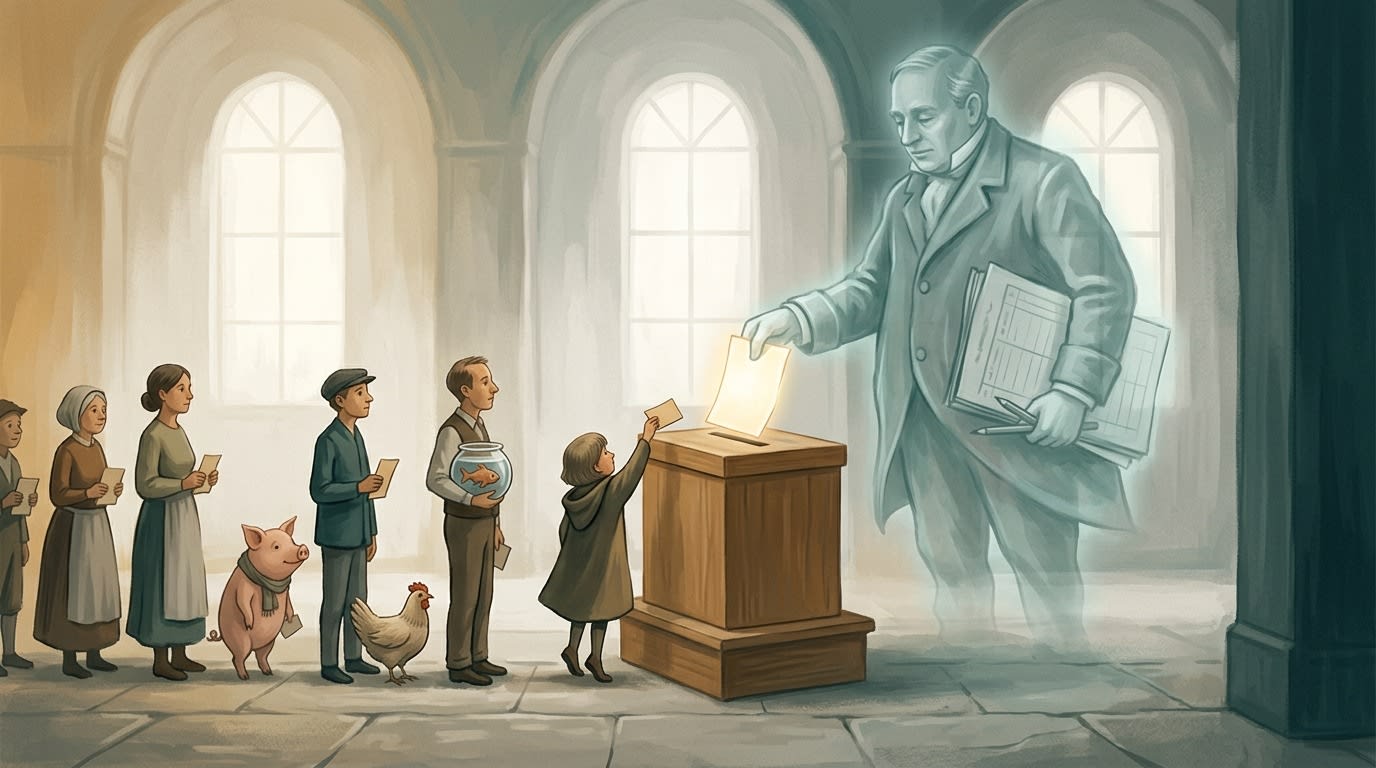
I will say this: the summing view uses an imaginary accountant, yet that accountant only counts real things: valence, intensity, duration of consciousness, all of them properties present in the experience itself. Hence, the beings vote, and the accountant counts the votes. Under the Saturation View, the accountant votes: it discounts a joy according to a relation no one feels.
But what about inequality? Inequality is also a pattern that possibly no one feels. Imagine the two sealed rooms again: in world A the two someones have a positive welfare of 2 and 10, and in world B both have a welfare of 6. No one ever feels any inequality, so why should we prefer world B?
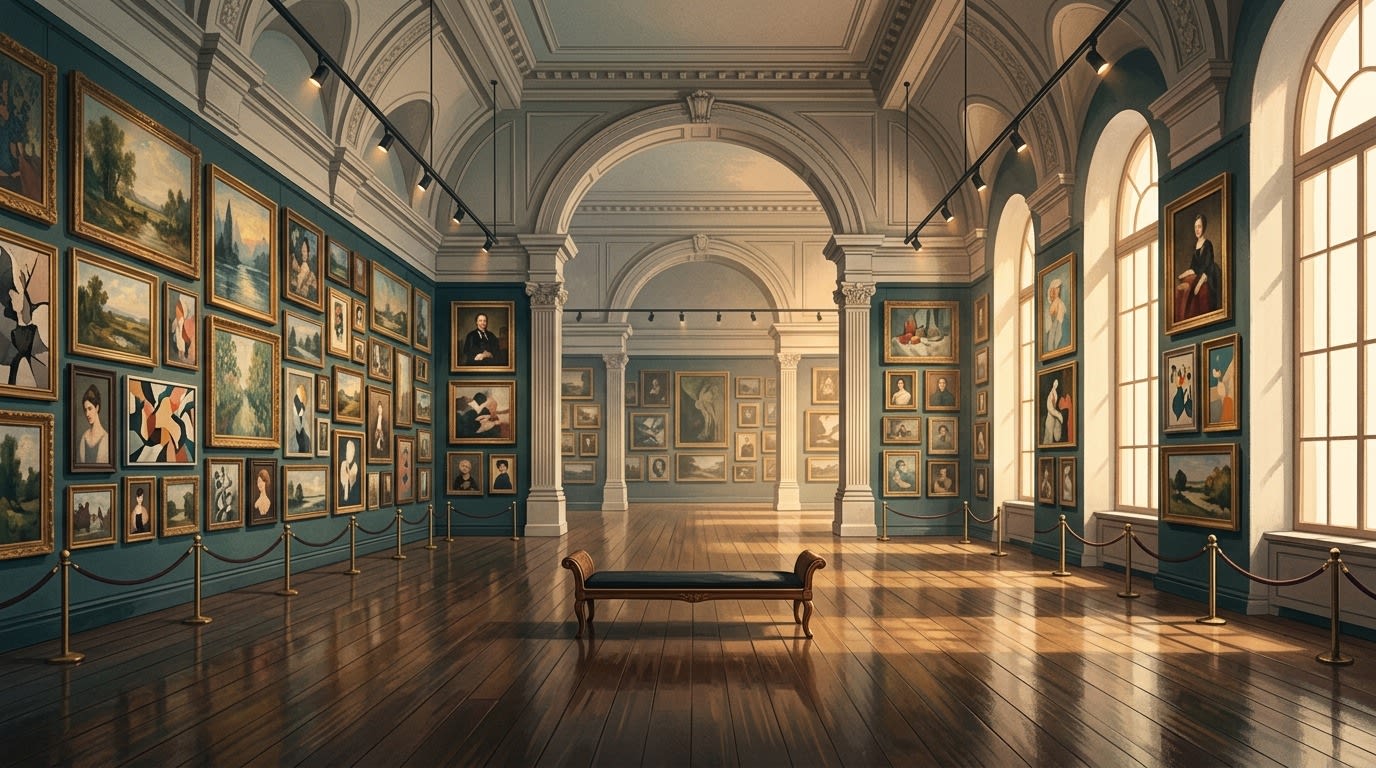
The universe has no point of view. When we pretend it has one only in order to count what real beings really feel, I think that is a justifiable ethical move. When we let that pretend point of view vote, real beings pay the price. On the Saturation View there is always some point where real felt welfare should be sacrificed for an unfelt pattern: some being's day made worse so that the world looks better to no one. A civilization steering by this view is putting a lot of effort into decorating a gallery that has no visitors.



Excellent job describing this clearly and accessibly. (And teaching me about Saturationism) You portray this well from where I stand on the opposite shore!
I think that truth and variety matter and would prefer to live in a universe with more truth and more variety even at the cost of "loss of perfection" or suffering[1]. Even if I could not tell the difference (unaware of deceptions) or never experienced any positive effects (from variety). I personally value these things, despite them not simplifying to additional positive valence.
Here are some values I have that don't pan out to positive welfare:
1) I think if someone dedicates their life to some endeavor, and they are feeling the rush of emotions as their life's project comes to an end, it would be "bad" if those exact same emotions/experience were via beaming that feeling into their mind. They cared about the project itself, they wanted it to be due to their own effort, they are not doing it for the pleasurable experience portion.
2) I think it is bad if we, with well meaning, erase[2] everyone's memory to replay their perfect happiest possible moment over and over again for the rest of their lifetimes. I think, even if nothing could be a better world of experience for everyone, and no one will ever know it's a lie, that this is a flawed[3] life and a flawed world.
3) [4]Someone who changes the future but doesn't live to see it has, in some sense, a better life than someone who tried and failed, even though their felt experience is identical.
4) [4]I think it would be a shame if many things are never understood or discovered before the universe ends, regardless of how this translates to total happiness experienced.
5) I think an empty universe is bad in comparison to what it could have been, even if no one exists to prefer something else.
You cannot imagine an unwatched world without mentally watching it
Yes, but I think that if you delete the outside view then lots of things are incoherent and worse.
The badness of death disappears. We know that being dead is bad because of the outside view where they could be happily living. Same for unborn people. Accounting for past and future experiences is using an outside view, no one is actively having those experiences. Similarly, if we forcibly rewrite everyone's desires to be something terrible, (like to desire everyone dies horribly, and then we all happily satisfy this!) this only is bad from outside.
The summing view makes arbitrary outside view choices too. Why sum? Why not only care about the single happiest life ever lived? No one experiences the sum, the lives that didn't happen, or the future. You are asking the accountant to look at total welfare achieved out of potential welfare possible, not just total welfare and without judgement on worlds which could have existed instead. There is nothing to evaluate, without an outside view to compare against. Choosing to "add them up" instead of "average them" or "prioritize the worst-off" is a world-shape preference the accountant imposes, not something anyone experiences. You want to say the Totalist's account is fundamental while the Saturationist's account is doing something superficial. But the Totalist is just as arbitrarily choosing how and what to aggregate when he's adding up experiences, and using an outside view to do it. Yes, variety across experiences is an outside view parameter, but that isn't unusual.
Its also a little weird to assume positive welfare "exists" and "can be summed." Maybe when you "sum" it, the redundant identical feelings overlap, occupying the space of one single unique experience, and summing it results in the Saturationist's account. Maybe that's just how adding up felt experiences works.
Edit: The next sections I think I'm being uncharitable/shuttered in some way, but I'm not sure how.
No one proposes an ugly impersonal value.No, variety and truth are very much an ugly impersonal values. These could have very high costs and often result in a lot of suffering. All kinds of stories celebrate people who wrecked their lives forcing truth or justice into the world, or chased perfection/uniqueness (even when it doesn't work!), which is strange behavior if these values are just about netting more pleasurable experiences. Their value did NOT evaporate when it had an net-negative-welfare cost. Sometimes we admire it as a life more well-lived, in some non-welfare sense. They had purpose instead of happiness, or something. We often hold these values dear albeit with conflicted uncertainty about what isbestandrightandmatters mostwhen it had such a terrible downside.Wedon'tcelebrate the people that are happiest and heroically help others bury their head in the sand to protect their happiness. Which would indicate that happiness is not the single final value...Ask A whether she wants to switch worlds: she is indifferent, and she must be, because if she preferred one, the welfare would not be equal. Ask B, same answer, because nothing changes for him.Turning around and sating that "this must mean the welfare wasn't equal" is hard to respond to. Maybe its high quality welfare without being higher quantity? People do things for for results that they will never personally experience all the time. Its weird to say those values are fake.I think there are additional fundamental values beyond welfare, like variety and truth. Unfortunately I'm not sure if they can be explained further than "I value them..." so I may have to just describe them and then stop.I think I might be motte and bailey-ing. I think I'd probably retreat to variety greatly increasing welfare/valence, and be willing to confine this to only cases when it resulted in actual felt experiences at some point down the line. I may just think experiences are much greater relative to your position, when they are complex and varied experiences. We do have to come back to actual beings with actual values, (probably also being actually experienced).
I'm not so willing to accept that identical copied lives add just as much value as varied equally valenced lives.
Anyway, all this results in this belief that I have:
If we reach the world where everyone has the most perfect life, and it's the same life, I think this world is worse than many non-identical, not-quite-perfect lives. I wouldn't force worse lives on anyone, but I'd volunteer to live a worse life so that the universe contains something different. Normally sharing my different life would benefit others; but even if no one benefited at all and I wasted my perfection, I think I might still want to do it.
I'm open to the possibility that I'm a limited idiot who can't see what the god-minds of the future will want. In my defense, I'm not hopelessly unimaginative. I fully expect that we will want to do currently-crazy-sounding things likes erase ourselves, limit/reshape our minds, replay experiences on loop, merge into amorphous monads, do tedious activities in deep utopia, and tons of other unimaginable things that might seem undesirable, even hideous, to me today...) The god-minds might all agree that tiling the universe with hedonium is obviously correct. Maybe I've just intrinsified some stuff that is a mere side-effect of promoting progress or weeding out traitors or something that will no longer apply in the grand scheme of things. But from my best attempts at imagining the god-minds at the end of the universe, I think they would value variety and truth even at the expense of some lost hedonium.
I would also not maximize truth and variety at all costs.
assuming they didn't agree to it. I expect we will choose to do this to ourselves quite a lot actually.
Maybe not a bad life compared to today's good lives, etc. It's an alright future. But I think its far worse than many other life-shapes and potential worlds that include variety.
I'm not entirely sure I hold this actually.
Thanks for putting your thoughts in detail about all this! For me it comes down to the question: Is there any value in something that doesn't exist? I think there isn't. A variety which is between lives, which is experienced by no one, doesn't exist. On the other hand when I calculate welfare and I sum them up, I am doing an operation on the welfare but I am only playing with things that really exist. I'm not adding anything fictional. I think our language in many ways promote caring for fictional not existing things. imo this is a philosophical mistake. We should only care about reality.
Morality doesn't exist. Welfare isn't an objective weight. These things are fictional.
Responding to your meaning, I am bothered you are right: experiences are the only things that should have moral weight. I want to agree. But I hit some problems I can't resolve easily:
Pursuing the world that is nothing but tiny single purpose happiness circuits, or pond scum only experiencing blissful happiness and nothing else, is an end state I cannot accept being the best outcome. The problem is things like consciousness, variety, truth, perception, concepts, are at best extraneous and get in the way of pumping out maximum utils/welfare. Delete everything -> only welfare.
The way out, that I'm aware of, is either to add "quality of happiness" and suppose complex happiness is stronger than pure simplistic happiness. Or suppose some kind of saturation of similar kinds of happiness. Or that variety is some additional value.
How do you grapple with it?
imo truth (which I find extremely important) has value as so far as it is an experience or relating affecting experience. Same with variety, and consciousness is the basis for experience. So as far as those things are at the individual level, they exist and have meaning, but there is no meaning to this as far as it is viewed not at the individual level, e.g. variety between lives (unaware of each other) , truth as viewed from above by some god (though from a practical perspective it is good and wise that we value truth this way).
I agree morality like rights is not something that exists outside experience, nothing does (or nothing meaningful does, I use the word exist only for experiences), but as far as morality is a thought experiment we use to better experiences, that is a useful tool